
Public Holidays and Leave in the Philippines (2026): Pay Rules and Statutory Leave
The 2026 and 2027 holiday calendars, what each day type pays, and the statutory leave a Philippine employer has to give.
 By
What must you pay for holidays and leave in the Philippines?
Unworked regular holidays are paid at 100% of the daily wage and worked ones at 200%. Special non-working days pay 130% if worked and nothing if not. Statutory leave is narrow: five days of service incentive leave, then maternity, paternity, solo parent and special leaves for defined cases.
- Regular holiday: unworked 100%, worked 200%
- Special non-working day: worked 130%, else no pay
- Sick leave: none beyond the five service incentive days
A Philippine payroll runs on two calendars. One is set by presidential proclamation every September: it names the regular holidays and special days for the next year.[1] The other is set by statute, and it decides how much leave an employee can claim.
Holidays cause the most payroll errors, because the pay changes with the day type, whether the person worked and whether it also fell on their rest day. Leave causes the most hiring questions, because the answer to ‘how much sick leave?’ is shorter than most foreign teams expect.
We cover the calendars first, then the pay rules with worked amounts, then each statutory leave. For what these add to a hire’s cost, see the employer costs page.
How do regular holidays differ from special days?
Philippine law sorts every public day into one of three types, and the pay follows the type, not the name on the calendar.[2] A regular holiday is paid even when nobody works. A special non-working day follows ‘no work, no pay’. A special working day is an ordinary day.
That’s why the same holiday can cost you nothing one year and a full day’s wage the next. Proclamations sometimes move a date between types, and the advisory for the year is what you follow.
The four day types and what each pays
| Day type | If not worked | If worked, first eight hours |
|---|---|---|
| Regular holiday | 100% of the daily wage | 200% |
| Special non-working day | No work, no pay | 130% |
| Special working day | No work, no pay | 100%, an ordinary day |
| Regular holiday on a rest day | 100% of the daily wage | 260% |
Our view. Print the type next to every holiday in your payroll calendar, not only the date. Most underpayments we hear about start with a team that read ‘holiday’ and applied the regular-holiday rate to a special day, or the reverse.
Which days are holidays in 2026?
Proclamation 1006 sets ten regular holidays, four special non-working days, four additional special days and one special working day for 2026.[1] It leaves the Muslim holidays to later proclamations, and both have since been declared as regular holidays: Eid’l Fitr on 20 March and Eid’l Adha on 27 May.[3][4]
2026 holidays under Proclamation 1006, with the two Eid proclamations
| Date | Day | Occasion | Type |
|---|---|---|---|
| 1 January | Thursday | New Year’s Day | Regular |
| 17 February | Tuesday | Chinese New Year | Additional special |
| 25 February | Wednesday | EDSA anniversary | Special working |
| 20 March | Friday | Eid’l Fitr | Regular |
| 2 and 3 April | Thursday, Friday | Maundy Thursday, Good Friday | Regular |
| 4 April | Saturday | Black Saturday | Additional special |
| 9 April | Thursday | Araw ng Kagitingan | Regular |
| 1 May | Friday | Labor Day | Regular |
| 27 May | Wednesday | Eid’l Adha | Regular |
| 12 June | Friday | Independence Day | Regular |
| 21 August | Friday | Ninoy Aquino Day | Special |
| 31 August | Monday | National Heroes Day | Regular |
| 1 November | Sunday | All Saints’ Day | Special |
| 2 November | Monday | All Souls’ Day | Additional special |
| 30 November | Monday | Bonifacio Day | Regular |
| 8 December | Tuesday | Immaculate Conception | Special |
| 24 December | Thursday | Christmas Eve | Additional special |
| 25 December | Friday | Christmas Day | Regular |
| 30 December | Wednesday | Rizal Day | Regular |
| 31 December | Thursday | Last day of the year | Special |
What does the 2027 calendar look like?
Proclamation 1427 declares ten regular holidays, four special non-working days, four additional special non-working days and one special working day for 2027.[5][2]
Eid’l Fitr and Eid’l Adha aren’t in the list. They’ll be proclaimed once the dates are fixed from the Islamic calendar, so budget two more regular holidays for 2027 now and confirm the dates later.
Three regular holidays land on a Saturday in 2027: Labor Day, Independence Day and Christmas Day. Whether that costs you anything depends on the employee’s rest day, which the pay rules below handle.
2027 holidays under Proclamation 1427
| Date | Day | Occasion | Type |
|---|---|---|---|
| 1 January | Friday | New Year’s Day | Regular |
| 6 February | Saturday | Chinese New Year | Additional special |
| 25 February | Thursday | EDSA anniversary | Special working |
| 25 and 26 March | Thursday, Friday | Maundy Thursday, Good Friday | Regular |
| 27 March | Saturday | Black Saturday | Additional special |
| 9 April | Friday | Araw ng Kagitingan | Regular |
| 1 May | Saturday | Labor Day | Regular |
| 12 June | Saturday | Independence Day | Regular |
| 21 August | Saturday | Ninoy Aquino Day | Special |
| 30 August | Monday | National Heroes Day | Regular |
| 1 November | Monday | All Saints’ Day | Special |
| 2 November | Tuesday | All Souls’ Day | Additional special |
| 30 November | Tuesday | Bonifacio Day | Regular |
| 8 December | Wednesday | Immaculate Conception | Special |
| 24 December | Friday | Christmas Eve | Additional special |
| 25 December | Saturday | Christmas Day | Regular |
| 30 December | Thursday | Rizal Day | Regular |
| 31 December | Friday | Last day of the year | Special |
How is holiday pay worked out?
For a regular holiday the employee gets 100% of the daily wage if they don’t work, as long as they were present or on paid leave on the previous working day.[2] If the previous day was a rest day or non-working day, the condition moves back to the last working day before it.[2]
Work it and you pay 200% for the first eight hours.[6] If the holiday is also the employee’s rest day, add 30% of that 200%, which makes 260%.[7] Overtime adds a further 30% of the hourly rate on the day’s rate.[6]
Special non-working days work the other way round. Not worked, nothing is owed unless a policy or practice says otherwise. Worked, the employee gets 130%, and on a rest day the first eight hours go to 150%.[2][8]
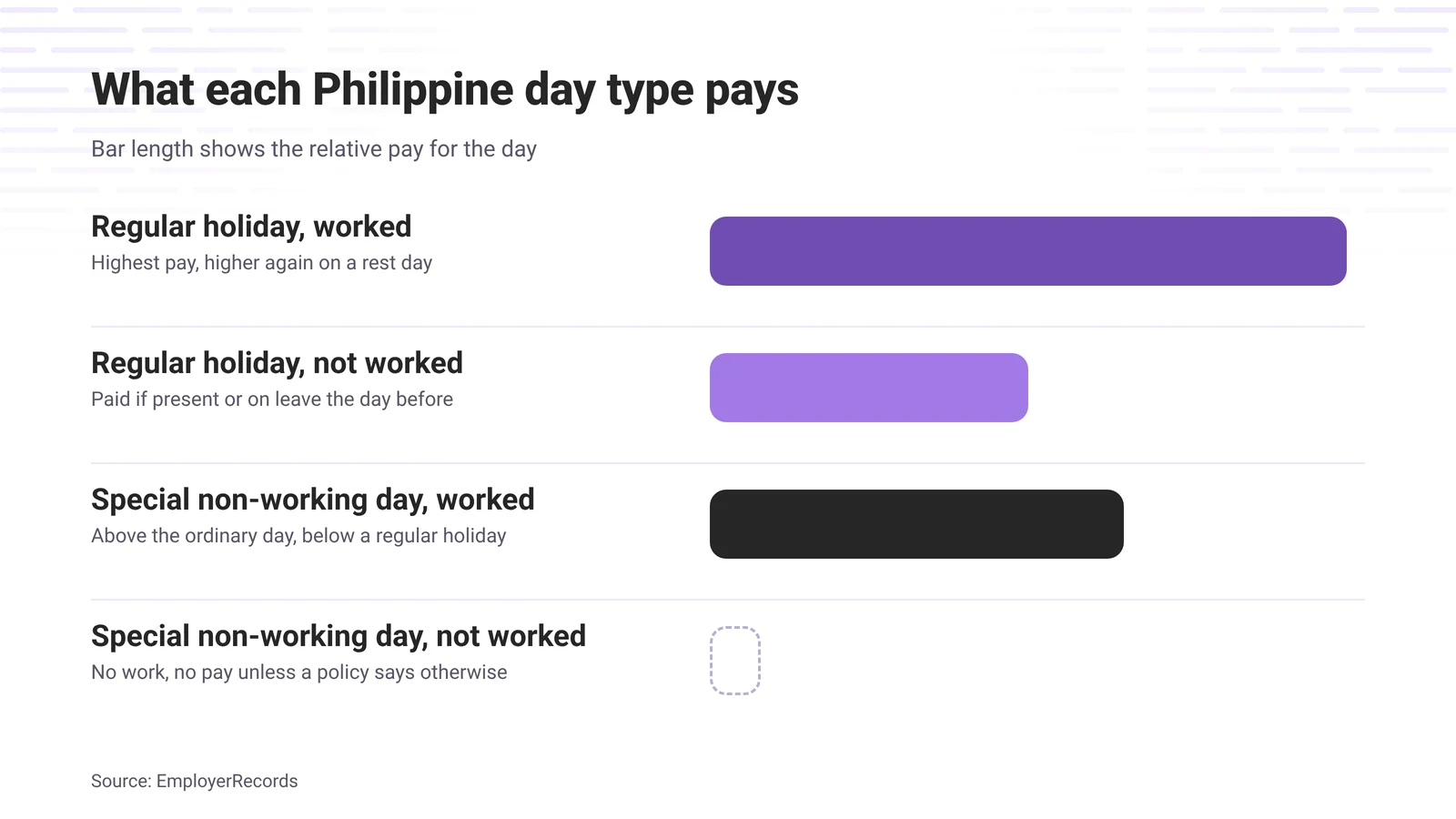
Holiday pay rules from DOLE labor advisories, as a share of the daily wage
| Situation | Regular holiday | Special non-working day |
|---|---|---|
| Not worked | 100%, if present or on paid leave the day before | No work, no pay |
| Worked, first eight hours | 200% | 130% |
| Worked on the rest day | 260% | 150% |
| Overtime, hourly rate times | 200% x 130% | 130% x 130% |
| Overtime on the rest day, hourly rate times | 200% x 130% x 130% | 150% x 130% |
A caution. The published 2027 advisory prints one overtime formula with the percent signs missing, so we’ve used the rest-day rate from the 2019 advisory for the 150%. Check the current advisory before you pay out, because DOLE reissues it each year.
What does a holiday cost at a ₱1,000 daily wage?
Take a daily wage of ₱1,000, which makes the hourly rate ₱125. A regular holiday that nobody works costs ₱1,000. Staff who work it cost ₱2,000, and two hours of overtime add ₱650 on top.
The table below runs every case, so you can match your payroll to it.
Pay for one day at a ₱1,000 daily wage, our calculation
| Situation | First eight hours | Overtime | Total for the day |
|---|---|---|---|
| Regular holiday, not worked | ₱1,000 | – | ₱1,000 |
| Regular holiday, worked | ₱2,000 | – | ₱2,000 |
| Regular holiday, worked, plus 2 hours overtime | ₱2,000 | ₱650 | ₱2,650 |
| Regular holiday on a rest day, worked | ₱2,600 | – | ₱2,600 |
| Special day, not worked | ₱0 | – | ₱0 |
| Special day, worked | ₱1,300 | – | ₱1,300 |
| Special day on a rest day, worked | ₱1,500 | – | ₱1,500 |
Monthly-paid staff aren’t outside these rules. Both daily-paid and monthly-paid employees are entitled to holiday pay, so a monthly salary already covers the unworked regular holiday and you only add the premium when someone works.[9]
Does every employer have to pay holiday pay?
Not quite. Article 94 of the Labor Code exempts retail and service establishments that regularly employ fewer than ten workers from paying regular holiday pay.[9][10]
It’s a narrow carve-out. It covers retail and service businesses only, and only the regular-holiday benefit. A software company with five Philippine employees isn’t a retail or service establishment for this purpose, so the exemption wouldn’t help it.
What leave does Philippine law actually require?
Less than most foreign employers assume. There’s one general leave, service incentive leave, and a short list of leaves tied to a specific event: birth, parenthood, violence at home or gynaecological surgery.[11][12]
Everything else, including sick leave, vacation beyond five days, bereavement and birthday leave, is a matter for your contract or policy.[13][14]
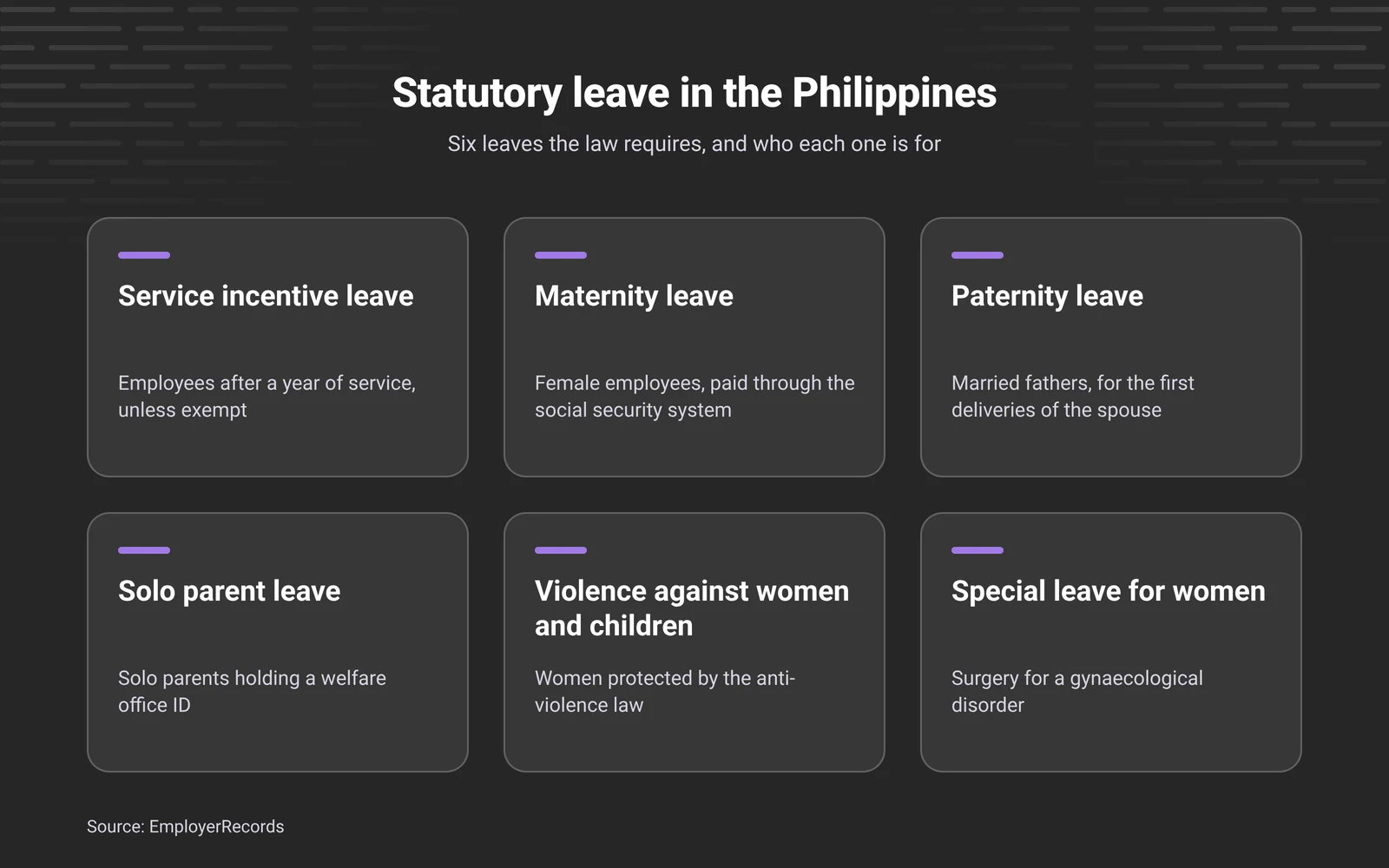
Statutory leave at a glance
| Leave | Entitlement | Who qualifies |
|---|---|---|
| Service incentive leave | 5 paid days a year | One year of service, with exemptions |
| Maternity | 105 days, 120 for solo parents | Female employees, paid through SSS |
| Paternity | 7 days | Married fathers, first four deliveries |
| Solo parent | 7 days a year | Solo parents with a DSWD ID |
| Violence against women and children | Up to 10 days, extendible | Women covered by RA 9262 |
| Special leave for women | Up to 2 months | After surgery for a gynaecological disorder |
How does service incentive leave work?
After one year of service, an employee is entitled to five days of paid leave a year under Article 95 of the Labor Code.[11][15] The five days can be taken as vacation or sick leave.[13]
Unused days at year end can be converted to cash, so many employers simply pay them out in the pay run after the anniversary.[11]
Who’s out? Establishments regularly employing fewer than ten people, and employers who already give at least five days of paid vacation leave.[16][15] If your policy gives 15 days of paid leave, SIL is already covered and you don’t add five on top.
Practical point. Write the policy as one pool of paid leave that is at least five days. That satisfies SIL, avoids a separate sick leave debate and keeps the cash-out rule simple for payroll.
Is sick leave mandatory in the Philippines?
No. The law doesn’t create a separate sick leave. The five service incentive days are the only statutory paid leave an ordinary employee can use when ill.[13][14]
Most employers add their own sick and vacation days to stay competitive for hires, and many set bereavement leave at around three days, though it isn’t required.[14] Carry-over and cash conversion above SIL are the employer’s call.[13]
Once a policy exists, it can become a practice. Withdrawing a benefit that staff have received for years is a common source of money claims, so write down whether a benefit is contractual or discretionary at the start.
How much maternity leave must you give?
Female employees get 105 days of maternity leave with full pay under Republic Act 11210, whether the delivery is normal or by caesarean.[17][18] Solo parents get 15 extra days with full pay, and an employee can ask for 30 more days unpaid.[18][19]
A miscarriage or emergency termination of pregnancy carries 60 days.[14][20] A mother can also allocate up to seven days of her leave to the child’s father, married or not.[15]
Cash flow works like this: the employer advances the pay and the Social Security System reimburses it once it has proof of payment.[19][13]
What it means for budgeting. Treat maternity as a cash flow item, not a cost, but plan for it. The advance lands in one pay cycle and the reimbursement arrives later, so small teams feel the timing even though the law makes them whole.
What are the paternity and solo parent leave rules?
Paternity leave is seven days with full pay for a married man, for the first four deliveries of the legitimate spouse he lives with.[12][14]
Solo parents can take seven days a year for parental duties, but the eligibility test varies by source: one guide says one year of service and another says six months, and both want a solo parent ID from the local social welfare office.[12][20] We’d ask for the ID first and check the current rule with your lawyer or EOR before refusing a request.
Neither leave is something to improvise. Both turn on paperwork, so ask for the birth certificate or the ID before you approve the days.
What other protected leaves exist for women?
Women who are victims of violence under RA 9262 are entitled to up to ten days of paid leave, extendible when a protection order says so. The employee has to provide a certification.[11][12][15]
Special leave for women covers up to two months with full pay after surgery for a gynaecological disorder.[12][14]
These leaves are rare in practice, so the risk is not cost. It’s an HR manager who has never heard of them and refuses the request. Put both in your handbook.
What do holidays and leave add to the cost of a hire?
For a monthly-paid employee, the unworked regular holiday is already inside the salary, so the cost shows up in two places: the premium when somebody works a holiday, and the leave you pay out.
For a daily-paid employee on ₱1,000, the 12 regular holidays of 2026 add up to ₱12,000 for days nobody worked, and five SIL days are ₱5,000 more. That’s our arithmetic on the multiples above, not a published figure.
The rest of the employer burden, the contributions and the 13th month, sits on the employer costs page.
Our view. Budget holidays by counting them on the calendar, not by adding a flat percentage. A year with two Eid holidays and Holy Week on weekdays costs more than the one before it.
Who runs holiday and leave rules when you hire through an EOR?
The EOR is the employer of record, so it applies the holiday pay rules in its payroll and processes SSS maternity claims. You decide who works on a holiday, and that decision has a price.
Ask the provider two things before you sign: whether its contract leave policy goes above the five SIL days, and whether it passes holiday premium through at cost. Our EOR providers in the Philippines page lists providers to compare.
Holiday pay calculator
Choose the day type, whether the person worked and whether it was also a rest day. The defaults give ₱2,650 for a regular holiday worked with two hours of overtime on a ₱1,000 daily wage.
Philippines holiday pay by day type
Estimate only. It applies the DOLE multiples to a basic daily wage and ignores cost of living allowance, night differentials, company policy and collective agreements. Check the advisory for the year before you pay.
Where do holiday and leave payments go wrong?
Holiday errors are rarely big on one payslip. They repeat every year across every person, which is how they turn into back pay claims.
What we’d do first. Build the payroll calendar from the proclamation, tag each date with its type, then add the Eid dates the day they’re announced. Related pay rules are covered in the guides on minimum wage by region, average salary, 13th month pay and termination and separation pay. For the wider picture on hiring in the Philippines, start from the Philippines hiring guide.
Questions about holidays and leave in the Philippines
Short answers to the holiday pay and leave questions employers ask most, checked against the proclamations, DOLE advisories and legal guides cited below on 24 November 2026.
Do monthly-paid employees get extra pay for regular holidays?
Their salary already covers the unworked holiday. If they work it, you add the premium on top, so a regular holiday worked is paid at double the daily rate.
What do I pay if an employee works on Christmas Day?
Christmas Day is a regular holiday, so 200% of the daily wage for the first eight hours. If it’s also the person’s rest day, 260%.
Is a special non-working day paid if nobody works?
No. The rule is no work, no pay, unless your policy, practice or collective agreement says otherwise.
Are Eid holidays paid like other regular holidays?
Yes. The 2026 proclamations made Eid’l Fitr and Eid’l Adha regular holidays, so the regular holiday rules applied. Each year’s dates are proclaimed separately.
How many days of paid leave must I give in the first year?
None. Service incentive leave starts after one year of service, so a new hire has no statutory paid leave until then. Maternity and the other event-based leaves have their own conditions.
Can unused service incentive leave be paid out?
Yes. Unused days at the end of the year can be converted to cash, and many employers settle them in payroll.
Who pays for maternity leave?
You advance the pay for the 105 days, and the Social Security System reimburses the amount once you send proof of payment.
Does an exempt small shop have to pay holiday pay?
Retail and service establishments regularly employing fewer than ten workers are exempt from regular holiday pay. A company outside retail and service doesn’t get that exemption by being small.
Is there mandatory sick leave in the Philippines?
Not as a separate leave. The five service incentive days can be used when an employee is sick, and anything more is up to your policy or contract.
References and sources
Every figure on this page comes from the sources below. Numbers in square brackets in the text link to the matching entry. Several leave rules rest on law firm and legal guide summaries because we could not open every agency page, and our own calculations are labelled. All sources were checked on 24 November 2026.
- ↑Proclamation No. 1006, declaring the regular holidays and special (non-working) days for the year 2026. Official Gazette via Lawphil, 3 September 2025. lawphil.net. Retrieved 24 November 2026. Primary
- ↑DOLE releases 2027 holiday pay rules. GMA News. gmanetwork.com. Retrieved 24 November 2026. News
- ↑DOLE issues holiday pay rules for Eid’l Fitr. Inquirer.net, 18 March 2026. newsinfo.inquirer.net. Retrieved 24 November 2026. News
- ↑Proclamation No. 1264, declaring 27 May 2026 a regular holiday in observance of Eid’l Adha. Official Gazette via Lawphil, 21 May 2026. lawphil.net. Retrieved 24 November 2026. Primary
- ↑Philippine Holidays 2027: Regular Holidays, Special Non-Working Days, and Special Working Days. Nicolas and De Vega Law Offices. ndvlaw.com. Retrieved 24 November 2026. Law firm
- ↑DOLE issues reminder on holiday pay rules. Inquirer.net. newsinfo.inquirer.net. Retrieved 24 November 2026. News
- ↑DOLE sets pay rules ahead of Undas, Bonifacio Day holidays. Manila Bulletin, 23 October 2025. mb.com.ph. Retrieved 24 November 2026. News
- ↑DOLE Labor Advisory on pay rules for a special non-working day. Department of Labor and Employment, hosted on Scribd, 2019. scribd.com. Retrieved 24 November 2026. Primary copy
- ↑Holiday Pay. LaborLaw.ph. laborlaw.ph. Retrieved 24 November 2026. Guide
- ↑Do retail and service establishments have a legal obligation to provide holiday pay?. Nicolas and De Vega Law Offices. ndvlaw.com. Retrieved 24 November 2026. Law firm
- ↑Philippines leave laws. Jibble. jibble.io. Retrieved 24 November 2026. Guide
- ↑Philippines employment law overview: employee benefits. L&E Global. leglobal.law. Retrieved 24 November 2026. Law firm
- ↑Philippines leave laws. Vacation Tracker. vacationtracker.io. Retrieved 24 November 2026. Guide
- ↑Leave policies in the Philippines. Playroll. playroll.com. Retrieved 24 November 2026. Guide
- ↑Mandatory Leave Benefits Under Philippine Labor Law. Respicio and Co.. respicio.ph. Retrieved 24 November 2026. Guide
- ↑Philippines: Employee rights. Brightmine. hrcenter.us.brightmine.com. Retrieved 24 November 2026. Guide
- ↑Employment 2025, Philippines: required leaves. Chambers and Partners, 2025. gpg-pdf.chambers.com. Retrieved 24 November 2026. Law firm
- ↑The 105-Day Expanded Maternity Leave Law, Republic Act No. 11210. Asian Development Bank, Law and Policy Reform. lpr.adb.org. Retrieved 24 November 2026. Summary
- ↑Paid leave in the Philippines. RemoFirst. remofirst.com. Retrieved 24 November 2026. Guide
- ↑Leave policy in the Philippines: Employer’s guide in 2026. Payoneer. payoneer.com. Retrieved 24 November 2026. Guide
About the author
Nagendra Yadav is the founder of SynkPay.co and has co-founded companies across India, Australia, and the United States. He previously worked as a lead engineer at Tier-1 Australian banks.
View all articles by NagendraMinimum wage and salary guides for other countries
Compare the Philippines with the pay floors and salary levels employers work with in other markets.
 Philippines13th Month Pay13th Month Pay in the Philippines (2026): 1/12 of Basic Pay, Due 24 DecemberWho gets it, how to compute it, the 24 December deadline, the tax-free cap and what it adds to employer...Read the guidePhilippinesAverage salaryAverage Salary in the Philippines (2026): Pay by Role and RegionOfficial PSA wage data by industry, role and region, what each figure measures, take-home pay, employer cost and how to...Read the guidePhilippinesEmployer costsEmployer Costs in the Philippines (2026): Contributions Cap at ₱6,230What SSS, PhilHealth and Pag-IBIG cost an employer at each salary, and how the 13th month changes the total.Read the guidePhilippinesMinimum wageMinimum Wage in the Philippines (2026): Rates by Region and CostEvery regional daily rate in force, the NCR-27 injunction, daily to monthly conversion and what an employer pays on top...Read the guidePhilippinesTermination and Separation PayTermination and Separation Pay in the Philippines (2026): Up to One Month per YearWhich grounds let you end a Philippine hire, the notices each needs, how separation pay is worked out and what...Read the guide
 Czech RepublicAverage salaryAverage Salary in the Czech Republic (2026): CZK 50,650 a MonthAverage and median pay, regional gaps, gross to net and what employers add on top, from the Czech Statistical Office.Read the guide
Hiring in the Philippines?
The hiring guide covers employer costs, holiday and leave rules and your EOR options in one place.