
Employer Costs in the Philippines (2026): Contributions Cap at ₱6,230
What SSS, PhilHealth and Pag-IBIG cost an employer at each salary, how the 13th month changes the total and when to remit.
How much does it cost to employ someone in the Philippines?
Employer contributions in the Philippines cost 13.4% of salary at ₱25,000 and 8.7% at ₱60,000, because each scheme stops growing at a ceiling. The most an employer pays is ₱6,230 a month per employee. Add the 13th month accrual and the total on-cost comes to 21.8% and 17.1%.
- Cap: ₱6,230 a month in employer contributions
- Crossover: 13th month exceeds SSS from about ₱42,400
- Remit: monthly to SSS, PhilHealth and Pag-IBIG
Three agencies take a cut of every Philippine payroll: the Social Security System (SSS), PhilHealth and the Pag-IBIG Fund. All three set a rate and a ceiling for 2026, so the monthly bill stops rising once pay passes the top of each band.[1][2][3]
That’s why a flat ’employer cost is X%’ figure misleads. A junior hire costs a bigger share on top of salary than a director does.
We take the three contributions at their statutory rates and then add the 13th month as a separate accrual, because the law makes it a cost of every covered hire. Those two layers are the budget. Everything past them, such as an HMO plan or a transport allowance, is your own policy. For the salary you’re loading all this onto, see the minimum wage page and the average salary page.
Which contributions does the employer pay?
Four payments sit on the employer side: SSS at 10%, the Employees’ Compensation premium, PhilHealth at 2.5% and Pag-IBIG at 2%.[1][4][3] The employee carries a matching share of three of them, and none of the EC premium.
Look at the right-hand column of the table before anything else. It’s the reason the employer bill flattens. Salary above the ceiling adds nothing to that scheme.
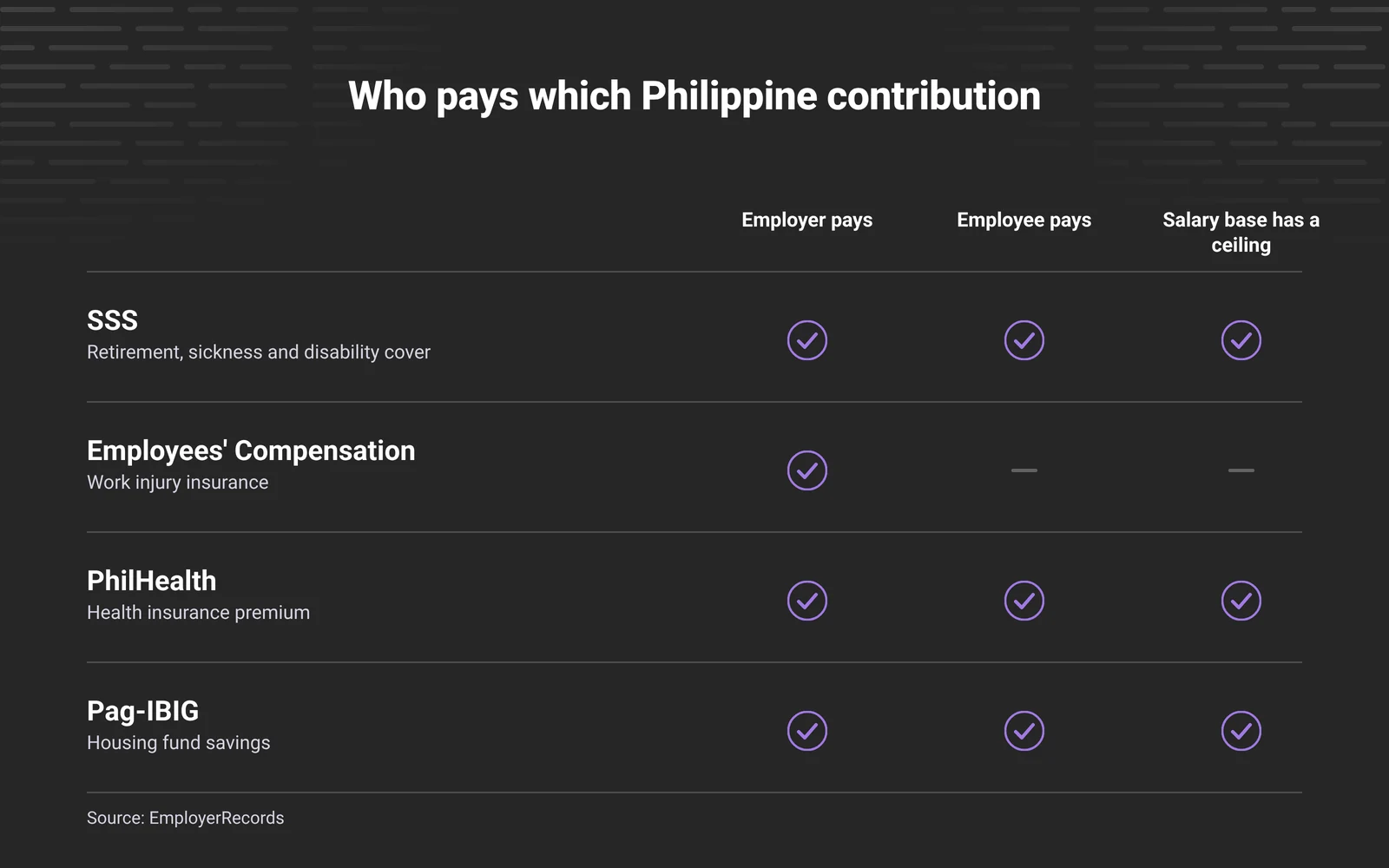
Who pays what in the Philippines in 2026
| Scheme | Employer | Employee | Salary base ceiling |
|---|---|---|---|
| SSS | 10% of salary credit, plus EC | 5% of salary credit | ₱35,000 salary credit |
| Employees’ Compensation (EC) | ₱10 or ₱30 a month | Nothing | Flat amount |
| PhilHealth | 2.5% of basic salary | 2.5% of basic salary | ₱100,000 basic salary |
| Pag-IBIG | 2% of fund salary | 2% of fund salary | ₱10,000 fund salary, so ₱200 each |
What does an employer pay to SSS each month?
Employers pay 10% of the employee’s monthly salary credit (MSC), plus a ₱10 or ₱30 EC premium.[1][5] That credit is a bracket value, not the raw salary. It moves in ₱500 steps from ₱5,000 to ₱35,000, so someone paid ₱60,000 is treated as earning ₱35,000.
EC is ₱10 where the salary credit is below ₱15,000 and ₱30 from ₱15,000 up, and the employer alone pays it.[6] At the top of the table that makes the employer’s maximum ₱3,530 a month, against ₱1,750 for the employee.[1]
SSS employer share by salary, our calculation from the published schedule
| Monthly pay | Salary credit | Employer 10% | EC | Employer total |
|---|---|---|---|---|
| ₱15,000 | ₱15,000 | ₱1,500 | ₱30 | ₱1,530 |
| ₱25,000 | ₱25,000 | ₱2,500 | ₱30 | ₱2,530 |
| ₱35,000 | ₱35,000 | ₱3,500 | ₱30 | ₱3,530 |
| ₱60,000 | ₱35,000 | ₱3,500 | ₱30 | ₱3,530 |
It didn’t always sit here. SSS stepped it up to 15% in total at the start of 2025, lifting the employer share to 10% and the ceiling from ₱30,000 to ₱35,000, and the schedule stays the same for 2026.[7]
The detail people miss. SSS maps pay into a bracket using a range of compensation, so a raise of a few hundred pesos can leave the contribution unchanged or move it by a full ₱50. Reclassify the bracket in the month pay changes, not at year end.
What does PhilHealth charge employers in 2026?
PhilHealth takes 5% of monthly basic salary, split equally, so the employer pays 2.5%.[8][2] The base has a floor of ₱10,000 and a ceiling of ₱100,000, which puts the employer share between ₱250 and ₱2,500 a month.[4]
That 5% rate has held since 2024 and we found no scheduled increase for 2026.[8] Someone on ₱120,000 is charged as if they earned ₱100,000.
PhilHealth premium by salary, our calculation from the published schedule
| Monthly basic salary | Salary base used | Total premium 5% | Employer 2.5% |
|---|---|---|---|
| ₱10,000 | ₱10,000 | ₱500 | ₱250 |
| ₱25,000 | ₱25,000 | ₱1,250 | ₱625 |
| ₱60,000 | ₱60,000 | ₱3,000 | ₱1,500 |
| ₱100,000 | ₱100,000 | ₱5,000 | ₱2,500 |
| ₱120,000 | ₱100,000 | ₱5,000 | ₱2,500 |
Is Pag-IBIG a fixed ₱200 for employers?
Employers pay 2% of monthly fund salary, with the fund salary capped at ₱10,000, so the employer share tops out at ₱200 a month.[3] That’s the same ₱200 for someone on ₱25,000 and someone on ₱250,000.
Pag-IBIG doubled the cap from ₱5,000 in February 2024, and the maximum employer share went from ₱100 to ₱200 with it.[9] Anyone earning ₱1,500 or less pays at 1% on the employee side, a case you’ll almost never meet in a formal payroll.[9]
Our view. Treat Pag-IBIG as a fixed line of ₱200 per head in the budget. It’s the smallest figure on the page, and it’s the one that caused the most confusion when the cap changed, because older payroll templates still carry ₱100.
Why does the employer cost fall as a percentage of pay?
Because the three schemes stop at different salaries, the employer share of pay sits near 13% to 15% up to ₱35,000 and then falls to under 4% for the highest earners. Pag-IBIG stops at ₱10,000, SSS at a ₱35,000 salary credit and PhilHealth at ₱100,000.
Here it is at twelve salary points. Below ₱35,000 the line is almost flat, because SSS and PhilHealth both still scale with pay. Above ₱35,000 only PhilHealth does, and above ₱100,000 nothing does, so the contribution is a flat ₱6,230.
SSS with EC, PhilHealth and Pag-IBIG, before the 13th month
Source: our calculation from the SSS, PhilHealth and Pag-IBIG schedules above. The 13th month accrual is excluded.
Does the 13th month change the total cost?
Expect 8.33% on top of basic payroll for the 13th month, accrued at one twelfth of pay every month and paid by 24 December.[10][11] Unlike the contributions it never hits a ceiling, so it grows with every raise.
That’s why we count it in the employer cost. At ₱25,000 it’s 38% of the on-top bill, and at ₱180,000 it’s 71% of it. Rules on who qualifies, how to compute a leaver’s share and the tax-free limit sit in our 13th month pay guide.
What is the total employer cost at ₱25,000, ₱60,000 and ₱180,000?
At ₱60,000 a month the employer pays ₱10,230 on top of salary, or 17.1%. At ₱25,000 it’s ₱5,438 (21.8%) and at ₱180,000 it’s ₱21,230 (11.8%). These match the figures on our Philippines hiring guide, which counts the 13th month in the percentage. A published worked example at ₱30,000 lands on the same ₱3,980 in contributions that the schedules give us.[12]
Published guides don’t agree on a single number because they mix bases and salary points. One puts mid-level contributions at about 11.8% of pay and the whole on-cost near 20%.[10] Another quotes 15% to 16% for contributions before the 13th month, a figure we can’t reproduce from the schedules.[13] We separate the layers so you can see which one a figure includes.
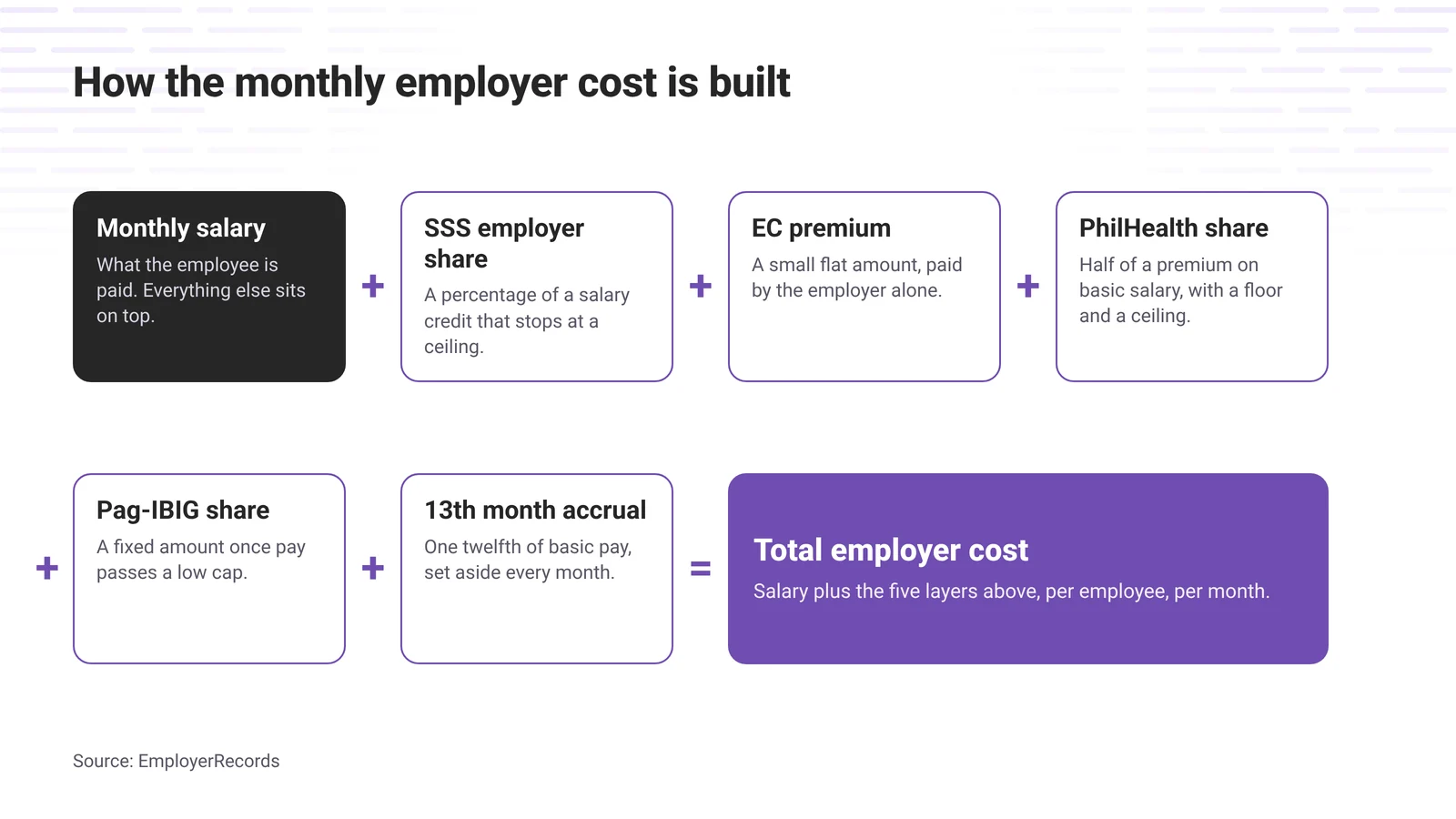
Employer cost on top of monthly pay at three salaries, our calculation
| Monthly pay | SSS and EC | PhilHealth | Pag-IBIG | 13th month | Total on top | Share of pay |
|---|---|---|---|---|---|---|
| ₱25,000 | ₱2,530 | ₱625 | ₱200 | ₱2,083 | ₱5,438 | 21.8% |
| ₱60,000 | ₱3,530 | ₱1,500 | ₱200 | ₱5,000 | ₱10,230 | 17.1% |
| ₱180,000 | ₱3,530 | ₱2,500 | ₱200 | ₱15,000 | ₱21,230 | 11.8% |
₱60,000 wage plus ₱10,230 in contributions and accrual.
17.1% on top of the wageWhere we start. We budget on the three-salary table, not on a single percentage. If your hire sits near ₱42,400 a month, the 13th month accrual and the SSS share are almost exactly equal, and every peso above that goes to the 13th month side.
What costs sit outside the contribution tables?
Statutory leave and holiday pay don’t show up in a contribution table, but they’re real cost. Philippine law requires far less leave than most markets, so this layer is thin.
Health cover, transport allowances and signing bonuses are market practice, not law, and they vary too much to model. If you offer an HMO plan, add its premium as a separate line.
What do employees pay on their side?
Employees fund a matching share of SSS, PhilHealth and Pag-IBIG out of their own pay, and the employer withholds it. It doesn’t add to your cost, but it affects the take-home figure a candidate compares offers on.
At ₱60,000 the deductions total ₱3,450 before income tax. Withholding tax is separate and sits outside this page.
Employee deductions that come out of pay, our calculation
| Monthly pay | SSS 5% | PhilHealth 2.5% | Pag-IBIG 2% | Total deducted |
|---|---|---|---|---|
| ₱25,000 | ₱1,250 | ₱625 | ₱200 | ₱2,075 |
| ₱60,000 | ₱1,750 | ₱1,500 | ₱200 | ₱3,450 |
| ₱180,000 | ₱1,750 | ₱2,500 | ₱200 | ₱4,450 |
Do the same costs apply to foreign employees and EOR hires?
Yes. Foreign nationals working for a local employer are covered by SSS, PhilHealth and Pag-IBIG unless a bilateral social security agreement says otherwise.[14][15] Tax residency doesn’t change that.[14]
With an EOR, the provider is the legal employer, so it registers, withholds and remits, and you reimburse the cost plus its fee. Ask for the contribution lines and the 13th month accrual itemised, because a bundled monthly rate hides whether the ceilings are in it. Compare ranked options on our page for EOR providers in the Philippines, and run the full picture through the EOR cost calculator.
Setting up your own Philippine entity makes you the registered employer. Read what an employer of record is and the work permits guide before choosing.
When do employers have to remit the contributions?
Remit every month, and expect the deadline to differ by agency. Published sources give different dates for each scheme, and we couldn’t open the agency pages that would settle it, so don’t build your calendar from a blog post, including this one.
Here’s what we found.
Remittance timing in published guidance, which does not agree
| Scheme | What guides report | What to do |
|---|---|---|
| SSS | Due by the end of the following month, or a date between the 10th and 30th set by the employer number.[16][15] | Use the schedule shown in your SSS employer portal. |
| PhilHealth | Between the 10th and 15th of the following month, or by month end.[17][15] | Confirm the date in the PhilHealth employer module. |
| Pag-IBIG | The 10th of the following month in most guides, with quarterly remittance for small employers.[17][18] | Check the due date on your Pag-IBIG employer account. |
The simple fix. Set your payroll cut-off for the earliest date any source gives, the 10th. You’ll never be late, and it costs nothing to remit early.
What are the penalties for late or missing contributions?
SSS charges 2% a month on unpaid contributions, and a failure to comply with the Social Security Act carries a fine of ₱5,000 to ₱20,000 or imprisonment of six years and one day to twelve years.[16][19]
PhilHealth and Pag-IBIG attach their own interest and fines. Guides quote rates between 2% and 3% a month for them, and they don’t match one another, so we won’t state one figure.[18] Criminal liability can reach the officers of a company, not only the company.[18]
An employee’s SSS benefit rights don’t suffer when the employer fails to remit, so the liability stays with you, not with them.[20]
What must you register before the first payroll?
A Philippine employer has to register with each agency and report every employee. For SSS that means registering the business and filing an employment report for each hire.[19]
PhilHealth and Pag-IBIG need their own employer numbers, and each employee needs a member number before the first remittance.[15] Register before you pay anyone, so the first remittance has somewhere to go.
If you hire through an EOR, none of this is yours to do. If you hire through your own entity, build registration into the start date.
Employer cost calculator for the Philippines
Enter a monthly basic salary. Results use the same brackets, ceilings and rounding as the tables above, so ₱60,000 returns ₱10,230.
Philippines employer cost, 2026 rules
Estimate only. It uses the statutory rates and ceilings above and leaves out HMO plans, allowances, leave cost and EOR fees. For fees and year-one costs use the full Philippines cost calculator.
Where do budgets for Philippine hires go wrong?
We see the same four slips when a foreign team prices its first Philippine role.
What we’d do before the offer goes out. Price the hire at the actual salary on the three-salary table and add the 13th month. If the figure lands within a few pesos of the hub calculator, it’s right. If it doesn’t, one of the ceilings is wrong. The year-end bonus is covered in the 13th month pay guide, leave pay in public holidays and leave, and the cost of ending a hire in termination and separation pay. Pay benchmarks are in the average salary and minimum wage guides.
Questions about employer costs in the Philippines
Short answers to what employers ask most about Philippine payroll on-costs, checked against the published SSS, PhilHealth and Pag-IBIG schedules on 24 November 2026.
What is the employer cost percentage in the Philippines?
It depends on pay. Contributions alone are 13.4% at ₱25,000 and 8.7% at ₱60,000. With the 13th month accrual the on-cost is 21.8% and 17.1%.
What’s the maximum an employer pays in SSS, PhilHealth and Pag-IBIG each month?
₱6,230 per employee: ₱3,530 to SSS including EC, ₱2,500 to PhilHealth and ₱200 to Pag-IBIG. That’s reached at a basic salary of ₱100,000 or more.
Is the 13th month part of employer cost?
Yes. It’s a legal obligation, so we count it as a monthly accrual of one twelfth. It adds 8.33% to basic payroll.
Do I pay SSS on the full salary if the employee earns ₱80,000?
No. SSS caps the salary credit at ₱35,000, so your share is ₱3,500 plus a ₱30 EC premium. PhilHealth is charged on the full ₱80,000 at 2.5%.
Do foreign employees count?
Generally yes, unless a social security agreement between their country and the Philippines applies. Confirm that before you register them.
Is there an employer payroll tax on top?
We found no separate employer payroll tax. The employer’s statutory costs are the three contributions, EC and the 13th month.
References and sources
Every figure on this page comes from the sources below. Numbers in square brackets in the text link to the matching entry. We could not open the SSS, PhilHealth or Pag-IBIG pages directly, so the rates rest on guides that quote the agency schedules, and our own calculations are labelled. All sources were checked on 24 November 2026.
- ↑SSS Contribution Table 2026: Employer Guide. Cirquolus. cirquolus.com. Retrieved 24 November 2026. Guide
- ↑PhilHealth Contribution 2026: Employer Guide. Cirquolus. cirquolus.com. Retrieved 24 November 2026. Guide
- ↑Pag-IBIG contribution table 2026: Rates and employer obligations explained. Xero. xero.com. Retrieved 24 November 2026. Guide
- ↑PhilHealth Contribution Guide 2026. iScale Solutions. iscale-solutions.com. Retrieved 24 November 2026. Guide
- ↑SSS Contribution Table 2026: All 61 Brackets and Shares. PH Salary Calculator. phsalarycalculator.com. Retrieved 24 November 2026. Guide
- ↑SSS Contribution Table 2026: All Brackets and Voluntary Rates. taxcalculator.com.ph. taxcalculator.com.ph. Retrieved 24 November 2026. Guide
- ↑SSS Contribution Table 2026: Complete Guide for OFWs and Self-Employed Members. World Ngayon. worldngayon.com. Retrieved 24 November 2026. Guide
- ↑PhilHealth Contribution Table 2026: Premium Rates Explained. taxcalculator.com.ph. taxcalculator.com.ph. Retrieved 24 November 2026. Guide
- ↑Pag-IBIG Contribution Table 2026. MoneyNow. moneynow.ph. Retrieved 24 November 2026. Guide
- ↑Philippines Payroll, Benefits and Tax Regulations in 2026. Second Talent. secondtalent.com. Retrieved 24 November 2026. Guide
- ↑DoLE issues 13th-month pay rules. Daily Tribune, 10 November 2026. tribune.net.ph. Retrieved 24 November 2026. News
- ↑Hire Employees in the Philippines: 2026 EOR, Payroll and Employment Guide. Global Expansion. globalexpansion.com. Retrieved 24 November 2026. Guide
- ↑Philippines hiring guide. Teamed. teamed.global. Retrieved 24 November 2026. Guide
- ↑SSS, PhilHealth and Pag-IBIG Membership Rules for Foreign Employees Philippines. Respicio and Co., 30 May 2025. respicio.ph. Retrieved 24 November 2026. Guide
- ↑Employer Duties to Remit SSS, PhilHealth and Pag-IBIG Contributions in the Philippines. Lawyer Philippines. lawyer-philippines.com. Retrieved 24 November 2026. Guide
- ↑SSS Contributions: 2025 rates and employer remittance obligations. Batas Natin. batasnatin.com. Retrieved 24 November 2026. Guide
- ↑Payroll Compliance in the Philippines: What CFOs Must Know. ASEAN Briefing. aseanbriefing.com. Retrieved 24 November 2026. Guide
- ↑Penalties for Late Employee Contribution Payments in the Philippines. Respicio and Co.. respicio.ph. Retrieved 24 November 2026. Guide
- ↑Employers reminded to comply with the SS Law. Manila Bulletin, 16 August 2021. mb.com.ph. Retrieved 24 November 2026. News
- ↑Remit P92 billion in workers’ contributions to SSS, employers urged. Inquirer News. newsinfo.inquirer.net. Retrieved 24 November 2026. News
About the author

Manjuri Dutta is Co-Founder and Content Editor at EmployerRecords.com, covering Employer of Record providers and global hiring platforms. She evaluates providers on entity ownership, statutory compliance, and real pricing rather than vendor claims, and built the verification process used across EmployerRecords' country guides, checking vendor claims against government registries and public filings.
View all articles by ManjuriMinimum wage and salary guides for other countries
Compare the Philippines with the pay floors and salary levels employers work with in other markets.
 Philippines13th Month Pay13th Month Pay in the Philippines (2026): 1/12 of Basic Pay, Due 24 DecemberWho gets it, how to compute it, the 24 December deadline, the tax-free cap and what it adds to employer...Read the guidePhilippinesAverage salaryAverage Salary in the Philippines (2026): Pay by Role and RegionOfficial PSA wage data by industry, role and region, what each figure measures, take-home pay, employer cost and how to...Read the guidePhilippinesMinimum wageMinimum Wage in the Philippines (2026): Rates by Region and CostEvery regional daily rate in force, the NCR-27 injunction, daily to monthly conversion and what an employer pays on top...Read the guidePhilippinesPublic Holidays and LeavePublic Holidays and Leave in the Philippines (2026): Pay Rules and Statutory LeaveHoliday pay by day type, the 2026 and 2027 calendars and the statutory leave a Philippine employer has to give.Read the guidePhilippinesTermination and Separation PayTermination and Separation Pay in the Philippines (2026): Up to One Month per YearWhich grounds let you end a Philippine hire, the notices each needs, how separation pay is worked out and what...Read the guide
 Czech RepublicAverage salaryAverage Salary in the Czech Republic (2026): CZK 50,650 a MonthAverage and median pay, regional gaps, gross to net and what employers add on top, from the Czech Statistical Office.Read the guide
Hiring in the Philippines?
The hiring guide covers employer costs, termination rules and your EOR options in one place.