
Minimum Wage in the Philippines (2026): Rates by Region and Cost
Every regional daily rate in force, what happened to Wage Order NCR-27, how to convert daily rates to monthly pay, and what an employer really pays on top in contributions, 13th month pay and premiums.
What the minimum wage in the Philippines is in 2026
The highest minimum wage in the Philippines is ₱755 a day for non-agricultural workers in Metro Manila, in force since 26 September 2026 under Wage Order NCR-28. There is no national rate: 17 regional rates run from ₱401 a day (BARMM agriculture) to ₱755.
- NCR-27 is not in force: a Pasig court injunction has blocked it since August 2026.
- At ₱19,693 a month in Metro Manila, the employer cost is ₱24,006.
- CALABARZON cities moved to ₱645 on 26 October 2026, and Bicol and BARMM rise on 1 December.
The highest minimum wage in the Philippines is ₱755 a day for non-agricultural workers in Metro Manila (NCR), in force since 26 September 2026 under Wage Order NCR-28. Agricultural workers, retail and service businesses with 15 or fewer workers, and manufacturers with fewer than 10 workers in NCR have a floor of ₱718. Our minimum wage by country tracker shows the Philippine range next to 194 other countries, converted to one monthly figure.[1][2]
There is no single national rate. Each region’s wage board sets its own daily minimum, so the floor outside Metro Manila ranges from ₱401 a day for agricultural work in parts of BARMM to ₱645 in the CALABARZON cities from 26 October 2026. All rates are for a normal working day of up to eight hours.
The rule that decides which rate applies
The rate is set by where the employee works, not where they live or where the employer is registered. A remote employee working from home in Cebu is paid at the Central Visayas rate, even if the employer’s office is in Makati. For field staff who move between regions, the rate of the establishment’s location applies.
Daily minimum wage by region in the Philippines
Every region has its own daily minimum, set by a Regional Tripartite Wages and Productivity Board and summarised by the National Wages and Productivity Commission (NWPC). The table shows the rate in force for each region as of late October 2026, with the order that set it.[1][3][4][5]
Most boards split rates by sector (non-agriculture and agriculture) and by establishment size, usually giving retail and service businesses with 10 or 15 or fewer workers a lower floor. Some also tier rates by city or municipality class.
Daily minimum wage by region, as of 26 October 2026
| Region | Wage order, effective | Non-agriculture (₱/day) | Agriculture (₱/day) | Notes |
|---|---|---|---|---|
| NCR (Metro Manila) | NCR-28, 26 Sep 2026 | 755 | 718 | 718 for retail/service with 15 or fewer workers and manufacturing under 10 |
| CAR (Cordillera) | CAR-24, 30 Dec 2025 | 505 | 505 | Single rate for all sectors |
| I (Ilocos) | RB 1-24, 19 Nov 2025 | 480 to 505 | 480 | 505 for firms with 10 or more workers, 480 below that |
| II (Cagayan Valley) | RTWPB 2-24, 5 Nov 2025 | 500 | 500 | Single rate |
| III (Central Luzon) | RBIII-26, 2nd tranche, 16 Apr 2026 | 560 to 600 | 545 to 570 | Retail/service 515 to 590; lower rates in Aurora |
| IV-A (CALABARZON) | IVA-23, 26 Oct 2026 | 550 to 645 | 550 | 645 cities, 590 first-class towns, 550 other towns; 525 to 600 under IVA-22 until 25 Oct |
| IV-B (MIMAROPA) | RB-MIMAROPA-13, 1 Jan 2026 | 455 | 455 | Uniform |
| V (Bicol) | RBV-23, 1st tranche, 8 Apr 2026 | 455 | 455 | Rises to 480 on 1 Dec 2026 |
| VI (Western Visayas) | RBVI-29, 19 Nov 2025 | 525 to 550 | 520 | 550 over 10 workers; new order (590) approved 21 Oct 2026, not yet in force |
| VII (Central Visayas) | ROVII-27, 14 Oct 2026 | 542 to 582 | 542 to 582 | 582 Class A (Metro Cebu), 542 Class B |
| VIII (Eastern Visayas) | RB VIII-25, 2nd tranche, 1 Jun 2026 | 470 | 440 | 440 for retail/service with 10 or fewer workers |
| IX (Zamboanga Peninsula) | RIX-24, 2nd tranche, 1 Jun 2026 | 464 | 451 to 464 | 451 for retail/service with 1 to 9 workers |
| X (Northern Mindanao) | RX-24, 2nd tranche, 1 May 2026 | 485 to 500 | 485 to 500 | 485 for retail/service with 10 or fewer workers |
| XI (Davao) | RB XI-24, 2nd tranche, 1 Sep 2026 | 540 | 525 | One regional rate, no city tiers |
| XII (SOCCSKSARGEN) | RB XII-25, 2nd tranche, 15 Dec 2025 | 460 | 443 | Cotabato City follows BARMM |
| XIII (Caraga) | RXIII-20, 2nd tranche, 1 May 2026 | 475 | 475 | Uniform |
| BARMM | BARMM-05, 1st tranche, 6 Aug 2026 | 411 to 436 | 401 to 411 | Rises to 436 to 461 (agriculture 426 to 436) on 1 Dec 2026 |
Plantation, size and area splits are simplified here. Several orders have more categories than a summary table can show, such as plantation versus non-plantation agriculture or cottage and handicraft firms. Check the full wage order for the exact category before setting pay.
The Negros Island Region
The Negros Island Region created in 2024 does not yet have its own wage order. Negros Occidental and Bacolod are covered by the Western Visayas board, and Negros Oriental and Siquijor by the Central Visayas board, as the 2026 orders for both regions confirm.
Wage Order NCR-27, the court injunction and NCR-28
Wage Order NCR-27 is a Metro Manila wage order that never took effect. It was approved on 23 June 2026 to raise the minimum by ₱85 in two steps: ₱60 from 25 July 2026 (to ₱755) and ₱25 from 20 January 2027 (to ₱780). Two construction firms challenged it at the Pasig Regional Trial Court, Branch 152, which blocked it the day before the first step.[6][7]
The wage board responded with a separate order. NCR-28, issued on 7 September 2026 and published on 11 September, grants a single ₱60 increase from 26 September 2026: ₱755 for non-agriculture and ₱718 for the smaller categories. It has no second step and no back pay to July. As of 24 October 2026 no court order blocks it, so ₱755 is the rate to pay.
NCR-27 and NCR-28 timeline
| Date | What happened |
|---|---|
| 18 Jul 2025 | NCR-26 takes effect: ₱695 non-agriculture, ₱658 smaller categories |
| 23 Jun 2026 | NCR-27 approved: ₱60 from 25 Jul 2026, ₱25 from 20 Jan 2027 |
| 24 to 30 Jul 2026 | Pasig RTC issues a status quo ante order, then a temporary restraining order |
| 11 Aug 2026 | Labour groups petition the Supreme Court against the lower-court orders |
| 13 Aug 2026 | Pasig RTC grants a writ of preliminary injunction on a ₱10 billion bond |
| 7 Sep 2026 | NCR-28 issued: single ₱60 increase; published 11 Sep |
| 26 Sep 2026 | NCR-28 takes effect: ₱755 and ₱718 |
| 29 Sep 2026 | The firms ask the Supreme Court to dismiss the petition as moot because of NCR-28 |
| 20 Oct 2026 | Pasig RTC denies the government’s motion to lift the injunction, cuts the bond to ₱5 billion and lets labour groups intervene |
What is still open. The Supreme Court has not ruled on the labour groups’ petition, which argues that wage order challenges belong before the NWPC, not a trial court. A second case, brought by a fishing federation in the Navotas Regional Trial Court, produced no restraining order. If the injunction were lifted, it is not settled whether NCR-27’s ₱780 step would apply in January 2027 on top of NCR-28. Do not budget ₱780 unless a court or the NWPC confirms it.
Our view. Budget on the ₱755 rate and treat any further step as unconfirmed until a court or the wage board says otherwise. Writing an unconfirmed rate into a contract creates a promise that is hard to withdraw.
How minimum wages are set, and what changes next
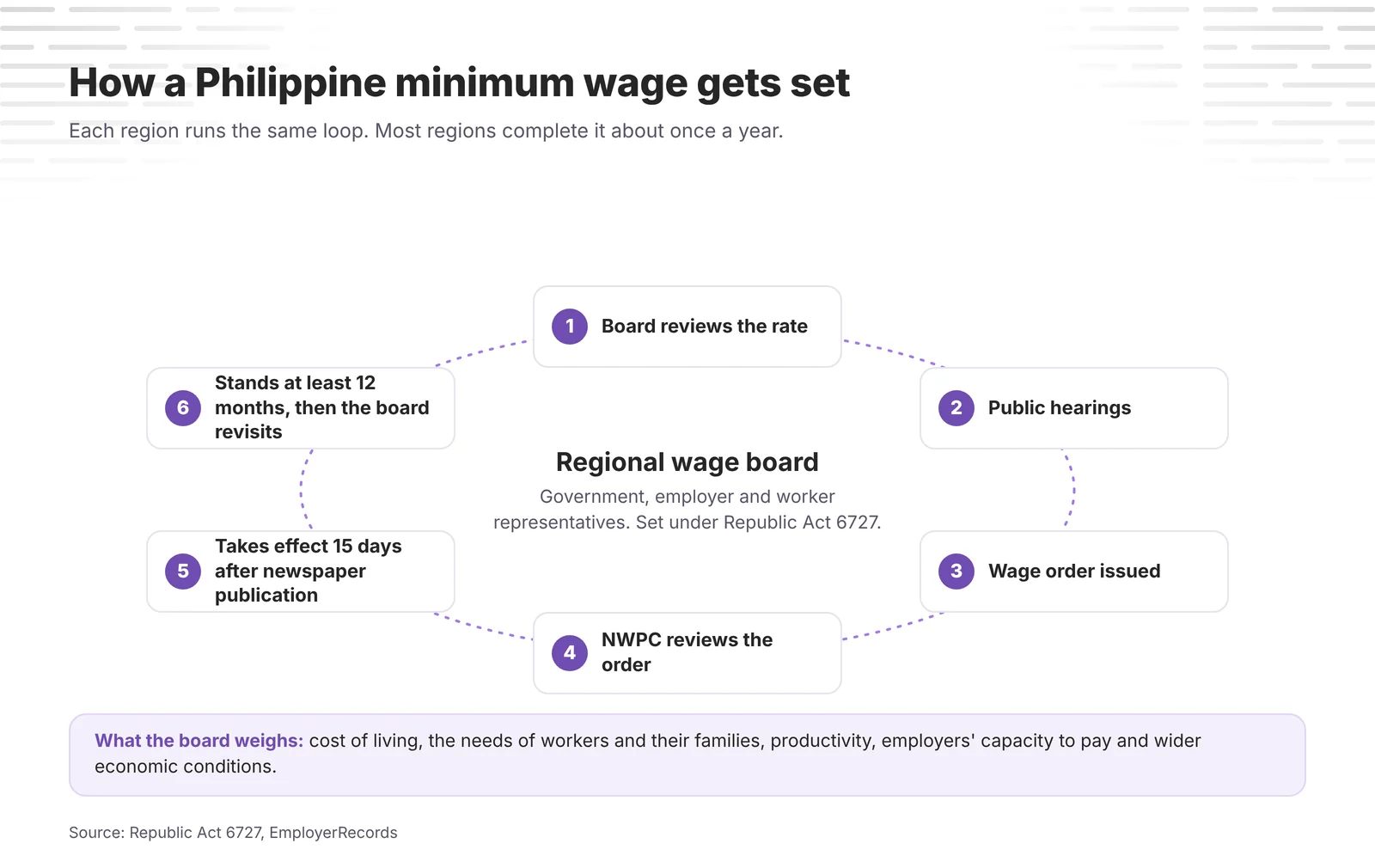
Minimum wages are set region by region under the Wage Rationalization Act (Republic Act 6727). Each regional board, made up of government, employer and worker representatives, reviews the rate, holds public hearings and issues a wage order, which the NWPC then reviews. The order takes effect 15 days after it is published in a newspaper of general circulation.[1]
Boards weigh the cost of living, the needs of workers and their families, productivity, employers’ capacity to pay and wider economic conditions. A wage order normally stands for at least 12 months before the board revisits it, so most regions move once a year, often in two tranches.
Scheduled and pending changes
Known changes after 24 October 2026
| Region | Change | Date |
|---|---|---|
| IV-A (CALABARZON) | IVA-23: up to ₱45 a day, top rate ₱645 | 26 Oct 2026 |
| VI (Western Visayas) | Wage Order 30: ₱40 to ₱45 a day, top rate ₱590 (awaiting publication) | Expected mid-November 2026 |
| V (Bicol) | RBV-23 second tranche: ₱455 to ₱480 | 1 Dec 2026 |
| BARMM | BARMM-05 second tranche: up to ₱461 | 1 Dec 2026 |
| NCR | NCR-27 second tranche (₱780): blocked by injunction | 20 Jan 2027, uncertain |
Is there a national legislated wage increase?
No. Congress has not passed a national across-the-board increase. In June 2025 the House approved a ₱200 a day bill and the Senate a ₱100 version, but the two chambers did not reconcile them before the 19th Congress ended. The bills were refiled in the 20th Congress and labour coalitions were still pressing for a ₱200 increase in March 2026, but none has become law, so regional wage orders remain the only source of minimum wage increases.
How to convert the daily minimum wage to a monthly salary
Multiply the daily rate by a factor and divide by 12: monthly equivalent = daily rate x factor / 12. The factor is the number of paid days in a year, and it depends on the work schedule and whether rest days are paid, following the Department of Labor and Employment (DOLE) handbook on statutory benefits.[2]
Use 365 for employees paid for every day of the month, including rest days. Use 313 for a six-day week where unworked rest days are unpaid, and 261 for a five-day week on the same basis. A monthly salary is compliant only if it equals or exceeds the daily minimum times the right factor, divided by 12.
Monthly equivalents in pesos
| Rate | Daily (₱) | 261 days, 5-day week | 313 days, 6-day week | 365 days, all days paid |
|---|---|---|---|---|
| NCR non-agriculture | 755 | 16,421 | 19,693 | 22,965 |
| NCR smaller firms, agriculture | 718 | 15,617 | 18,728 | 21,839 |
| CALABARZON cities (from 26 Oct) | 645 | 14,029 | 16,824 | 19,619 |
| BARMM, other areas | 411 | 8,939 | 10,720 | 12,501 |
The 26-day shortcut. DOLE announcements often quote monthly figures at 26 working days (₱755 x 26 = ₱19,630). It is a quick estimate, not a substitute for the factor that matches the employment contract.
Metro Manila minimum wage, 2015 to 2026
The Metro Manila rate has risen 53.8% since June 2016, from ₱491 to ₱755, but not every year. It was frozen at ₱537 from November 2018 to June 2022, through the pandemic, and has risen every year since, with the last three increases each above 5%. Budget for an annual review in each region where you employ.
Rate in force at the end of each year (2026: from 26 September)
Source: RTWPB-NCR wage orders NCR-19 to NCR-28. NCR-27 is excluded because it never took effect.
| Wage order | Effective | Daily (₱) | Change |
|---|---|---|---|
| NCR-19 | Apr 2015 | 481 | |
| NCR-20 | Jun 2016 | 491 | 2.1% |
| NCR-21 | Oct 2017 | 512 | 4.3% |
| NCR-22 | Nov 2018 | 537 | 4.9% |
| NCR-23 | Jun 2022 | 570 | 6.1% |
| NCR-24 | Jul 2023 | 610 | 7.0% |
| NCR-25 | Jul 2024 | 645 | 5.7% |
| NCR-26 | Jul 2025 | 695 | 7.8% |
| NCR-28 Current | Sep 2026 | 755 | 8.6% |
Who the minimum wage covers, and who is exempt
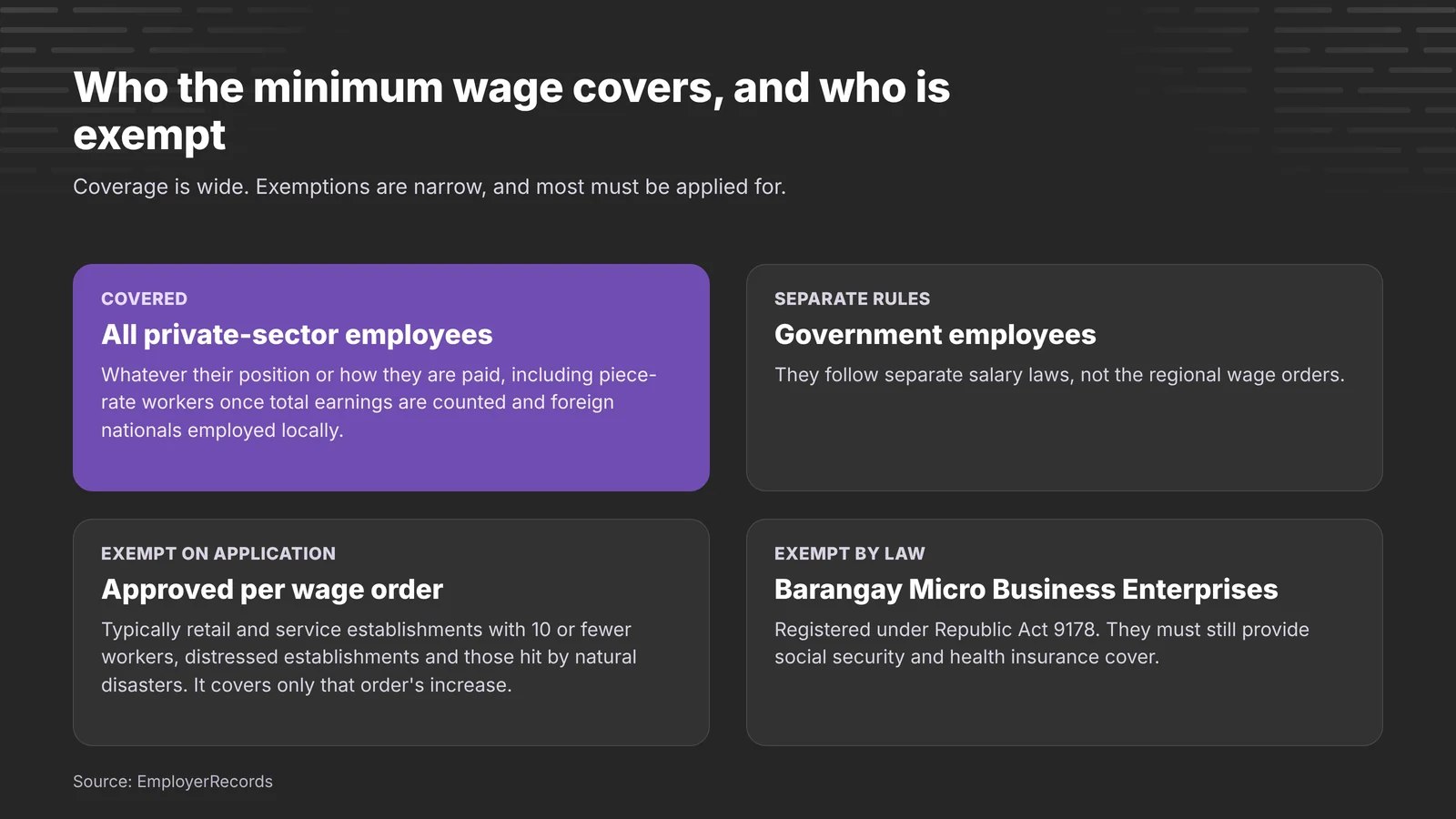
The minimum applies to all private-sector employees, whatever their position or how they are paid, including piece-rate workers once total earnings are counted and foreign nationals employed locally. Government employees follow separate salary laws.[2]
Exemptions an employer can apply for
Most wage orders let certain businesses apply to their regional board for exemption from a specific increase, typically retail and service establishments with 10 or fewer workers, distressed establishments and those hit by natural disasters. The exemption is not automatic: it must be applied for and approved, and it covers only that order’s increase.
Barangay Micro Business Enterprises registered under Republic Act 9178 (assets of ₱3 million or less) are exempt from the minimum wage law, but must still provide social security and health insurance cover.
Special categories. Apprentices and learners may be paid no less than 75% of the applicable minimum under an approved programme. Domestic workers (kasambahay) have separate monthly minimums under Republic Act 10361: from October 2026 it is ₱7,500 in Central Visayas and CALABARZON.
What an employer pays on top of the minimum wage
A minimum wage employee in Metro Manila costs about 22% more than the wage itself once mandatory contributions and 13th month pay are counted. Three social insurance schemes apply from the first month: the Social Security System (SSS), PhilHealth and Pag-IBIG.[8]
SSS is charged on a monthly salary credit (MSC) bracket, not exact pay. A worker earning ₱19,693 falls in the ₱19,500 bracket, so the employer pays 10% of ₱19,500 plus ₱30 for Employees’ Compensation.
The mandatory cost items
Monthly employer cost at the NCR minimum wage
₱19,693 wage (₱755 x 313 / 12) plus ₱4,313 in contributions and 13th month accrual.
21.9% on top of the wageThe example is a six-day week at the NCR non-agriculture rate. At about ₱63 to the US dollar (16 October 2026), that is roughly $313 in wages and $381 in total cost a month. It excludes service incentive leave, worth about ₱315 a month once it applies (5 x ₱755 / 12), and any overtime or holiday premiums.
Pag-IBIG’s cap means the percentage on top falls slightly at higher salaries, while SSS rises with pay up to the ₱35,000 credit ceiling. To model a specific role, the EOR cost calculator works through the same components.
Our view. The minimum wage is the least informative number in a hiring budget. At the Metro Manila rate this page puts the real monthly cost at ₱24,006, about ₱4,300 above the wage, once contributions and the 13th month accrual are added.
Income tax for minimum wage earners
Minimum wage earners pay no income tax on their statutory minimum wage. Under the TRAIN Law (Republic Act 10963), their holiday pay, overtime pay, night-shift differential and hazard pay are also exempt, so no withholding applies to that pay.[8]
Separately, the first ₱250,000 of annual taxable income is taxed at 0% for every employee, which covers most minimum-wage salaries anyway. The employer still registers the employee, deducts the employee shares of SSS, PhilHealth and Pag-IBIG, and issues the annual BIR Form 2316.
Extra pay can change the picture. Allowances and other pay above the minimum wage package are taxable once they push income past the exemptions, and 13th month pay and other benefits are tax-free only up to ₱90,000 a year combined.
Working hours, overtime and holiday pay
Normal hours under the Labor Code are eight a day, excluding a meal break of at least 60 minutes, with one rest day after six consecutive working days. Work beyond eight hours is overtime, and the daily minimum wage does not include any premium pay.
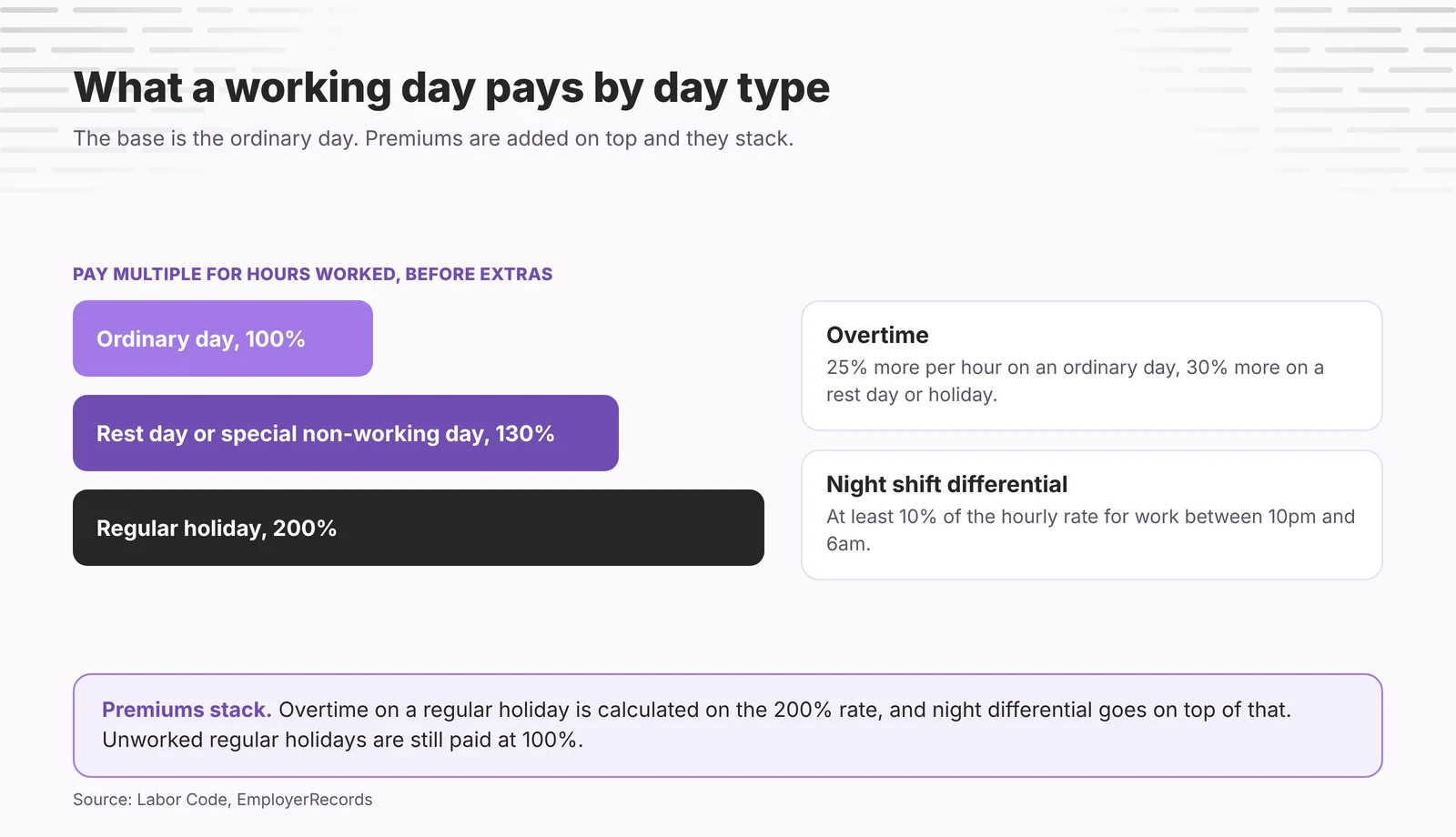
Night-shift differential adds at least 10% of the hourly rate for work between 10pm and 6am, which matters for customer support and BPO roles serving overseas time zones. Premiums stack: overtime on a regular holiday is calculated on the 200% holiday rate, and night differential on top of that.
Leave entitlements in the Philippines
The statutory minimum is five days of paid service incentive leave a year after one year of service, under Article 95 of the Labor Code. It does not apply to establishments with fewer than 10 workers or to employers that already give at least five days of paid vacation leave, and unused days must be converted to cash at the end of the year.
Many employers give more paid vacation and sick leave than the statutory five days, and candidates for office roles expect it.
Family and special leave
Maternity leave is 105 days at full pay (120 for solo parents), funded by SSS benefits with the employer paying any salary difference. Fathers get seven days of paid paternity leave, solo parents seven days a year, and women employees up to two months of special leave after gynaecological surgery. Victims of violence against women and children are entitled to 10 days of paid leave.
13th month pay is mandatory
Every rank-and-file employee who worked at least one month in the calendar year is entitled to 13th month pay under Presidential Decree 851. It equals one-twelfth of the total basic salary earned in the year and must be paid by 24 December.[8]
For a full year at the NCR minimum on a six-day week that is ₱19,693. Overtime, holiday premiums and allowances are excluded from the base unless they are built into basic pay. Employees who leave during the year receive a pro-rated amount with their final pay. For how the 13th month and bonuses show up in typical pay, see the average salary in the Philippines guide.
Accrue it monthly. 13th month pay is the largest single cost after the wage itself, about 8.33% of basic pay. Foreign employers new to the Philippines often miss it in budgets because it is a bonus in name but a legal obligation in practice.
Wage distortion after a minimum wage increase
A minimum wage increase can squeeze the gap between minimum-wage staff and those just above them, which Article 124 of the Labor Code calls wage distortion. The law does not require a matching across-the-board raise, but it does require the employer to correct the distortion, through the grievance machinery in unionised workplaces or by negotiation, with the National Conciliation and Mediation Board if needed.
In Metro Manila, a supervisor on ₱850 a day was ₱155 above the minimum before NCR-28 and is ₱95 above it now. Budget for adjustments to the pay grades just above the floor whenever a region’s rate rises, not only for minimum-wage employees. The occupation and industry bands in our Philippines salary guide show where those grades sit.
Minimum wage vs market pay in the Philippines
Most skilled roles pay well above the minimum. In the April 2025 Labor Force Survey, the Philippine Statistics Authority put average daily basic pay at ₱1,387 for managers, ₱1,214 for professionals and ₱747 for clerical support workers, against ₱428 for elementary occupations.[9]
The minimum wage mainly shapes pay for entry-level service, retail, manufacturing and agricultural work. For hiring in technology, finance or shared services, treat it as the legal floor and benchmark offers against market data instead; our average salary guide for the Philippines covers pay by sector and role.
Cost of living
Labour groups argue that the minimum falls well short of a family living wage: the Trade Union Congress of the Philippines put the Central Visayas figure at about ₱1,400 a day in 2026. Housing and transport in Metro Manila and Metro Cebu are the main pressures, and employers who pay modestly above the floor generally find hiring and retention easier.
Our view. For anything beyond entry-level work, the minimum is a legal floor, not a pay band. Price the role from market data and use the minimum only to confirm you clear the floor in the employee’s region.
Penalties for paying below the minimum wage
Underpaying the minimum wage is a crime under Republic Act 8188. The penalty is a fine of ₱25,000 to ₱100,000, imprisonment of two to four years, or both, and a convicted offender cannot apply for probation.[10]
The employer must also pay double indemnity: twice the unpaid wage owed to each employee, and paying it does not remove criminal liability. Where the employer is a company, the prison term falls on its responsible officers, such as the president, general manager or managing director.
Underpayment is easy to trigger. The common causes are using the wrong region’s rate for remote staff, missing a wage order’s effective date, using a monthly factor that does not match the schedule, and leaving premiums out of the pay run. DOLE inspections and worker complaints both lead to back-pay orders.
Hiring in the Philippines as an international company
A foreign company cannot run Philippine payroll without a local entity or an intermediary. The employer must register with SSS, PhilHealth, Pag-IBIG and the Bureau of Internal Revenue, pay salaries in pesos at least twice a month, at intervals of no more than 16 days, track every regional wage order and file monthly remittances.
Foreign nationals working in the Philippines need an Alien Employment Permit from DOLE and a work visa, covered in our guide to EOR visas and work permits.
Ending employment
Dismissal requires a just cause, such as serious misconduct, or an authorised cause, such as redundancy. Authorised-cause terminations need 30 days’ written notice to the employee and to DOLE, and separation pay of half a month to one month’s pay per year of service depending on the cause.
Using an employer of record
Companies without a local entity can hire through an employer of record, which acts as the legal employer in the Philippines and handles contracts, payroll, contributions, 13th month pay and regional wage order updates. The client still sets the salary, so paying the right regional rate stays a shared responsibility. Our guide to the best EOR providers in the Philippines compares providers, and the Philippines hiring guide covers costs at every salary level, benefits and work permits. Before you fix a rate, read the related guides on 13th month pay, employer costs, termination and separation pay and public holidays and leave.
Questions about the Philippine minimum wage
Short answers to what employers ask most about regional rates, NCR-27, the real cost of a minimum-wage hire and the rules around it, checked against wage board and court reports on 24 October 2026.
What is the minimum wage in the Philippines in 2026?
The highest is ₱755 a day for non-agricultural workers in Metro Manila under Wage Order NCR-28, in force since 26 September 2026, and ₱718 for agriculture and smaller retail, service and manufacturing firms. Other regions range from ₱401 to ₱645 a day.
What is Wage Order NCR-27 and is it in force?
NCR-27 was a ₱85 Metro Manila increase approved in June 2026, in two steps from 25 July 2026 and 20 January 2027. It never took effect: a Pasig court injunction blocks it, and on 20 October 2026 the court refused to lift it. A Supreme Court petition is pending. NCR-28 separately set ₱755 from 26 September 2026.
Is there a national minimum wage in the Philippines?
No. Each regional wage board sets its own rate. Bills for a national ₱100 to ₱200 daily increase were approved separately by the House and Senate in 2025 but never reconciled, and no legislated increase has been enacted as of October 2026.
How do you convert the daily minimum wage to a monthly salary?
Multiply the daily rate by 365, 313 or 261 and divide by 12, depending on whether all days are paid, a six-day week or a five-day week applies. At ₱755 that gives ₱22,965, ₱19,693 or ₱16,421 a month.
How much does a minimum wage employee cost an employer?
In Metro Manila on a six-day week, about ₱24,006 a month: ₱19,693 in wages plus ₱1,980 SSS, ₱492 PhilHealth, ₱200 Pag-IBIG and ₱1,641 for 13th month pay, or 21.9% on top of the wage.
Is 13th month pay mandatory in the Philippines?
Yes. Under Presidential Decree 851, rank-and-file employees who worked at least one month in the year must receive one-twelfth of their annual basic salary by 24 December. It is tax-free up to ₱90,000 combined with other benefits.
What are the penalties for paying below the minimum wage?
Under Republic Act 8188, a fine of ₱25,000 to ₱100,000, imprisonment of two to four years, or both, plus double indemnity: twice the unpaid wages owed. Company officers can be imprisoned and probation is not available.
Can you hire in the Philippines without a local entity?
Yes. An employer of record can act as the legal employer, registering the employee with SSS, PhilHealth, Pag-IBIG and the tax bureau and running payroll at the correct regional minimum wage, so a foreign company can hire without its own entity.
References and sources
Every figure on this page comes from the sources below. Numbers in square brackets in the text link to the matching entry. Official statistics are used wherever they exist, and our own calculations are labelled as estimates. All sources were checked on 24 October 2026.
- ↑Current daily minimum wage rates by region. National Wages and Productivity Commission. nwpc.dole.gov.ph. Retrieved 24 October 2026. Official
- ↑Minimum wage in the Philippines: rates by region. LaborCode.ph. laborcode.ph. Retrieved 24 October 2026. Guide
- ↑Central Visayas wage hike takes effect. Daily Tribune. tribune.net.ph. Retrieved 24 October 2026. News
- ↑CALABARZON minimum wage up by P45 on Oct. 26. GMA News. gmanetwork.com. Retrieved 24 October 2026. News
- ↑P40 to P45 wage hike approved in Region 6. The Manila Times. manilatimes.net. Retrieved 24 October 2026. News
- ↑Firms urge SC to dismiss Metro Manila wage hike case. Daily Tribune. tribune.net.ph. Retrieved 24 October 2026. News
- ↑Court allows labor groups to join wage hike legal tussle. The Manila Times. manilatimes.net. Retrieved 24 October 2026. News
- ↑SSS, PhilHealth and Pag-IBIG contribution tables 2026. KAMI Workforce. kamiworkforce.com. Retrieved 24 October 2026. Guide
- ↑Average daily basic pay by occupation, April 2025 Labor Force Survey. GMA News, citing PSA. gmanetwork.com. Retrieved 24 October 2026. Data
- ↑Republic Act 8188: penalties and double indemnity. The LawPhil Project. lawphil.net. Retrieved 24 October 2026. Law
About the author

Dhiraj Das is Co-Founder of EmployerRecords.com, where he leads content, research and partnerships. He has worked in content and online publishing for more than 15 years, and before EmployerRecords he founded a number of successful content brands. For the past six years he has specialised in HR technology, Employer of Record services and global hiring. His background in digital marketing and search shapes how EmployerRecords researches and presents its provider reviews, country hiring guides and cost data, so employers can compare their options and hire abroad with clear, checked information.
View all articles by DhirajRelated guides for employers
Other Philippines guides from this hiring guide, plus pay floors and salary levels in other markets.
 Philippines13th Month Pay13th Month Pay in the Philippines (2026): 1/12 of Basic Pay, Due 24 DecemberWho gets it, how to compute it, the 24 December deadline, the tax-free cap and what it adds to employer...Read the guidePhilippinesAverage salaryAverage Salary in the Philippines (2026): Pay by Role and RegionOfficial PSA wage data by industry, role and region, what each figure measures, take-home pay, employer cost and how to...Read the guidePhilippinesEmployer costsEmployer Costs in the Philippines (2026): Contributions Cap at ₱6,230What SSS, PhilHealth and Pag-IBIG cost an employer at each salary, and how the 13th month changes the total.Read the guidePhilippinesPublic Holidays and LeavePublic Holidays and Leave in the Philippines (2026): Pay Rules and Statutory LeaveHoliday pay by day type, the 2026 and 2027 calendars and the statutory leave a Philippine employer has to give.Read the guidePhilippinesTermination and Separation PayTermination and Separation Pay in the Philippines (2026): Up to One Month per YearWhich grounds let you end a Philippine hire, the notices each needs, how separation pay is worked out and what...Read the guide
 Czech RepublicMinimum wageMinimum Wage in the Czech Republic (2026): CZK 22,400 a MonthThe monthly and hourly minimum wage for 2026, the increase for 2027, overtime and what employers add on top.Read the guide
Hiring in the Philippines?
See the full cost of a hire at any salary, mandatory benefits, work permits and the providers that employ in the Philippines.