
Termination and Separation Pay in the Philippines (2026): Up to One Month per Year
Which grounds let you end a Philippine hire, the notices each one needs, how separation pay is worked out and what a missed step costs.
 By
What ends a job lawfully in the Philippines?
You can end a Philippine job only for a just cause (employee fault) or an authorized cause (business or health), after the right notices. Separation pay is owed for authorized causes only: one month per year of service for redundancy, half a month per year for retrenchment, with a one-month floor.
- Authorized cause: notice to employee and DOLE, 30 days ahead
- Just cause: two written notices, with a chance to reply
- Final pay: due within 30 days of the last day
Security of tenure is written into Philippine law. No employee can be dismissed except for a just or an authorized cause, and only after the employer has followed due process.[1][2]
Most foreign employers get this wrong in the same place. They pick a reason, then think about the paperwork, when the reason decides almost everything: which notices you send, whether you owe separation pay and what a mistake costs.
This page walks through both routes, the separation pay formulas with worked amounts, the cost of getting the process wrong and the final pay you owe on the last day. If you’re pricing a hire rather than an exit, start with the employer costs page instead.
Just cause or authorized cause: which one applies?
Ask one question first: is this about something the employee did? If yes, it’s a just cause under Article 297. If the reason is the business or the employee’s health, it’s an authorized cause under Articles 298 and 299.[2][3]
The two routes don’t mix. A poor performer can’t be ‘made redundant’ to avoid a hearing, and a restructuring can’t be dressed up as misconduct to avoid separation pay. Labour arbiters look at the real reason, and the employer carries the burden of proving it.
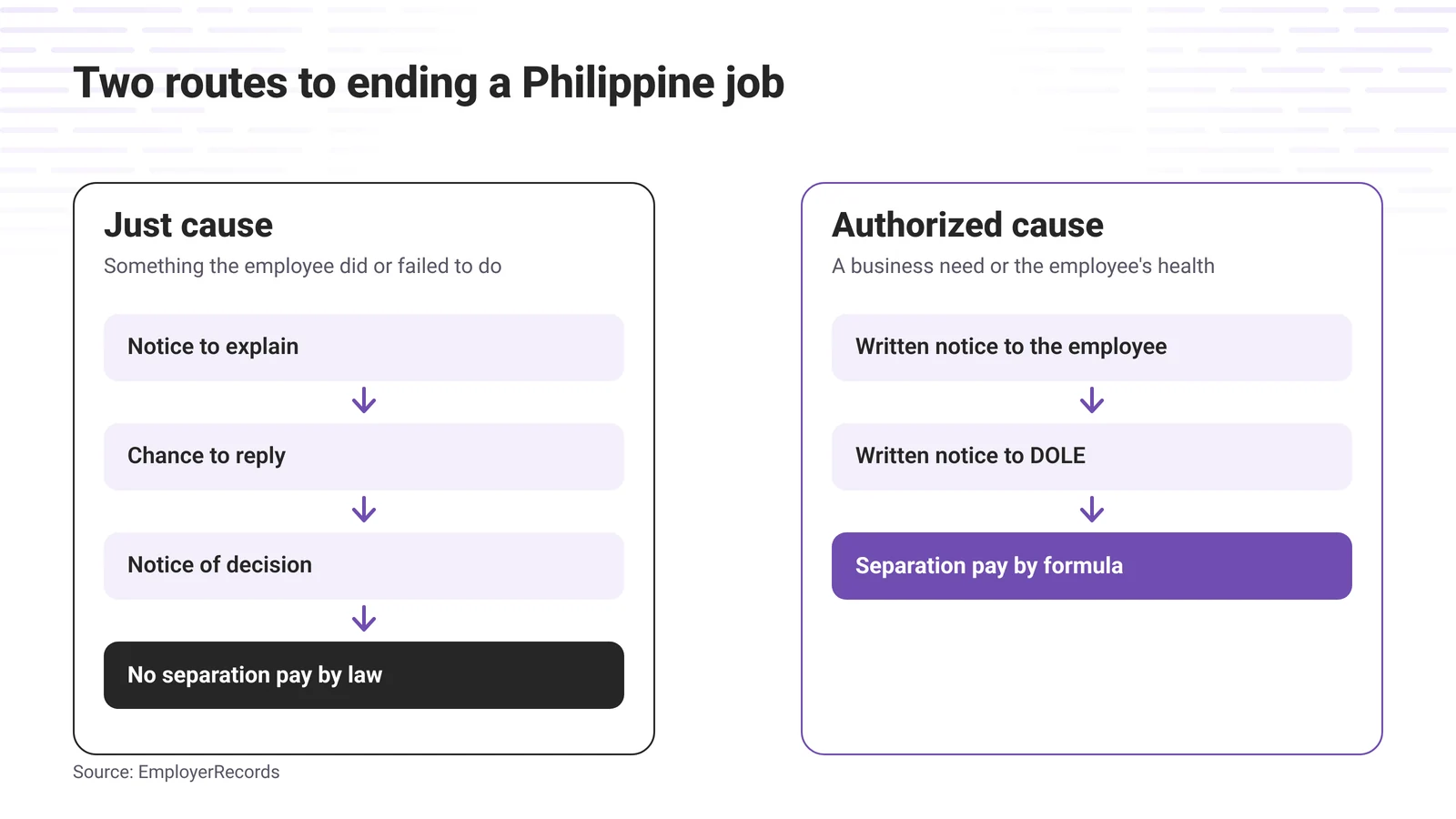
Just cause and authorized cause compared
| Just cause | Authorized cause | |
|---|---|---|
| What triggers it | Something the employee did or failed to do | A business need or the employee’s health, no fault involved |
| Legal basis | Article 297 of the Labor Code | Articles 298 and 299 |
| Notices | Notice to explain, then notice of decision | One notice to the employee and one to DOLE |
| Timing | At least five calendar days to reply to the first notice | At least 30 days before the end date |
| Separation pay | None by law | Yes, by formula |
What counts as a just cause for dismissal?
Article 297 lists five grounds, and nothing else qualifies.[4][5] DOLE’s rules describe all of them as causes directly attributable to the fault or negligence of the employee.[2]
Underperformance on its own sits awkwardly in this list. It usually has to be framed as gross and habitual neglect, which means documented warnings over time, not one bad quarter.
Our view. The grounds that fail most often in practice are loss of trust and neglect, because the file is thin. If you can’t hand a labour arbiter dated warnings and the employee’s replies, treat the case as unproven and talk to counsel before you send anything.
What is the twin-notice rule for a just-cause dismissal?
The twin-notice rule means two written notices with a real chance to answer in between.[3] Skip the first notice, or send both on the same day, and the dismissal is exposed even where the ground is solid.
DOLE Department Order 147-15 sets out the contents of each notice and the hearing standard.[2] Employers sometimes use preventive suspension while they investigate, which is a separate decision and needs its own documentation.
Process note. Date every document and keep proof of delivery. In a dispute the paper trail is the only evidence you control.
Which authorized causes carry separation pay?
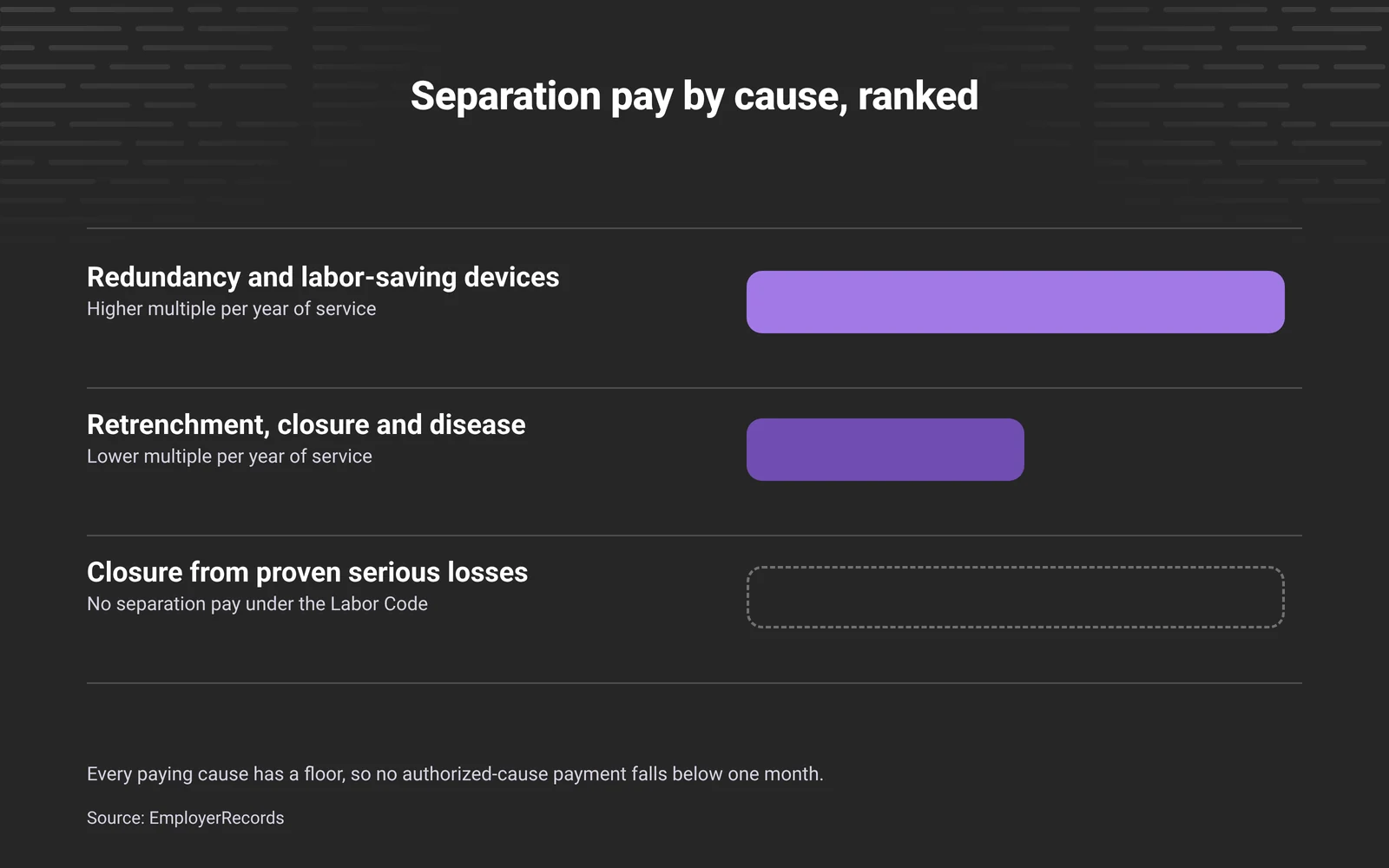
Articles 298 and 299 allow six situations. Labor-saving devices and redundancy pay the higher rate, one month per year of service. Retrenchment, closure that isn’t caused by serious losses and disease pay the lower rate, half a month per year. In every case there’s a floor of one month.[6][7][8]
Closure because of proven serious losses is the only authorized cause with no statutory separation pay, and the employer has to prove those losses.[9] The closure itself must be genuine and not a way around employees’ rights.[10]
Authorized causes, notice and minimum separation pay
| Cause | Notice | Minimum separation pay |
|---|---|---|
| Installation of labor-saving devices | 30 days, to employee and DOLE | One month, or one month per year of service, whichever is higher |
| Redundancy | 30 days, to employee and DOLE | One month, or one month per year of service, whichever is higher |
| Retrenchment to prevent losses | 30 days, to employee and DOLE | One month, or half a month per year of service, whichever is higher |
| Closure not due to serious losses | 30 days, to employee and DOLE | One month, or half a month per year of service, whichever is higher |
| Closure due to proven serious losses | 30 days, to employee and DOLE | None under the Labor Code |
| Disease | Written notice, steps differ under the DOLE order | One month, or half a month per year of service, whichever is higher |
Disease is the odd one out, and the one we’d take legal advice on before using. It needs a medical basis, and DOLE’s order treats the notice steps for it differently from the other five.[2]
Our view. Redundancy is the cause we see used most and defended worst. You need to show the position is actually surplus, that you used fair criteria to pick who goes and that you acted in good faith. A role that is re-advertised three months later will not pass.
How do you calculate separation pay?
Take the monthly pay, multiply by the years of service and by the multiple for the cause, then compare the result with one month’s pay and pay whichever is higher.[11] A fraction of at least six months counts as a whole year, and a shorter fraction doesn’t round up.[9]
Here’s the result at ₱40,000 a month. The last two columns differ by exactly a factor of two once service passes one year.
Separation pay for a ₱40,000 monthly salary, our calculation
| Service | Years credited | Redundancy, labor-saving | Retrenchment, closure, disease |
|---|---|---|---|
| 3 months | minimum | ₱40,000 | ₱40,000 |
| 2 years 3 months | 2 | ₱80,000 | ₱40,000 |
| 5 years 7 months | 6 | ₱240,000 | ₱120,000 |
| 10 years | 10 | ₱400,000 | ₱200,000 |
One point needs care. For retirement pay the Supreme Court reads ‘half a month’ as 22.5 days, which adds a share of the 13th month and five days of service incentive leave to the 15 days.[12] Some practitioners use the same 22.5 days for separation pay as the safer benchmark.[13] The statute’s own wording for separation pay says half a month, and that’s what our table and calculator use, so check a bigger claim against the 22.5-day reading before you settle it.
A practical reading. Where the two readings differ by a few thousand pesos, the cost of arguing exceeds the difference. We’d pay the higher figure on small cases and keep the statutory reading for large headcount exercises, where it adds up.
How much notice does an authorized-cause termination need?
You need to serve two separate written notices at least one month, in practice 30 days, before the end date: one to each affected employee and one to DOLE.[10][14] The period counts backwards from the date the termination takes effect.
A group announcement, a text message or a notice handed over on the last day doesn’t count.[9] Each notice should name the authorized cause and the effective date, so the employee can see why employment is ending.
Guides name DOLE’s regional office with jurisdiction over the workplace as the recipient.[15] Where an office is reached by post, build the delivery time into your 30 days.
What does it cost to get the process wrong?
If the ground is valid but you skipped a notice, the dismissal usually stands and you pay nominal damages. The Supreme Court set that at ₱30,000 for just cause in Agabon and ₱50,000 for authorized cause in Jaka, because an authorized cause starts with the employer’s own decision.[16][17]
Those amounts aren’t a fixed tariff. Courts weigh the cause invoked, the employer’s good faith and how many people were affected, and the award applies per employee, so a 20-person redundancy without notice isn’t a ₱50,000 problem.[17]
The bigger risk is no valid cause at all. That means reinstatement, full backwages from the day of dismissal and often damages and attorney’s fees.[18]
What a missed step costs, by situation
| Situation | Likely outcome |
|---|---|
| Valid just cause, no twin notices | Dismissal stands, nominal damages of ₱30,000 under the Agabon ruling |
| Valid authorized cause, no 30-day notice | Dismissal stands, nominal damages of ₱50,000 under the Jaka ruling |
| No valid cause, process followed | Illegal dismissal: reinstatement and full backwages |
| No valid cause, no process | Illegal dismissal, with damages and attorney’s fees possible |
When must final pay and the certificate of employment be released?
Release the final pay within 30 days of the separation date, unless a company policy, contract or collective agreement sets a shorter period. Issue a certificate of employment within three days of the employee’s request.[19]
The 30 days apply whatever the reason for leaving, whether dismissal, resignation or end of contract.[19] They apply to separation pay as well, so the exit payment can’t wait for the next payroll cycle.
Clearance. Employers can hold final pay while an employee finishes clearance or settles accountabilities, but that doesn’t suspend the clock indefinitely.[21] Tell the employee in writing what is outstanding the same week they leave, and release the rest.
What notice must an employee give when resigning?
An employee resigning without just cause gives at least one month’s written notice under Article 300.[22] The employer can shorten or waive the period, and the final pay clock then starts on the actual last day.
No separation pay is owed on resignation by law, though a contract or policy may promise some. Where the employee leaves without notice, the employer can claim damages, but only proven losses.[22]
Be careful with ‘resignations’ you ask for. A resignation extracted by pressure is treated as an illegal dismissal, whatever the letter says.[23]
Do the same rules apply to probationary and fixed-term staff?
Mostly yes, with two timing differences. A probationary hire can’t be kept past the probation period and then treated as probationary, and a fixed-term contract has to be genuine, because courts look closely at terms used to avoid regular status.[24]
Retirement isn’t termination, though people confuse the two when someone is close to retirement age. Separation pay and retirement pay are different benefits with different formulas.
Is separation pay taxable?
Separation pay owed because of an authorized cause under Article 298 or 299, or because of death, sickness or disability, is exempt from income tax and from withholding.[13]
That exemption follows the cause, not the label on the payslip. A negotiated settlement for a dismissal that was really for misconduct isn’t covered, and gets taxed as ordinary income.
What does a Philippine redundancy cost in total?
Take someone on ₱40,000 a month with five years and seven months of service. That’s six years credited, so a redundancy pays ₱240,000 in separation pay, six times the monthly salary. A retrenchment of the same person pays ₱120,000.
On top of that sit the final pay items, the pro-rated 13th month among them, and 30 days of notice during which the employee is still on payroll and contributions keep running. Our employer costs page has those monthly figures.
Where we start. Budget the exit at the separation pay table plus one extra month of full employer cost. If a redundancy needs the CEO’s approval, that number is what they’re approving.
Who ends the job when you hire through an EOR?
When the hire sits with an Employer of Record, the EOR is the legal employer, so it serves the notices and makes the payments. You decide that the role should end. They run the legal process.
Contracts differ on who carries separation pay and the cost of a missed step, so read that clause before you sign, not when you need it. Our EOR providers in the Philippines page lists providers worth comparing on termination support.
Separation pay and notice date calculator
Enter the monthly pay, the service and the cause. The result applies the multiples, the six-month rounding rule and the one-month floor, so ₱40,000 with five years and seven months returns ₱240,000 for a redundancy.
Philippines separation pay and notice date
Estimate only. It applies the Labor Code multiples and the six-month rounding rule and leaves out company policy, collective agreements, unpaid wages and the 13th month. Notice is counted as 30 calendar days before the last day. Ask counsel before a large exit.
Where do Philippine terminations go wrong?
Four slips account for most of the exposure we see foreign teams create.
What we’d do first. Write down the ground, the evidence and the end date on one page before anything goes to the employee. If that page has gaps, the notice will have them too. Exit costs sit next to the other statutory pay rules, covered in the guides on minimum wage by region, average salary and public holidays and leave. The other Philippine pay and exit rules are collected in the Philippines hiring guide.
Questions about termination and separation pay in the Philippines
Short answers to what employers ask most before ending a Philippine hire, checked against the Labor Code summaries and DOLE rules cited below on 24 November 2026.
Can I dismiss an employee without a reason in the Philippines?
No. Dismissal needs a just or an authorized cause and due process. Ending employment for no stated reason is treated as illegal dismissal.
Is separation pay owed when an employee is fired for misconduct?
Not by law. Separation pay attaches to authorized causes. A contract, policy or collective agreement can still promise it.
How is separation pay calculated for retrenchment?
Half a month’s pay for every year of service, with a floor of one month. A fraction of six months or more counts as a full year.
Do I need to tell DOLE about every termination?
For authorized causes, yes. You serve a written notice on DOLE and on the employee at least 30 days before the end date. Just-cause dismissals follow the twin-notice rule instead.
What happens if I skip the 30-day notice?
If the cause is valid, the dismissal usually stands and you pay nominal damages, which the Supreme Court has set at ₱50,000 per employee for authorized causes. Invalid cause? Reinstatement and backwages.
How long do I have to pay final pay?
Within 30 days of the separation date. A shorter policy or contract period wins. The certificate of employment follows within three days of the employee asking for it.
Can an employee resign without notice?
Only for the just causes the Labor Code lists. Otherwise one month’s written notice is expected, and the employer can waive part of it.
Is separation pay subject to income tax?
Not when it’s paid because of an authorized cause, death, sickness or disability. Other settlement payments can be taxable.
References and sources
Every figure on this page comes from the sources below. Numbers in square brackets in the text link to the matching entry. We could not open the DOLE and Labor Code pages directly for every point, so several rules rest on law firm and legal guide summaries, and our own calculations are labelled. All sources were checked on 24 November 2026.
- ↑Amending the Implementing Rules and Regulations of Book VI of the Labor Code. Digest.ph. digest.ph. Retrieved 24 November 2026. Primary text
- ↑Department Order No. 147-15, Rules on the application of just and authorized causes of termination. Supreme Court E-Library. elibrary.judiciary.gov.ph. Retrieved 24 November 2026. Primary
- ↑Due Process Requirements for Employee Dismissal Philippines. Lawyer Philippines. lawyer-philippines.com. Retrieved 24 November 2026. Guide
- ↑Compliance check: Philippines just causes for termination. Herbert Smith Freehills Kramer, April 2024. hsfkramer.com. Retrieved 24 November 2026. Law firm
- ↑Labor Code of the Philippines, Book Six: Post-Employment. PNL Law. pnl-law.com. Retrieved 24 November 2026. Primary text
- ↑Separation pay for seasonal employees. Freedom of Information, Philippines. foi.gov.ph. Retrieved 24 November 2026. Government
- ↑Philippines: employment termination guide. L&E Global. leglobal.law. Retrieved 24 November 2026. Law firm
- ↑Employment 2025, Philippines: severance and separation pay. Chambers and Partners, 2025. gpg-pdf.chambers.com. Retrieved 24 November 2026. Law firm
- ↑Employee Rights During Redundancy, Retrenchment, or Business Closure. Lawyer Philippines. lawyer-philippines.com. Retrieved 24 November 2026. Guide
- ↑Employee Rights During Redundancy, Retrenchment, or Business Closure. Respicio and Co.. respicio.ph. Retrieved 24 November 2026. Guide
- ↑Computation of Separation Pay. LaborLaw.ph. laborlaw.ph. Retrieved 24 November 2026. Guide
- ↑Retirement Pay. LaborLaw.ph. laborlaw.ph. Retrieved 24 November 2026. Guide
- ↑Separation Pay Requirements Under Philippine Labor Code. Lawyer Philippines. lawyer-philippines.com. Retrieved 24 November 2026. Guide
- ↑Philippines: Employment and Labour Law. Legal 500. legal500.com. Retrieved 24 November 2026. Law firm
- ↑What are the notice requirements for authorized termination?. Nicolas and De Vega Law Offices. ndvlaw.com. Retrieved 24 November 2026. Law firm
- ↑Agabon-JAKA-Lambert Framework: Nominal Damages for Due Process Violation. Batas Natin, 19 May 2026. batasnatin.com. Retrieved 24 November 2026. Guide
- ↑Cash equivalent of belated due process: Is it P30,000 or P50,000?. The Philippine Star, 19 April 2005. philstar.com. Retrieved 24 November 2026. News
- ↑Explainer: illegal dismissal. LaborLaw.ph. laborlaw.ph. Retrieved 24 November 2026. Guide
- ↑DOLE Labor Advisory No. 06, Series of 2020: Guidelines on the Payment of Final Pay and Issuance of Certificate of Employment. Platon Martinez. platonmartinez.com. Retrieved 24 November 2026. Law firm
- ↑Final pay and COE must be released on time, DOLE reminds employers. Manila Bulletin, 22 January 2026. mb.com.ph. Retrieved 24 November 2026. News
- ↑Final pay. Divina Law, published in the Daily Tribune, 24 April 2026. divinalaw.com. Retrieved 24 November 2026. Law firm
- ↑Voluntary Resignation Rules in the Philippines: The Mandatory Thirty-Day Notice Period. Nicolas and De Vega Law Offices. ndvlaw.com. Retrieved 24 November 2026. Law firm
- ↑Forced Resignation Employee Rights Philippines. Lawyer Philippines. lawyer-philippines.com. Retrieved 24 November 2026. Guide
- ↑Due Process Requirements for Employee Dismissal Philippines. Lawyer Philippines. lawyer-philippines.com. Retrieved 24 November 2026. Guide
About the author
View all articles by FizaMinimum wage and salary guides for other countries
Compare the Philippines with the pay floors and salary levels employers work with in other markets.
 Philippines13th Month Pay13th Month Pay in the Philippines (2026): 1/12 of Basic Pay, Due 24 DecemberWho gets it, how to compute it, the 24 December deadline, the tax-free cap and what it adds to employer...Read the guidePhilippinesAverage salaryAverage Salary in the Philippines (2026): Pay by Role and RegionOfficial PSA wage data by industry, role and region, what each figure measures, take-home pay, employer cost and how to...Read the guidePhilippinesEmployer costsEmployer Costs in the Philippines (2026): Contributions Cap at ₱6,230What SSS, PhilHealth and Pag-IBIG cost an employer at each salary, and how the 13th month changes the total.Read the guidePhilippinesMinimum wageMinimum Wage in the Philippines (2026): Rates by Region and CostEvery regional daily rate in force, the NCR-27 injunction, daily to monthly conversion and what an employer pays on top...Read the guidePhilippinesPublic Holidays and LeavePublic Holidays and Leave in the Philippines (2026): Pay Rules and Statutory LeaveHoliday pay by day type, the 2026 and 2027 calendars and the statutory leave a Philippine employer has to give.Read the guide
 Czech RepublicAverage salaryAverage Salary in the Czech Republic (2026): CZK 50,650 a MonthAverage and median pay, regional gaps, gross to net and what employers add on top, from the Czech Statistical Office.Read the guide
Hiring in the Philippines?
The hiring guide covers employer costs, termination rules and your EOR options in one place.