
13th Month Pay in the Philippines (2026): 1/12 of Basic Pay, Due 24 December
Who gets it, how to compute it for starters and leavers, the ₱90,000 tax cap and what late payment costs an employer.
What is 13th month pay in the Philippines?
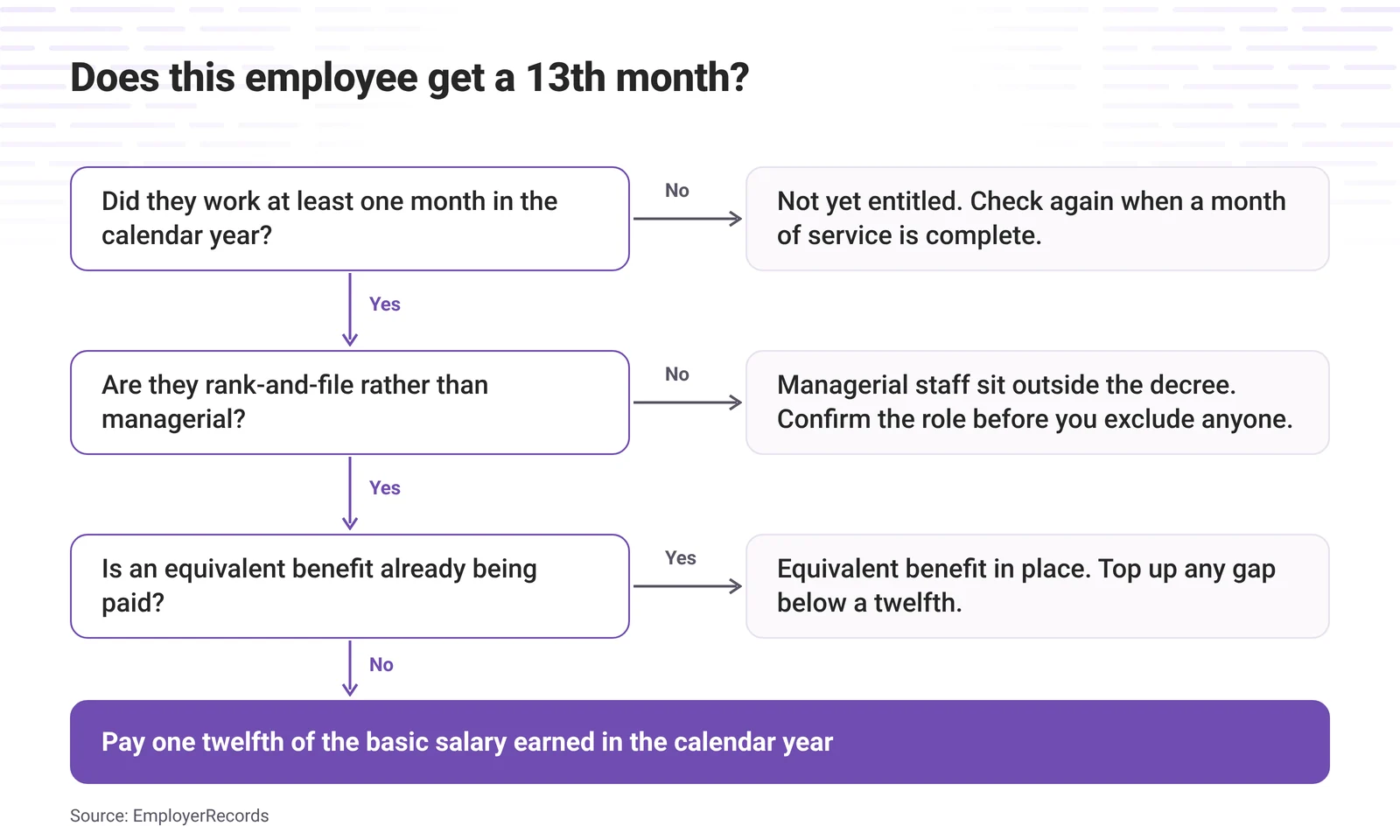
13th month pay in the Philippines is a mandatory year-end payment of one-twelfth of the basic salary a rank-and-file employee earned in the calendar year. Employers must pay it by 24 December to anyone with at least one month of service, and DOLE grants no exemptions or deferments.
- Deadline: pay by 24 December, report by 15 January
- Tax: first ₱90,000 of 13th month and bonuses is exempt
- Employer cost: 8.3% of basic payroll, accrued monthly
Presidential Decree 851 is the source, issued in December 1975 and now part of the Labor Code as Article 5.[1][2] DOLE restates it every November. This year’s restatement is Labor Advisory No. 21, signed on 6 November 2026, and it keeps the 24 December deadline.[3]
It isn’t a bonus. A bonus is something you can size, delay or skip, and this is none of those. DOLE calls it a labour standard it won’t compromise on.[4]
For a foreign employer the surprise is the size. Budget thirteen months of basic pay for each covered employee, not twelve. A ₱60,000 a month hire costs ₱780,000 in basic pay over a year once December lands. Start from the floor on our minimum wage page and the market levels on the average salary page, then add the twelfth.
Who has to get 13th month pay?
Every rank-and-file employee in the private sector is covered if they worked at least one month in the calendar year.[2] Job title, employment status and how you pay them don’t change that, and since the 1987 revised guidelines dropped the old ₱1,000 salary ceiling, neither does the pay level.[5]
Regular, probationary, casual, contractual, seasonal and project-based staff all qualify.[6] DOLE’s advisory also names the cases that most often trip up payroll teams, and a person on two payrolls is one of them: each employer owes its own share.[7]
Which employees don’t get a 13th month?
Managerial employees are outside the decree, and a DOLE undersecretary has said the same of supervisory staff.[8] Government employers are out too.[9] Almost everyone else is in.
Who falls outside the decree, and the catch in each case
| Group | Position | The catch |
|---|---|---|
| Managerial employees | Not entitled | The test is power over policy, hiring or discipline, not the job title.[10] |
| Government bodies | Not covered by the decree | Corporations that operate in practice as private subsidiaries of the government are the exception.[9] |
| Employers already paying an equivalent | Treated as complying | Only if it equals a twelfth of basic pay. Any shortfall must be paid.[9] |
| Household workers (kasambahay) | Entitled | The decree left household employers out, but Republic Act 10361 grants it after one month of service.[8] |
| Employers in financial difficulty | No exemption | The old rules allowed relief with prior authorisation, yet DOLE now says it grants no exemptions or deferments.[3] |
Our view. We wouldn’t leave a supervisor out on the strength of a title. The decree turns on managerial powers, and DOLE’s remark about supervisors is a spoken one. Have local counsel confirm any exclusion before the first December payroll runs.
How do you calculate 13th month pay?
Take the total basic salary earned in the calendar year and divide it by twelve.[2] Notice the word earned. That means what the employee actually received in basic pay, not what the contract would have paid across twelve full months.
DOLE’s advisory works four examples.[2]
Run it monthly. Setting aside one twelfth of basic payroll each month turns December into a transfer instead of a budget shock. It also keeps the figure honest when pay changes mid-year.
What counts as basic salary for the calculation?
Basic salary is what you pay for the work done and nothing layered on top. Cost-of-living allowances, profit-sharing and allowances that weren’t part of regular pay sit outside it under the implementing rules.[9] Practitioner guides also keep out overtime, holiday and rest day premiums, night differential and the cash value of unused leave.[6]
What goes into the base and what stays out
| Counts as basic salary | Doesn’t count |
|---|---|
| Basic wage actually paid, monthly or daily | Overtime pay |
| A fixed or guaranteed commission built into pay | Holiday and rest day premiums |
| Salary differentials paid during maternity leave | Night shift differential |
| Piece-rate earnings from output | Cash conversion of unused leave |
| Basic pay for days worked in a part year | Allowances, profit-sharing and discretionary bonuses |
Where payroll trips. Commission is where teams disagree with themselves. DOLE counts a fixed or guaranteed commission as basic pay and leaves a variable one out.[2] On our reading, a rep with a guaranteed ₱10,000 a month adds ₱10,000 to the monthly base, and a rep paid per closed deal adds nothing. We’d write that split into the contract.
How is it worked out for part-year staff?
Pro-rating is plain arithmetic: add up the basic pay earned in the calendar year and divide by twelve.[2] Starters, leavers, people on unpaid leave and anyone whose pay changed all fall out of that one sum.
In the last row, the promoted employee is paid only for the months spent in a covered role.[7]
Our calculation: five part-year cases
| Case | Basic pay earned | 13th month pay |
|---|---|---|
| Joins on 1 June at ₱45,000 a month, 7 months | ₱315,000 | ₱26,250 |
| Raise mid-year: ₱40,000 for 4 months, then ₱46,000 for 8 | ₱528,000 | ₱44,000 |
| ₱50,000 a month with ₱8,000 deducted for unpaid leave in one month | ₱592,000 | ₱49,333.33 |
| Resigns at the end of September at ₱33,000 a month, 9 months | ₱297,000 | ₱24,750 |
| ₱38,000 for 6 months as rank-and-file, then promoted to manager | ₱228,000 | ₱19,000 |
Leavers
When is 13th month pay due, and can you split it?
24 December is the last day to pay under the decree.[1] We found no rule that moves it for weekends, so treat the last working day before the 24th as your real deadline.
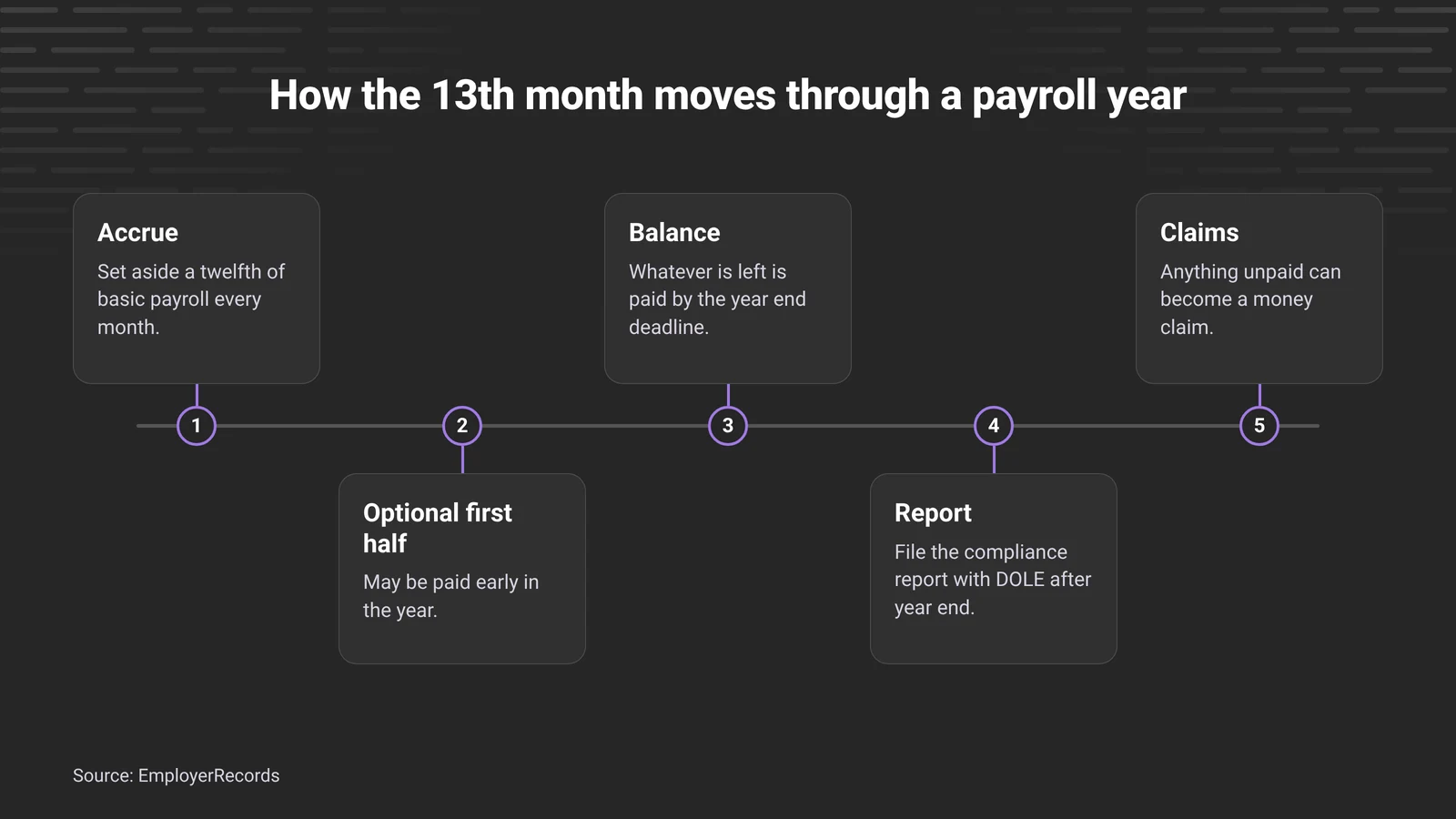
You may split it. Half can go before the regular opening of school and the rest by 24 December, and a recognised union can negotiate the schedule.[9] After year end, covered employers file a compliance report with DOLE by 15 January, and recent years have used its online portal.[9][11]
Is 13th month pay taxable in the Philippines?
Each year, the first ₱90,000 of 13th month pay and other benefits combined is exempt from income tax.[12] Christmas bonuses and productivity incentives share the same cap, so the exemption isn’t ₱90,000 for the 13th month alone.[13]
Anything above the cap is added to taxable compensation. It still applied in 2026 after the latest BIR rule changes.[14] Lawmakers have filed bills to raise it to ₱150,000, and we found no enacted increase as of 24 November 2026.[15]
Our calculation: how the ₱90,000 cap applies
| Basic salary a month | Other benefits | 13th month pay | Total benefits | Taxable excess |
|---|---|---|---|---|
| ₱30,000 | ₱0 | ₱30,000 | ₱30,000 | ₱0 |
| ₱60,000 | ₱0 | ₱60,000 | ₱60,000 | ₱0 |
| ₱60,000 | ₱45,000 | ₱60,000 | ₱105,000 | ₱15,000 |
| ₱120,000 | ₱20,000 | ₱120,000 | ₱140,000 | ₱50,000 |
Tell staff early. A bonus-heavy December pushes people over a cap they forgot was shared. That complaint lands in your HR inbox, not in payroll, so explain the limit before the money moves.
Do SSS, PhilHealth and Pag-IBIG apply to it?
The implementing rules say 13th month pay isn’t counted as regular wages for overtime, premium pay, social security or Medicare contributions.[9] Read plainly, the December payment doesn’t raise the salary credit your SSS contribution rests on.
We found no separate ruling on Pag-IBIG. Its contribution is a flat amount in our Philippines hiring guide, so there’s nothing to recompute either way.
What does 13th month pay cost the employer?
Plan on 8.3% of basic payroll, a twelfth, accrued every month. Once salary passes about ₱42,400 a month it’s the largest employer add-on, because SSS stops growing at its salary credit ceiling while the 13th month keeps scaling with pay.
On a ₱60,000 hire the accrual is ₱5,000 a month, more than the ₱3,530 SSS share.
Employer add-ons at three salary points, from our Philippines hiring guide
| Monthly salary | 13th month accrual | SSS and EC | All add-ons | Share of salary |
|---|---|---|---|---|
| ₱25,000 | ₱2,083 | ₱2,530 | ₱5,438 | 21.8% |
| ₱60,000 | ₱5,000 | ₱3,530 | ₱10,230 | 17.1% |
| ₱180,000 | ₱15,000 | ₱3,530 | ₱21,230 | 11.8% |
₱60,000 salary plus ₱10,230 in statutory add-ons, a twelfth of it being the 13th month.
17.1% on top of the salaryOne basis, stated twice. Our hub’s percentages include the accrual. Strip it out and the add-ons on ₱60,000 are ₱5,230, or 8.7%. Both figures are right, so check which one a quote is using before you compare providers.
Can a Christmas bonus count as the 13th month?
A Christmas bonus counts toward the 13th month only if the employer already pays at least a twelfth of basic salary in that form, and any gap must be topped up.[9] Mid-year bonuses, profit shares and other cash bonuses are tested the same way. Cash and stock dividends, cost-of-living allowances, regular allowances and non-cash benefits don’t count.[9]
Existing benefits are protected as well. Employers also can’t cut supplements or favourable practices that staff already enjoyed.[9]
Label it. If you want a year-end bonus to double as the 13th month, say so in writing and show a separate 13th month line on the December payslip. A fuzzy label turns a clean payment into a dispute.
Who pays it when you hire through an EOR?
A foreign company owes the 13th month through whichever entity employs the person in the Philippines. With an EOR that provider is the legal employer, so it calculates the pay, withholds the tax and files the DOLE report, and you carry the cost.[6]
Ask whether it invoices a monthly accrual or one lump sum in December. One keeps your monthly cost steady, the other doesn’t. Compare ranked options on our page for EOR providers in the Philippines, and run your own numbers in the EOR cost calculator.
New to the model? Start with what an employer of record is and the work permits guide if the hire isn’t a Philippine national.
13th month pay calculator for the Philippines
Enter basic salary, the months worked this year and any other bonuses paid. Defaults match the ₱60,000 example in the tables above.
Philippines 13th month pay, 2026 rules
Estimate only. It assumes steady basic pay, no unpaid leave and the full ₱90,000 shared cap, and it leaves out withholding and employer contributions. For fees and year-one costs use the full Philippines cost calculator.
What happens if you pay late or skip it?
An employer that misses 24 December owes a debt, and staff can file money claims at any DOLE regional or field office.[4] DOLE offices monitor compliance under Department Order 238 of 2023, and DOLE has processed compliance orders against firms that didn't pay.[2][16]
We found no fixed peso fine in the decree or its implementing rules. The exposure is the unpaid amount plus the cost of a claim, because the rules treat non-payment as a money claim.[9]
Tight cash is not a defence. Instalments are the only flexibility the rules offer, and the first half has to leave before the school year opens. A December request for extra time has no basis.
Where do employers go wrong most often?
These are the four mistakes we'd check before any December payroll file goes out.
What we'd do first. Pull a list of everyone paid in the calendar year, including leavers, and match it line by line to the base. Names missing from a year-end headcount are usually the ones that cause the claim. The rest of the pay package is covered in the guides on employer costs, termination and separation pay and public holidays and leave.
Questions about 13th month pay in the Philippines
Short answers to what employers ask most about the 13th month pay, checked against DOLE Labor Advisory No. 21 and the PD 851 rules on 24 November 2026.
Do small businesses have to pay it?
Yes. Size doesn't matter. DOLE says it grants no exemptions or deferments, and the old relief for distressed employers needed prior authorisation from the Labour Secretary.
Does a probationary employee get a 13th month?
Yes, once they've worked a month in the calendar year. It's the proportion of basic pay they earned. Probation doesn't shrink it.
What if someone resigns in March?
They're owed a proportionate share for the months worked. An employee who earned ₱96,000 in basic pay before leaving is owed ₱8,000. We'd pay it in the final pay run.
Is it calculated on gross salary?
No. It's one-twelfth of basic salary earned. Overtime, premiums, night differential, allowances and discretionary bonuses stay out of the base.
Can I pay it in two instalments?
Yes. Half goes before the regular opening of school and the rest by 24 December, and a recognised union can negotiate a different schedule. Paying the whole amount in December is also fine.
Does an overseas company hiring through an EOR still have to pay it?
Yes. The EOR is the legal employer and pays it, then passes the cost to you.
Will the ₱90,000 tax-free limit go up?
Bills to raise it to ₱150,000 have been filed, but we found no enacted increase as of 24 November 2026. Until a law passes, the first ₱90,000 of 13th month pay and other benefits combined stays exempt. Anything above is taxable.
References and sources
Every figure on this page comes from the sources below. Numbers in square brackets in the text link to the matching entry. Official sources are used wherever they exist, and our own calculations are labelled. All sources were checked on 24 November 2026.
- ↑Presidential Decree No. 851, s. 1975: Requiring All Employers to Pay Their Employees a 13th-Month Pay. Senate of the Philippines, 16 December 1975. ldr.senate.gov.ph. Retrieved 24 November 2026. Law
- ↑Philippines orders 13th-month pay by Dec 24; resigned and terminated employees also eligible. People Matters Global, 2026. sea.peoplemattersglobal.com. Retrieved 24 November 2026. News
- ↑DoLE issues 13th-month pay rules. Daily Tribune, 10 November 2026. tribune.net.ph. Retrieved 24 November 2026. News
- ↑Employers urged to give 13th month pay on time. SunStar Pampanga, 9 December 2018. pressreader.com. Retrieved 24 November 2026. News
- ↑Revised Guidelines on the Implementation of the 13th Month Pay Law. Department of Labor and Employment, 16 November 1987. digest.ph. Retrieved 24 November 2026. Law
- ↑13th month pay in the Philippines: An employer's calculation and compliance guide. Employment Hero. employmenthero.com. Retrieved 24 November 2026. Guide
- ↑FAQ: 13th Month Pay. laborlaw.ph. laborlaw.ph. Retrieved 24 November 2026. Guide
- ↑DOLE: 'Kasambahays' entitled to 13th month pay. ABS-CBN News, 16 November 2023. abs-cbn.com. Retrieved 24 November 2026. News
- ↑Rules and Regulations Implementing Presidential Decree No. 851. Department of Labor and Employment, 1975. chanrobles.com. Retrieved 24 November 2026. Law
- ↑Entitlement and Computation of 13th Month Pay in the Philippines. Respicio and Co.. respicio.ph. Retrieved 24 November 2026. Guide
- ↑13th-month pay submission deadline looms, DOLE reminds private firms. Manila Bulletin, 2 January 2026. mb.com.ph. Retrieved 24 November 2026. News
- ↑President Duterte signs TRAIN Act into law. Presidential Communications Office, 2017. mirror.pco.gov.ph. Retrieved 24 November 2026. Official
- ↑Tax Implications for 13th Month Pay and Christmas Bonuses in the Philippines. ASEAN Briefing. aseanbriefing.com. Retrieved 24 November 2026. Guide
- ↑Flash Alert 2026-014: BIR Revenue Regulation No. 29-2025 on de minimis benefits. KPMG, 2026. kpmg.com. Retrieved 24 November 2026. Guide
- ↑Makabayan bloc pushes P150,000 tax-free cap on 13th month pay and bonuses. DZRH News, 9 February 2026. dzrh.com.ph. Retrieved 24 November 2026. News
- ↑1,300 firms fail to give workers' 13th-month pay. The Philippine Star, 22 October 2021. philstar.com. Retrieved 24 November 2026. News
About the author

Emma Whitmore is an EOR and Global Employment Content Writer at EmployerRecords, where she researches and writes practical resources on Employer of Record (EOR) services, international hiring, global payroll, employment compliance, and workforce expansion across international markets. With more than 15 years of experience in B2B content and editorial research, Emma specializes in turning complex employment regulations into clear, actionable guidance for HR leaders, founders, and globally distributed teams. Her work focuses on helping businesses understand country-specific hiring requirements, compare global employment providers, and navigate compliance with confidence.
View all articles by EmmaMinimum wage and salary guides for other countries
Compare the Philippines with the pay floors and salary levels employers work with in other markets.
 PhilippinesAverage salaryAverage Salary in the Philippines (2026): Pay by Role and RegionOfficial PSA wage data by industry, role and region, what each figure measures, take-home pay, employer cost and how to...Read the guidePhilippinesEmployer costsEmployer Costs in the Philippines (2026): Contributions Cap at ₱6,230What SSS, PhilHealth and Pag-IBIG cost an employer at each salary, and how the 13th month changes the total.Read the guidePhilippinesMinimum wageMinimum Wage in the Philippines (2026): Rates by Region and CostEvery regional daily rate in force, the NCR-27 injunction, daily to monthly conversion and what an employer pays on top...Read the guidePhilippinesPublic Holidays and LeavePublic Holidays and Leave in the Philippines (2026): Pay Rules and Statutory LeaveHoliday pay by day type, the 2026 and 2027 calendars and the statutory leave a Philippine employer has to give.Read the guidePhilippinesTermination and Separation PayTermination and Separation Pay in the Philippines (2026): Up to One Month per YearWhich grounds let you end a Philippine hire, the notices each needs, how separation pay is worked out and what...Read the guide
 Czech RepublicAverage salaryAverage Salary in the Czech Republic (2026): CZK 50,650 a MonthAverage and median pay, regional gaps, gross to net and what employers add on top, from the Czech Statistical Office.Read the guide
Hiring in the Philippines?
The hiring guide covers employer costs, SSS and PhilHealth, termination rules and your EOR options in one place.