
Minimum Wage in Spain (2026): €1,221 a Month in 14 Payments
The rate, who gets which version of it, what a minimum wage hire costs once extra payments and social security are added, and what changes in 2027.
What is the minimum wage in Spain in 2026?
Spain’s minimum wage (SMI) for 2026 is €1,221 a month in 14 payments, or €17,094 a year, for a full-time employee. It’s gross, covers every sector, age and region, and has been owed since 1 January 2026 under Royal Decree 126/2026. Collective agreements often pay more.
- Next change: €1,286 a month from 1 January 2027, approved
- Range: €40.70 a day; €57.82 a day on contracts up to 120 days
- Employer cost: about 54.2% on top of one monthly payment
Royal Decree 126/2026 set it. It appeared in the BOE on 19 February 2026, took effect the next day, and pay is due back to 1 January.[1] The government’s own explainer gives the same figures and puts the rise at 3.1% on 2025.[2]
Read the number carefully. €1,221 is the monthly amount in a year of 14 payments, so the annual floor is €17,094. Paid in 12 instalments instead, the same pay is €1,424.50 a month (our calculation: €17,094 divided by 12).
One national figure covers farming, industry and services. There’s no regional rate and no lower rate for young workers.[1] And it’s gross: the employee’s social security comes out of it.
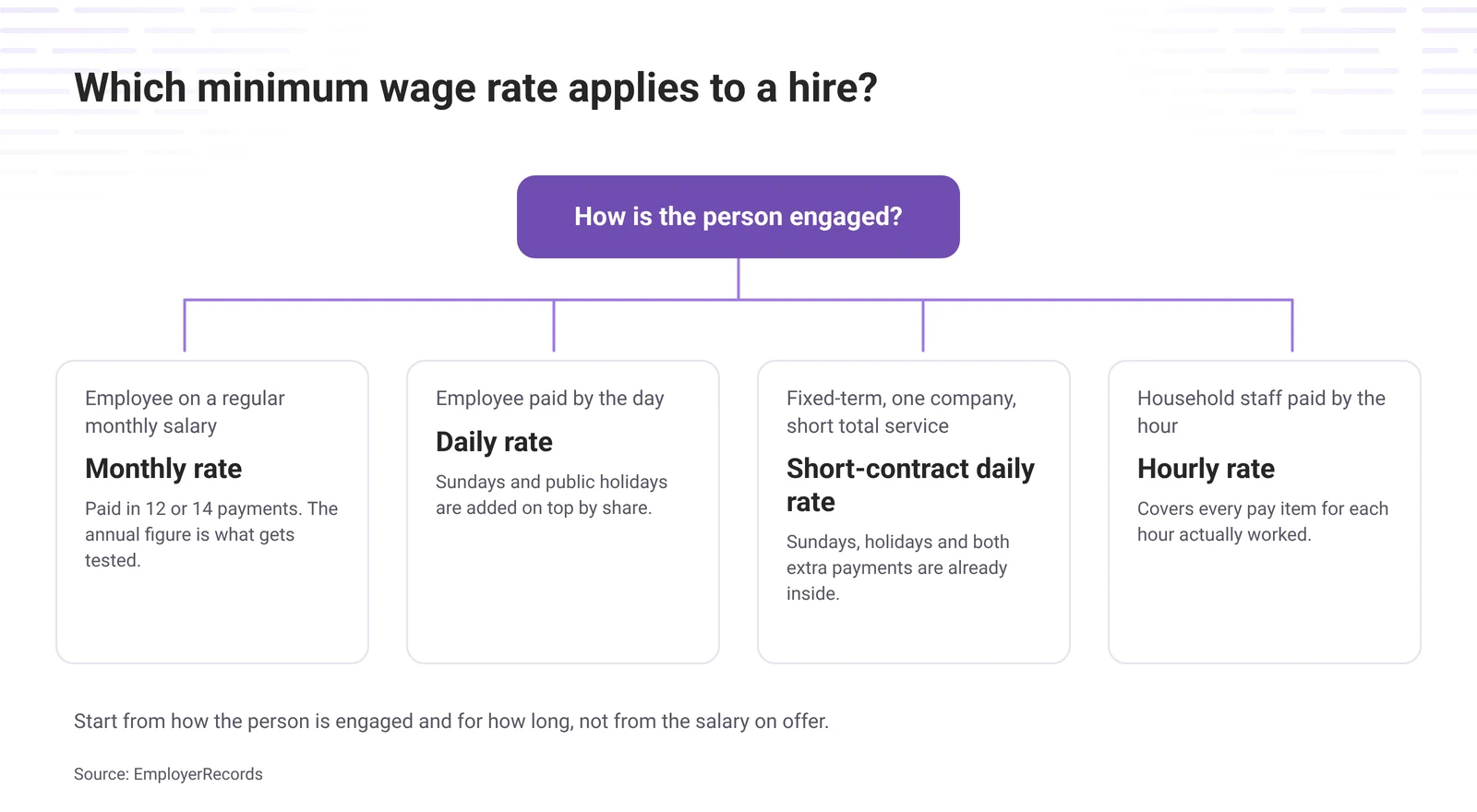
Which minimum wage rate applies to your hire?
Three rates cover almost every hire: the monthly rate for ordinary employees, a daily rate for staff paid by the day, and a higher daily rate for contracts of 120 days or less. Household workers paid by the hour have a fourth, set separately.
The board below sorts the usual situations. Find the contract type first, then read the amount across.
Minimum wage rates in Spain, 2026[1]
| Rate | Amount | What it covers |
|---|---|---|
| Monthly, 14 payments Current | €1,221 | Gross, full-time, paid by the month |
| Annual | €17,094 | The comparison figure for the yearly test |
| Daily | €40.70 | Staff paid by the day; excludes the share of Sundays and holidays |
| Daily, contracts up to 120 days | €57.82 | Includes Sundays, holidays and both extra payments |
| Household staff, by the hour | €9.55 | External regime; covers every pay item |
| Monthly, 12 payments (our calculation) | €1,424.50 | The annual figure spread over 12 months |
Is the minimum wage paid in 12 or 14 payments?
Either, and the annual floor doesn’t change. Pay is compared over a year, and the annual comparison figure can never fall below €17,094.[1]
Take two cleaners on the same contract. One gets 14 payments of €1,221. Her colleague gets 12 payments of €1,424.50. They earn exactly the same, but the second payslip looks about 17% bigger, and a finance team that compares payslips instead of annual totals will decide the first one is underpaid.
Many collective agreements require two extra payments, and some let you prorate them over the year. How that works is covered in our Spain hiring guide.
What we’d do. Put the number of payments and the annual gross figure in the offer letter, in the same sentence. A candidate quoted €1,221 by one recruiter and €1,424.50 by another will assume one of them is wrong.
How has Spain’s minimum wage changed since 2016?
From €655.20 in 2016 to €1,221 in 2026, the monthly rate rose 86.4% (our calculation from the official tables).[3][1] Counted from 2018, the government’s figure is 66%.[2]
One year did most of the work. In 2019 it jumped 22.3%, from €735.90 to €900.[3] Later rises were smaller: 5.6% in 2020, 8.0% in 2023, 5.0% in 2024 and 4.4% in 2025 (our calculations).[3] The 2025 amount of €1,184 was set by Royal Decree 87/2025.[4]
Timing matters for back pay. 2026 was approved in February, but pay is owed from 1 January, so employers who paid the old rate in January and February owed the difference.[1]
One bar per year, in force at year end
Source: Ministerio de Trabajo y Economía Social data (2016 to 2024), Royal Decrees 87/2025 and 126/2026. The 2027 bar is the amount approved by the Council of Ministers on 17 November 2026, not yet published in the BOE.
Who decides the minimum wage, and how?
Each year the government sets it by royal decree, after consulting the most representative unions and employer associations.[5] The Workers’ Statute tells it to weigh consumer prices, average national productivity, labour’s share of national income and the general economic situation.[5] A mid-year review applies if the price forecast is missed.[5]
In practice an advisory commission reports first. Behind the 2026 decree sits a commission report of 12 December 2025, and the text states the aim of reaching 60% of the average wage, citing the European Social Charter.[1] Our Spain average salary guide shows where that average sits today.
Consultation is required. Agreement isn’t.
Our read. That 60% target ties the minimum wage to average pay, so it tends to move with it. Budget for a rise every year rather than a freeze, and read the November commission report as an early signal of the next figure.
What will the minimum wage be in 2027?
On 17 November 2026 the Council of Ministers approved €1,286 a month, 5.3% above 2026, with effect from 1 January 2027.[6] That adds €65 a month and €910 a year.[6]
As of 19 November the pay decree isn’t in the BOE. The 18 November issue carried a decree-law on income tax for 2027 minimum wage earners, but not the decree that fixes the amount.[7] The daily rate for short contracts and the hourly rate for household staff will sit in that text, and we haven’t seen either.
It got there fast. On 4 November the expert commission recommended 4.9%, or €1,281.[8] The Ministry’s draft, reported the next day, went to 5.3%.[9] CCOO and UGT had asked for at least 7%.[8]
What does a minimum wage hire cost an employer?
A full-time hire at the minimum wage costs about €1,883 a month once the two extra payments and employer social security are counted. That’s 54.2% on top of one monthly payment (our calculation).
Contributions are charged on a base that includes the pro rata share of the extra payments, so €1,221 becomes €1,424.50 for contribution purposes.[10] The legal floor for that base is €1,424.40 for contribution groups 4 to 7, ten cents lower, so a full-time minimum wage hire is never pushed to a higher base.[10] Groups 1 to 3 have higher floors, from €1,435.20 to €1,989.30, which matters if a graduate or technician is on a minimum wage contract.[10]
Employer rates for 2026 are 23.60% for common contingencies, 0.75% for the intergenerational equity mechanism (MEI), 5.50% for unemployment on open-ended contracts, 0.20% for FOGASA and 0.60% for training.[10]
€1,221 wage plus €662 in extra payment accrual and employer contributions.
54.2% on top of the wageAssumption. We used the 1.5% accident rate for office work, the one our Spain hiring guide uses. Hospitality, cleaning, farming and construction pay other rates set by activity code, and we haven’t published those because we haven’t read the full tariff table. Check yours before you budget.
Two bases, one cost. On annual pay the employer contributions are 32.15%, the figure in our hiring guide. Our 54.2% measures the whole add-on against a single monthly payment, because 14 payments are carried by 12 months of cost, and it includes the extra payments, which are pay and not tax.
A fixed-term contract lifts the employer’s unemployment rate to 6.70%, and a contract under 30 days adds €33.62 when it ends.[10] For a wider price check, the EOR cost calculator covers provider fees too.
Our Spain employer costs guide has the full rate table, the contribution base limits and the sick pay rules behind that cost.
Check a salary against the minimum wage
Enter the pay you plan to offer and the tool tests the annual total against the floor, then prices the hire. It uses the rates from the table above, so the default matches the €1,883 shown there.
Spain minimum wage check and hire cost, 2026 rules
Our estimate. It assumes a full-time contract with the 2026 employer rates from the cost table, contributions on pay spread over 12 months, and a total that includes the monthly accrual of both extra payments. It leaves out the €33.62 charge on contracts under 30 days, part-time minimum bases and any EOR fee. Annual cost is twelve times the monthly total. See the full Spain cost calculator for fees, currency and year-one costs.
Can bonuses and supplements count towards the minimum wage?
Not in our reading. The decree treats the minimum as the base and adds supplements from a collective agreement or contract on top of it (article 2).[1] The annual comparison figure is the minimum plus those supplements, and it can’t fall below €17,094 (article 3).[1]
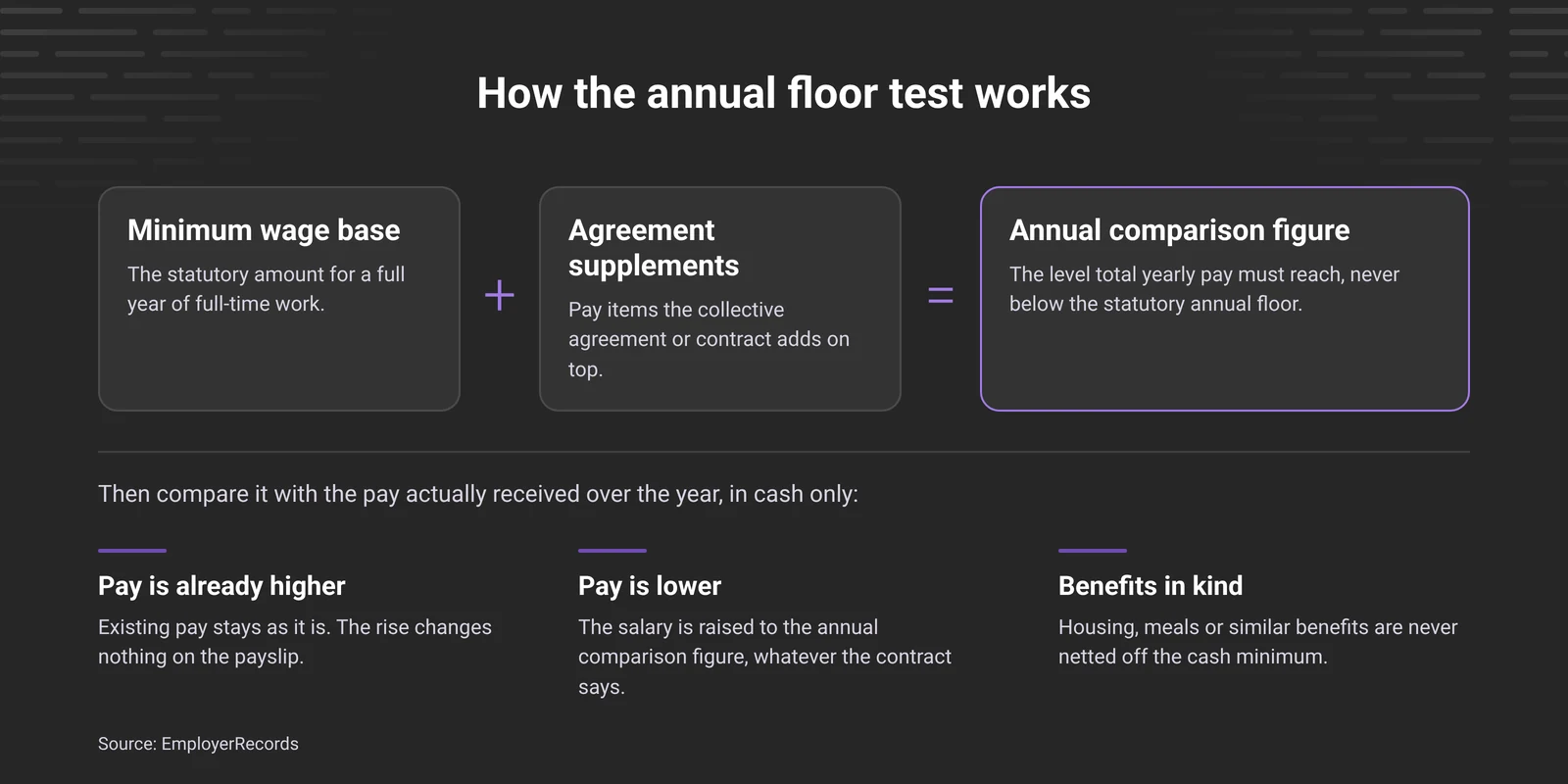
Two rules sit beside that. Only cash counts, so a housing or meal benefit can’t be netted off the minimum.[1] And existing pay stays as it is if the total annual pay is already higher than the comparison figure.[1]
Where it isn’t, the lower salary has to be raised to the annual total.[1] Article 3 also lets the employer offset the rise against pay already received on an annual, full-time basis under the law, an agreement or an individual contract in force.[1] What that offset covers in your sector is the point to confirm with a local adviser.
Our view. This is where underpayment hides, not in the headline rate. A low base with large supplements can look fine in total and still fail the test. Ask your Spanish adviser before you absorb any voluntary bonus into a minimum wage rise.
How does the minimum wage apply to part-time and short contracts?
Part-time staff get the minimum wage pro rata: when the working time is below the legal full day, pay is reduced in proportion.[1] At half time that’s €610.50 a month in 14 payments, or €8,547 a year (our calculation).
Fixed-term staff who work 120 days or less for one company move to the €57.82 daily rate, which already includes Sundays, holidays and both extra payments.[1] The test is service to the same company, so in our reading a string of short contracts shouldn’t keep someone on that rate once the total passes 120 days.
Minimum wage by working time, 14 payments (our calculation)
| Working time | Monthly | Annual |
|---|---|---|
| 100% | €1,221 | €17,094 |
| 75% | €915.75 | €12,820.50 |
| 50% | €610.50 | €8,547 |
| 25% | €305.25 | €4,273.50 |
Training contracts follow the agreement. For the alternance contract, where the agreement says nothing, pay can’t fall below 60% of the agreement salary in the first year and 75% in the second, and never below the minimum wage in proportion to the time worked.[5] Check which contract you’re using before you price it.
Do minimum wage earners pay tax and social security?
They pay social security but no income tax. People on the minimum wage are exempt from personal income tax (IRPF), and the government has kept it that way for 2027.[2][7]
Employees pay 6.50% of the contribution base: 4.70% common contingencies, 0.15% MEI, 1.55% unemployment and 0.10% training.[10] It applies to the €1,424.50 base, not to €1,221, so the deduction is €92.59 a month.
Our estimate assumes no income tax withholding. Net pay is the annual €17,094 less twelve deductions of €92.59, which is about €15,983. Quote take-home without the number of payments and a candidate will compare €1,332 with a payslip of about €1,128 and think one is wrong.
Does a collective agreement override the national minimum?
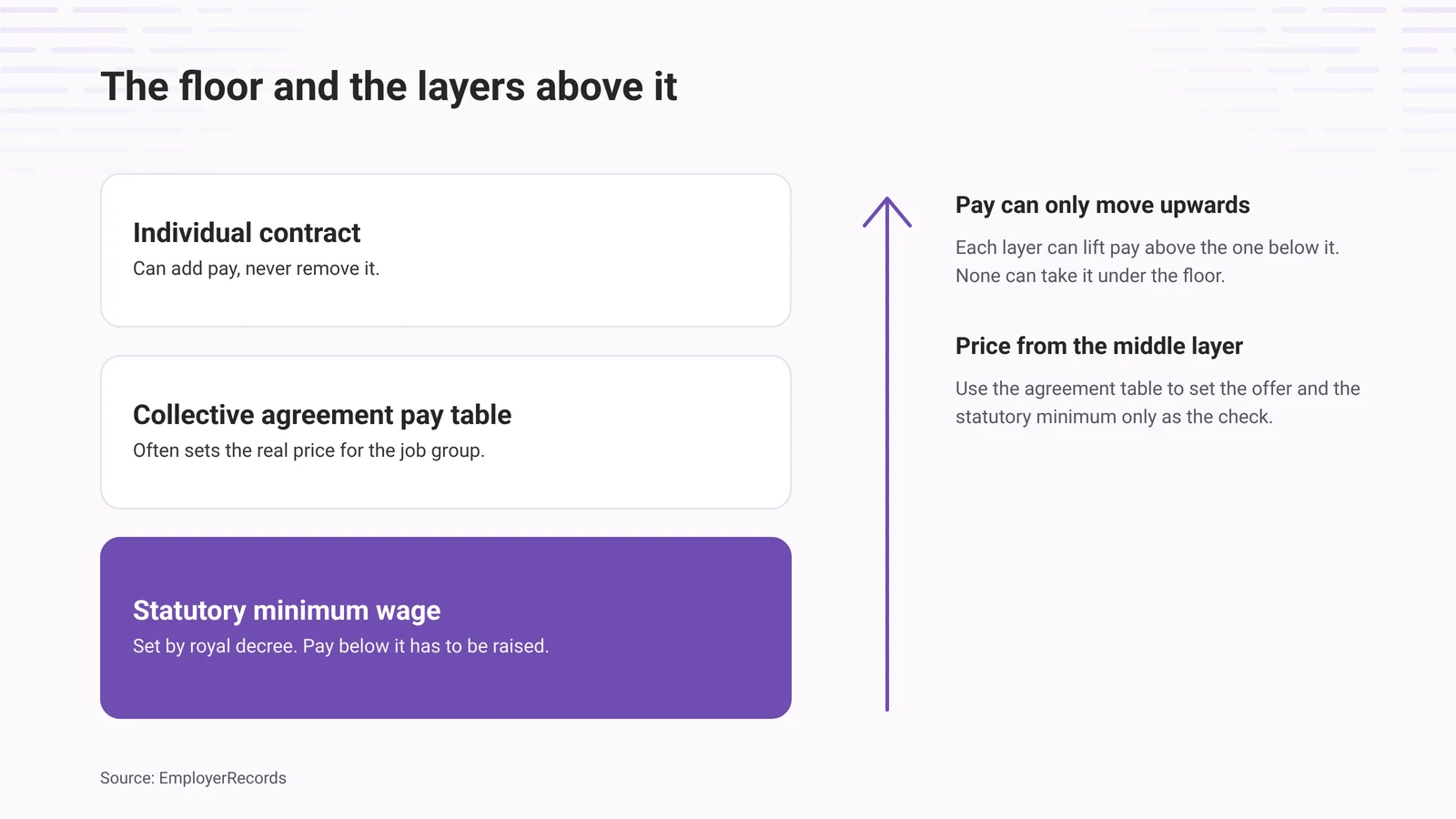
It can only sit above it. If an agreement’s pay level falls below the annual minimum wage, the minimum wins and the pay level has to be raised to match.[1]
What employers actually pay usually comes from the agreement’s table for the job group, and it’s often higher than €1,221.
Which agreement binds you depends on the activity and sometimes the province, and it applies whether or not you’ve heard of it. Our Spain hiring guide explains how to identify it.
Where the agreement and the decree meet is the absorption rule from the section above. That’s the part to check with a local adviser.
What we’d do. Price the offer from the agreement’s table for the job group and use the minimum wage only as the check. An offer set at the national minimum for a role the agreement prices higher is the one that comes back as a claim.
What happens if you pay below the minimum wage?
Employees can claim the difference, and a labour inspection becomes a real risk. A claim for pay must be brought within one year of the day it could first be made.[5]
Spain’s sanctions law lists non-payment, and repeated delay in paying, the salary owed as a very serious infringement.[11] Very serious labour fines run from €7,501 to €225,018, in three grades.[11] The law doesn’t mention the minimum wage by name, so in our reading that bracket is the exposure, not the likely outcome of a small shortfall.
What we’d do. If you find a shortfall, pay the arrears from 1 January with the next payroll and keep the working. 2026 added €37 a month on 2025, so a two-month gap is €74 before the extra payments’ share.
Which other rules and contracts use the minimum wage?
Beyond payroll, the figure is a reference point, and the rules differ by context.
Does a foreign or EOR hire get a different minimum?
No. One minimum applies to every employee in the country, with no distinction by sex or age.[1] An employer of record is the legal employer in Spain, so it pays the same floor and passes the cost on.
What changes for foreign hires is the permit salary threshold, not the floor. Our Spain guide starts at €41,356.36 a year, far above €17,094. Our guides on EOR visas and work permits and how an employer of record works cover the rest.
Near the floor the fee model matters most, because a flat monthly fee is a bigger share of a small payroll.
Worth checking first. For roles priced near the floor, ask each provider for a percentage-of-salary quote as well as the flat fee, then compare the totals at Spain EOR providers.
How does Spain’s minimum wage compare with the EU?
Spain sits in the middle group of EU countries, well below France and Germany and above Portugal. Eurostat’s January 2026 release shows Spain at €1,381, but that’s the 2025 level, because the 2026 rise wasn’t in force when the data was collected.[12]
Eurostat adjusts 14-payment countries to a monthly equivalent.[12] Applying the same method to €1,221 in 14 payments gives €1,424.50 a month (our calculation), which still sits between Portugal and France.
Monthly minimum wage in euros, 1 January 2026, Eurostat[12]
| Country | Euros a month |
|---|---|
| Portugal | 1,073 |
| Spain (2025 level) | 1,381 |
| France | 1,823 |
| Netherlands | 2,295 |
| Germany | 2,343 |
Compare the cost percentages with care. Spain’s 54.2% includes two extra payments, which are pay and not tax. On its own, the contribution rate is 32.15%. For other markets, see our guides to Brazil and the United Kingdom.
Questions about the minimum wage in Spain
Short answers to what employers ask most about Spain’s minimum wage, checked against the BOE and the government’s published figures on 19 November 2026.
Is Spain’s minimum wage gross or net?
Gross. €1,221 is before the employee’s social security, and no income tax applies at this level.
Should I pay the minimum wage in 12 or 14 payments?
Either works as long as the annual total reaches €17,094. Check the collective agreement first, because it often fixes the number of extra payments, and write the schedule into the contract.
How much is the minimum wage per hour in Spain?
For household workers paid by the hour it is €9.55. No hourly rate exists for other staff: full-time pay is monthly or daily, and an hourly equivalent depends on the working hours in the agreement.
Does the minimum wage differ by region, age or industry?
No. One figure applies to every activity, sex and age. Only contracts of up to 120 days and hourly household work have their own rates.
What will the minimum wage be in 2027?
€1,286 a month in 14 payments, or €18,004 a year, approved by the Council of Ministers on 17 November 2026 and effective from 1 January 2027. We couldn’t find the decree in the BOE when we checked.
Do minimum wage workers pay income tax?
No. It’s exempt from income tax, and the government has kept that for 2027. Employees still pay 6.50% social security.
How much does a minimum wage employee cost in total?
About €1,883 a month, or roughly €22,600 a year, on an open-ended full-time contract with the office accident rate. A fixed-term contract, a different activity or an EOR fee all change it.
References and sources
Every figure on this page comes from the sources below. Numbers in square brackets in the text link to the matching entry. Official statistics are used wherever they exist, and our own calculations are labelled as estimates. All sources were checked on 19 November 2026.
- ↑Real Decreto 126/2026, de 18 de febrero, por el que se fija el salario mínimo interprofesional para 2026. Boletín Oficial del Estado, 19 February 2026. boe.es. Retrieved 19 November 2026. Law
- ↑SMI 2026: How much is the Minimum Wage increasing by and who benefits?. La Moncloa. lamoncloa.gob.es. Retrieved 19 November 2026. Official
- ↑Salario mínimo interprofesional (Anuario de Estadística 2025, table 10.1.5). Ministerio de Agricultura, Pesca y Alimentación, with data from the Ministerio de Trabajo y Economía Social. mapa.gob.es. Retrieved 19 November 2026. Data
- ↑Real Decreto 87/2025, de 11 de febrero, por el que se fija el salario mínimo interprofesional para 2025. Ministerio de Trabajo y Economía Social (BOE of 12 February 2025). mites.gob.es. Retrieved 19 November 2026. Law
- ↑Real Decreto Legislativo 2/2015, de 23 de octubre, por el que se aprueba el texto refundido de la Ley del Estatuto de los Trabajadores. Boletín Oficial del Estado, consolidated text. boe.es. Retrieved 19 November 2026. Law
- ↑El Gobierno eleva el Salario Mínimo Interprofesional hasta los 1.286 euros mensuales. La Moncloa, Consejo de Ministros, 17 November 2026. lamoncloa.gob.es. Retrieved 19 November 2026. Official
- ↑Sumario del BOE del 18 de noviembre de 2026, núm. 287. Boletín Oficial del Estado, 18 November 2026. boe.es. Retrieved 19 November 2026. Law
- ↑La Comisión de Expertos recomienda a Trabajo subir el SMI un 4,9% en 2027, hasta 1.281 euros al mes. El Derecho (Europa Press), 4 November 2026. elderecho.com. Retrieved 19 November 2026. News
- ↑El Ministerio de Trabajo plantea subir un 5,3% el salario mínimo en 2027, hasta los 1.286 euros al mes. Diari de Tarragona, 5 November 2026. diaridetarragona.com. Retrieved 19 November 2026. News
- ↑Orden PJC/297/2026, de 30 de marzo, por la que se desarrollan las normas legales de cotización a la Seguridad Social, desempleo, protección por cese de actividad, Fondo de Garantía Salarial y formación profesional para el ejercicio 2026. Boletín Oficial del Estado, 31 March 2026. boe.es. Retrieved 19 November 2026. Law
- ↑Real Decreto Legislativo 5/2000, de 4 de agosto, por el que se aprueba el texto refundido de la Ley sobre Infracciones y Sanciones en el Orden Social. Boletín Oficial del Estado, consolidated text. boe.es. Retrieved 19 November 2026. Law
- ↑Now available: first 2026 data on minimum wages. European Commission, Eurostat release, 30 January 2026. ec.europa.eu. Retrieved 19 November 2026. Data
About the author

Dhiraj Das is Co-Founder of EmployerRecords.com, where he leads content, research and partnerships. He has worked in content and online publishing for more than 15 years, and before EmployerRecords he founded a number of successful content brands. For the past six years he has specialised in HR technology, Employer of Record services and global hiring. His background in digital marketing and search shapes how EmployerRecords researches and presents its provider reviews, country hiring guides and cost data, so employers can compare their options and hire abroad with clear, checked information.
View all articles by DhirajMinimum wage and salary guides for other countries
Compare Spain with the pay floors and salary levels employers work with in other markets.
 SpainAnnual Leave and Extra PayAnnual Leave and Extra Pay in Spain (2026): 30 Days and Two Extra PaymentsStatutory leave, extra payments, public holidays and the exit pay they create, with a calculator.Read the guideSpainAverage salaryAverage Salary in Spain: €29,540 a Year (INE 2024 Data)Mean, median, sectors, regions and what an average-paid hire costs an employerRead the guideSpainEmployer costsEmployer Costs in Spain (2026): 30.65% Plus the Accident PremiumSocial security rates, contribution base limits, the solidarity charge, sick pay and what a real salary costsRead the guideSpainContracts and probationEmployment Contracts and Probation in Spain (2026): Contract Types, Limits and What to StateContract types, temporary limits, probation caps and what to stateRead the guideSpainTermination and SeveranceTermination and Severance in Spain (2026): 20 and 33 Days a YearDismissal routes, indemnities, notice and caps, with a worked case and a severance calculator.Read the guide
 Czech RepublicMinimum wageMinimum Wage in the Czech Republic (2026): CZK 22,400 a MonthThe monthly and hourly minimum wage for 2026, the increase for 2027, overtime and what employers add on top.Read the guide
Hiring in Spain?
Our Spain hiring guide covers employer costs, contracts, collective agreements and how an employer of record compares with your own entity.