
UK Minimum Wage 2026 and 2027: Rates, Apprentices and Employer Penalties
The hourly minimum wage for every age band and for apprentices, what counts toward pay, the accommodation offset and the penalties HMRC applies when an employer underpays.
UK minimum wage at a glance
From 1 April 2026 the National Living Wage for workers aged 21 and over is £12.71 an hour. It rises to £13.21 from 1 April 2027, a 3.9% increase the government has accepted in full. Younger workers and apprentices have lower rates, and employers face penalties of up to 200% of arrears for underpaying.
- 21 and over: £12.71 from April 2026, £13.21 from April 2027
- 18 to 20: £10.85 from April 2026, £11.27 from April 2027
- Under 18 and apprentice: £8.00 from April 2026, £8.31 from April 2027
The National Minimum Wage is a legal floor on hourly pay in the UK. The rate depends on age and on whether the worker is an apprentice, and it is reviewed every April.[1] A worker must be over school leaving age to qualify, and aged 21 or over to receive the National Living Wage, the highest rate.[1]
All figures on this page are gross hourly pay before tax. Employer costs such as National Insurance and pension contributions sit on top of the minimum. They are covered in our UK employer costs guide.
UK minimum wage rates for 2026 and 2027
GOV.UK publishes the rates for April 2026 and April 2027 side by side.[1] The government accepted the Low Pay Commission’s recommendations for 2027 in full.[2]
UK National Minimum Wage hourly rates by worker group
| Worker group | From April 2025 | From April 2026 | From April 2027 |
|---|---|---|---|
| 21 and over (National Living Wage) | £12.21 | £12.71 In force | £13.21 |
| 18 to 20 | £10.00 | £10.85 | £11.27 |
| Under 18 | £7.55 | £8.00 | £8.31 |
| Apprentice | £7.55 | £8.00 | £8.31 |
The April 2026 uprating added 50p (4.1%) to the National Living Wage. The 18 to 20 rate rose 85p (8.5%), and the under 18 and apprentice rates rose 45p (6.0%).[3] For April 2027 GOV.UK lists a 3.9% rise to £13.21, with the 18 to 20 rate up 42p to £11.27.[4] The under 18 and apprentice rates move from £8.00 to £8.31, which is 31p by our arithmetic. The April 2025 column comes from the Check Your Pay campaign page.[5]
Check the accommodation offset separately. The sources we checked confirm the April 2026 offset only. We have not found a confirmed 2027 figure, so this page does not state one.
Which rate applies to which worker
The rate follows the worker, not the job title. Age sets the band, and apprentice status can override it.[1]
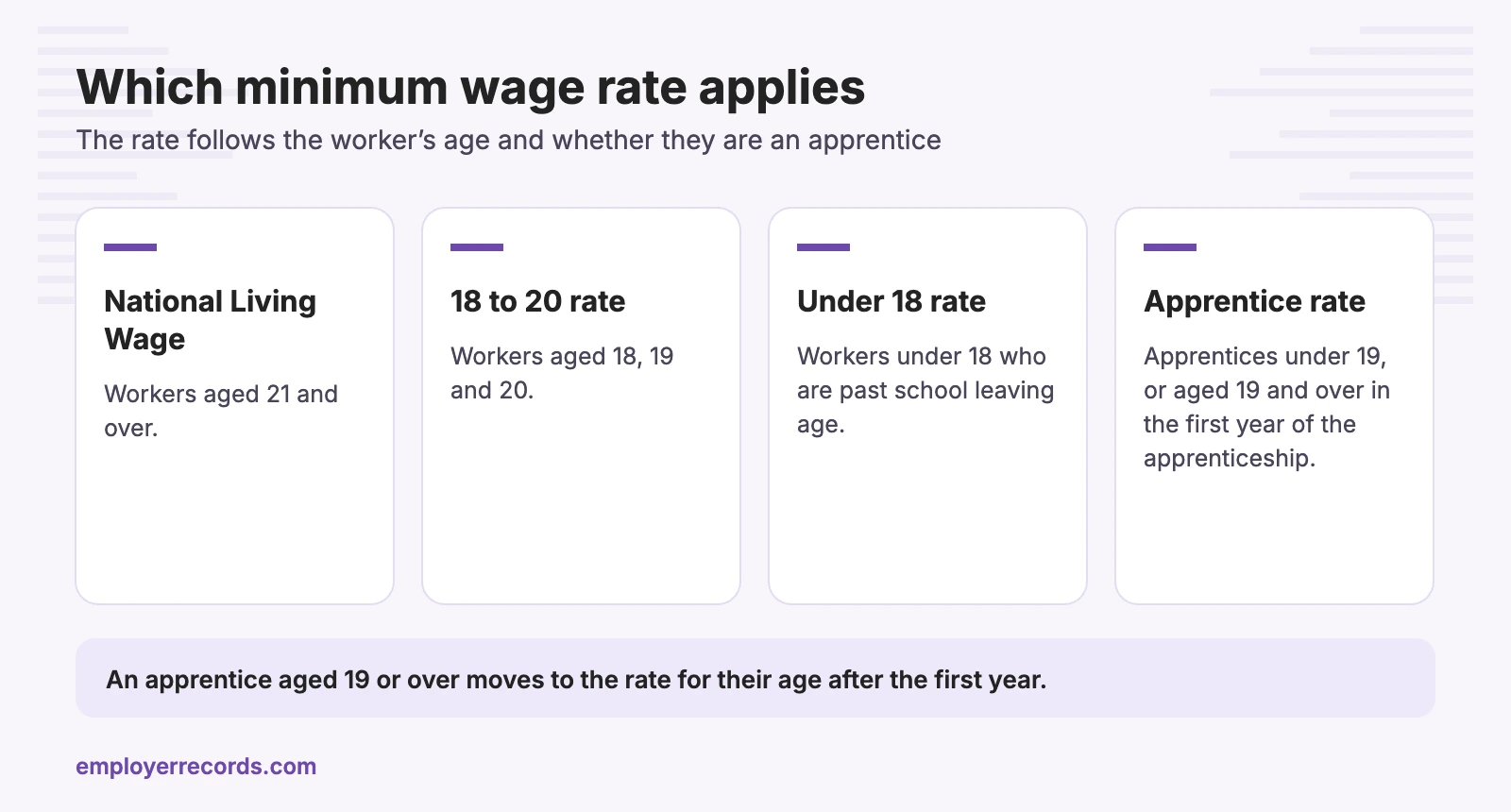
Birthdays change the rate. A worker moving into an older band becomes entitled to the higher rate. Check each worker’s age band whenever you run payroll.
Apprentice minimum wage rules
Apprentices get the apprentice rate if they are under 19, or 19 or over and in the first year of the apprenticeship. An apprentice aged 21 in the first year is entitled to £8.00 an hour, not the National Living Wage.[1]
After the first year, an apprentice aged 19 or over moves to the rate for their age. An apprentice under 19 stays on the apprentice rate.[6]
The government’s naming bulletins list the same mistakes again and again: paying the apprentice rate to a 19 year old after the first year, paying it to someone who is not an apprentice, and not raising pay when the apprenticeship ends.[7]
How HMRC checks minimum wage pay
Pay is tested by pay period, the interval at which the worker is paid. That can be weekly, monthly or an irregular gap such as every 10 days.[8] The test uses gross pay, before tax and National Insurance, divided by the hours worked in the period.[9]
Our example: a worker aged 25 is paid £400.00 for 30 hours. That is £13.33 an hour, above the £12.71 National Living Wage. The same £400.00 for 32 hours is £12.50 an hour and falls short.
What counts toward the minimum wage
Gross pay for the hours worked counts, including sales commission and performance related pay.[9] Accommodation counts only up to the offset. Several other payments are excluded.[10]
Payments and the minimum wage calculation
| Payment | Counts? | Note |
|---|---|---|
| Basic pay for hours worked | Yes | Gross pay, before tax and National Insurance |
| Sales commission and performance pay | Yes | Part of gross pay for the pay period |
| Accommodation provided by the employer | Up to the offset | £11.10 a day from April 2026 |
| Tips, service charges and cover charges | No | Customer payments do not top up pay |
| Extra pay for unsocial hours on a shift | No | Premiums sit outside the calculation |
| Food, a car, childcare vouchers | No | No other company benefit counts |
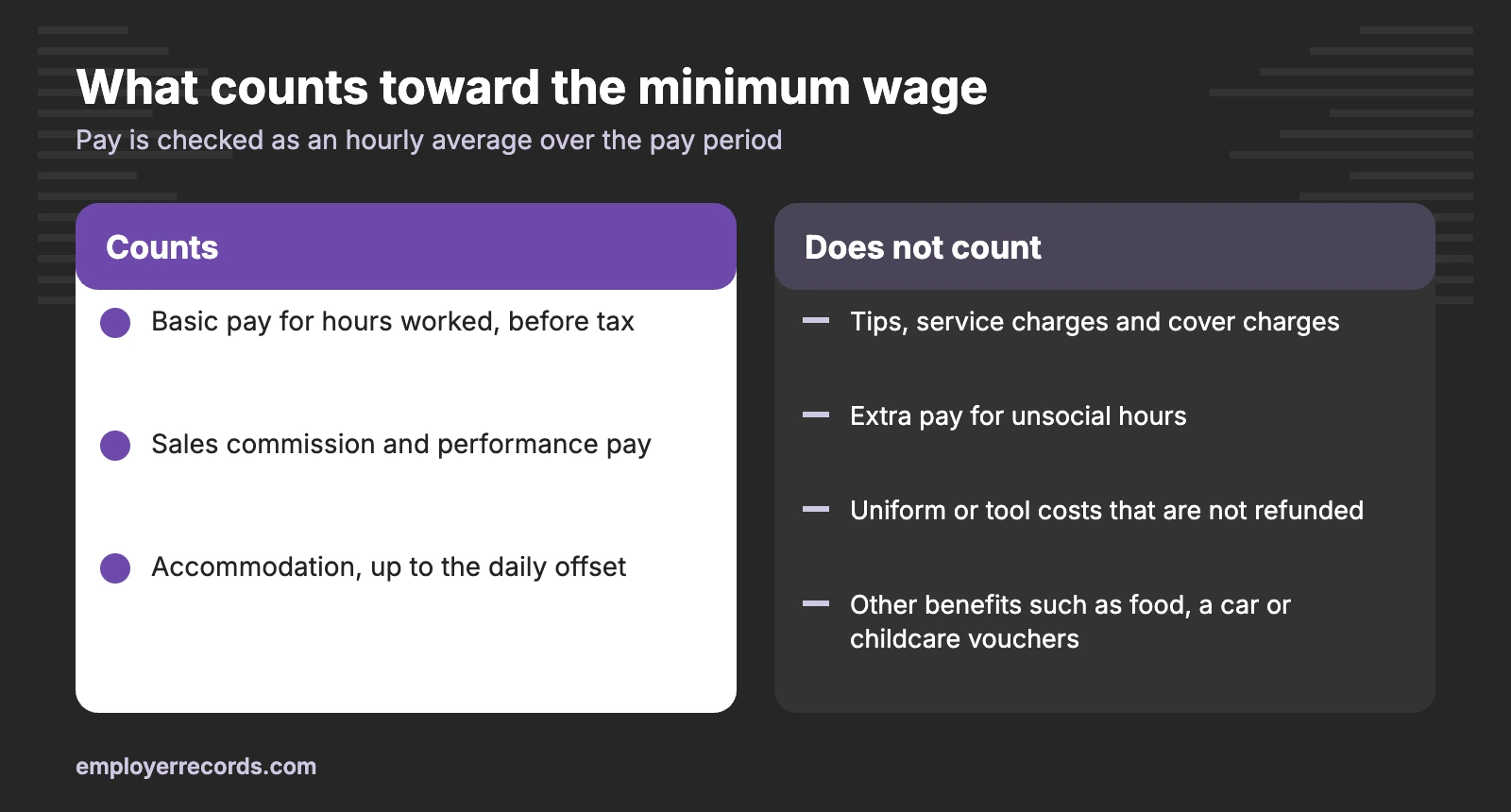
Payments made for the employer’s own use or benefit, and things the worker bought for the job and is not refunded for, such as tools, uniform and safety equipment, are also left out of the calculation.[10]
Accommodation offset
An employer that provides accommodation can count part of its value toward the minimum wage. From April 2026 the offset is £11.10 a day or £77.70 a week, up from £10.66 a day.[11][12] No other kind of company benefit counts.[11]
Free accommodation still affects the calculation, because the offset is credited against pay.[8] If the employer charges more than the offset, the excess reduces the pay that counts.[13]
Our example: a 40 hour week at £12.71 needs £508.40 of qualifying pay. With free accommodation, £77.70 counts, so £430.70 must be paid in cash.
What a minimum wage salary costs a year
Gross annual pay at the National Living Wage for 52 weeks (our estimate)
| Weekly hours | From April 2026 | From April 2027 | Increase |
|---|---|---|---|
| 37.5 hours | £24,784.50 | £25,759.50 | £975.00 |
| 40 hours | £26,436.80 | £27,476.80 | £1,040.00 |
These figures are the hourly rates multiplied by hours and 52 weeks. They are gross pay only. Employer National Insurance, pension contributions and other costs come on top. See our UK employer costs guide for the wider cost picture.
What changes on 1 April 2027
The government accepted the Low Pay Commission’s recommendations in full. The National Living Wage rises 3.9% to £13.21, and the 18 to 20 rate rises to £11.27.[2] The under 18 and apprentice rates become £8.31.[4]
The gap between the two adult bands widens from £1.86 to £1.94 an hour, by our arithmetic from the published rates.
Plan before April. Rates change on 1 April each year.[1] If you pay close to the floor, update payroll and any fixed pay in contracts before that date.
Penalties for paying below the minimum wage
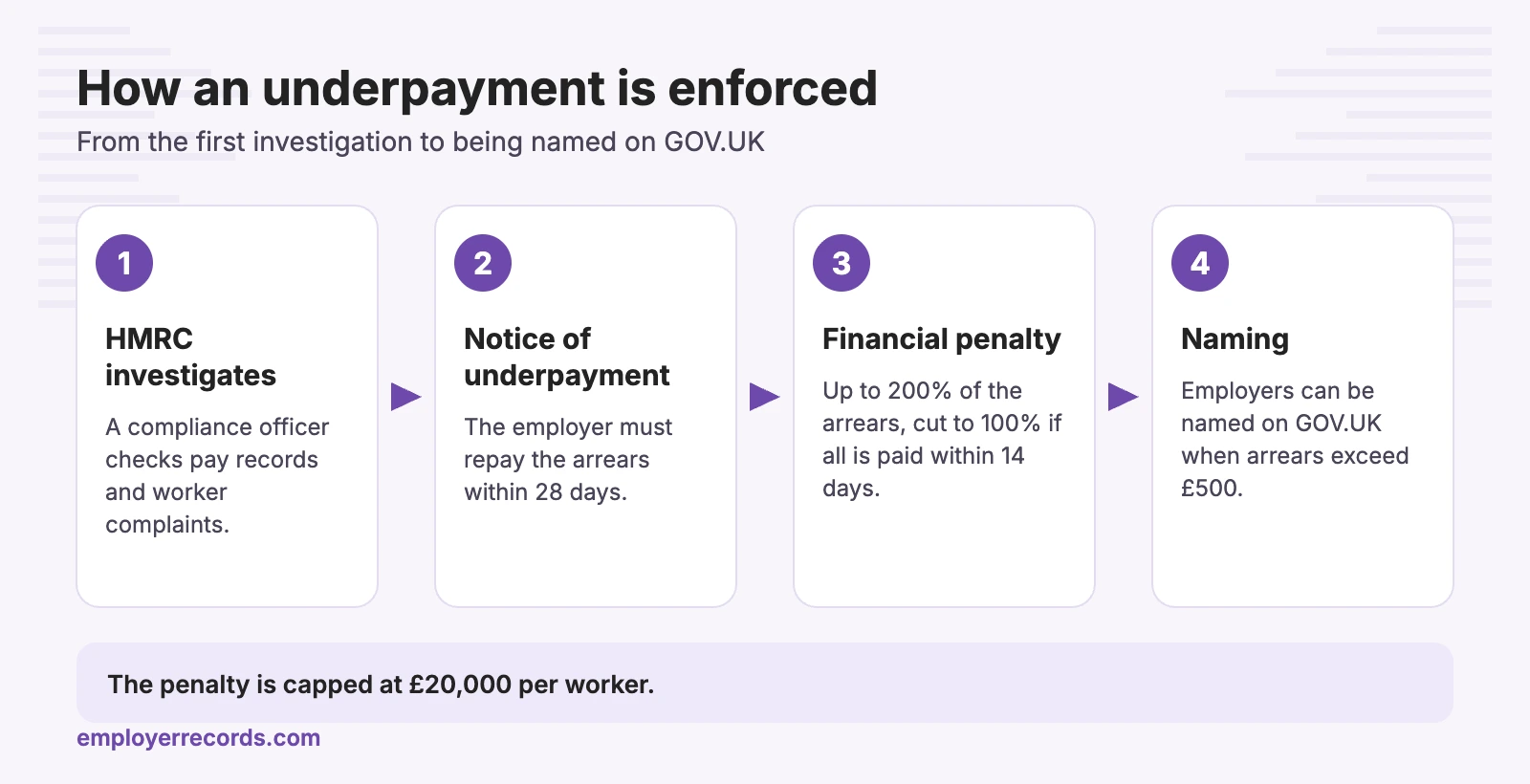
If a compliance officer believes a worker has been underpaid, HMRC can issue a notice of underpayment. It can require the employer to repay arrears to each worker named and to pay a penalty.[14] Arrears must be repaid within 28 days.[15]
The penalty can be up to 200% of the arrears, capped at £20,000 per worker. It is reduced by 50% if the employer complies fully within 14 days.[14][16] Employers can be named on GOV.UK when the arrears owed exceed £500.[15]
Employer of Record hires and the minimum wage
An Employer of Record becomes the legal employer of the worker in the UK, so minimum wage compliance sits with the provider. The salary you agree still has to clear the rate for the worker’s age and hours. This is our reading of how the arrangement works.
Sponsored workers have separate salary requirements. Our Skilled Worker visa guide covers them.
Common minimum wage mistakes
Our view
The headline rate is rarely where employers go wrong. The problems sit in the details around it: apprentices left on the lower rate, accommodation charged above the offset, and pay that looks right on paper but falls short once hours are averaged over the pay period.
If you pay hourly staff near the floor, put 1 April on the calendar, check each worker’s age band at every pay run, and keep records that show how the hourly figure was reached.
UK minimum wage FAQ
What is the UK minimum wage in 2026?
The National Living Wage is £12.71 an hour for workers aged 21 and over from 1 April 2026. The 18 to 20 rate is £10.85, and the under 18 and apprentice rates are £8.00.
What will the minimum wage be in April 2027?
The National Living Wage rises 3.9% to £13.21 from 1 April 2027. The 18 to 20 rate becomes £11.27, and the under 18 and apprentice rates become £8.31.
Does the minimum wage apply to part-time workers?
Yes. The rates are hourly, so they apply however many hours someone works. Workers must be over school leaving age to qualify.
What is the minimum wage for 18 to 20 year olds?
It is £10.85 an hour from April 2026 and £11.27 from April 2027. Workers aged 21 and over move to the National Living Wage.
Who gets the apprentice rate?
Apprentices under 19, and apprentices aged 19 or over in the first year of the apprenticeship. After the first year, those aged 19 or over move to the rate for their age.
Can employers count accommodation toward the minimum wage?
Yes, up to the offset of £11.10 a day or £77.70 a week from April 2026. Charges above the offset reduce the pay that counts, and no other benefit counts.
Do tips count toward the minimum wage?
No. Tips, service charges and cover charges are excluded from the calculation, so employers cannot use them to reach the rate.
What is the penalty for paying below the minimum wage?
HMRC can require arrears to be repaid and add a penalty of up to 200% of the arrears, capped at £20,000 per worker. Employers can also be named on GOV.UK.
Is the National Living Wage the same as the Real Living Wage?
No. The National Living Wage is the legal minimum for workers aged 21 and over. The Real Living Wage is a voluntary rate set by the Living Wage Foundation.
Does an Employer of Record have to pay the UK minimum wage?
Yes. The provider is the legal employer, so the pay must meet the minimum for the worker’s age and hours. This is our reading of the arrangement.
References and sources
Every figure on this page comes from the sources below. Numbers in square brackets in the text link to the matching entry. Official statistics are used wherever they exist, and our own calculations are labelled as estimates. All sources were checked on 24 October 2026.
- ↑National Minimum Wage and National Living Wage rates. GOV.UK. gov.uk. Retrieved 16 November 2026. Official
- ↑LPC recommendations take the National Living Wage to £13.21. GOV.UK. gov.uk. Retrieved 16 November 2026. Official
- ↑Minimum wage rates for 2026. GOV.UK. gov.uk. Retrieved 16 November 2026. Official
- ↑Minimum wage rates for 2027. GOV.UK. gov.uk. Retrieved 16 November 2026. Official
- ↑Are you an apprentice? Check Your Pay. GOV.UK Check Your Pay. checkyourpay.campaign.gov.uk. Retrieved 16 November 2026. Official
- ↑NMWM05260: apprentices aged under 19. HM Revenue and Customs. gov.uk. Retrieved 16 November 2026. Guide
- ↑National Minimum Wage Naming Scheme: educational bulletin. GOV.UK. assets.publishing.service.gov.uk. Retrieved 16 November 2026. Guide
- ↑National Minimum Wage and Living Wage: effect of accommodation on the minimum wage. GOV.UK. gov.uk. Retrieved 16 November 2026. Official
- ↑The National Minimum Wage and Living Wage. nidirect. nidirect.gov.uk. Retrieved 16 November 2026. Guide
- ↑The National Minimum Wage and Living Wage: employers and the minimum wage. GOV.UK. gov.uk. Retrieved 16 November 2026. Official
- ↑National Minimum Wage and Living Wage: accommodation rates. GOV.UK. gov.uk. Retrieved 16 November 2026. Official
- ↑The National Minimum Wage (Amendment) Regulations 2026. UK Government. legislation.gov.uk. Retrieved 16 November 2026. Law
- ↑NMWM10260: accommodation charges and the offset. HM Revenue and Customs. gov.uk. Retrieved 16 November 2026. Guide
- ↑Calculating the minimum wage: enforcing the minimum wage. GOV.UK. gov.uk. Retrieved 16 November 2026. Official
- ↑National Minimum Wage enforcement and compliance report 2024 to 2025. GOV.UK. assets.publishing.service.gov.uk. Retrieved 16 November 2026. Data
- ↑NMWM13226: calculating the penalty on a notice of underpayment. HM Revenue and Customs. gov.uk. Retrieved 16 November 2026. Guide
About the author

Emma Whitmore is an EOR and Global Employment Content Writer at EmployerRecords, where she researches and writes practical resources on Employer of Record (EOR) services, international hiring, global payroll, employment compliance, and workforce expansion across international markets. With more than 15 years of experience in B2B content and editorial research, Emma specializes in turning complex employment regulations into clear, actionable guidance for HR leaders, founders, and globally distributed teams. Her work focuses on helping businesses understand country-specific hiring requirements, compare global employment providers, and navigate compliance with confidence.
View all articles by EmmaRelated guides for employers
Other United Kingdom guides from this hiring guide, plus pay floors and salary levels in other markets.
 United KingdomIR35IR35 for Foreign Employers (2026): Off-Payroll Rules, Costs and RiskWhen UK off-payroll rules reach a foreign company, who decides status, what inside IR35 costs and how an EOR removes...Read the guideUnited KingdomMaternity and Paternity LeaveMaternity and Paternity Leave in the UK (2026): Pay, Rules and Employer CostUK family leave for employers in 2026/27: maternity, paternity and shared parental leave, the £194.32 statutory rate, HMRC recovery and...Read the guideUnited KingdomSkilled Worker VisaSkilled Worker Visa Sponsorship in the UK (2026): Rules, Fees and CostWhich jobs qualify, salary thresholds, sponsor licence and visa fees, sponsor duties and the real cost of one sponsored hire,...Read the guideUnited KingdomAverage salaryUK Average Salary 2026: Median Pay, Hourly Rates and Employer CostUnited Kingdom · Pay benchmarks 2026← Part of the United Kingdom hiring guide UK Average Salary 2026: Median Pay, Hourly...Read the guideUnited KingdomEmployer costsUK Employer Costs 2026/27: National Insurance, Pension and Other On-CostsWhat a UK employer pays on top of salary in 2026 to 2027: National Insurance, Employment Allowance, pension, sick pay,...Read the guideUnited KingdomEmployment Rights Act 2025UK Employment Rights Act 2025: What Changes for Employers and WhenDates and changes from the UK Employment Rights Act 2025 for employers: day one sick pay, six month unfair dismissal...Read the guide
Hiring in the United Kingdom?
See what a UK hire costs at any salary, with employer NI, pension, contracts, notice rules and the providers that employ in Britain.