
UK Employer Costs 2026/27: National Insurance, Pension and Other On-Costs
What a UK employer pays on top of salary: National Insurance, the Employment Allowance, reliefs for young staff, the minimum pension, sick pay, insurance and the cost at three salary levels.
UK employer costs at a glance
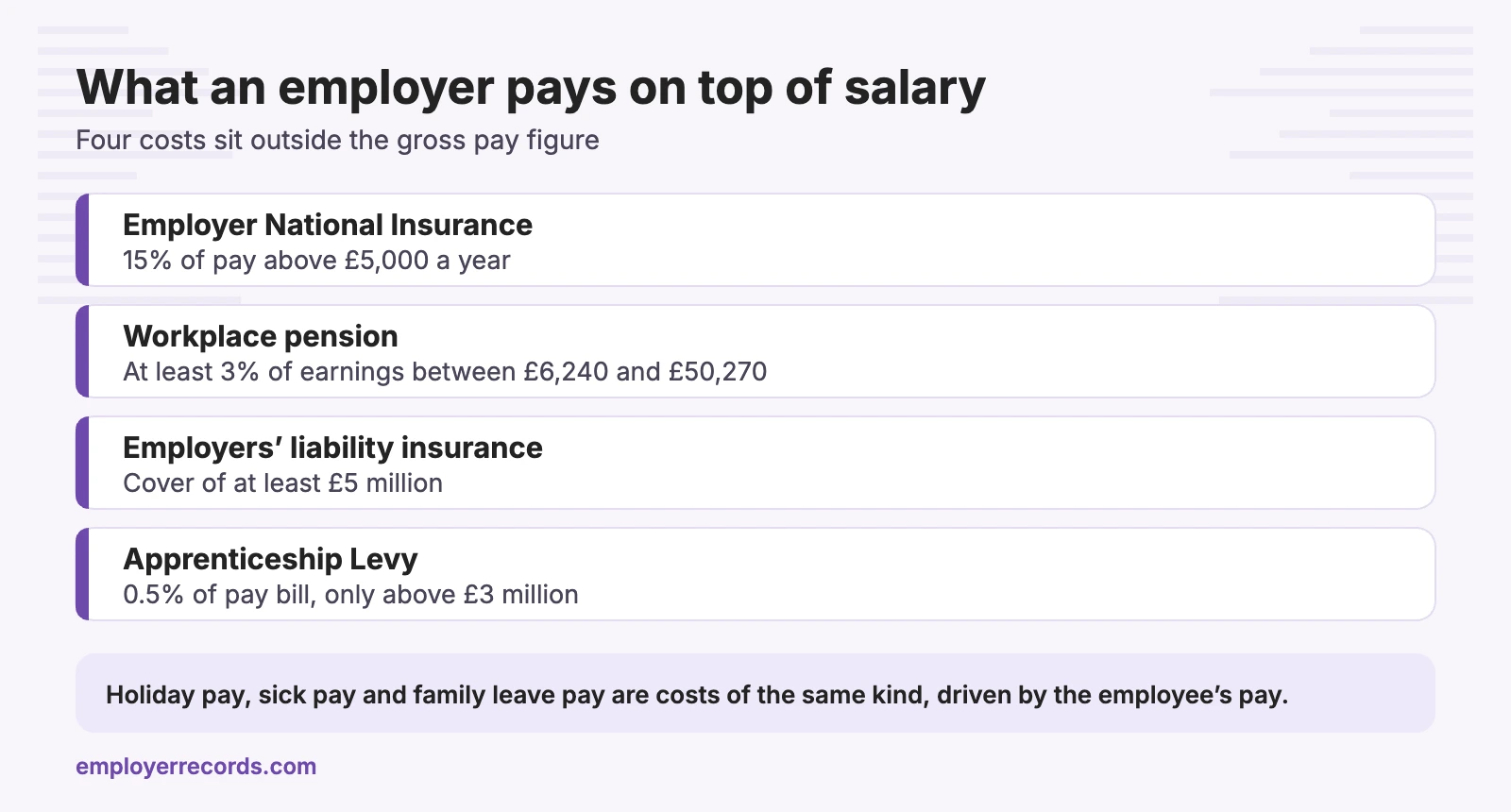
Employer National Insurance in the UK is 15% on pay above £5,000 a year for 2026 to 2027. A workplace pension adds at least 3% of earnings between £6,240 and £50,270. For a £45,000 salary that is about £7,162.80 a year on top, or 15.9%, before insurance and sick pay.
- Employer NI: 15% above £5,000 a year (£96 a week)
- Pension: employer pays at least 3% of earnings from £6,240 to £50,270
- Employment Allowance: up to £10,500 off employer NI for eligible firms
UK employer costs come from a short list of statutory items: employer National Insurance, a minimum workplace pension contribution, and the cost of sick pay and family leave pay. Compulsory employers’ liability insurance and, for very large payrolls, the Apprenticeship Levy complete the list.[1]
Figures are for the 2026 to 2027 tax year, which runs from 6 April 2026 to 5 April 2027.[1] Income tax and employee National Insurance come out of the worker’s pay. They are not an extra cost to the employer.
What an employer pays on top of salary
Employer National Insurance and the minimum pension are charged on top of gross salary in every pay run. Employers’ liability insurance is an annual premium. The Apprenticeship Levy applies to few employers. Sick pay and family leave pay depend on the employee’s pay and on how much absence you have.
Employer National Insurance rates and thresholds
Employers pay Class 1 National Insurance at 15% on an employee’s earnings above the Secondary Threshold. For 2026 to 2027 that threshold is £96 a week, £417 a month or £5,000 a year.[1] It was £175 a week in 2024 to 2025.[2]
Employer Class 1 National Insurance thresholds, 2026 to 2027
| Threshold | Weekly | Monthly | Annual |
|---|---|---|---|
| Secondary Threshold (employer starts paying) | £96 | £417 | £5,000 |
| Upper secondary threshold, employees under 21 | £967 | £4,189 | £50,270 |
| Apprentice upper secondary threshold, under 25 | £967 | £4,189 | £50,270 |
| Veterans upper secondary threshold | £967 | £4,189 | £50,270 |
| Freeport and Investment Zone upper secondary threshold | £481 | £2,083 | £25,000 |
Zero rate reliefs for young employees and apprentices
Employers pay a 0% rate of secondary National Insurance on earnings up to £967 a week, or £50,270 a year, for employees under 21, for apprentices under 25 and for armed forces veterans.[3] Above that threshold the full 15% applies to all earnings over it, with no reduction.[1]
Eligible employees in a Freeport or Investment Zone special tax site have a lower zero rate band of £25,000 a year.[1]
Check each employee. The reliefs depend on the individual employee, so apply them per person and not to a whole payroll. This is our reading of how the thresholds work in practice.
Employment Allowance
Eligible employers can reduce their annual employer National Insurance bill by up to £10,500 for 2026 to 2027. The allowance is applied each time payroll runs until the amount is used or the tax year ends.[4]
It works against employer Class 1 National Insurance only, not Class 1A or Class 1B.[5] Employers with more than one PAYE scheme should nominate the scheme most likely to carry at least £10,500 of liability.[5]
The claimant must be a business or public body doing less than half its work in the public sector, and a company with a single director cannot claim if that director is the only employee liable for secondary National Insurance.[6][7] Pay within the IR35 off-payroll rules and domestic employees such as nannies are also left out, unless they are care or support workers.[8]
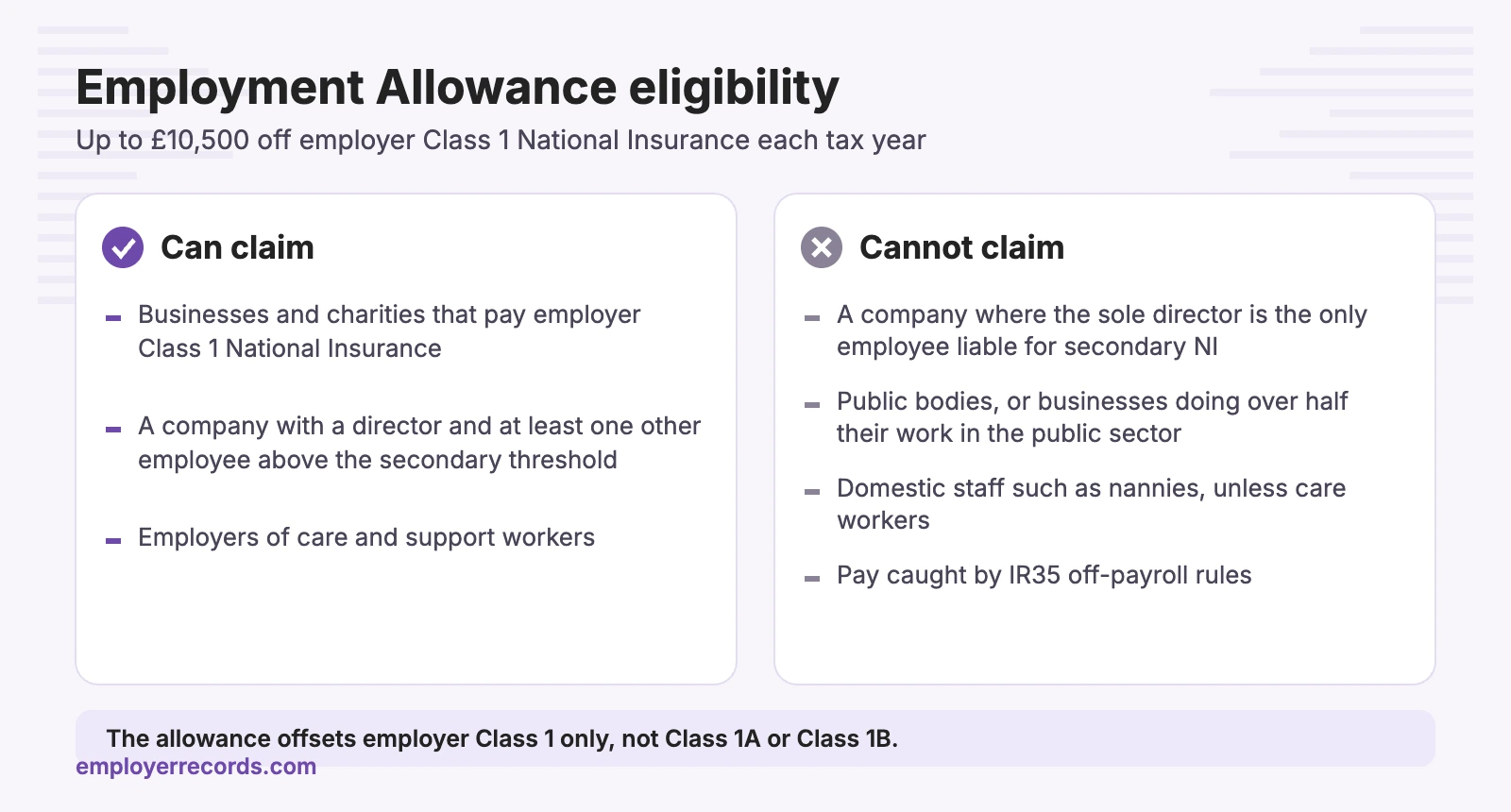
Our reading. A new UK company with a director and one other employee earning above the Secondary Threshold can be eligible. A company whose only paid employee is its sole director cannot.
Workplace pension contributions
Employers must automatically enrol eligible workers into a workplace pension. That covers workers aged 22 or over and under State Pension age who earn more than £10,000 a year and work in the UK.[9][10]
The minimum total contribution is 8% of qualifying earnings, and the employer pays at least 3% of that. For 2026 to 2027 qualifying earnings are the slice between £6,240 and £50,270 a year.[11]
Automatic enrolment earnings thresholds, 2026 to 2027
| Threshold | Annual | Monthly | Weekly |
|---|---|---|---|
| Lower level of qualifying earnings | £6,240 | £520 | £120 |
| Earnings trigger for automatic enrolment | £10,000 | £833 | £192 |
| Upper level of qualifying earnings | £50,270 | £4,189 | £967 |
By our arithmetic the minimum employer contribution tops out at £1,320.90 a year, which is 3% of the £44,030 band.
Sick pay, holiday and family leave costs
Since 6 April 2026, Statutory Sick Pay is paid from the first day of absence to all eligible employees, whatever they earn. The rate is £123.25 a week or 80% of average weekly earnings, whichever is lower.[1][12] It is paid for up to 28 weeks.[13] Employers cannot reclaim it.[12]
Most workers are entitled to 5.6 weeks of paid holiday a year, which is 28 days on a five day week. Employers can count bank holidays towards it.[14] Holiday is paid inside salary, so it is not an extra cost line, but it reduces the working weeks you get for the price.
Statutory Maternity Pay is £194.32 a week, or 90% of earnings if lower, after the first six weeks at 90% of pay.[1] Our maternity and paternity leave guide covers the full cost.
Employers’ liability insurance and the Apprenticeship Levy
Employers’ liability insurance is compulsory from the day you become an employer. The cover must be at least £5 million from an authorised insurer, and the fine is £2,500 for every day you are not properly insured.[15]
The Apprenticeship Levy is 0.5% of the annual pay bill, with a £15,000 allowance. In practice only employers with a pay bill above £3 million pay it.[16] It applies even to employers with no apprentices.[17]
What a UK hire costs at three salaries
Employer on-cost at three salaries, 2026 to 2027 (our estimate)
| Salary | Employer NI | Minimum pension | Total on-cost | Share of salary |
|---|---|---|---|---|
| £30,000 | £3,750.00 | £712.80 | £4,462.80 | 14.9% |
| £45,000 | £6,000.00 | £1,162.80 | £7,162.80 | 15.9% |
| £70,000 | £9,750.00 | £1,320.90 | £11,070.90 | 15.8% |
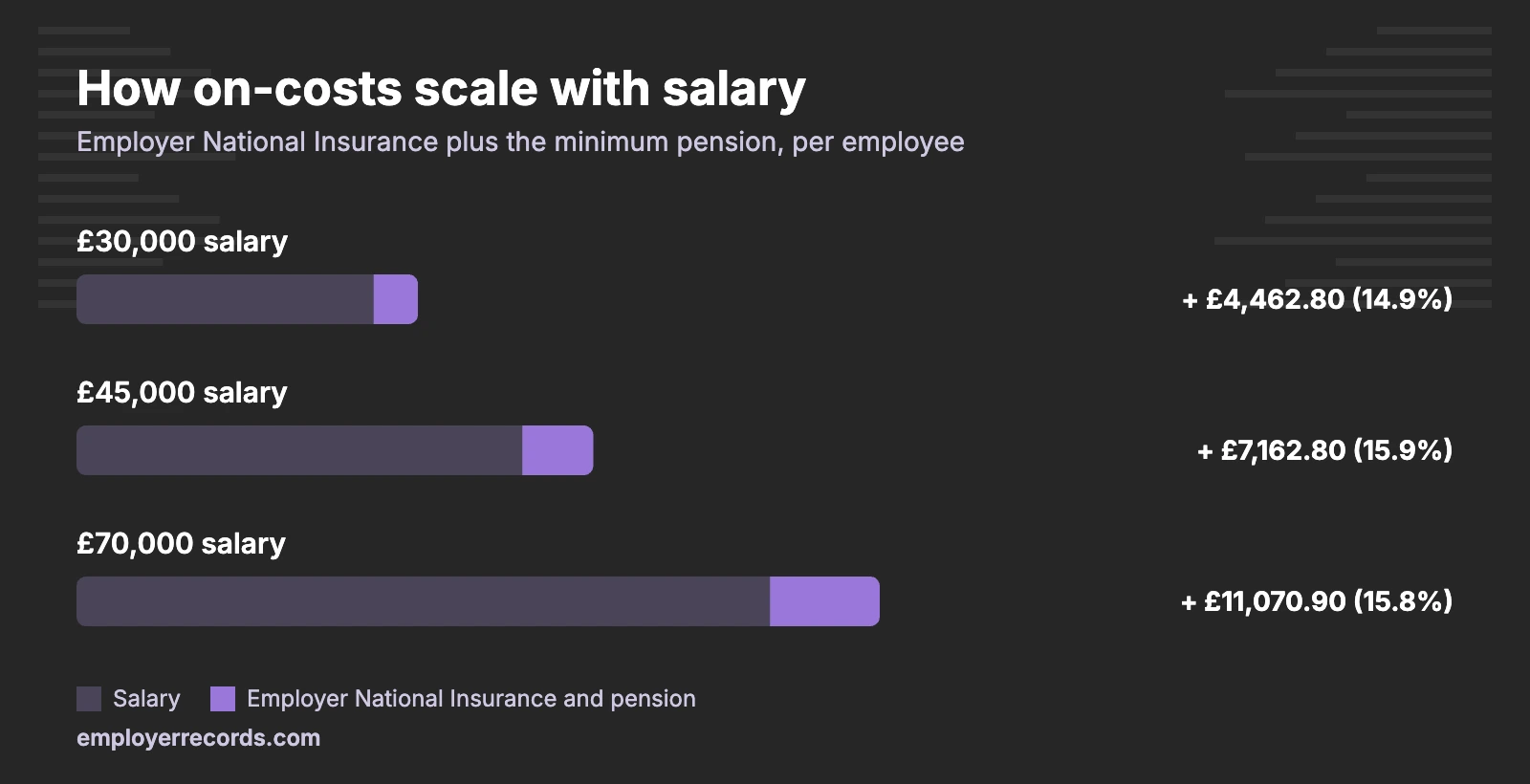
Method: employer National Insurance is 15% of salary above £5,000. The pension is 3% of earnings between £6,240 and £50,270. Real payroll calculates National Insurance per pay period, so actual figures can differ by a few pounds. The table leaves out insurance, sick pay and any Employment Allowance.
An eligible employer with a single employee on one of these salaries could offset the whole National Insurance figure for the £30,000 and £45,000 examples, since both are below £10,500. That is our arithmetic and it depends on eligibility.
Rates for 2027 to 2028
The Budget 2026 rates and allowances annex lists the Secondary Threshold at £96 a week and the Employment Allowance at £10,500 for 2027 to 2028, the same as 2026 to 2027. The Lower Earnings Limit moves from £129 to £133 a week.[18]
Pay floors change separately. Our UK minimum wage guide covers the April 2027 rates.
Employer of Record hires and UK employer costs
An Employer of Record runs UK payroll as the legal employer, so these costs run through its payroll and are passed on to you with its fee. This is our reading of how the model works, and pricing differs by provider. Compare options in our UK EOR provider guide.
For wider UK context, see our UK hiring guide.
Common employer cost mistakes
Our view
The UK is one of the simpler places to cost a hire. Two items drive almost everything, employer National Insurance and the minimum pension, and both fit in a spreadsheet.
The traps sit in eligibility. The Employment Allowance depends on company structure, and the under 21 and apprentice reliefs change the answer for junior hires. Check those first, then budget insurance and sick pay as small fixed lines.
UK employer costs FAQ
What is the employer National Insurance rate in the UK?
Employers pay 15% on earnings above the Secondary Threshold of £5,000 a year (£96 a week) for 2026 to 2027.
How much does it cost to employ someone on £45,000?
By our estimate, about £7,162.80 on top of salary for employer National Insurance and the minimum pension, so roughly £52,163 in total before insurance and sick pay.
What is the Employment Allowance?
It lets eligible employers cut their employer Class 1 National Insurance bill by up to £10,500 in the tax year. A company whose only paid employee is its sole director cannot claim.
How much must an employer pay into a pension?
At least 3% of the employee’s qualifying earnings, which are earnings between £6,240 and £50,270 a year. The total minimum contribution is 8%.
Do employers pay National Insurance on employees under 21?
Not up to £967 a week, which is £50,270 a year. Above that threshold the full 15% applies to all earnings over it.
Do small employers pay the Apprenticeship Levy?
No. It is 0.5% of the pay bill with a £15,000 allowance, so only employers with a pay bill above £3 million pay it.
References and sources
Every figure on this page comes from the sources below. Numbers in square brackets in the text link to the matching entry. Official statistics are used wherever they exist, and our own calculations are labelled as estimates. All sources were checked on 24 October 2026.
- ↑Rates and thresholds for employers 2026 to 2027. HM Revenue and Customs. gov.uk. Retrieved 16 November 2026. Official
- ↑Rates and allowances: National Insurance contributions. HM Revenue and Customs. gov.uk. Retrieved 16 November 2026. Official
- ↑2026 to 2027: Employer further guide to PAYE and National Insurance contributions. HM Revenue and Customs. gov.uk. Retrieved 16 November 2026. Official
- ↑Employment Allowance: what you will get. HM Revenue and Customs. gov.uk. Retrieved 16 November 2026. Official
- ↑Claiming Employment Allowance: further employer guidance. HM Revenue and Customs. gov.uk. Retrieved 16 November 2026. Official
- ↑Employment Allowance: check if you are eligible. HM Revenue and Customs. gov.uk. Retrieved 16 November 2026. Official
- ↑Single-director companies and Employment Allowance: further guidance. HM Revenue and Customs. gov.uk. Retrieved 16 November 2026. Official
- ↑Employment Allowance: check if you can claim for previous years. HM Revenue and Customs. gov.uk. Retrieved 16 November 2026. Official
- ↑Automatic enrolment into a workplace pension: key facts. GOV.UK. assets.publishing.service.gov.uk. Retrieved 16 November 2026. Guide
- ↑Earnings thresholds. The Pensions Regulator. thepensionsregulator.gov.uk. Retrieved 16 November 2026. Official
- ↑Making contributions to your pension scheme. The Pensions Regulator. thepensionsregulator.gov.uk. Retrieved 16 November 2026. Official
- ↑April 2026 issue of the Employer Bulletin. HM Revenue and Customs. gov.uk. Retrieved 16 November 2026. Official
- ↑Statutory Sick Pay (SSP): overview. GOV.UK. gov.uk. Retrieved 16 November 2026. Official
- ↑Holiday entitlement: entitlement. GOV.UK. gov.uk. Retrieved 16 November 2026. Official
- ↑Employers’ liability insurance. GOV.UK. gov.uk. Retrieved 16 November 2026. Official
- ↑ALM06000: introduction to the Apprenticeship Levy. HM Revenue and Customs. gov.uk. Retrieved 16 November 2026. Guide
- ↑Help with the Apprenticeship Levy and Employment Allowance: purpose, scope and background. HM Revenue and Customs. gov.uk. Retrieved 16 November 2026. Official
- ↑Budget 2026: overview of tax legislation and rates, Annex A. HM Treasury. gov.uk. Retrieved 16 November 2026. Official
About the author

Dhiraj Das is Co-Founder of EmployerRecords.com, where he leads content, research and partnerships. He has worked in content and online publishing for more than 15 years, and before EmployerRecords he founded a number of successful content brands. For the past six years he has specialised in HR technology, Employer of Record services and global hiring. His background in digital marketing and search shapes how EmployerRecords researches and presents its provider reviews, country hiring guides and cost data, so employers can compare their options and hire abroad with clear, checked information.
View all articles by DhirajRelated guides for employers
Other United Kingdom guides from this hiring guide, plus pay floors and salary levels in other markets.
 United KingdomIR35IR35 for Foreign Employers (2026): Off-Payroll Rules, Costs and RiskWhen UK off-payroll rules reach a foreign company, who decides status, what inside IR35 costs and how an EOR removes...Read the guideUnited KingdomMaternity and Paternity LeaveMaternity and Paternity Leave in the UK (2026): Pay, Rules and Employer CostUK family leave for employers in 2026/27: maternity, paternity and shared parental leave, the £194.32 statutory rate, HMRC recovery and...Read the guideUnited KingdomSkilled Worker VisaSkilled Worker Visa Sponsorship in the UK (2026): Rules, Fees and CostWhich jobs qualify, salary thresholds, sponsor licence and visa fees, sponsor duties and the real cost of one sponsored hire,...Read the guideUnited KingdomAverage salaryUK Average Salary 2026: Median Pay, Hourly Rates and Employer CostUnited Kingdom · Pay benchmarks 2026← Part of the United Kingdom hiring guide UK Average Salary 2026: Median Pay, Hourly...Read the guideUnited KingdomEmployment Rights Act 2025UK Employment Rights Act 2025: What Changes for Employers and WhenDates and changes from the UK Employment Rights Act 2025 for employers: day one sick pay, six month unfair dismissal...Read the guideUnited KingdomMinimum wageUK Minimum Wage 2026 and 2027: Rates, Apprentices and Employer PenaltiesUK minimum wage rates for 2026 and 2027 by age band, apprentice rules, what counts toward pay, the accommodation offset...Read the guide
Hiring in the United Kingdom?
See what a UK hire costs at any salary, with employer NI, pension, contracts, notice rules and the providers that employ in Britain.