
Average Salary in Spain: €29,540 a Year, Gross (INE 2024 Data)
The mean, median and most common salary, how pay splits by sector, occupation and region, and what an employee on the average salary costs an employer.
What is the average salary in Spain in 2026?
The average gross salary in Spain is €29,540 a year, or about €2,462 a month over 12 months, in INE’s 2024 wage survey published in May 2026. Median pay is €24,497 and the most common salary €16,520. All three are full-year gross figures for employees, before any 2026 pay rises.
- Median: €24,497 a year, the pay of the middle employee
- Most common: €16,520, the most frequent salary
- Employer cost: about 32% on top of gross pay
INE published the definitive 2024 figures on 28 May 2026, and they’re the newest official annual numbers there are.[1] The mean rose 5.3% on 2023, which Europa Press counted as the eleventh straight year of growth.[1][2]
No official 2026 annual average exists yet. When you budget for 2026 you’re reading a 2024 number, so allow for the two years of pay rises in between. Pay growth since then shows up in the quarterly labour cost survey, covered further down.
All the figures here are gross, per employee, for a full year. They include the two extra payments most contracts carry, so the monthly equivalent depends on whether you divide by 12 or 14.
Mean, median or most common salary: which one should you use?
They’re three different questions. A mean divides total pay by headcount, so a few very high salaries drag it up. Median pay belongs to the employee in the middle. Mode, the most common salary, is where the largest group sits.
Spain shows the gap clearly. Half of employees earned less than €24,497, yet the mean was €29,540, because pay at the top is stretched.[1]
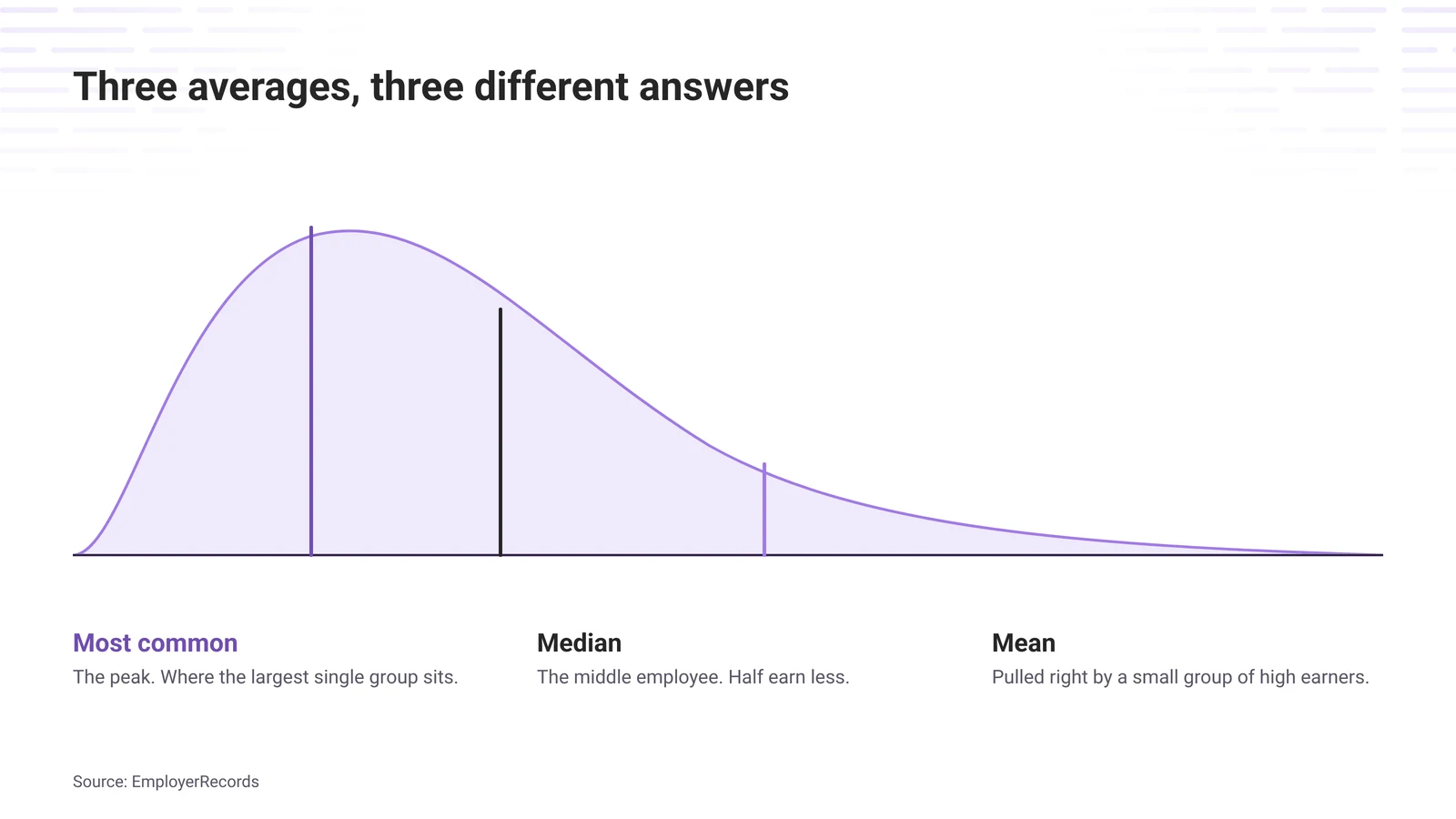
Salary measures in Spain, gross, 2024 (INE)[1]
| Measure | Per year | Per month, 12 payments | What it tells you |
|---|---|---|---|
| Mean | €29,540 | €2,462 | Total pay divided by employees, lifted by high earners |
| Median | €24,497 | €2,041 | Half of employees earn less, half earn more |
| Most common | €16,520 | €1,377 | The salary held by the largest single group of employees |
Monthly figures are our calculation: the annual figure divided by 12.
Our view. Price a role from the median for its sector and occupation, not from the national mean. A mean is a headline figure. It describes nobody in particular.
What is the average salary by sector in Spain?
Sector spreads are wide. Energy supply paid €57,932 on average, 96.1% above the national mean, while hospitality paid €17,653, 40.2% below it.[1]
Technology employers should look at the information and communications row. It rose 7.7% in the year, among the fastest of any sector.[1]
Mean gross annual salary by sector, 2024, and change on 2023 (INE)[1]
| Sector | Mean per year | Change on 2023 |
|---|---|---|
| Electricity, gas and air conditioning supply | €57,932 | +6.4% |
| Financial and insurance activities | €51,863 | +6.0% |
| Information and communications | €42,742 | +7.7% |
| Public administration | €37,518 | +3.1% |
| Professional, scientific and technical | €35,165 | +8.0% |
| Manufacturing | €32,882 | +5.9% |
| Health activities | €32,225 | +3.2% |
| Education | €32,210 | +4.2% |
| Transport and storage | €28,910 | +4.4% |
| Construction | €26,965 | +5.9% |
| Retail and wholesale trade | €25,779 | +6.8% |
| Administrative and support services | €21,097 | +6.1% |
| Hospitality | €17,653 | +3.9% |
INE lists more sectors than we show. We picked the 13 most useful to foreign employers hiring office, tech and service staff. Women’s and men’s figures for every section are in the INE release.
How much does pay vary by occupation?
More than sector, occupation sets the price of a hire. Directors and managers averaged €63,865, 116.2% above the national mean.[1] Unskilled service workers averaged €16,063, 45.6% below it.[1]
That’s a spread of nearly four to one inside the same economy. A single country average hides it.
Mean gross annual salary by main occupation group, 2024 (INE)[1]
| Occupation group | Mean per year |
|---|---|
| Directors and managers | €63,865 |
| Other technicians and professionals | €45,514 |
| Scientific and intellectual professionals | €40,555 |
| Support technicians and professionals | €34,917 |
| Office staff not dealing with the public | €29,919 |
| Office staff dealing with the public | €23,138 |
| Catering and retail service workers | €18,919 |
| Unskilled service workers | €16,063 |
We show eight occupation groups, the ones that cover most hires an international employer makes. Office roles that don’t deal with the public sit close to the national mean, at €29,919.[1]
Which regions pay the highest and lowest salaries in Spain?
Pay follows the regional economy. Pay in the Basque Country led at €35,170, ahead of Madrid at €34,410 and Navarre at €32,605.[1] Extremadura, Canarias and Castilla-La Mancha sat at the bottom.[1]
From top to bottom the gap is €10,191, or 40.8% (our calculation from the INE figures).
INE doesn’t publish a clean city figure in this release. For a hire in Barcelona or Valencia, use the regional number as a floor and check the collective agreement for the province.
What is the gender pay gap in Spain?
Women earned 83.9% of the average male salary in 2024, a gap of 16.1 points.[1] INE warns that the raw gap should be read with contract type, hours, occupation and seniority in mind.[1]
For an employer the practical point is narrower. Pay bands set per role, with no discretionary starting offers, are the cleanest way to stay out of this number.
How fast are salaries growing in Spain?
INE’s quarterly survey gives the freshest read. In the second quarter of 2026 total labour cost per worker rose 4.0% on a year earlier, after 4.9% in the first quarter.[3][4]
Put the 2024 mean next to those rates and a rough 2026 equivalent lands above €30,000 (our estimate, assuming growth near 4% to 5% a year in 2025 and 2026). Treat that as a planning figure, not a statistic.
Our read. Budget for pay growth of 4% to 5% a year in the sectors that matter to you, and check it against the agreement table. Minimum wage rises of 5.3% in 2027 will pull up the bottom of the scale.[5]
Is a Spanish salary quoted in 12 or 14 payments?
Either, and it changes how an offer reads. Many Spanish contracts pay 14 times a year, with two extra payments in summer and December. Others prorate those into 12.
Take the 2024 mean of €29,540. In 14 payments it is €2,110 a payment (our calculation). In 12 it is €2,462. Same pay, a payslip that looks 17% bigger.[1]
Write the annual gross figure and the number of payments into every offer. A candidate who sees €2,462 from one recruiter and €2,110 from another will assume somebody is wrong.
What does an employee on the average salary cost an employer?
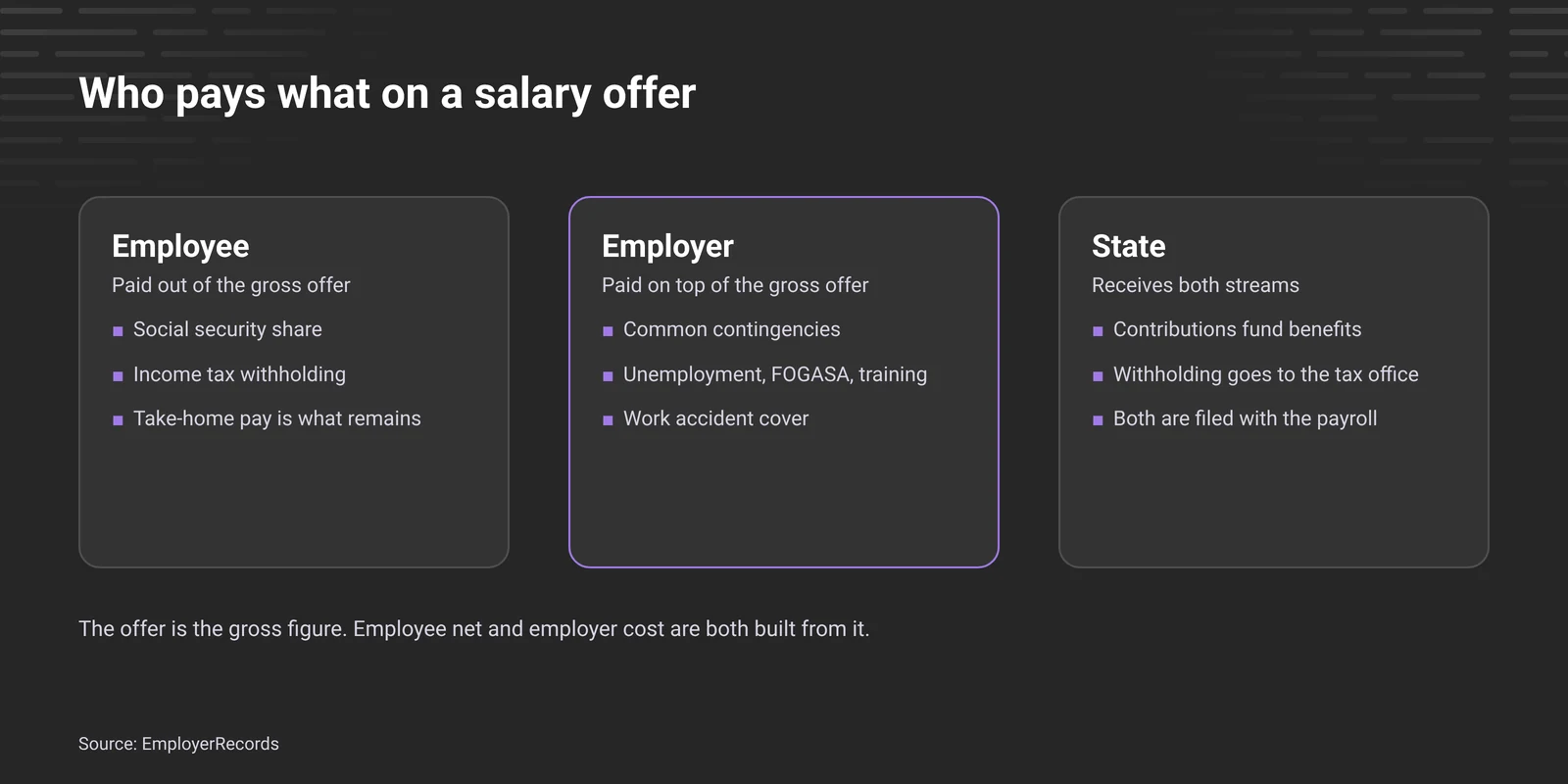
Hiring at the national mean of €29,540 costs about €39,032 a year in total. Employer contributions add €9,492, or 32.1% on top of pay (our calculation).
Employer rates for 2026 are 23.60% for common contingencies, 0.75% for the intergenerational equity mechanism (MEI), 5.50% for unemployment on open-ended contracts, 0.20% for FOGASA and 0.60% for training.[6] We add the 1.5% office accident rate used in our Spain hiring guide.
Each component is rounded to the euro per month, so the total differs from the 32.15% hub rate by a few cents.
€29,540 pay plus €9,492 in employer contributions.
32.1% on top of the wageAssumption. Accident rates vary by activity, and we haven’t published the full tariff. Contributions stop growing once the monthly base reaches the legal maximum of €5,101.20, which in our reading happens at about €61,200 a year.[6] Hospitality, cleaning and construction pay other accident rates, so check yours.
Our EOR cost calculator adds provider fees on top. The full breakdown of rates, bases and sick pay is in our Spain employer costs guide. Both extra payments are already inside the annual pay figure here, which is why the add-on is 32.1% and not the 54.2% quoted in our minimum wage guide, where it’s measured against one monthly payment.
Work out what a salary costs you in Spain
Enter the gross salary you plan to offer and the tool prices the hire. Its default is the national mean, so the result matches the cost table above.
Spain salary cost for an employer, 2026 rules
Our estimate. It uses the 2026 employer rates from the cost table, the 1.5% default accident rate, a base of one twelfth of annual pay and the legal base limits of €1,424.40 and €5,101.20 a month. It leaves out the higher minimum bases of contribution groups 1 to 3, the €33.62 charge on contracts under 30 days, benefits in kind and any EOR fee. See the full Spain cost calculator for fees, currency and year-one costs.
How do you benchmark a salary offer in Spain?
Start narrow and work outward. A national average is the last number to reach for. We’ve ordered the steps in the checklist below the way we use them.
Take a marketing manager in Madrid. Compare with the occupation group, not the economy, and note that the Madrid figure of €34,410 sits well above the national mean.[1]
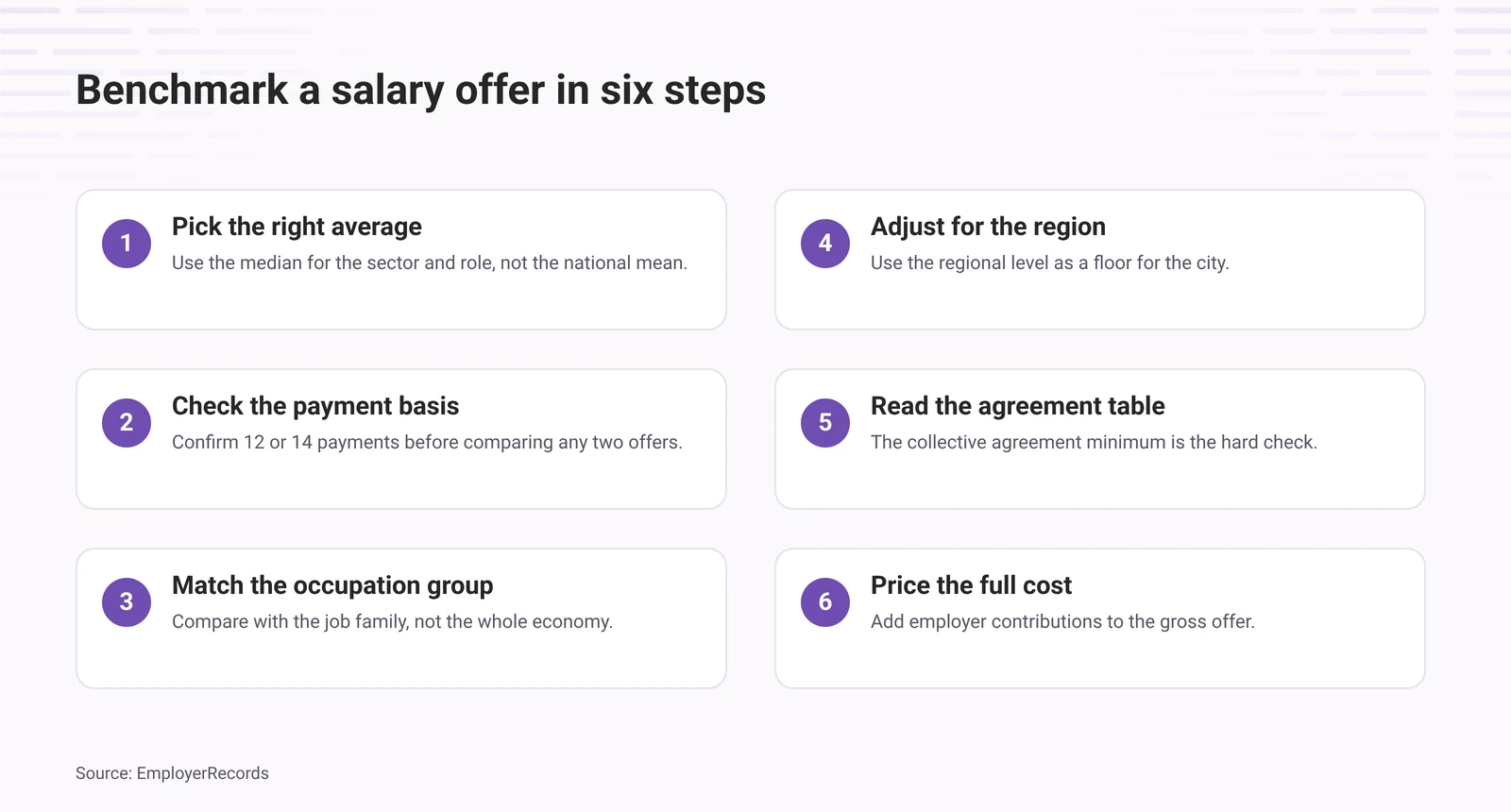
What we’d do. Quote two numbers to your hiring manager, the sector median and the collective agreement table minimum. If the offer sits below the second, stop. It will come back as a claim, whatever the first number says.
Which Spanish pay statistics should employers use?
Two INE surveys answer different questions, and mixing them causes bad budgets.
INE’s annual wage survey measures gross earnings per employee over a full year. Its quarterly labour cost survey measures what employers pay per worker per month, social contributions included.[1][3]
The two INE surveys compared
| Question | Annual wage survey | Quarterly labour cost survey |
|---|---|---|
| What it measures | Gross annual earnings per employee | Labour cost per worker per month |
| Latest period | 2024, published May 2026 | Second quarter 2026, published September 2026 |
| Includes employer contributions | No | Yes, in “other costs” |
| Best use | Salary benchmarks | Pay growth and total cost trends |
In the second quarter of 2026 labour cost averaged €3,388.15 per worker per month: €2,512.68 in wages and €875.47 in other costs.[3] Other costs came to 34.8% of wages (our calculation), a market-wide figure that mixes all firms. Our 32.1% for a single office hire is lower because it excludes extras such as severance, training and benefits.
How does the average salary compare with the minimum wage?
At €17,094 a year, the 2026 minimum wage is 57.9% of the 2024 mean and 69.8% of the median (our calculations, mixing years, so a rough guide).[7][1] Government policy targets 60% of the average wage.[7]
Most common pay tells a sharper story. At €16,520 in 2024 it sat about 4% above that year’s minimum wage of €15,876, which means the largest group of employees was paid close to the legal floor.[1][8]
Our Spain minimum wage guide covers the rates, the annual floor test and what a minimum wage hire costs.
Does a foreign or EOR hire earn a different salary in Spain?
Spanish law sets no separate pay scale. An employer of record is the legal employer in Spain, so it pays the local salary and passes the cost on.
What changes is the permit threshold. In our Spain guide, the highly qualified route starts at €41,356.36 a year, about 40% above the national mean (our calculation). Our guides on EOR visas and work permits and how an employer of record works cover the route.
For other markets, compare with the salary guides for Brazil, the United Kingdom and Germany.
Questions about the average salary in Spain
Short answers to what employers ask most about Spanish pay, checked against INE data and the BOE on 19 November 2026.
What is the average salary in Spain?
INE puts the mean at €29,540 a year in 2024, the latest definitive data. Median pay is €24,497 and the most common salary is €16,520. All three are gross.
Is the average salary gross or net?
Gross. Employees pay 6.50% social security on top of that, plus income tax, so take-home is lower. Our figures stop at gross.
What is the average monthly salary in Spain?
About €2,462 a month if you divide the 2024 mean by 12, or €2,110 a payment in a 14-payment year. Both are our calculations.
Which sector pays the most in Spain?
Electricity, gas and air conditioning supply, at €57,932 a year, then financial services at €51,863 and information and communications at €42,742.
Which region pays the most?
Basque Country pay is €35,170, ahead of Madrid at €34,410. Extremadura pays the least at €24,979.
How much does it cost to employ someone at the average salary?
About €39,032 a year in total, or 32.1% more than the pay itself, on an open-ended office contract. Fixed-term contracts, other activities and EOR fees change it.
Is there a 2026 average salary yet?
No. INE’s annual survey for 2026 will come out in 2028. Its quarterly labour cost survey, which showed a 4.0% annual rise in the second quarter of 2026, is the best guide for now.
How does the average salary compare with the minimum wage?
At €17,094, the 2026 annual minimum is about 58% of the 2024 mean. Most common pay sits just above the minimum.
References and sources
Every figure on this page comes from the sources below. Numbers in square brackets in the text link to the matching entry. Official statistics are used wherever they exist, and our own calculations are labelled as estimates. All sources were checked on 19 November 2026.
- ↑Encuesta Anual de Estructura Salarial (EAES). Año 2024. Datos definitivos. Instituto Nacional de Estadística, 28 May 2026. ine.es. Retrieved 19 November 2026. Data
- ↑El salario más frecuente en España alcanza los 16.520 euros tras la subida del SMI. Europa Press, via Bolsamania, 28 May 2026. bolsamania.com. Retrieved 19 November 2026. News
- ↑Encuesta Trimestral de Coste Laboral (ETCL). Segundo trimestre 2026. Instituto Nacional de Estadística, 17 September 2026. ine.es. Retrieved 19 November 2026. Data
- ↑Encuesta Trimestral de Coste Laboral (ETCL). Primer trimestre 2026. Instituto Nacional de Estadística. ine.es. Retrieved 19 November 2026. Data
- ↑El Gobierno eleva el Salario Mínimo Interprofesional hasta los 1.286 euros mensuales. La Moncloa, Consejo de Ministros, 17 November 2026. lamoncloa.gob.es. Retrieved 19 November 2026. Official
- ↑Orden PJC/297/2026, de 30 de marzo, por la que se desarrollan las normas legales de cotización a la Seguridad Social, desempleo, protección por cese de actividad, Fondo de Garantía Salarial y formación profesional para el ejercicio 2026. Boletín Oficial del Estado, 31 March 2026. boe.es. Retrieved 19 November 2026. Law
- ↑Real Decreto 126/2026, de 18 de febrero, por el que se fija el salario mínimo interprofesional para 2026. Boletín Oficial del Estado, 19 February 2026. boe.es. Retrieved 19 November 2026. Law
- ↑Salario mínimo interprofesional (Anuario de Estadística 2025, table 10.1.5). Ministerio de Agricultura, Pesca y Alimentación, with data from the Ministerio de Trabajo y Economía Social. mapa.gob.es. Retrieved 19 November 2026. Data
About the author

Manjuri Dutta is Co-Founder and Content Editor at EmployerRecords.com, covering Employer of Record providers and global hiring platforms. She evaluates providers on entity ownership, statutory compliance, and real pricing rather than vendor claims, and built the verification process used across EmployerRecords' country guides, checking vendor claims against government registries and public filings.
View all articles by ManjuriSalary guides for other countries
Compare Spain with the salary levels employers work with in other markets.
 SpainAnnual Leave and Extra PayAnnual Leave and Extra Pay in Spain (2026): 30 Days and Two Extra PaymentsStatutory leave, extra payments, public holidays and the exit pay they create, with a calculator.Read the guideSpainEmployer costsEmployer Costs in Spain (2026): 30.65% Plus the Accident PremiumSocial security rates, contribution base limits, the solidarity charge, sick pay and what a real salary costsRead the guideSpainContracts and probationEmployment Contracts and Probation in Spain (2026): Contract Types, Limits and What to StateContract types, temporary limits, probation caps and what to stateRead the guideSpainMinimum wageMinimum Wage in Spain (2026): €1,221 a Month in 14 PaymentsSpain's minimum wage is €1,221 a month in 14 payments, with the rates, employer cost and 2027 rise explained.Read the guideSpainTermination and SeveranceTermination and Severance in Spain (2026): 20 and 33 Days a YearDismissal routes, indemnities, notice and caps, with a worked case and a severance calculator.Read the guide
 Czech RepublicAverage salaryAverage Salary in the Czech Republic (2026): CZK 50,650 a MonthAverage and median pay, regional gaps, gross to net and what employers add on top, from the Czech Statistical Office.Read the guide
Hiring in Spain?
Our Spain hiring guide covers employer costs, contracts, collective agreements and how an employer of record compares with your own entity.