
Average Salary in Brazil (2026): R$3,790 a Month by Sector and Region
What Brazilian workers earn on average, why four official figures disagree, how take-home pay is built, and what a hire costs on top.
What is the average salary in Brazil in 2026?
Brazilian workers earned an average of R$3,790 a month from all jobs in July to September 2026. That is a gross mean from IBGE’s PNAD Contínua survey, 3.6% higher than a year earlier after inflation. Formal hires in September averaged only R$2,429, so price new offers against that lower figure.
- Range: R$1,491 in domestic work to R$5,284 in finance and ICT
- Next change: minimum wage proposed at R$1,741 from January 2027
- Employer cost: 50.9% on top of gross pay, with no ceiling
IBGE publishes the figure as a rolling three-month average, one new month at a time, and the latest reading covers July to September 2026.[1] Pay here means gross habitual pay, before INSS and income tax, and it leaves out payments that don’t arrive regularly.[2]
Who is counted matters. Everyone aged 14 or over who was working and had work income counts, formal and informal, across every job they hold.[1] Anyone out of work isn’t in the average.
At about R$5.65 to the US dollar on 13 November 2026, R$3,790 is roughly US$671.[3] That’s a market temperature reading. It tells you where Brazil sits, not what to offer.
Why do published Brazil salary figures differ?
Four official series answer four different questions, so you will see R$2,429, R$3,676, R$3,790 and R$4,595 all quoted as “the average salary in Brazil”.
None is wrong. They count different people, different jobs and different months, and the gaps between them are large enough to wreck a budget if you pick the wrong one.
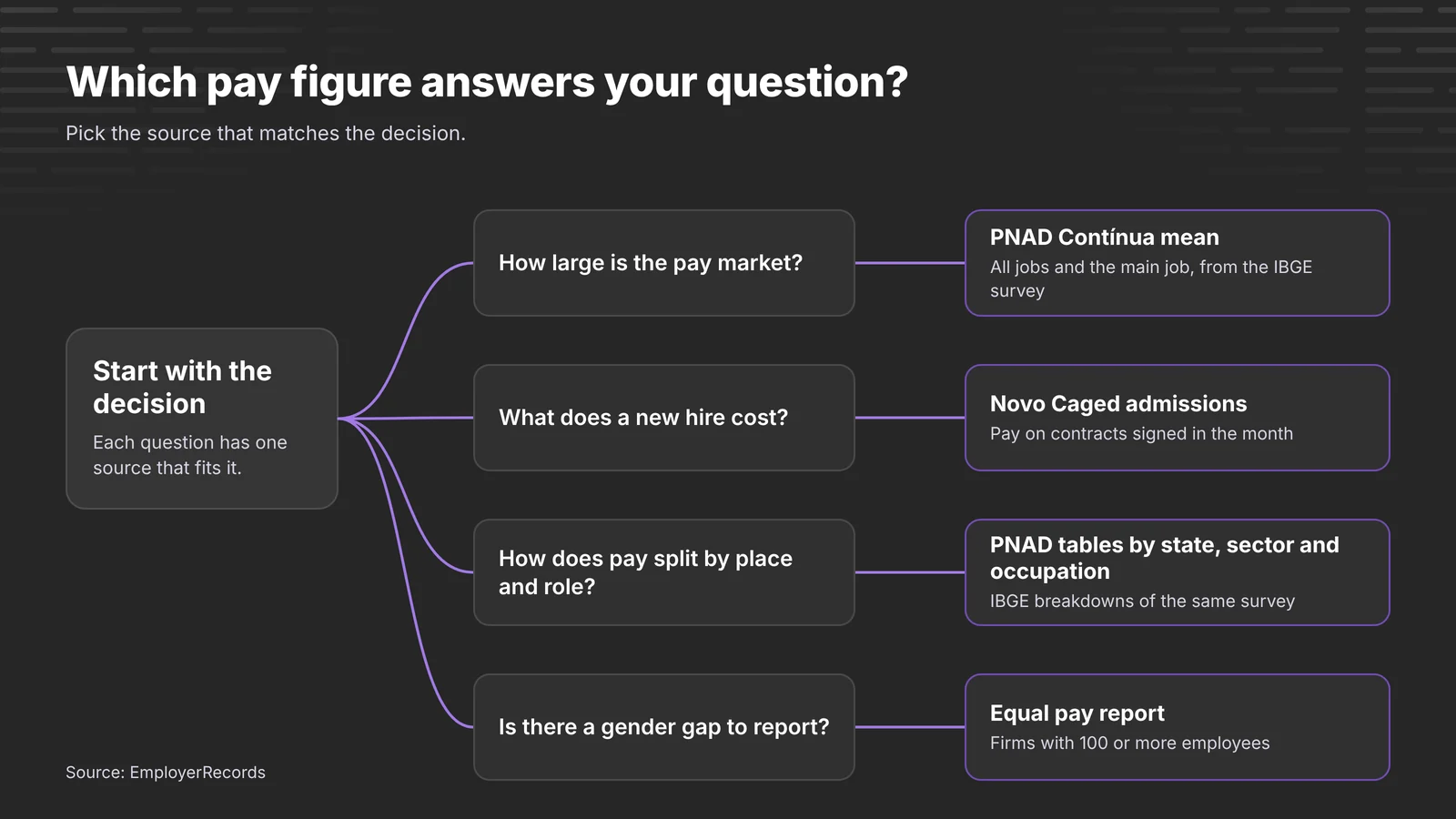
Four Brazilian pay figures and what each one measures
| Figure | Mean pay (R$) | Who and when |
|---|---|---|
| PNAD, all jobs | 3,790 | Everyone working with pay, every job held, July to September 2026.[1] |
| PNAD, main job | 3,676 | The same workers, main job only, July to September 2026.[4] |
| Novo Caged, admissions | 2,429.41 | People hired into formal jobs in September 2026.[5] |
| Equal pay report | 4,594.89 | All staff at the private firms covered by the report published in April 2026.[6] |
Our view. Caged is the only number built from contracts signed that month. If you’re setting an offer, it’s the right anchor, and a budget built on the survey mean would sit about 56% above what employers actually paid new hires in September.
Higher figures in the equal pay report come from its coverage: it only counts private firms with 100 or more employees.[6]
We found no published median for all workers in 2026. IBGE’s annual release for 2025 gives a mean of R$3,560 from all jobs and doesn’t report a median.[7] Any “median Brazil salary” you see quoted for this year isn’t coming from IBGE.
How much do employees, domestic workers and the self-employed earn?
Private-sector employees with a signed work card average R$3,403 a month in main-job pay, and those without it average R$2,681.[4] That signed card is worth about 27% in pay, before any benefit.
Mean main-job pay by position, July to September 2026
| Position | Mean pay (R$) |
|---|---|
| All workers with pay | 3,676 |
| Private-sector employees, all | 3,217 |
| Private-sector employees with a signed work card | 3,403 |
| Private-sector employees without a signed work card | 2,681 |
| Public-sector employees | 5,589 |
| Domestic workers | 1,491 |
| Employers | 9,238 |
| Employers with a CNPJ | 10,067 |
| Own-account workers | 3,140 |
| Own-account workers with a CNPJ | 5,360 |
| Own-account workers without a CNPJ | 2,287 |
Own-account workers with a CNPJ are the closest published match to PJ contractors, and they earn R$5,360. Take the R$3,403 employee, add 50.9% employer cost, and you get roughly R$5,135 a month.
That’s our calculation, but it explains why a PJ rate that looks high often just prices the same package an employee would get through CLT.
Reading the table. Own-account and employer rows describe business owners’ draws, not salaries. Don’t use them as an offer benchmark for an employee.
Which sectors pay the highest average salaries in Brazil?
Information, communication, finance, real estate and professional services top the list at R$5,284 a month, just ahead of public administration, defence, education and health at R$5,140.[8]
Domestic services sit at the bottom at R$1,491, which makes the spread across the table about 3.5 times.
Main-job pay by activity group, July to September 2026
| Activity group | Mean pay (R$) |
|---|---|
| Information, communication, finance, real estate and professional services | 5,284 |
| Public administration, defence, education and health | 5,140 |
| Industry (all) | 3,645 |
| Transport, storage and mail | 3,523 |
| Commerce and vehicle repair | 3,103 |
| Construction | 2,983 |
| Other services | 2,869 |
| Accommodation and food | 2,441 |
| Agriculture, forestry and fishing | 2,405 |
| Domestic services | 1,491 |
Software and tech roles sit somewhere inside the top group, but the group also holds banks, property firms, consultancies and administrative services, so it isn’t tech pay.
IBGE doesn’t publish developer salaries. Figures quoted for developers, designers or analysts come from private surveys, and we haven’t cited one.
What do different occupations earn in Brazil?
Directors and managers average R$9,741 a month in their main job, about 5.9 times the R$1,660 earned in elementary occupations.[9]
April to June 2026 is the latest quarter IBGE has published for occupation groups.
Pay by occupation group in the main job, April to June 2026
| Occupation group | Mean pay (R$) |
|---|---|
| Directors and managers | 9,741 |
| Military and police | 7,258 |
| Professionals in sciences and intellectual occupations | 7,182 |
| Technicians and mid-level professionals | 4,567 |
| Machine and plant operators | 2,906 |
| Skilled craft and manual workers | 2,732 |
| Administrative support | 2,727 |
| Service and sales workers | 2,659 |
| Skilled agricultural workers | 2,463 |
| Elementary occupations | 1,660 |
| All occupations | 3,621 |
Where hires land. Most degree-level roles fall in two groups: technicians and mid-level professionals at R$4,567, and sciences and intellectual professionals at R$7,182. That second group also covers doctors, lawyers and teachers, so treat it as a ceiling for the range and not as a figure to quote for one role.
Which Brazilian regions and states pay the most?
At R$4,362 a month from all jobs, the Centre-West leads, then the South at R$4,238 and the Southeast at R$4,124. North and Northeast trail at R$2,926 and R$2,645.[10]
Federal District pay tops the table because the federal civil service sits there. Public administration averages R$5,140 nationally in the sector table above, and the capital has a civil service no state matches. That’s our reading, not an IBGE finding.[8]
Where the employee lives, not where your company is registered, decides which collective agreement and which pay floor apply.[11] We found no official city-level figures for São Paulo or Rio in the tables we read, so city benchmarks need a private survey or the local agreement.
How fast are salaries rising in Brazil?
Real average pay rose 3.6% in the year to September 2026, from R$3,660 to R$3,790.[1] Most of that rise happened early.
Pay peaked at R$3,811 in the quarter ending in March, slipped to R$3,753 by June and has recovered to R$3,790. Since January the net gain is R$11 a month.
Each bar is the three months ending in the month shown
Source: IBGE PNAD Contínua, real values, workers with pay. [1]
IBGE reports these values in constant prices, so the rise is after inflation. Averages hide inequality too: the Gini coefficient for habitual earnings from all jobs was 0.491 in 2025, almost unchanged from 0.487 in 2024.[7]
If you promised reviews that track the market, a flat line since January means the market isn’t doing the work for you, and the annual raise in the collective agreement still binds.
How big is the gender pay gap in Brazil?
Women earned R$3,177 against R$3,959 for men in their main job in April to June 2026, so the gap in the survey is about 19.8%.[12] The equal pay report puts the gap at 21.3% among private firms with 100 or more employees, up from 20.7% in the previous edition.[6]
Both are raw gaps. Neither compares the same job, hours or seniority, so don’t use either to set an individual salary.
Law 14.611/2023 requires pay transparency reporting from companies with 100 or more employees, and the 2026 report covered about 53.5 thousand establishments.[6] Below that size you aren’t required to publish, but a competitor above it already does.
How does the average salary compare with the minimum wage?
National minimum pay is R$1,621 a month, a long way below the market for any professional role. For a given job, the collective agreement usually sets a higher floor, called the piso, along with an annual raise and often meal vouchers.[11]
Check that agreement before you check this table. For a professional role, the national minimum is the number that matters least.
How much is take-home pay on an average Brazilian salary?
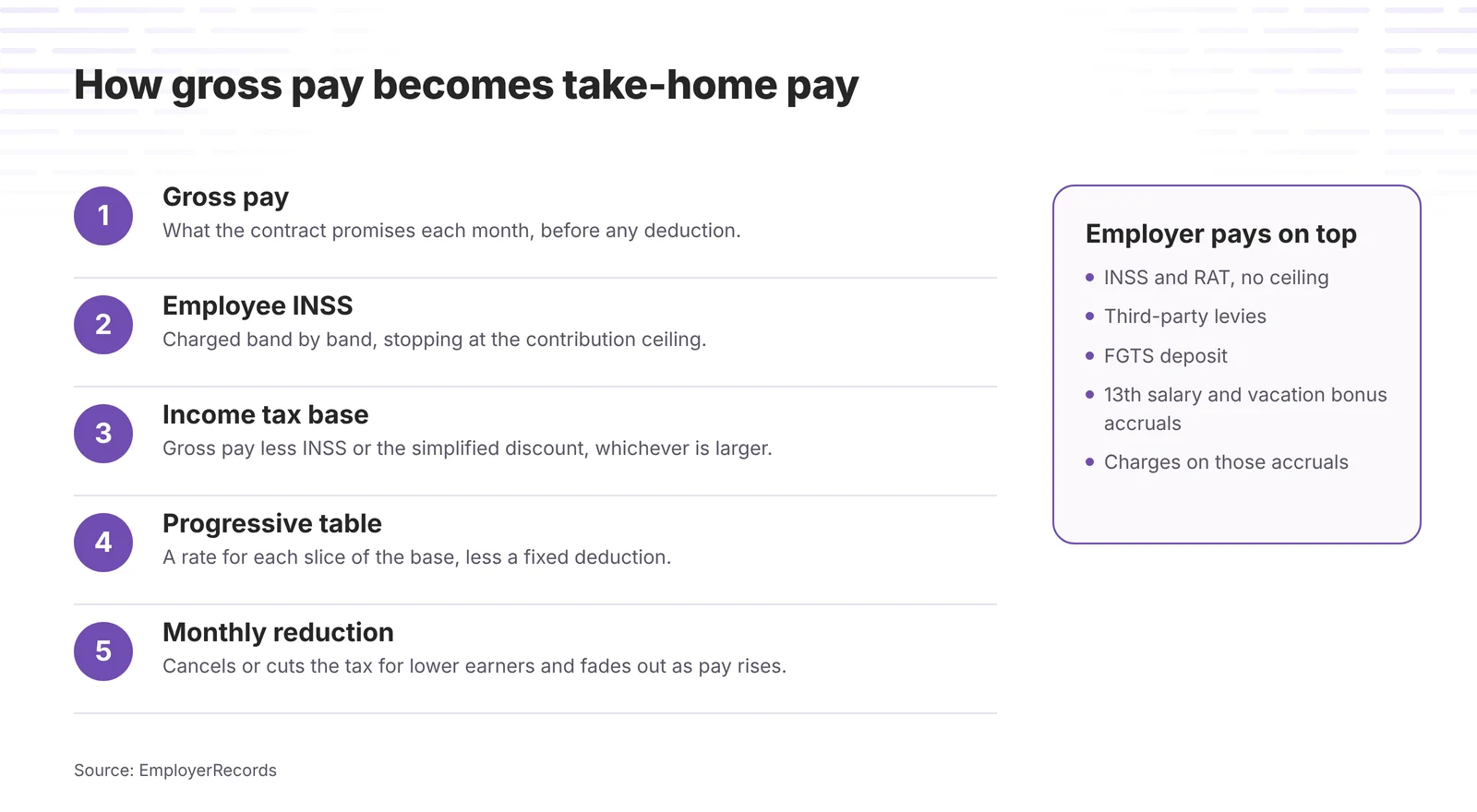
On R$3,790 gross, an employee takes home R$3,446.60 a month. INSS takes R$343.40 and no income tax is withheld.
Monthly take-home pay at seven gross salaries (our calculation from the 2026 rules)
| Gross monthly salary | Employee INSS | Income tax withheld | Net pay | Net share of gross |
|---|---|---|---|---|
| R$1,621 | R$121.58 | R$0.00 | R$1,499.42 | 92.5% |
| R$2,700 | R$218.69 | R$0.00 | R$2,481.31 | 91.9% |
| R$3,790 | R$343.40 | R$0.00 | R$3,446.60 | 90.9% |
| R$5,000 | R$501.51 | R$0.00 | R$4,498.49 | 90.0% |
| R$8,100 | R$935.51 | R$1,061.50 | R$6,102.99 | 75.3% |
| R$12,000 | R$988.09 | R$2,119.55 | R$8,892.36 | 74.1% |
| R$27,000 | R$988.09 | R$6,244.55 | R$19,767.36 | 73.2% |
Take R$5,000. INSS is R$501.51, but the simplified R$607.20 discount is larger, so the income tax base is R$4,392.80. Tax on that base comes to R$312.89, and the monthly reduction cancels it exactly.[13][14]
Above R$5,000 the reduction fades by 13.3 cents for every extra real, until it disappears at R$7,350. That’s why a raise from R$5,000 to R$5,200 leaves the employee with only R$100.38 more, since the raise itself is taxed at about 36% on top of the 14% INSS.
Check the payslip. If an employee on R$7,000 asks why a R$500 raise lifts net pay by only R$265.15, this is the reason. Between R$5,000 and R$7,350 a raise is worth about half its face value to the employee, so price offers on net pay as well as gross.
What are the INSS and income tax rates for employees in 2026?
Employee INSS runs from 7.5% to 14% in four bands and stops at a ceiling of R$8,475.55, which makes the highest monthly contribution R$988.09.[15]
Employee INSS bands, 2026
| Monthly contribution salary (R$) | Rate | Total INSS at top of band (R$) |
|---|---|---|
| Up to 1,621.00 | 7.5% | 121.58 |
| 1,621.01 to 2,902.84 | 9% | 236.94 |
| 2,902.85 to 4,354.27 | 12% | 411.11 |
| 4,354.28 to 8,475.55 | 14% | 988.09 |
Each rate applies only to the slice inside its band. Nobody pays 14% on a whole salary.[15]
Income tax is withheld on what is left after INSS, or after a R$607.20 simplified discount where that is bigger. Each dependent deducts R$189.59 a month.[13]
Monthly income tax withholding table, 2026
| Tax base (R$) | Rate | Deduction (R$) |
|---|---|---|
| Up to 2,428.80 | 0% | 0 |
| 2,428.81 to 2,826.65 | 7.5% | 182.16 |
| 2,826.66 to 3,751.05 | 15% | 394.16 |
| 3,751.06 to 4,664.68 | 22.5% | 675.49 |
| Above 4,664.68 | 27.5% | 908.73 |
Law 15.270/2025 then reduces the tax. Monthly taxable income up to R$5,000 gets a reduction of up to R$312.89, which cancels the tax. Between R$5,000.01 and R$7,350 the reduction is R$978.62 minus 0.133145 times the income, so it reaches zero at R$7,350.[14]
Employer side. Your cost doesn’t move. Only the employee’s withholding changes with the exemption, so employer charges stay at the same percentage whatever the salary.[11]
Calculate net pay and employer cost for a Brazilian salary
Enter a monthly gross salary and the number of dependents. Results start at the average salary and match the take-home table above to the cent.
Brazil net pay and employer cost, 2026 rules
Estimate for one monthly payroll. It assumes a CLT employee on the 2026 INSS and income tax tables, a RAT of 2%, FPAS 515 third-party levies, and the 13th salary and vacation bonus accrued monthly. It leaves out the 40% FGTS fine, transport vouchers and collective agreement benefits. For EOR fees and currency, use the full Brazil cost calculator.
What does an average salary cost an employer in Brazil?
A R$3,790 hire costs R$5,718 a month, which is 50.9% on top of the wage. That is about US$1,012 at R$5.65 to the dollar.[3]
R$3,790 wage plus R$1,928 in charges and accruals.
50.9% on top of the wageTwo numbers circulate, and they measure different things. Charges alone on twelve salaries come to 35.8% of gross (22% INSS and RAT, 5.8% third-party levies and 8% FGTS). Add the 13th salary and vacation bonus, with the same charges falling on both, and you reach the 50.9% the hub uses.[11]
RAT is assumed at 2%. By law it’s 1%, 2% or 3% by activity, times a factor between 0.5 and 2.0, so the real charge can sit between 0.5% and 6%.[11] The 40% FGTS fine on a dismissal without cause isn’t in the number, nor are transport vouchers above 6% of salary or benefits set by a collective agreement.[11]
What we’d do first: ask your provider which FPAS code its entity pays, because it moves this figure more than any other input. Hub examples at R$2,700, R$8,100 and R$27,000 all land on the same 50.9%, which is why we don’t recommend a Brazil budget that adds a flat 30%.
How do you benchmark a salary offer in Brazil?
Start with the collective agreement for the role in the employee’s city, because it sets the salary floor and the annual raise date.[11] Then check the sector and region tables on this page, and keep the Novo Caged hiring pay as your reality check.
Three layers set pay in Brazil, and an offer has to clear all of them.
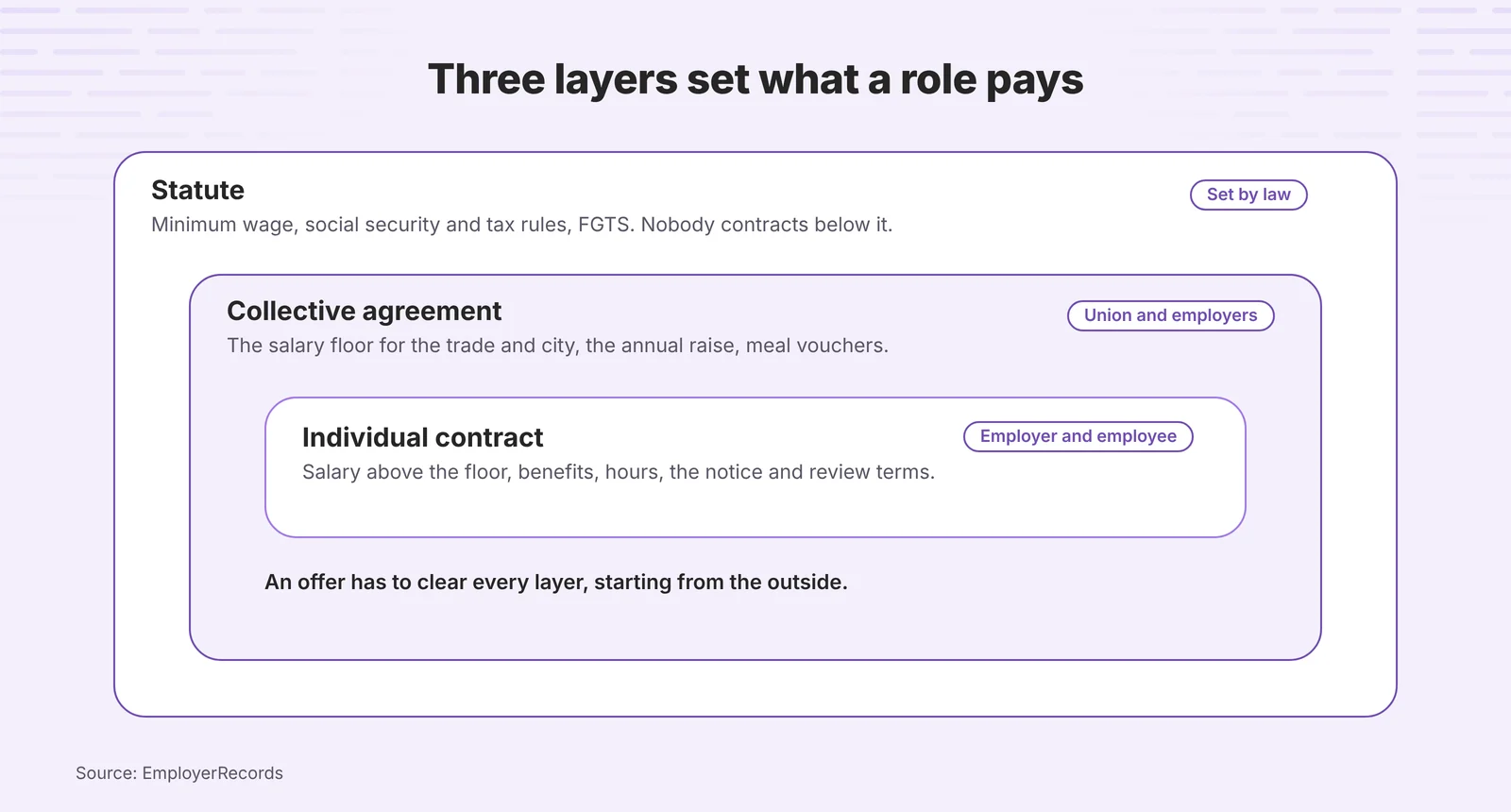
On top of that, the contract adds what the market demands: a salary above the floor, meal vouchers where the agreement expects them, a health plan for professional roles.[11]
Don’t budget on the survey mean. At R$3,790 a hire already sits well above the R$2,429 that new hires averaged in September. Use the occupation table for the range and the local agreement for the minimum.
Can you hire in Brazil without setting up a company?
Yes, through an employer of record that already holds a CNPJ and an eSocial registration. It becomes the legal employer on a CLT contract, and you direct the work.[11]
Market rates run from $599 to $899 per employee per month, roughly 8% to 16% of gross pay, with some providers listing from $399.[11] Paying a PJ invoice instead is the route labour courts challenge most often.
Foreign hires also need the right to work. Residence authorisation comes first, and only an EOR with its own Brazilian entity can sponsor one. Start with the Brazil EOR providers page, read what an employer of record does, and price a role in the EOR cost calculator.
What changes for pay and payroll in Brazil from 2027?
A shorter week at the same monthly pay raises the hourly cost. Going from 44 to 42 hours lifts the cost of each hour by about 4.8% in our calculation, and the 40-hour week due from 16 December 2027 takes the total to 10% over today.
Employer percentages stay put. What changes is the price of an hour, which matters if you pay by the hour or schedule shifts.
Once the salary is set, the rest of the bill follows from it. The employer costs guide shows the charges on top, the 13th salary and vacation pay and FGTS guides cover the two biggest add-ons, and the termination guide prices an exit.
Questions about the average salary in Brazil
Short answers to what employers ask most, checked against IBGE, the Novo Caged release and the 2026 payroll tables on 17 November 2026.
What is the average salary in Brazil right now?
R$3,790 a month from all jobs for July to September 2026, gross, from IBGE’s PNAD Contínua. It’s a mean in real terms, so a few very high earners pull it up.
Is that what a new hire in Brazil earns?
No. Formal hires in September 2026 averaged R$2,429, which is about 36% below the survey mean. It includes managers, civil servants and business owners who’ve been working for decades, so use hiring pay when you price an offer.
What is the median salary in Brazil?
We found no published median for 2026. IBGE’s annual release for 2025 gives a mean of R$3,560 and no median.
How much is take-home pay on R$3,790 a month?
R$3,446.60. INSS takes R$343.40 and no income tax is withheld, because the monthly exemption covers pay up to R$5,000.
Which state pays the most?
Distrito Federal, at R$6,171 a month from all jobs in April to June 2026. Among the states, São Paulo is next at R$4,447.
Does the R$5,000 income tax exemption lower what I pay an employee?
Not on your side. It raises the employee’s net pay. Your charges (INSS, RAT, third-party levies, FGTS and the accruals) stay at 50.9% of gross, so the employee gets more and you spend the same.
How much should I add to a salary to get the real cost of a Brazilian hire?
About 50.9%, with no ceiling. A R$3,790 hire costs R$5,718 a month once the 13th salary, the vacation bonus and every charge on them are counted.
References and sources
Every figure on this page comes from the sources below. Numbers in square brackets in the text link to the matching entry. Official statistics are used wherever they exist, and our own calculations are labelled as such. All sources were checked on 17 November 2026.
- ↑PNAD Contínua, tabela 6390: rendimento médio mensal real habitualmente recebido em todos os trabalhos. IBGE, SIDRA, rolling quarter to September 2026. sidra.ibge.gov.br. Retrieved 17 November 2026. Data
- ↑Glossário da PNAD Contínua mensal. IBGE. ftp.ibge.gov.br. Retrieved 17 November 2026. Official
- ↑Dólar fecha em R$ 5,65 após sessão de estabilidade. Brasil 61, 13 November 2026. brasil61.com. Retrieved 17 November 2026. News
- ↑PNAD Contínua, tabela 6389: rendimento médio mensal real no trabalho principal, por posição na ocupação. IBGE, SIDRA, rolling quarter to September 2026. sidra.ibge.gov.br. Retrieved 17 November 2026. Data
- ↑Brasil gera 121,3 mil empregos formais em setembro. Agência Gov, Ministry of Labour and Employment (Novo Caged), 4 November 2026. agenciagov.ebc.com.br. Retrieved 17 November 2026. Official
- ↑Emprego feminino aumenta 11%, mas desigualdade salarial persiste. Agência Brasil, 27 April 2026. agenciabrasil.ebc.com.br. Retrieved 17 November 2026. News
- ↑Rendimento de todas as fontes 2025: PNAD Contínua. IBGE, 2026. biblioteca.ibge.gov.br. Retrieved 17 November 2026. Official
- ↑PNAD Contínua, tabela 6391: rendimento médio mensal real no trabalho principal, por grupamento de atividades. IBGE, SIDRA, rolling quarter to September 2026. sidra.ibge.gov.br. Retrieved 17 November 2026. Data
- ↑PNAD Contínua, tabela 5444: rendimento médio mensal real no trabalho principal, por grupamentos ocupacionais. IBGE, SIDRA, second quarter 2026. sidra.ibge.gov.br. Retrieved 17 November 2026. Data
- ↑PNAD Contínua, tabela 6472: rendimento médio mensal real por Grande Região e Unidade da Federação. IBGE, SIDRA, second quarter 2026. sidra.ibge.gov.br. Retrieved 17 November 2026. Data
- ↑How to Hire Employees in Brazil: Costs, CLT Rules and EOR Options. EmployerRecords, verified 23 October 2026. employerrecords.com. Retrieved 17 November 2026. Guide
- ↑PNAD Contínua, tabela 5436: rendimento médio mensal real no trabalho principal, por sexo. IBGE, SIDRA, second quarter 2026. sidra.ibge.gov.br. Retrieved 17 November 2026. Data
- ↑Imposto de Renda Retido na Fonte a partir de janeiro de 2026: tabela mensal e deduções. Diário das Leis, February 2026. diariodasleis.com.br. Retrieved 17 November 2026. Guide
- ↑Receita Federal orienta fontes pagadoras e contribuintes a calcular a redução do imposto de renda a partir de 1º de janeiro de 2026. Legisweb, 11 December 2025. legisweb.com.br. Retrieved 17 November 2026. Guide
- ↑Portaria Interministerial MPS/MF nº 13: nova tabela de contribuição do INSS para 2026. Portal de Exigências Legais (Senior), 12 January 2026. documentacao.senior.com.br. Retrieved 17 November 2026. Guide
About the author

Emma Whitmore is an EOR and Global Employment Content Writer at EmployerRecords, where she researches and writes practical resources on Employer of Record (EOR) services, international hiring, global payroll, employment compliance, and workforce expansion across international markets. With more than 15 years of experience in B2B content and editorial research, Emma specializes in turning complex employment regulations into clear, actionable guidance for HR leaders, founders, and globally distributed teams. Her work focuses on helping businesses understand country-specific hiring requirements, compare global employment providers, and navigate compliance with confidence.
View all articles by EmmaSalary and minimum wage guides for other countries
Compare Brazil with the pay floors and salary levels employers work with in other markets.
 Brazil13th Salary and Vacation13th Salary and Vacation Pay in Brazil (2026): Rules and CostHow the 13th salary and vacation pay are calculated, when each is due and what they add to the cost...Read the guideBrazilEmployer costsEmployer Costs in Brazil (2026): 50.9% on Top of SalaryWhat a Brazil hire really costs: employer charges, the 13th and vacation accruals, FGTS and a worked R$8,100 example.Read the guideBrazilFGTSFGTS in Brazil (2026): 8% Deposit, 40% Fine and Late PenaltiesHow much the monthly FGTS deposit is, what pay it covers, what the dismissal fine costs and what a late...Read the guideBrazilMinimum wageMinimum Wage in Brazil (2026): R$1,621 a Month, State Floors and 2027 OutlookWhat the national minimum wage is, who it covers, which states set higher floors and what a minimum wage hire...Read the guideBrazilTermination and SeveranceTermination in Brazil (2026): Notice, 40% FGTS Fine and Final PayHow notice, severance and the FGTS fine work in Brazil, and what ending a contract costs an employer.Read the guideBrazilWork VisaWork Visa in Brazil (2026): VITEM V Steps, Fees and the Two-Thirds RuleWho files, which ministry decides, what it costs, how long it takes and how many foreign staff a company can...Read the guide
Hiring in Brazil?
The Brazil hiring guide covers CLT costs, the 2026 working week changes, contractor risk and the EOR route.