
Work Visa in Brazil (2026): VITEM V Steps, Fees and the Two-Thirds Rule
Who files, which ministry decides, what it costs, how long it takes and how many foreign staff a company can employ.
How does a work visa work in Brazil in 2026?
A foreign employee needs a work residence authorisation, which the Brazilian employer normally requests online. It goes to the Ministry of Justice, which aims at 30 days for a complete file. After that, the worker collects a VITEM V visa at a consulate and registers with the Federal Police.
- Fees: R$168.13 for the file, R$204.77 for the ID card
- Staff cap: foreign staff limited to a third, in firms the rule covers
- Timing: allow about four months from signed offer to ID card
In practice the employer files. It rests on a signed employment contract and the company’s own records, although the official service page lets either the worker or the hiring company start it on MigranteWeb.[1][2] The worker can’t simply turn up and look for a job on the same footing as a Brazilian.
Who decides is where many English guides are out of date. They name the Ministry of Labour. Today the official service page sends the request to the Ministry of Justice, through its labour immigration unit, the CGIL.[1] The 2017 rules still carry the old ministry’s name, which may explain why the mistake keeps spreading.
Editor’s note: the files that stall are rarely the ones with a weak candidate. They’re the ones where the job description and the CV don’t line up. Because the ministry compares the qualification with the role you named, write the role first and check the worker against it.
Which work routes does Brazil offer?
Most corporate hires use the first row below. Others matter when you’re deciding whether a person needs a sponsor at all.
Work and residence routes for foreign nationals
| Route | Who it suits | Brazilian sponsor needed? |
|---|---|---|
| Work residence with employment (VITEM V) | A foreign employee hired on a CLT contract | Yes. The employer files.[2][3] |
| Technical assistance without employment | Specialists serving a contract between companies | Yes. The company that asked for the service.[4] |
| Digital nomad residence (VITEM XIV) | A remote worker paid from abroad | No, and a Brazilian employer is not allowed.[5] |
| Graduates of Brazilian universities | Foreigners who finished a degree in Brazil and live there | A work contract tied to the field of study.[6] |
| Mercosur, family and similar | Mercosur nationals and relatives of residents | No sponsor needed.[7] |
| Tourist or visit entry | Meetings and short stays | Work isn’t allowed.[8] |
Digital nomad status draws the most wrong turns. It’s built for people whose income comes from abroad, so a foreign company that hires through a Brazilian employer of record can’t use it.[5][7]
Mercosur nationals and spouses of Brazilians can work without a sponsored visa.[7] Check that before you start a sponsor file for someone who doesn’t need one.
Who qualifies for a VITEM V?
Education and experience are weighed against the job. Under the 2017 rule on work with employment, the employer has to prove one of six combinations.[9]
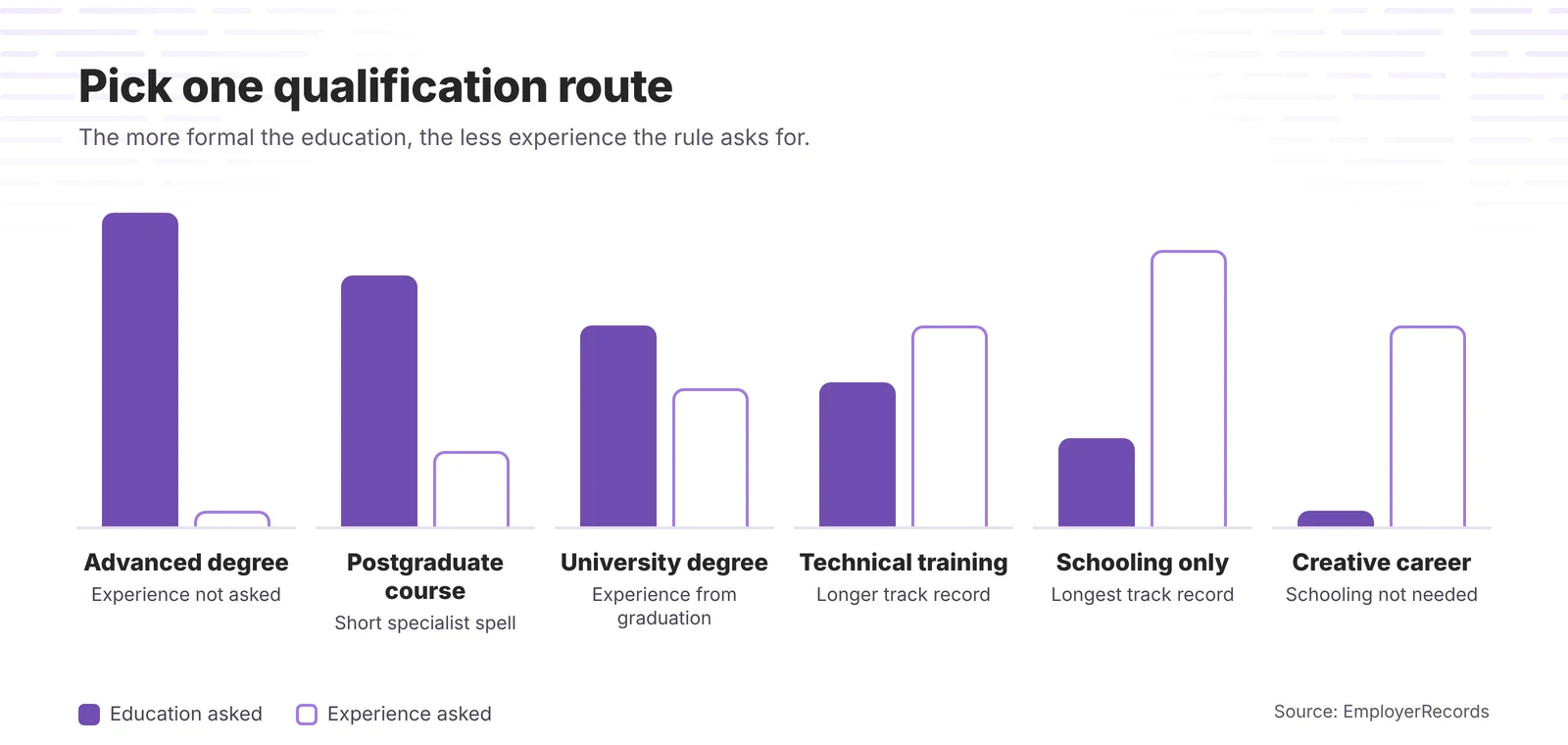
Qualification routes under RN 02/2017, article 2
| Route | Education | Experience |
|---|---|---|
| I | Master’s, doctorate or other higher qualification that fits the job | None stated |
| II | Postgraduate course of at least 360 hours | 1 year in the specialist area |
| III | University degree | 2 years, counted from graduation |
| IV | Technical-level training | 3 years |
| V | 12 years of schooling | 4 years, in a job that needs no technical or higher education |
| VI | No formal schooling needed | 3 years in an artistic or cultural profession |
Take a developer with a bachelor’s degree and 18 months of work since graduating. Route III asks for two years, so the file fails unless the person also holds a postgraduate course of at least 360 hours, which moves them to route II.
Some guides say a degree plus one year is enough. Per the rule text the ministry quotes, a degree holder needs two years, and one year only after that postgraduate course.[9] Diplomas and experience letters from abroad also need an apostille and a sworn translation made in Brazil.[2]
Read the current text. We took the six routes from the ministry’s own MigranteWeb data inventory, which reproduces the rule, and not from a consolidated resolution. Justice Ministry resolutions get amended, so have Brazilian counsel confirm the routes before you sign an offer.[9]
How do you get a Brazil work visa, step by step?
Five steps, and only one of them sits with the government for a fixed time. Everything else depends on how fast your documents move.
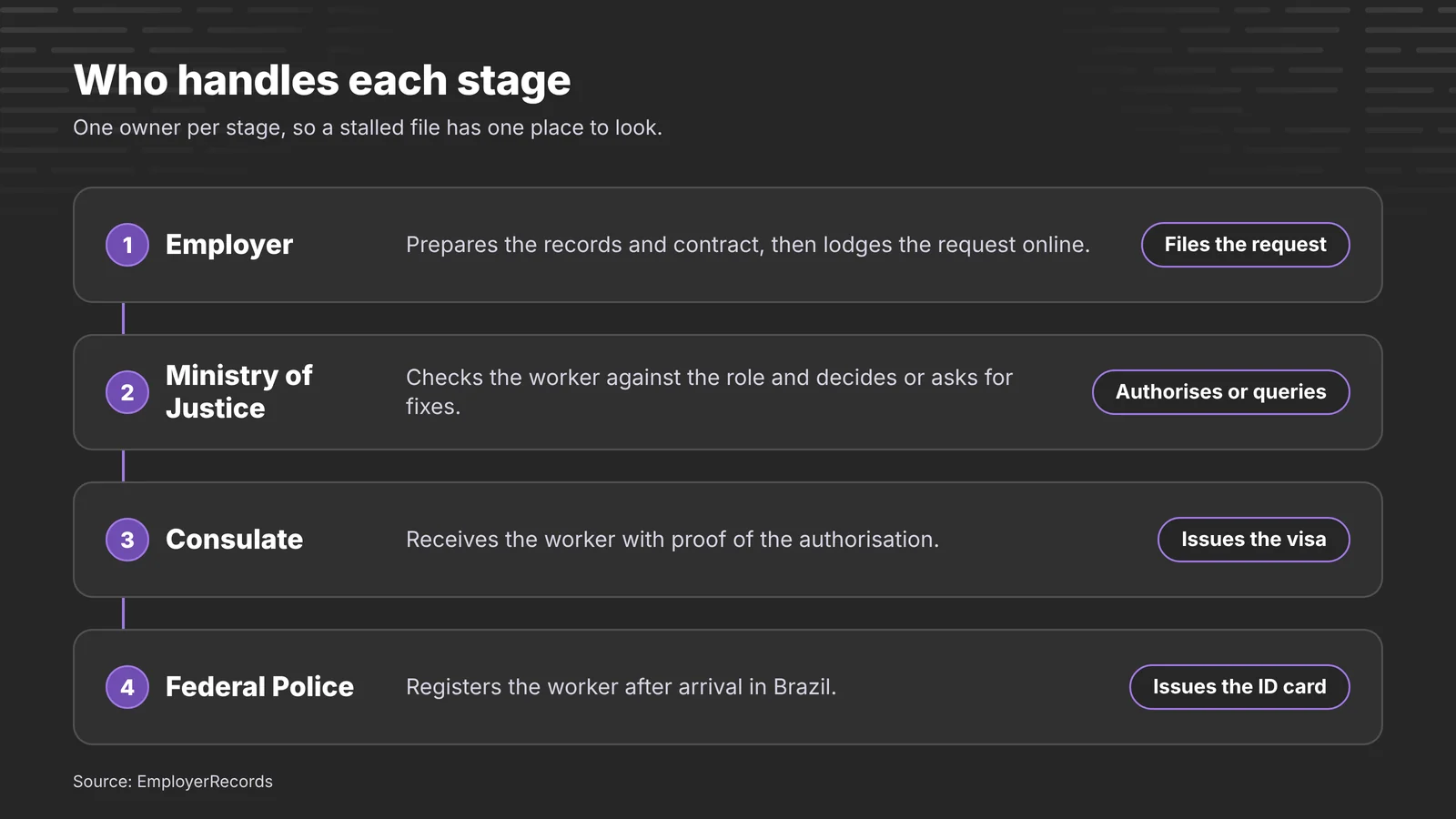
Five steps from signed offer to ID card
| Step | Who | What happens | Cost or time |
|---|---|---|---|
| 1 Prepare | Employer and worker | Company records, signed contract, passport, police certificates, sworn translations.[2] | Depends on you |
| 2 File | Employer | Register on MigranteWeb, lodge the request and pay the GRU.[1] | R$168.13 |
| 3 Review | Ministry of Justice | Decision, or a request for corrections.[1] | 30 days, 60 if queried |
| 4 Visa | Worker, at a consulate | Apply with proof that the authorisation exists.[10][8] | Fee varies by nationality |
| 5 Register | Worker, in Brazil | Federal Police registration and the ID card (CRNM).[11] | R$204.77 |
A file with gaps isn’t refused straight away. It’s suspended for 30 days from the electronic notice so the employer can fix it, and a further 30 days can be granted for good cause.[2] If the ministry denies the request, the employer has 10 days to appeal, and the reconsideration is due within 30 days.[2]
Registration with the Federal Police is due within 90 days of arrival under the 2017 decree, according to our hub and Brazilian immigration lawyers. We found no stated deadline on the Federal Police page, so don’t leave it late.[7][8][11]
Documents the authorisation file needs
| Side | What to prepare |
|---|---|
| Employer | Signed request form, company registration act, appointment act of the legal representative, CNPJ, power of attorney if an agent files, and the GRU payment proof.[2] |
| Worker | Valid passport, proof of parentage if it isn’t in the passport, criminal record certificates from every place lived in over the last five years, and a sworn declaration of no record elsewhere.[2] |
| Both | Signed employment contract and a justification for the hire.[8] |
Foreign documents need a Hague apostille, or consular legalisation where the country isn’t a party, plus a sworn translation by a translator registered in Brazil.[2]
Police certificates go stale. One Brazilian law firm says a criminal background check can’t be older than 90 days when it’s submitted. Order it close to filing, and not at the start of the project.[8]
How long does a Brazil work visa take?
Official clocks cover the ministry review and little else. Everything after that is an estimate, and the estimates disagree.
Time by stage, official and estimated
| Stage | Figure | Basis |
|---|---|---|
| Ministry review, complete file | Up to 30 days | Official[1] |
| Ministry review, file queried | Up to 60 days | Official[1] |
| Consular visa, one embassy | 5 to 10 business days | Official[10] |
| Consular visa, law firm estimate | 10 to 30 business days | Estimate[8] |
| Whole route, law firm estimate | 3 to 5 months | Estimate[8] |
| Whole route, provider estimate | 2 to 5 months | Estimate[12] |
Delays tend to come from apostilles and sworn translations, which the providers we read flag as the usual cause.[12] The ministry’s clock only starts once the file is complete.
For planning we’d use four months. It sits inside both estimates, and it leaves room for one round of corrections.
Nobody starts early. Workers shouldn’t start before the authorisation is published, even unpaid or remote for the Brazilian entity. Lawyers describe work without it as irregular, with fines, deportation proceedings and refusal of future applications as the risks.[8]
What does a work visa cost an employer?
Government fees are small. A work residence request costs R$168.13 and the ID card R$204.77, so R$372.90 in all, or about US$66.[1][13][14]
Official fees paid in Brazil
| Item | Amount (R$) | Approx. US$ |
|---|---|---|
| Work residence request, paid by GRU | 168.13 | US$30 |
| ID card issue, code 140120 | 204.77 | US$36 |
| Total official fees | 372.90 | US$66 |
Everything around the fees makes the real bill. One law firm puts the total at about R$2,000 to R$6,000 before legal fees, and a worked example near R$3,000.[8] Here’s a version built from its numbers.
Consular visa fees follow reciprocity, so what a worker pays depends on nationality and on the consulate. Embassy fee tables show the spread.[10][8]
A worked example of total costs (law firm estimate, our sum and conversion)
| Item | Amount (R$) | Approx. US$ |
|---|---|---|
| Work residence request | 168.13 | US$30 |
| Apostilles and sworn translations | 1,400 | US$248 |
| Consular visa, about US$100 | 565 | US$100 |
| ID card | 204.77 | US$36 |
| Courier, photos and travel | 600 | US$106 |
| Total | 2,937.90 | US$520 |
Lawyers’ fees come on top. One firm quotes US$1,200 to US$1,800 with legal help against US$600 to US$900 for a US citizen who does it alone.[15]
Next to payroll, the visa is the smaller cost. For a foreign employee on R$10,000 a month, charges add R$5,088 and the total comes to R$15,088 a month, about US$2,670.[7][14]
R$10,000 wage plus R$5,088 in charges and accruals.
50.9% on top of the wageCharges follow the basis in our Brazil hub: INSS and RAT at 22%, third-party levies at 5.8% and FGTS at 8%, each run at 10/9 because they also fall on the 13th salary and vacation bonus accruals.[7] RAT is assumed at 2%, and the 40% FGTS fine on a dismissal without cause sits outside the figure.[7]
We’d budget the visa and the first month’s payroll together. Visa fees are paid weeks before the first salary, and the two sit in different budget lines in most finance teams.
What is the two-thirds rule for foreign staff?
Under the CLT, covered companies must keep at least two thirds of their employees Brazilian, and the same share of the payroll.[16][17] It applies once a company has three or more employees, and the article names firms that run public-service concessions or carry on industrial or commercial activity.[16]
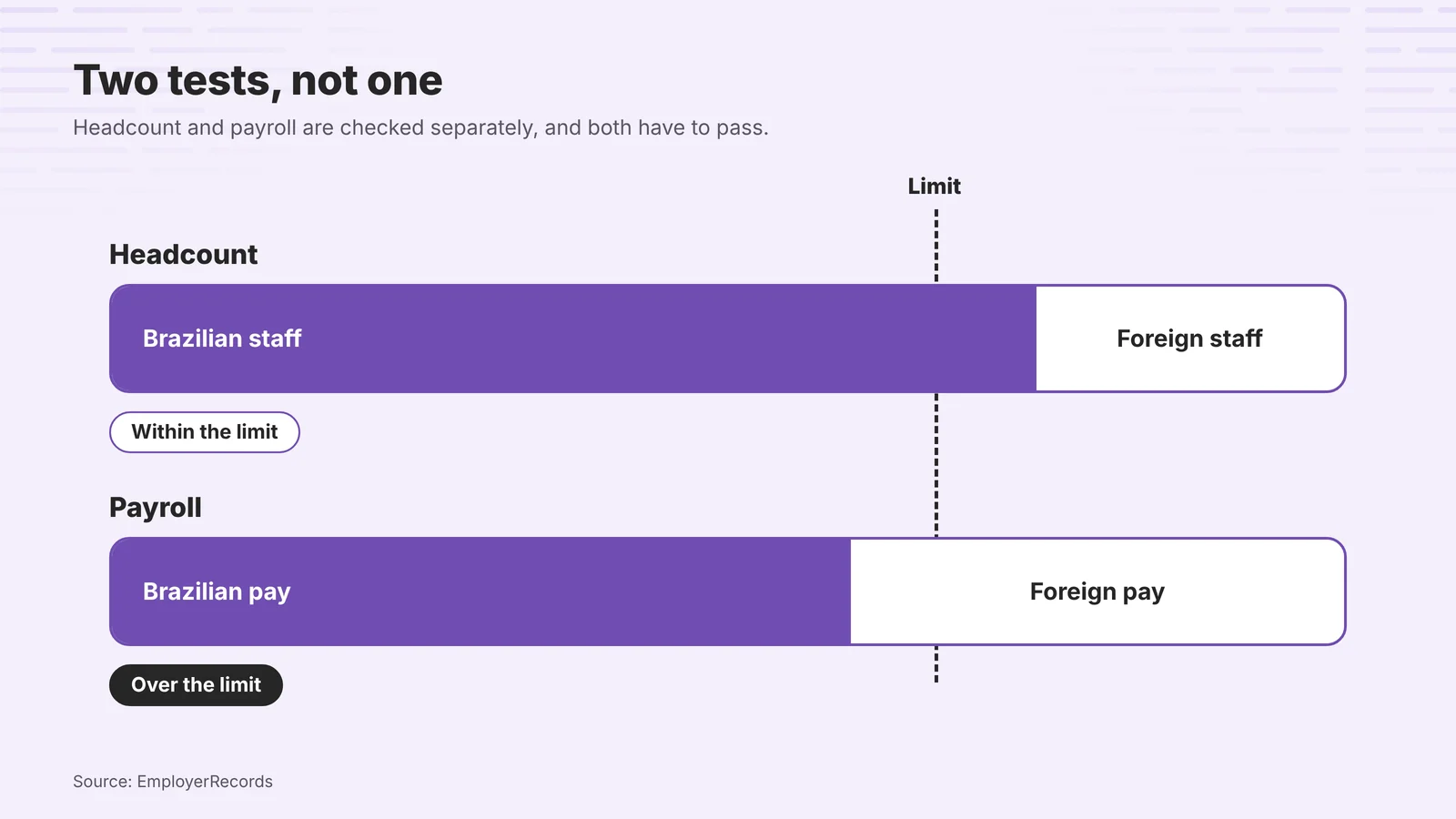
Branches and agencies with three or more staff count as separate establishments for the test.[18] Specialised technical staff fall outside it where the ministry finds a shortage of Brazilian workers, and foreigners with more than ten years of residence and a Brazilian spouse or child count as Brazilian.[19][20]
Pay has its own rule, and it runs the other way from what some guides say. Article 358 stops a company paying a Brazilian in a similar role less than the foreign colleague, with limited exceptions based on length of service.[21] Some labour lawyers argue the article didn’t survive the 1988 Constitution.[22] We wouldn’t plan around that argument.
Worked example, as loaded in the tool below
| Measure | Total | Foreign | Foreign share |
|---|---|---|---|
| Employees after the hire | 24 | 6 | 25.0% |
| Monthly payroll (R$) | 240,000 | 62,000 | 25.8% |
| Limit | 33.3% |
At 24 employees the most foreign staff allowed is 8, so this company has room for 2 more. Enter your own headcount and payroll below.
Check the foreign staff limit before you sponsor
Tests the CLT two-thirds rule on both headcount and payroll, on the basis that a company has three or more employees. Count every foreign employee, including the new hire, and leave out anyone who counts as Brazilian under the CLT. The tool doesn’t know whether your activity is covered or whether a shortage exemption applies, so treat it as a first screen and not as legal advice.
Payroll trips first. Headcount rarely breaks the limit. One or two senior foreign hires on high salaries can push the payroll share past a third while the headcount looks fine, so run both tests before you open a file.
Check coverage. Whether your company falls under the article turns on its activity. We’d treat the rule as applying unless Brazilian counsel confirms otherwise.
Can an employer of record sponsor the visa?
Yes, if the provider employs through its own Brazilian entity. That entity is the legal employer on the CLT contract, and it holds the tax number the file needs.[7]
One question deserves a direct answer from a provider: how many foreign nationals are on its Brazilian payroll today. Headcount and payroll tests are measured on the legal employer, which is the employer of record. That’s our reading of the rule and not a published position, so ask.
Fees are flat. Market rates run from $599 to $899 per employee per month, and visa costs sit on top.[7] Start with the Brazil EOR providers page, read what an employer of record does, and price the full month in the EOR cost calculator.
What happens after the first approval?
The first residence term is up to two years.[3] Fixed-term contracts and indefinite ones are treated differently on renewal, so write the contract term with the visa in mind.[8]
A worker may move between sites of the same company or group by notifying the ministry, rather than starting again.[24] Family members who come on family reunion residence can work.[7]
The visa only gets the person into the country. The contract then runs through Brazilian payroll, which the employer costs guide prices, with the 13th salary and vacation pay and FGTS guides covering the add-ons and the termination guide covering the exit.
Where do work visa files go wrong?
Same few things come up, file after file. A start date is fixed before the authorisation exists, so someone begins work on a tourist stamp. A police certificate is ordered in month one and has expired by month four. The job is described in one way on the contract and another on the file.
Foreign headcount is the quiet one. Teams run the visa and forget the two-thirds test until the file is queried.
If we had to pick one habit, it would be building the file backwards from the role: pick the qualification route first, name the job to match it, then collect the documents. It saves a round of corrections more often than anything else.
Questions about work visas in Brazil
Short answers to what employers ask most, checked against the official service pages and the 2017 rules on 17 November 2026.
Who applies for a Brazil work visa, the employee or the employer?
In practice the employer. It’s built on a signed employment contract and the company’s own records, and the official service page lets either side start it on MigranteWeb. Afterwards the worker collects the visa at a consulate.
How much does the government charge?
R$168.13 for the work residence request and R$204.77 for the ID card, which comes to R$372.90, or about US$66. Consular visa fees are extra and vary by nationality and consulate.
How long does approval take?
Ministry of Justice reviews aim at 30 days for a complete file and 60 days when corrections are requested. Signed offer to ID card usually takes three to five months, so plan for four.
Can someone start work on a tourist entry and fix the visa later?
No. Work on a tourist stamp is irregular, and Brazilian immigration lawyers warn of fines, deportation proceedings and refused future applications. Unpaid onboarding for the Brazilian entity counts too.
Does the two-thirds rule apply to every company?
Under the CLT it applies to companies with three or more employees that run public-service concessions or industrial or commercial activity. We’d treat it as applying unless Brazilian counsel confirms that your activity falls outside it.
Can an employer of record sponsor a work visa in Brazil?
Yes, if it employs through its own Brazilian entity, because the entity is the employer and holds the tax number the file needs. Ask a provider whether it has done it before and how long its files take.
Can a digital nomad visa holder work for a Brazilian employer?
No. The digital nomad visa covers remote work for an employer or clients abroad, with income of US$1,500 a month or US$18,000 in funds, so it can’t cover an employer of record hire.
Can the worker’s family come and work?
Family members apply for family reunion residence alongside the worker. That residence lets them work without a separate authorisation.
References and sources
Every figure on this page comes from the sources below. Numbers in square brackets in the text link to the matching entry. Official statistics are used wherever they exist, and our own calculations are labelled as such. All sources were checked on 17 November 2026.
- ↑Obter autorização de residência para fins laborais a imigrantes. Governo Federal, gov.br service page, updated 27 July 2026. gov.br. Retrieved 17 November 2026. Official
- ↑Resolução Normativa nº 01, de 1º de dezembro de 2017. Conselho Nacional de Imigração. edoc.ufam.edu.br. Retrieved 17 November 2026. Official
- ↑Autorização de residência para fins de trabalho. Schiefler Advocacia. schiefler.adv.br. Retrieved 17 November 2026. Guide
- ↑Resolução Normativa CNIg nº 3, de 1º de dezembro de 2017. Legisweb. legisweb.com.br. Retrieved 17 November 2026. Guide
- ↑Brazil digital nomad visa (VITEM XIV) in 2026. The Rio Times. riotimesonline.com. Retrieved 17 November 2026. News
- ↑Resolução CNIG/MJSP nº 50, de 27 de junho de 2024. Normas Legais. normaslegais.com.br. Retrieved 17 November 2026. Guide
- ↑How to Hire Employees in Brazil: Costs, CLT Rules and EOR Options. EmployerRecords, verified 23 October 2026. employerrecords.com. Retrieved 17 November 2026. Guide
- ↑Brazil Work Visa (VITEM V): Requirements & Process 2026. Ribeiro Cavalcante Advocacia, reviewed 23 August 2026. ribeirocavalcante.com.br. Retrieved 17 November 2026. Guide
- ↑Inventário de dados pessoais do MigranteWeb, quoting RN 02/2017, art. 2. Ministério da Justiça e Segurança Pública. gov.br. Retrieved 17 November 2026. Official
- ↑VITEM V, work visa. Embassy of Brazil in Doha, Itamaraty. gov.br. Retrieved 17 November 2026. Official
- ↑Registro de imigrante detentor de visto. Polícia Federal, updated 7 August 2026. gov.br. Retrieved 17 November 2026. Official
- ↑Brazil work visa guide. RemoFirst. remofirst.com. Retrieved 17 November 2026. Guide
- ↑Obter autorização de residência e carteira de registro migratório. Governo Federal, gov.br service page. gov.br. Retrieved 17 November 2026. Official
- ↑Dólar fecha em R$ 5,65 após sessão de estabilidade. Brasil 61, 13 November 2026. brasil61.com. Retrieved 17 November 2026. News
- ↑Brazil Work Visa (VITEM V) 2026: Requirements & Process. Ribeiro Cavalcante Advocacia. ribeirocavalcante.com.br. Retrieved 17 November 2026. Guide
- ↑Art. 352 da CLT. Petições Online. peticoesonline.com.br. Retrieved 17 November 2026. Guide
- ↑Art. 354 da CLT. Petições Online. peticoesonline.com.br. Retrieved 17 November 2026. Guide
- ↑Admissão de estrangeiro: o que diz a CLT. Pontotel. pontotel.com.br. Retrieved 17 November 2026. Guide
- ↑CLT, arts. 352 a 358, comentados. Aurum, updated 19 May 2025. aurum.com.br. Retrieved 17 November 2026. Guide
- ↑Art. 353 da CLT. Petições Online. peticoesonline.com.br. Retrieved 17 November 2026. Guide
- ↑Art. 358 da CLT. Petições Online. peticoesonline.com.br. Retrieved 17 November 2026. Guide
- ↑Espécies de equiparação salarial. vLex. vlex.com.br. Retrieved 17 November 2026. Guide
- ↑Resolução Normativa nº 30, de 12 de junho de 2018 (consolidada). Conselho Nacional de Imigração. edoc.ufam.edu.br. Retrieved 17 November 2026. Official
- ↑Decreto nº 9.199/2017, art. 147. Vade Mecum Previdenciário. vademecumprevidenciario.com.br. Retrieved 17 November 2026. Guide
About the author

Dhiraj Das is Co-Founder of EmployerRecords.com, where he leads content, research and partnerships. He has worked in content and online publishing for more than 15 years, and before EmployerRecords he founded a number of successful content brands. For the past six years he has specialised in HR technology, Employer of Record services and global hiring. His background in digital marketing and search shapes how EmployerRecords researches and presents its provider reviews, country hiring guides and cost data, so employers can compare their options and hire abroad with clear, checked information.
View all articles by DhirajWork permit and visa guides for other countries
See how other markets handle sponsorship, permits and the share of foreign staff.
 Brazil13th Salary and Vacation13th Salary and Vacation Pay in Brazil (2026): Rules and CostHow the 13th salary and vacation pay are calculated, when each is due and what they add to the cost...Read the guideBrazilAverage salaryAverage Salary in Brazil (2026): R$3,790 a Month by Sector and RegionWhat Brazilian workers earn on average, why four official figures disagree, and what a hire costs on top.Read the guideBrazilEmployer costsEmployer Costs in Brazil (2026): 50.9% on Top of SalaryWhat a Brazil hire really costs: employer charges, the 13th and vacation accruals, FGTS and a worked R$8,100 example.Read the guideBrazilFGTSFGTS in Brazil (2026): 8% Deposit, 40% Fine and Late PenaltiesHow much the monthly FGTS deposit is, what pay it covers, what the dismissal fine costs and what a late...Read the guideBrazilMinimum wageMinimum Wage in Brazil (2026): R$1,621 a Month, State Floors and 2027 OutlookWhat the national minimum wage is, who it covers, which states set higher floors and what a minimum wage hire...Read the guideBrazilTermination and SeveranceTermination in Brazil (2026): Notice, 40% FGTS Fine and Final PayHow notice, severance and the FGTS fine work in Brazil, and what ending a contract costs an employer.Read the guide
Hiring in Brazil?
The Brazil hiring guide covers CLT costs, the 2026 working week changes, contractor risk and the EOR route.