
Termination in Brazil (2026): Notice, 40% FGTS Fine and Final Pay
What it costs to end a Brazilian employment contract: notice, the FGTS fine, final pay and the four routes out, with a worked R$8,100 example and a calculator.
How much does it cost to terminate an employee in Brazil?
Ending a CLT contract without cause means notice, a 40% fine on the FGTS balance, final pay and proportional 13th salary and vacation. For R$8,100 and three and a half years of service, our estimate is R$33,406 in total, of which R$23,956 isn’t already accrued. A mutual agreement cuts the total to R$21,506.
- Notice: 30 days plus 3 per year of service, up to 90
- Fine: 40% of FGTS deposits, or 20% by agreement
- Final pay: due within ten days of the contract ending
Brazil has no probation-style grace period for ending a contract, so every dismissal runs through the same set of rules in the CLT and the FGTS law.[1][2] Most of the cost comes from two items: the notice period and the fine paid into the employee’s FGTS account.
We model one case throughout, so every number matches the Brazil hiring guide: a R$8,100 monthly salary, three years and six months of service, notice paid out instead of worked. Change any of it in the tool further down.
Our estimate. Totals on this page come from our own calculation on the rules cited, not from a payroll system. They leave out legal fees, any collective agreement severance and the employer’s INSS on the payments. Have your accountant confirm the figures before you sign a termination.
Which ways can a Brazilian employment contract end?
Four routes cover most exits, and the paperwork has to name one of them. Employers can dismiss without cause, both sides can agree to end the contract, the employee can resign, or the employer can dismiss for a serious breach.[1]
Money follows the route. Under the CLT, individual and collective dismissals count as the same thing, and no union approval or collective agreement is needed to carry one out.[1]
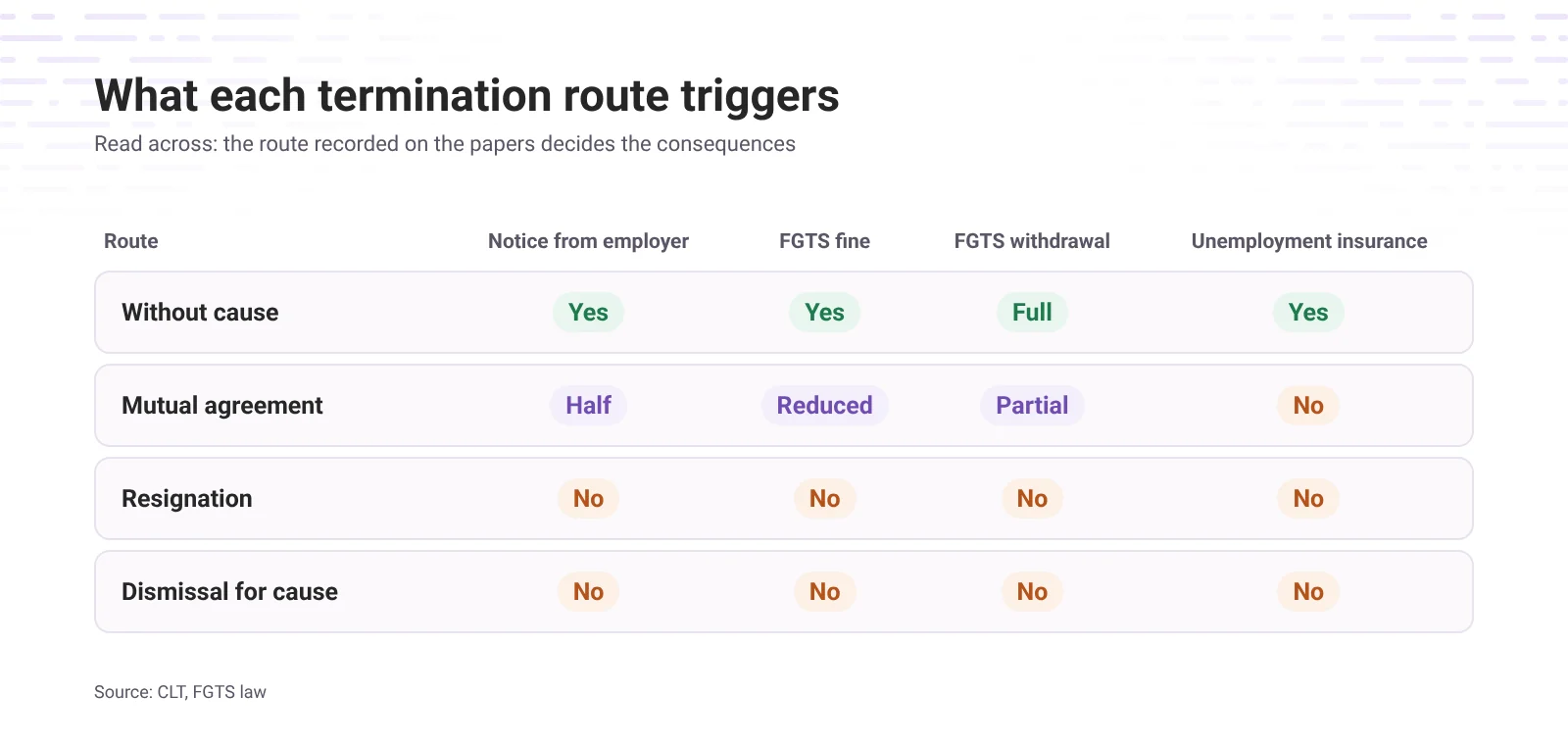
How the main termination routes compare (our summary of the sources cited)
| Route | Notice | FGTS fine | FGTS withdrawal | Unemployment insurance |
|---|---|---|---|---|
| Without cause by the employer | Owed by the employer | 40% | Full | Yes, if the waiting period is met |
| Mutual agreement, art. 484-A | Half, if paid out | 20% | Up to 80% | No |
| Resignation | Given by the employee | None | No | No |
| Dismissal for cause | None | None | No | No |
Our view: the cheapest route on paper is rarely the cheapest in practice. A dismissal for cause that a labour court overturns gets rewritten as a dismissal without cause, with the full package owed.
How long is the notice period?
Base notice is 30 days, and the CLT sets the same minimum for resignations.[1] A law from 2011 adds 3 days for every completed year of service at the same company, up to 90 days in total.[3] The Labour Ministry’s technical note counts the first year, so an employee with one year has 33 days and one with twenty years reaches the cap.[3]
That reading wasn’t obvious at first. Early commentary argued that the first three days only arrive at the second anniversary,[4] and some payroll systems still carry that setting. Ask which one your provider uses.
Extra days only help the employee. Under the ministry’s note, proportional notice is a right of the worker alone, so an employee who resigns still gives the base period.[5]
Notice can be worked or paid out. If you ask the employee to work it, the daily hours drop by two without a pay cut, or the employee can work full days and take seven consecutive days off at the end.[1] Either side can withdraw the notice before it ends, but the other side doesn’t have to accept.[1]
Habitual overtime counts in the pay for paid-out notice, and the notice period itself counts as service time.[1] Skip the notice and the employee is owed the salary for that period.[1]
What does the 40% FGTS fine really cost?
After notice, the fine is the largest single item, and it grows every year the employee stays. For a dismissal without cause, the employer deposits 40% of all FGTS deposits made during the contract, updated and with interest.[2] The employee doesn’t receive it as pay. It goes into the FGTS account and becomes available for withdrawal.[2]
Run it on our example. Three years and six months at R$8,100 builds about R$29,484 in deposits on salary and the 13th, which is 8% of each. Adding the deposit on the notice and the proportional 13th takes the base to about R$30,650, and the fine is R$12,260. That’s our calculation, before the correction and interest the statute adds.
Employers also deposit the months of the termination and the month before, if not yet paid.[2] A late deposit costs the TR, interest of 0.5% a month and a fine of 5% in the due month, and 10% after that.[2]
Mutual agreement and reciprocal fault. A mutual agreement halves the fine to 20%, and so does a dismissal for reciprocal fault or force majeure recognised by the labour court.[1][2] Employees who chose the annual birthday withdrawal still receive the fine on a dismissal without cause.[2]
Our view: finance teams that budget for the fine at the point of dismissal get surprised. It’s cheaper to carry it as a running provision, which is what the employer costs page does.
What is in the final pay package?
Final pay is more than a last salary. It adds the notice if paid out, the 13th and vacation earned so far with the extra third, the FGTS items above, and the days worked in the last month.[1][2]
Each item and its amount must appear on the receipt, and the employee’s release only covers the items listed.[1] Hand over the proof that the termination was reported and pay the amounts within ten days of the contract ending.[1]
What a dismissal without cause costs: R$8,100 salary, three years and six months (our calculation)
| Item | Amount | Already in the monthly cost? |
|---|---|---|
| Notice paid out (39 days) | R$10,530 | Not accrued |
| Proportional 13th salary (six months) | R$4,050 | Accrued in the monthly cost |
| Proportional vacation plus the extra third | R$5,400 | Accrued in the monthly cost |
| FGTS on the notice and 13th | R$1,166 | Not accrued |
| FGTS fine, 40% | R$12,260 | Not accrued |
| Total payout | R$33,406 | R$23,956 not accrued |
Here’s what that table says: of the R$33,406, only R$23,956 is new money. The 13th and vacation were already built into the cost per month on the employer costs page.
Late payment has its own penalty. Beyond the deadline the employer owes a fine to the employee equal to the employee’s salary, plus an administrative fine per worker.[1]
Is a mutual agreement worth offering?
Article 484-A lets employer and employee end the contract by agreement. Half the notice, if paid out, and half the FGTS fine are due, and every other item is paid in full.[1]
Employees can withdraw up to 80% of the FGTS balance, but can’t enter the unemployment insurance programme.[1] That is the price of the saving, and it’s why agreements usually need a real conversation first.
Dismissal without cause against a mutual agreement (same example, our calculation)
| Item | Without cause | Mutual agreement |
|---|---|---|
| Notice paid out | R$10,530 | R$5,265 |
| Proportional 13th and vacation | R$9,450 | R$9,450 |
| FGTS on the notice and 13th | R$1,166 | R$745 |
| FGTS fine | R$12,260 (40%) | R$6,046 (20%) |
| Total | R$33,406 | R$21,506 |
On our example the agreement saves R$11,900, just over a third of the total. Employees give that up in exchange for speed and a reference, not because the law steers them there.
What we’d do: record the agreement in writing with the figures attached, and don’t present it as the only way out. A signed agreement that was pushed on the employee is the kind of document a labour court re-reads.
When can you dismiss for cause, and what if you lose?
Article 482 lists specific grounds, and the employer has to prove one. A dismissal for cause pays no notice and no fine,[1][2] and the employee has no access to unemployment insurance.[6]
Risk runs the other way. If the employee challenges the reason and a labour judge reverses it, the exit becomes a dismissal without cause, and the benefit follows.[6]
An indirect dismissal works the other way round: the employee claims the employer breached the contract, and the right to notice and the benefit follow when it’s recognised.[1][7]
Some employees have temporary job protection through the constitution, statute or a collective agreement. Check before you serve notice, not after.
What does it cost when the employee resigns?
A resignation costs the employer less, and it also gives the employee less. There is no fine, no FGTS withdrawal and no unemployment insurance.[2][6]
Employees give notice, and if they leave without giving it, the employer can deduct the salary for that period.[1] The employee still gets earned 13th salary and vacation, and FGTS deposits made up to the last day stay in the account.
Check the paperwork. A resignation that follows a pressured conversation is a common source of claims. Keep the letter in the employee’s own words, dated, and don’t draft it for them.
Which deadlines apply after the last day?
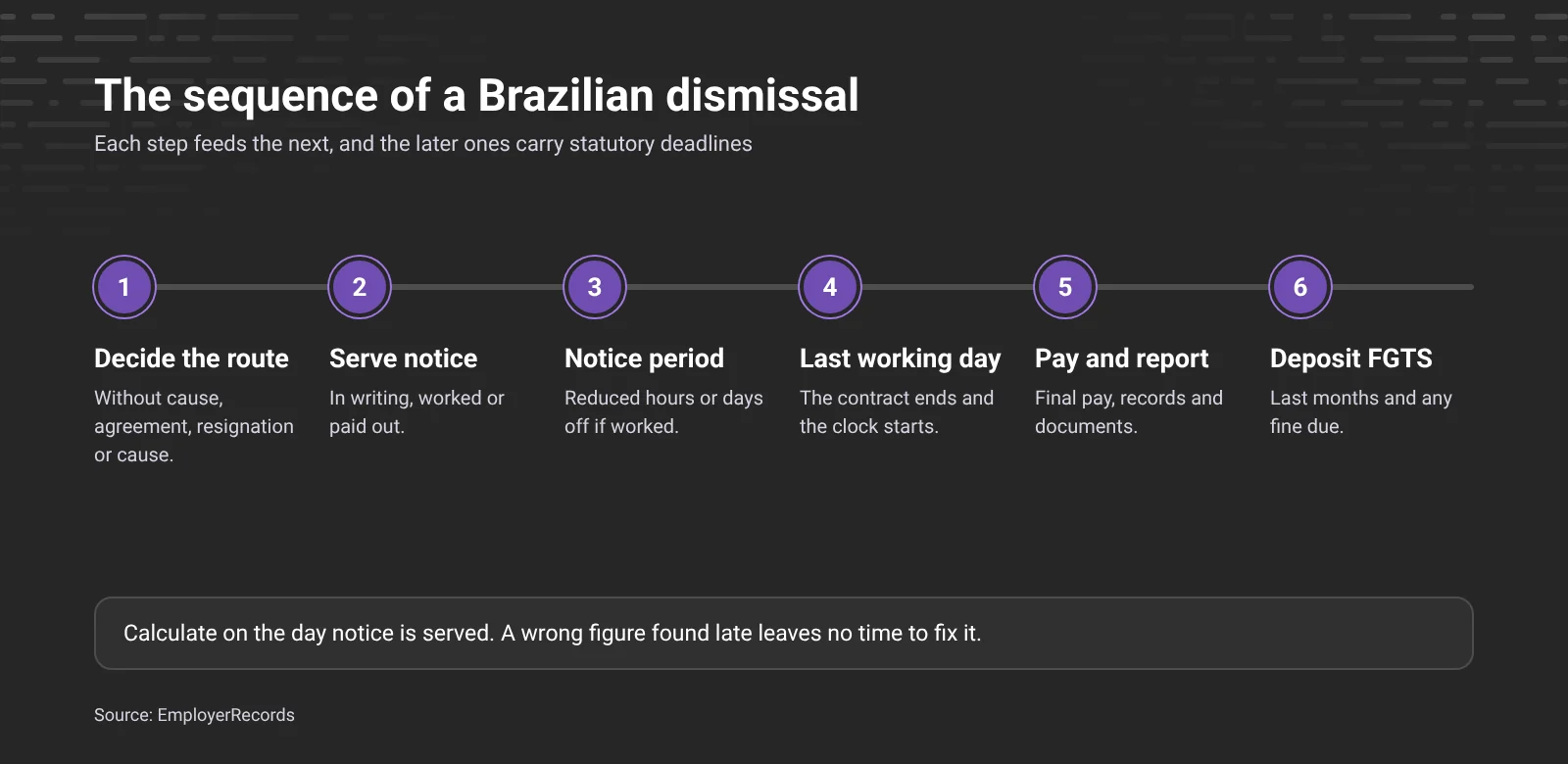
Three things run on the same ten-day clock: reporting the termination, handing over the documents and paying the amounts in the termination receipt.[1] The FGTS deposits and the fine fall under the same deadline.[2]
In practice the sequence is notice, last day, calculation, payment, then the records. Miss the order and a late payment fine follows.
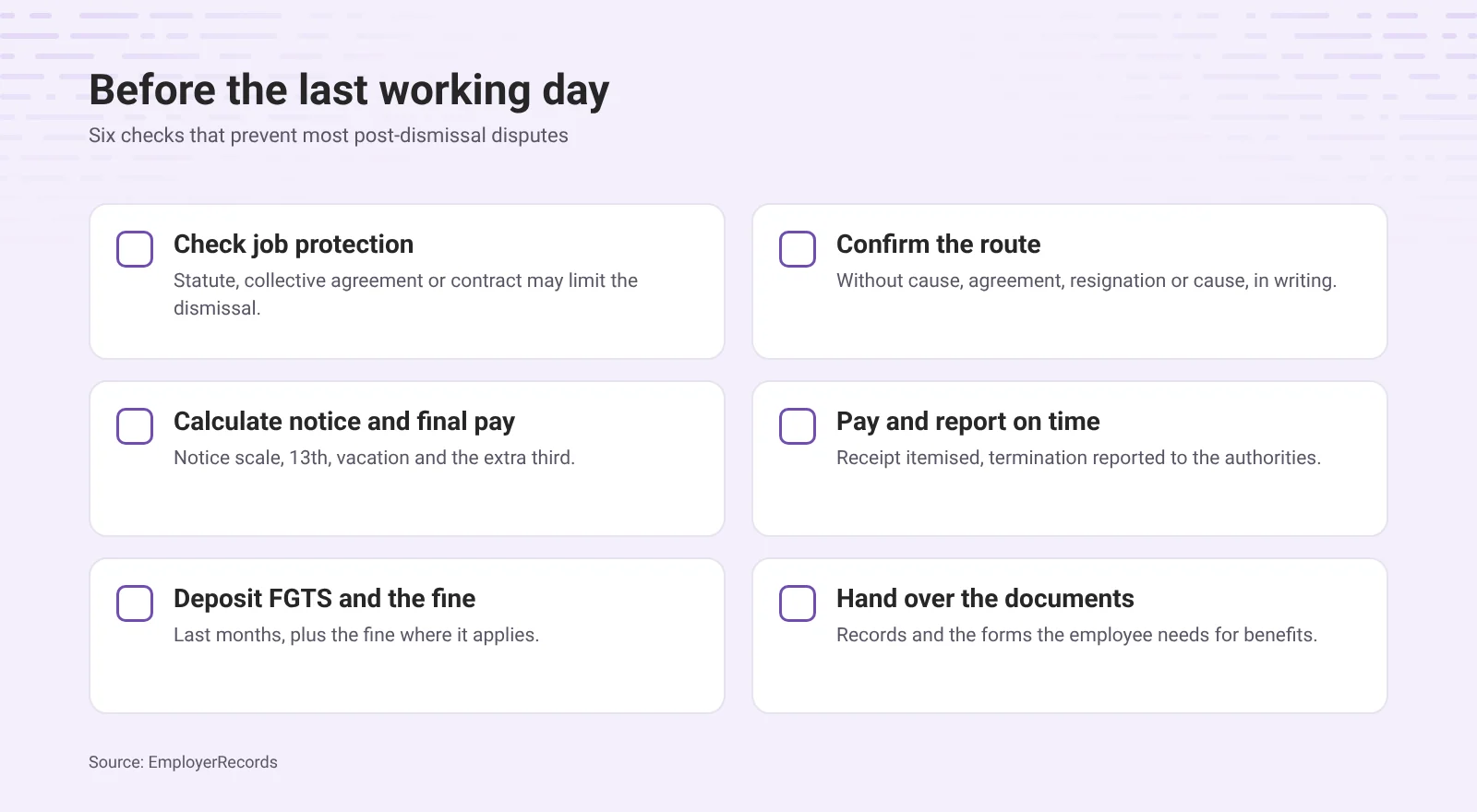
Our view: the safest habit is to calculate on the day notice is served, not on the last day. It leaves a week to fix a wrong figure.
What does the employee receive from the state?
Unemployment insurance is paid to employees dismissed without cause and in a recognised indirect dismissal.[6][7] The waiting period is 12 months worked in the last 18 for a first claim, then 9 and 6 for later ones.[7] Instalments run from three to five depending on months worked.[8]
Paperwork is the employer’s part. It reports the termination correctly in eSocial, and the employee applies directly.[6] Resignations, dismissals for cause and mutual agreements don’t qualify.[6][1]
How much will a dismissal cost?
Enter the salary and length of service. Defaults reproduce the table above, and each item is rounded before adding.
Brazil termination cost per employee
An estimate. It assumes notice is paid out, 8% FGTS on salary and the 13th, and a start in the same company. It leaves out interest on the fine, employer INSS on the payments, collective agreement severance and any EOR fee. For the full cost of employment, use the full Brazil cost calculator.
Where do termination budgets go wrong?
Most budgets forget the notice scale. A hire at five years has 45 days of notice, not 30, and the paid-out amount rises with it. At ten years it’s 60.
Next comes the fine base. People apply 40% to salary instead of to the FGTS deposits, which is a different and usually larger number once 13th salary deposits are counted.
Last is the route. Offering a mutual agreement to someone who then claims it was a dismissal is cheaper to avoid than to defend.
Who carries the termination risk with an EOR?
Statutory cost is the same, because the rules attach to the employment contract. What changes is who signs and who is responsible if a labour court disagrees with the reason recorded.
Ask the provider three things before you hire: who bears the cost of a dismissal without cause, whether it provisions the fine monthly, and how it handles a contested dismissal for cause. Our EOR cost calculator covers the fee side, and the Brazil EOR page compares providers.
Related rules sit in the minimum wage guide, the work visa guide and the employer costs guide. The pay that feeds a final settlement is explained in the 13th salary and vacation guide, and the deposits behind the fine are in the FGTS guide. If you’re new to the model, what an employer of record does explains the split.
Questions about terminating employees in Brazil
Short answers to what employers ask most about ending a Brazilian contract, checked against the CLT and the FGTS law on 18 November 2026.
How much notice does a Brazilian employee get?
Thirty days, plus three days for each completed year at the same company, up to 90 days. One year of service gives 33 days.
Is the FGTS fine paid to the employee?
Yes. It’s deposited into the employee’s FGTS account, at 40% of the deposits for a dismissal without cause, or 20% for a mutual agreement.
Can I dismiss someone without notice?
Only for cause. Without cause you either give the notice period or pay it out.
How quickly must final pay be made?
Within ten days of the contract ending. A late payment adds a fine equal to the employee’s salary.
Does a mutual agreement give the employee unemployment insurance?
No. It allows the employee to withdraw up to 80% of the FGTS balance, but not to enter the programme.
Does the employee owe notice when resigning?
Yes, at the base period. If they leave without it, the employer can deduct the salary for that period.
What if a dismissal for cause is overturned?
A labour judge can convert it to a dismissal without cause, which brings notice, the fine and the benefit.
References and sources
Every figure on this page comes from the sources below. Numbers in square brackets in the text link to the matching entry. Official statistics are used wherever they exist, and our own calculations are labelled as estimates. All sources were checked on 18 November 2026.
- ↑Decreto-Lei nº 5.452, de 1º de maio de 1943 (CLT). Câmara dos Deputados. www2.camara.leg.br. Retrieved 18 November 2026. Law
- ↑Lei nº 8.036, de 11 de maio de 1990. Câmara dos Deputados. www2.camara.leg.br. Retrieved 18 November 2026. Law
- ↑Aviso prévio proporcional é de 30 dias e mais 3 dias para cada ano trabalhado, incluindo o primeiro ano de serviço. TRT-3 (Tribunal Regional do Trabalho da 3ª Região), 21 March 2017. portal.trt3.jus.br. Retrieved 18 November 2026. Guide
- ↑Lei do aviso prévio proporcional deve gerar inúmeros processos judiciais. Consultor Jurídico, 2 November 2011. www.conjur.com.br. Retrieved 18 November 2026. News
- ↑Regulamentação obriga empresas a recalcular rescisões. Contadores.cnt.br, 11 June 2012. contadores.cnt.br. Retrieved 18 November 2026. News
- ↑Seguro-desemprego 2026: regras, quem tem direito e como pedir. Contabilidade Zen. www.contabilidadezen.com.br. Retrieved 18 November 2026. Guide
- ↑Seguro-desemprego 2026: cálculo, carência, parcelas e como solicitar. Marra CLT. www.marraclt.com.br. Retrieved 18 November 2026. Guide
- ↑Seguro-desemprego 2026: confira os novos valores e regras de concessão. Jornal Contábil. jornalcontabil.com.br. Retrieved 18 November 2026. News
About the author

Manjuri Dutta is Co-Founder and Content Editor at EmployerRecords.com, covering Employer of Record providers and global hiring platforms. She evaluates providers on entity ownership, statutory compliance, and real pricing rather than vendor claims, and built the verification process used across EmployerRecords' country guides, checking vendor claims against government registries and public filings.
View all articles by ManjuriMinimum wage and salary guides for other countries
Compare Brazil with the pay floors and salary levels employers work with in other markets.
 Brazil13th Salary and Vacation13th Salary and Vacation Pay in Brazil (2026): Rules and CostHow the 13th salary and vacation pay are calculated, when each is due and what they add to the cost...Read the guideBrazilAverage salaryAverage Salary in Brazil (2026): R$3,790 a Month by Sector and RegionWhat Brazilian workers earn on average, why four official figures disagree, and what a hire costs on top.Read the guideBrazilEmployer costsEmployer Costs in Brazil (2026): 50.9% on Top of SalaryWhat a Brazil hire really costs: employer charges, the 13th and vacation accruals, FGTS and a worked R$8,100 example.Read the guideBrazilFGTSFGTS in Brazil (2026): 8% Deposit, 40% Fine and Late PenaltiesHow much the monthly FGTS deposit is, what pay it covers, what the dismissal fine costs and what a late...Read the guideBrazilMinimum wageMinimum Wage in Brazil (2026): R$1,621 a Month, State Floors and 2027 OutlookWhat the national minimum wage is, who it covers, which states set higher floors and what a minimum wage hire...Read the guideBrazilWork VisaWork Visa in Brazil (2026): VITEM V Steps, Fees and the Two-Thirds RuleWho files, which ministry decides, what it costs, how long it takes and how many foreign staff a company can...Read the guide
Hiring in Brazil?
The hiring guide covers the CLT contract, entity options, notice and the full cost of an employee.