
Employment Contracts and Probation in Spain (2026): Contract Types, Limits and What to State
Which contract fits which need, how long temporary contracts can run, the probation caps, and what the written contract has to say.
How do employment contracts and probation work in Spain?
Spain treats every contract as open-ended unless a valid cause says otherwise. Probation can run up to six months for qualified technical staff, two months for other staff and three months for other staff in companies under 25 people, unless the collective agreement sets a different limit.
- Default: open-ended contract
- Probation: 6, 2 or 3 months
- Chaining: 18 months in 24 means permanent
Spanish law starts from a presumption: every employment contract is open-ended unless a valid reason says otherwise.[1] Most of what follows, from the probation caps to the chaining rule, flows from that default.
Two recent changes sit on top. Royal Decree 723/2026 replaced the old rules on what an employer must tell a new hire, and it has applied since 5 October 2026.[2] Royal Decree-law 39/2026 followed on 18 November and took effect the next day. It widens the duty to inform and rewrites the probation article.[3]
This guide covers the contract types, how long temporary contracts can run, the probation caps, what a written contract has to say, and a checker for probation limits.
Which contract fits the role?
Since the 2021 reform, fixed-term contracts exist for only two reasons. One is a production need and the other is covering a worker who keeps their post.[1][4] Everything else is open-ended, including seasonal work that returns every year.
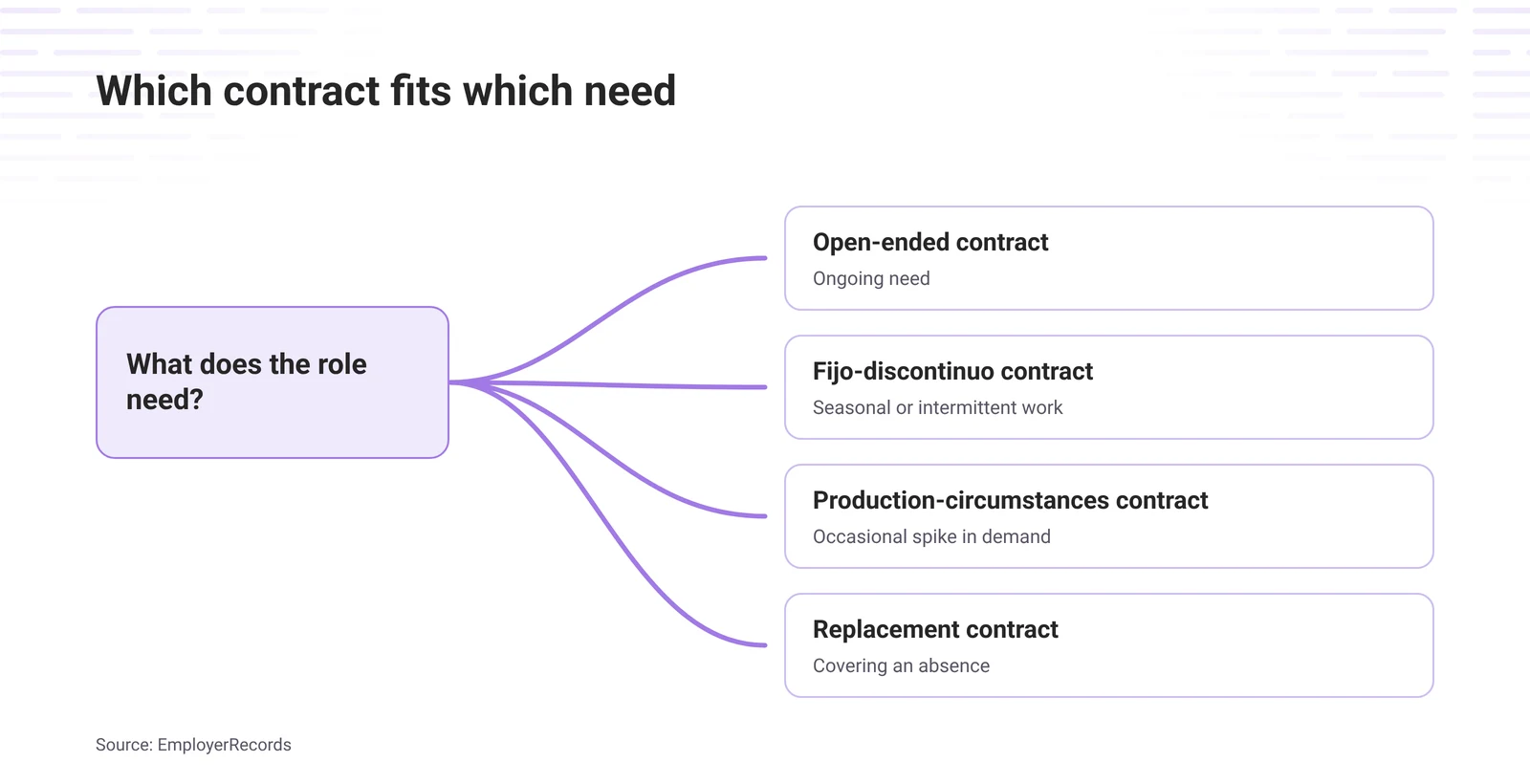
Contract types and their main limits[1]
| Contract | Use it for | Main limit |
|---|---|---|
| Open-ended | Ongoing work | Presumed by default |
| Fijo-discontinuo | Seasonal or intermittent work | Written, with the expected activity period |
| Production circumstances | An occasional spike in demand | Up to 6 months, 12 by sector agreement |
| Occasional short need | Predictable, short peaks | 90 days a year, never back to back |
| Replacement | Covering a named absent worker | Overlap of up to 15 days |
Training contracts follow their own rules, and we don’t cover them here.
Picture a Madrid retailer that needs extra hands for six weeks of sales. Production contracts work here, provided they name the specific circumstance and links it to the expected length.[1] A ski school that rehires the same instructors every winter is different. Because the need returns each year, a fijo-discontinuo contract is the lawful fit.[1]
How long can a temporary contract run?
A production contract can last up to six months. Sector collective agreements can lift that to one year, and the contract can be extended once within the maximum.[1]
Short, predictable needs have their own route. Companies can use occasional contracts for up to 90 days in a calendar year, or 120 in agriculture and agri-food. Those days can’t run back to back, and the employer must share a forecast with worker representatives in the last quarter of each year.[1]
Replacement contracts have to name the person replaced and the cause. A replacement can overlap with the absence for up to 15 days, and cover while a permanent post is being filled can last up to three months.[1]
The chaining rule catches employers who keep renewing. A worker employed for more than 18 months in any 24 under two or more production contracts with the same company or group becomes permanent.[1]
Say a warehouse signs one person to four contracts of five months each, with short gaps. That’s 20 months worked inside about two years, so the worker is permanent (our calculation).
Failing to register the worker with Social Security within a period equal to the probation limit has the same result.[1]
Watch this. A temporary contract used outside its two permitted causes turns into an open-ended one. Exit is where the cost lands, because the dismissal is that of a permanent employee. Our termination guide shows the amounts.
Article 21 bis adds a right to ask for something more stable. After six months of service, a worker can request a move from a temporary to an open-ended contract, among other changes. Employers must answer in writing with reasons within one month, or three months in firms with up to 10 workers.[3]
How long can probation last?
Probation has to be agreed in writing, and the cap depends on the worker and the company.[1]
Probation limits under Workers’ Statute article 14[1][5]
| Worker or contract | Maximum |
|---|---|
| Qualified technical staff | 6 months |
| Other staff | 2 months |
| Other staff in companies under 25 people | 3 months |
| Fixed-term contract of 6 months | 1 month |
| Shorter fixed-term contract | Reduced in proportion |
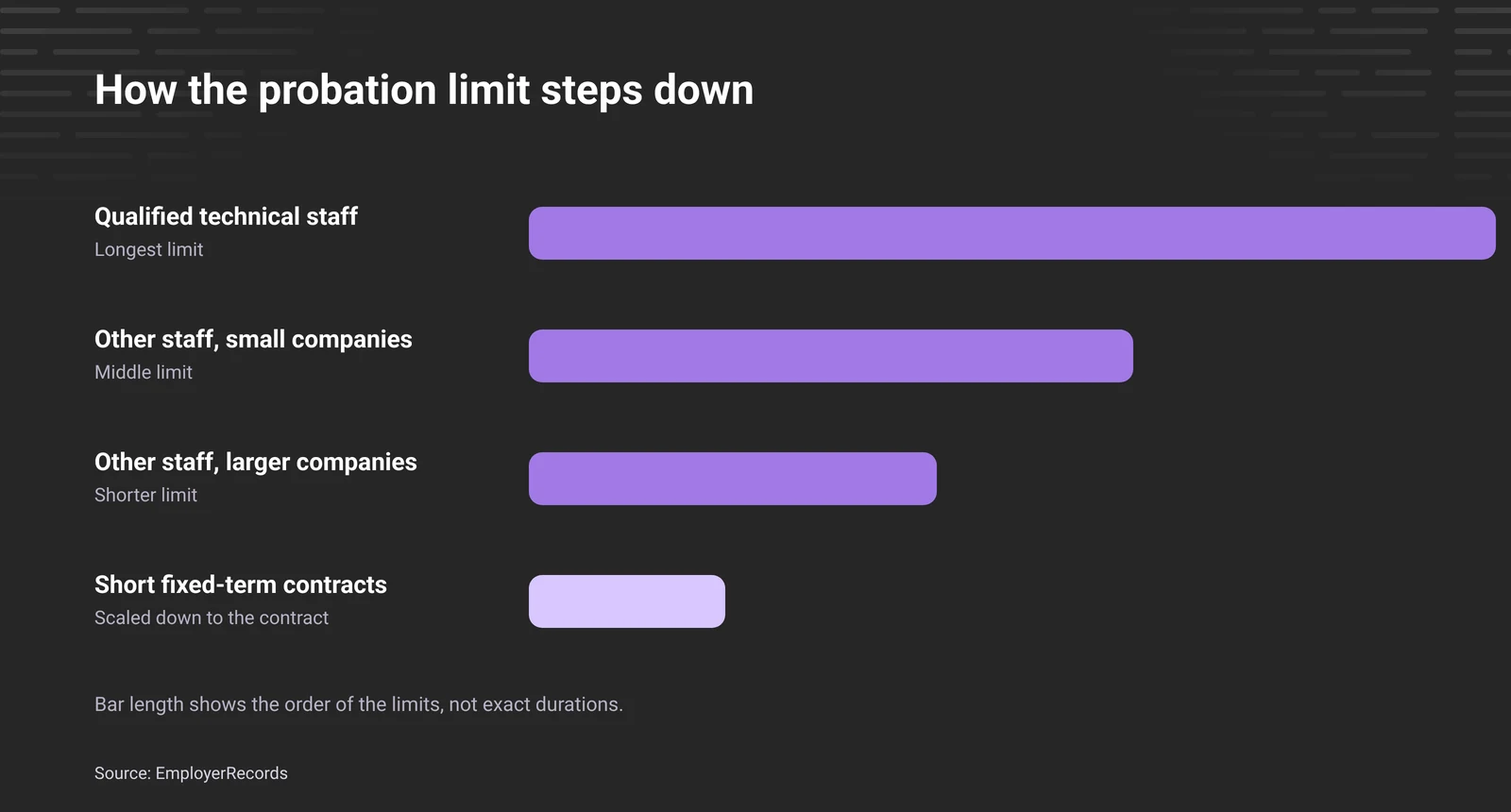
Collective agreements can vary these limits, so the statute is the starting point and the agreement has the last word.[1] Under the new text, an agreement that sets a longer period has to justify it expressly.[3]
The November decree-law rewrote article 14, and the caps in its text match the ones above.[5] The royal decree on information did not amend article 14, and it adds no formal duty to give reasons when someone fails probation.[6]
Take an 18-person Barcelona agency hiring an account manager on an open-ended contract. That one gets a three month cap. Hire the same role in a 40-person firm and the limit is two months.
Four-month production contracts fall under the proportional rule. We read that as about 20 days, though the text gives no formula (our estimate).
What we’d do. Don’t assume a degree alone makes a role qualified technical staff. Confirm the classification with local counsel before six months goes into a contract, and check what your agreement says.
What rules apply during probation?
During probation the worker has the same rights and duties as permanent staff, and either side may end the relationship during the period. Article 14 sets no notice period and no indemnity for that exit.[1]
Four limits catch employers out. A probation clause is void if the person already did the same functions for the company under any contract type. Dismissal is void for a pregnant worker and for someone on birth leave, unless the cause is unrelated. Illness, birth and similar situations pause the count only if both parties agree. And when probation ends without a notice, the contract takes full effect and the time counts towards seniority.[1]
A common case is the temp who gets an open-ended offer. If the person spent a year in the same job on a temporary contract, a new probation clause for the same functions is void.
Our view. Treat probation as a decision to make on day one, not a safety net. Voiding the clause can leave you handling the exit as an ordinary dismissal, and the termination guide prices that.
What must the written contract say?
A contract can be oral or written. Writing is required for part-time, fijo-discontinuo, training, relief and specific work contracts, and for any fixed-term contract longer than four weeks.[1] Where writing is required and missing, the contract is presumed open-ended and full-time unless proven otherwise. Either side can ask for a written contract at any time.[1]
Royal Decree 723/2026 adds what the employer must tell the worker. Expect pay, hours, the probation length and conditions, the applicable collective agreement with enough detail to identify it, and the procedure and notice periods for ending the contract.[7][8]
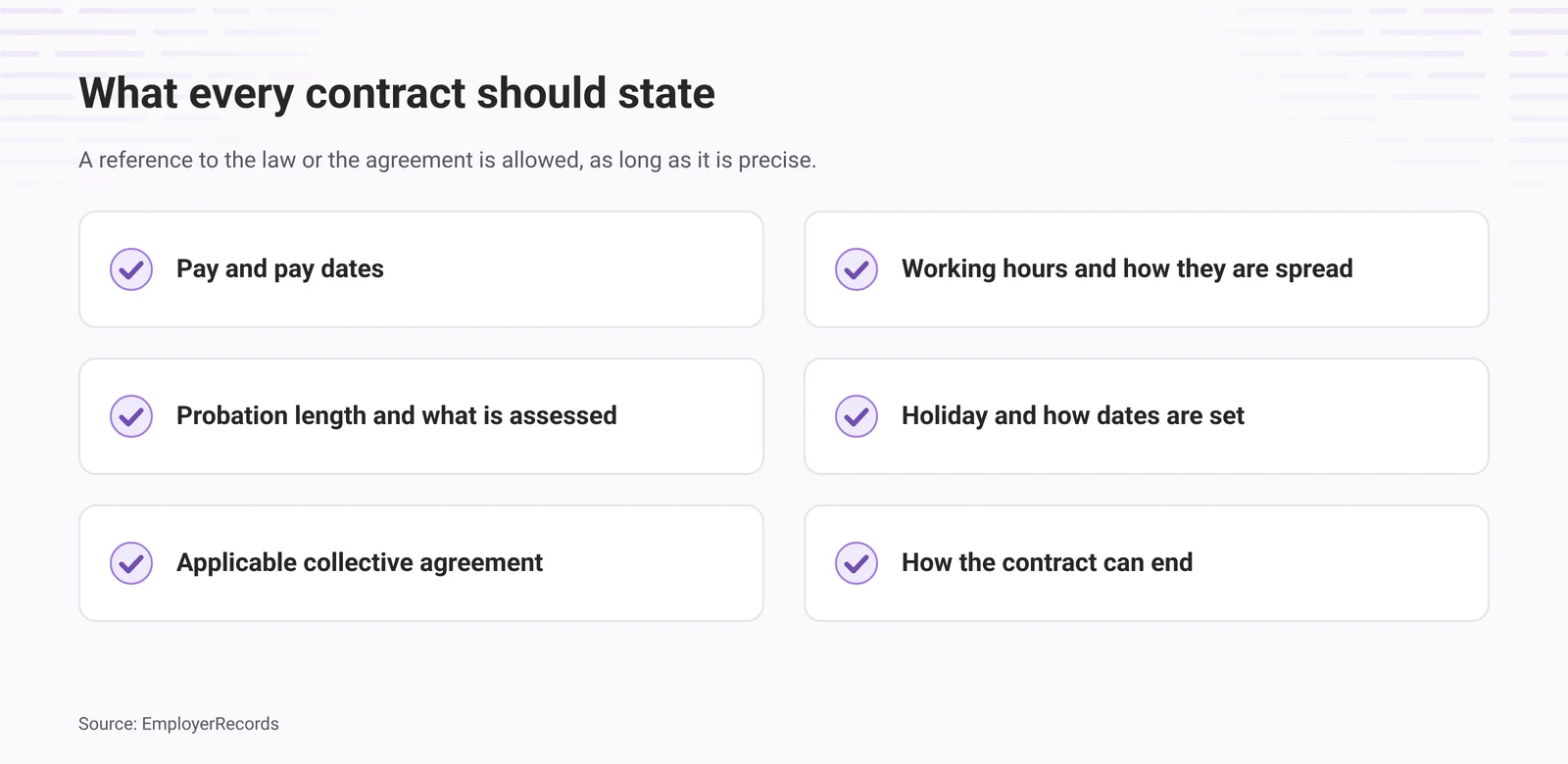
Referring to the agreement is allowed, but it has to be precise. A clause that only says pay or probation follows the agreement sends the worker off to find the answer, and that is what the new rules target.[8] The decree permits a reference to law or agreement for some items and not for others.[9]
The decree-law widens the duty. Before 19 November, the general information applied only to relationships longer than four weeks.[7] That threshold is gone, so every contract now needs written information at the start and after changes to the main terms.[3]
Contracts under four weeks already running on 19 November have a transition. Employers get 10 working days to provide the information once the worker asks.[3] Missing information moves from a minor to a serious infringement.[3]
Audit first. Check your contract template against the decree’s list this month. Replace each line that just says per agreement with the actual figure, or with a reference that names the agreement.
Check first. Decree-laws take effect on publication, and Congress votes on them afterwards. We couldn’t confirm that vote for this one, so check its status before you rely on the new items in a dispute.
Check the probation limit for a hire
Pick the contract, the role and the company size, then add a start date to see the last day under a calendar count. Defaults match the Barcelona agency case above, so the first result lines up with the text.
Spain probation limit checker
Our estimate. It applies the statutory limits in article 14 and counts calendar months from the start date. Fixed-term length is used only for fixed-term contracts, and shorter contracts are scaled in proportion, which is our reading because the text gives no formula. A collective agreement can set other limits, and pauses agreed by both parties move the end date. Check the agreement before you write the clause.
What do four hires look like in practice?
All four hires start on 1 December 2026. Each role shows the limit applied, and the last day uses a calendar count.
Edges matter most. Hire in a 24-person company and you get three months, but at 25 people it's two. Headcount is therefore a real input to the contract, and it can change between offer and start.
Probation end dates for four hires, our calculation
| Hire and limit applied | Start | Last day |
|---|---|---|
| Account manager, 18-person firm, 3 months | 1 Dec 2026 | 28 Feb 2027 |
| Same role, 40-person firm, 2 months | 1 Dec 2026 | 31 Jan 2027 |
| Qualified engineer, 40-person firm, 6 months | 1 Dec 2026 | 31 May 2027 |
| Sales cover, 4-month production contract, about 20 days | 1 Dec 2026 | 20 Dec 2026 |
The engineer row assumes the role counts as qualified technical staff. After the last day, the exit costs in our termination guide apply. For what a hire costs once pay and contributions are added, see the employer costs guide.
How does an employer of record handle contracts?
With an employer of record, the provider is the legal employer and issues the Spanish contract in its own name. It picks the contract type, applies the collective agreement and writes the probation clause. You direct the daily work.
Ask three things before you sign. Which agreement does the provider apply? What probation length does it put in the contract for your role? How does it handle the new information duty? Our EOR cost calculator prices the fee side, and the Spain EOR providers page compares the options.
Direct employment needs a Spanish entity. That route and its setup costs are in the Spain hiring guide.
Where do employers go wrong?
Four slips are worth avoiding. One is a temporary contract for work that never ends. Another is a probation clause for someone who already did the job. Then there is the contract that says per agreement where it should state the term, and the renewal of production contracts past the chaining limit.
Each one turns a cheap-looking choice into an open-ended contract, or into a void clause, at the worst moment.
Watch this. Headcount moves. Growth from 24 to 26 people between offer and start moves the probation cap for other staff from three months to two. Fix the figure in the contract at signing, and keep a record of the count you used.
For pay levels and extra payments around these contracts, see our minimum wage guide, average salary guide and annual leave and extra pay guide.
Questions about employment contracts and probation in Spain
Short answers to the questions employers ask most about contracts and probation in Spain, checked against the BOE on 19 November 2026.
Does a Spanish employment contract have to be in writing?
Not always. Writing is required for part-time, fijo-discontinuo, training, relief and specific work contracts, and for fixed-term contracts longer than four weeks. Either side can ask for a written contract at any time, and since 19 November the written information duty applies to every contract.
How long can probation last in Spain?
Up to six months for qualified technical staff, two months for other staff and three months for other staff in companies under 25 people. Fixed-term contracts of six months get one month, and shorter ones get less. A collective agreement can vary these limits.
Is notice or severance owed if probation ends?
Article 14 lets either side end the relationship during probation and sets no notice period or indemnity. Check the contract and the collective agreement for wording that adds anything, and see the exceptions for pregnancy and birth leave.
Can probation be paused or extended?
The statute sets a ceiling and leaves room for the collective agreement. Illness, birth and similar situations pause the count only if both parties agree.
Can an employer use probation for someone who already worked there?
Not for the same functions. A probation clause is void if the person already did those functions for the company under any contract type.
How long can a fixed-term contract last?
A production contract can run up to six months, or up to one year if the sector agreement allows it, with one extension inside that maximum. Occasional contracts allow 90 days a year, and replacement contracts last as long as the absence.
What is a fijo-discontinuo contract?
It is an open-ended contract for seasonal or intermittent work. It must be written and state the expected activity period and schedule, and call-ups must be made in writing or by a method that proves notice.
When does a temporary worker become permanent?
When the contract breaches the rules on causes and duration, when the worker is employed for more than 18 months in 24 under chained production contracts, or when the worker is not registered with Social Security within a period equal to the probation limit.
What must the contract tell the employee?
Royal Decree 723/2026 lists pay, hours, probation length and conditions, the applicable collective agreement with details that identify it, and the procedure and notice periods for ending the contract. It has applied since 5 October 2026.
Does an EOR change how contracts and probation work?
The provider becomes the legal employer and signs the Spanish contract, so the same rules apply to it. Ask for the draft contract, the agreement it applies and the probation length before the start date.
References and sources
Every figure on this page comes from the sources below. Numbers in square brackets in the text link to the matching entry. Official statistics are used wherever they exist, and our own calculations are labelled as estimates. All sources were checked on 19 November 2026.
- ↑Real Decreto Legislativo 2/2015, de 23 de octubre, por el que se aprueba el texto refundido de la Ley del Estatuto de los Trabajadores. Boletín Oficial del Estado, consolidated text. boe.es. Retrieved 19 November 2026. Law
- ↑Más transparencia en las relaciones laborales: qué cambia para las empresas con el RD 723/2026. Legal Today, 27 October 2026. legaltoday.com. Retrieved 19 November 2026. Analysis
- ↑RDL 39/2026: nuevos derechos laborales e igualdad salarial. Laboral Social, November 2026. laboral-social.com. Retrieved 19 November 2026. Analysis
- ↑Reforma laboral RDL 32/2021: resumen para empresas. Gobierno Vasco. euskadi.eus. Retrieved 19 November 2026. Official
- ↑Real Decreto-ley 39/2026, de 17 de noviembre, por el que se modifican el texto refundido de la Ley del Estatuto de los Trabajadores y otras normas. Boletín Oficial del Estado, 18 November 2026. boe.es. Retrieved 19 November 2026. Law
- ↑Real Decreto 723/2026: Medidas para fomentar la transparencia en las condiciones de trabajo. PwC Tax & Legal, 15 September 2026. periscopiofiscalylegal.pwc.es. Retrieved 19 November 2026. Analysis
- ↑Más transparencia laboral: nuevas obligaciones de información al personal a partir del 5 de octubre de 2026. Ashurst. ashurstperkinscoie.com. Retrieved 19 November 2026. Analysis
- ↑¿Qué información deben incluir los contratos de trabajo en 2026?. Ineaf. ineaf.es. Retrieved 19 November 2026. Analysis
- ↑Nuevas obligaciones de información en los contratos de trabajo tras el Real Decreto 723/2026. Supercontable. supercontable.com. Retrieved 19 November 2026. Analysis
About the author

Manjuri Dutta is Co-Founder and Content Editor at EmployerRecords.com, covering Employer of Record providers and global hiring platforms. She evaluates providers on entity ownership, statutory compliance, and real pricing rather than vendor claims, and built the verification process used across EmployerRecords' country guides, checking vendor claims against government registries and public filings.
View all articles by ManjuriMore Spain guides for employers
Pay, cost and contract guides from the same Spain cluster.
 SpainAnnual Leave and Extra PayAnnual Leave and Extra Pay in Spain (2026): 30 Days and Two Extra PaymentsStatutory leave, extra payments, public holidays and the exit pay they create, with a calculator.Read the guideSpainAverage salaryAverage Salary in Spain: €29,540 a Year (INE 2024 Data)Mean, median, sectors, regions and what an average-paid hire costs an employerRead the guideSpainEmployer costsEmployer Costs in Spain (2026): 30.65% Plus the Accident PremiumSocial security rates, contribution base limits, the solidarity charge, sick pay and what a real salary costsRead the guideSpainMinimum wageMinimum Wage in Spain (2026): €1,221 a Month in 14 PaymentsSpain's minimum wage is €1,221 a month in 14 payments, with the rates, employer cost and 2027 rise explained.Read the guideSpainTermination and SeveranceTermination and Severance in Spain (2026): 20 and 33 Days a YearDismissal routes, indemnities, notice and caps, with a worked case and a severance calculator.Read the guide
 Czech RepublicAverage salaryAverage Salary in the Czech Republic (2026): CZK 50,650 a MonthAverage and median pay, regional gaps, gross to net and what employers add on top, from the Czech Statistical Office.Read the guide
Hiring in Spain?
Our Spain hiring guide covers employer costs, contracts, collective agreements and how an employer of record compares with your own entity.