
FGTS in Brazil (2026): 8% Deposit, 40% Fine and Late Penalties
How the FGTS works for employers in Brazil: the 8% monthly deposit, what counts as pay, the dismissal fine, withdrawals and late-deposit penalties, with a worked R$8,100 example and a calculator.
How much is the FGTS deposit in Brazil?
Employers pay 8% of each employee’s pay into a separate FGTS account every month, due by the 20th of the following month, and 2% for apprentices. On R$8,100 that’s R$648 a month and R$8,424 a year with the 13th. Dismissal without cause adds a fine of 40% of all deposits.
- Deposit: 8% of pay, or 2% for apprentice contracts
- Deadline: the 20th of the month after the pay month
- On exit: 40% fine on all deposits, 20% in some routes
FGTS appears on every Brazilian payroll, and most foreign employers meet it as a line on an invoice before they understand it. It’s a monthly deposit into a separate account in the employee’s name. It also sets the size of the fine when you end a contract.[1]
We use one case throughout so the numbers match the Brazil hiring guide and the termination page: a monthly salary of R$8,100 and three years of service. Change both in the tool near the end.
Our estimate. Amounts on this page are our own calculation from the rules cited. They leave out the TR correction and interest on deposits, income tax and any EOR fee.
What is the FGTS?
FGTS stands for Fundo de Garantia do Tempo de Serviço, the service-time guarantee fund. Employers deposit a percentage of pay into each worker’s account every month.[1] Think of it as a savings account the employer funds and the employee can’t touch at will.
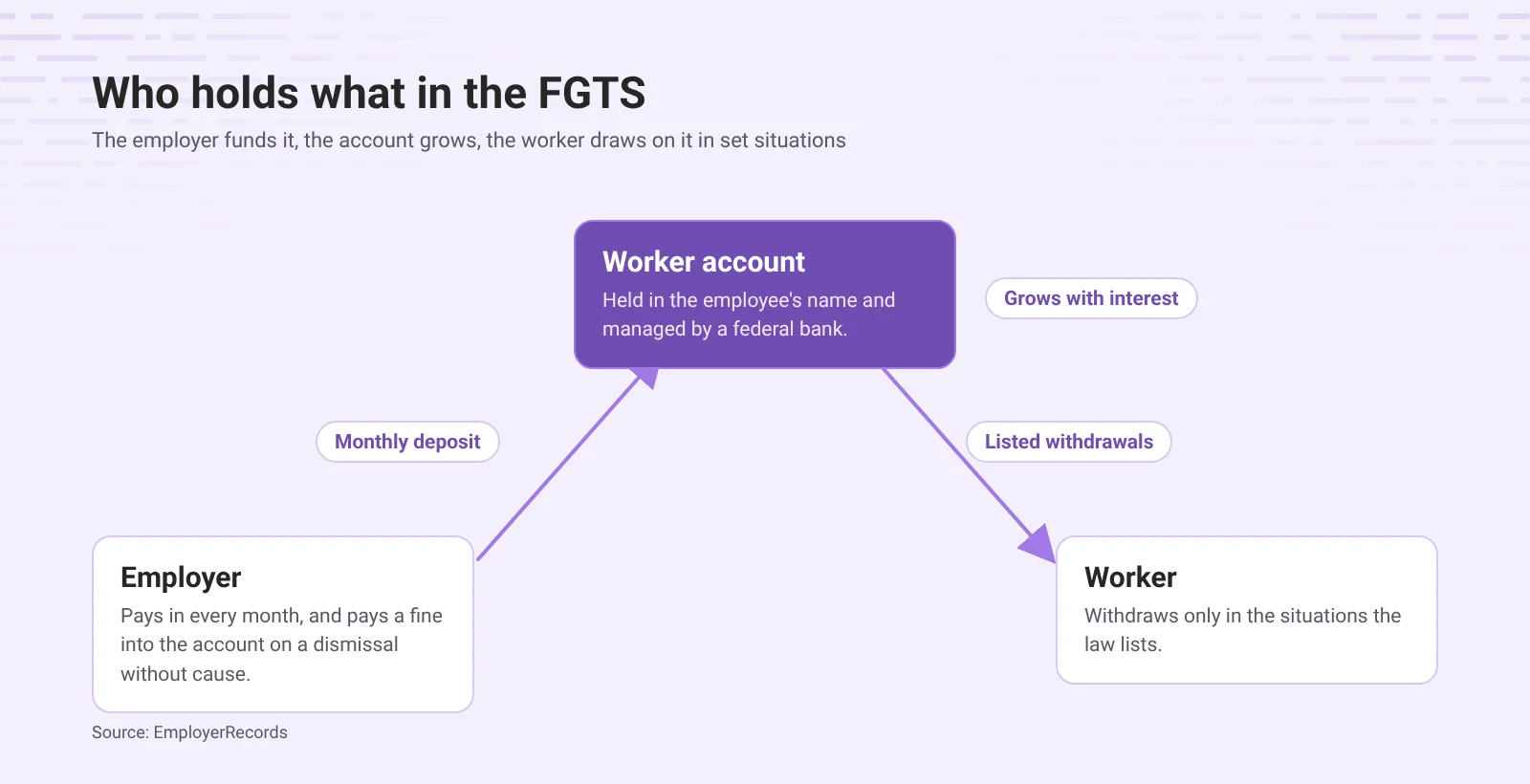
Our view: foreign teams often file FGTS under payroll tax. It isn’t one. Workers own the money, you never see it again, and it returns only as a bigger fine.
What pay does the 8% apply to?
Pay received or owed in the previous month is the base, and it includes the items in CLT articles 457 and 458 and the 13th salary.[1] Parcels that Lei 8.212 excludes from the social security base are left out.[1]
Company directors who aren’t employees can be treated like other workers if the company chooses.[1] Self-employed workers, occasional workers and civil servants under their own regime aren’t workers for FGTS purposes.[1]
What counts toward the 8% base (our summary of the sources cited)
| Item | In the FGTS base? |
|---|---|
| Pay and benefits under CLT arts. 457 and 458 | Yes[1] |
| 13th salary | Yes[1] |
| Leave after a work accident | Deposit still due[1] |
| Compulsory military service | Deposit still due[1] |
| Items listed in art. 28, §9 of Lei 8.212 | No[1][2] |
| Self-employed, occasional workers, civil servants under their own regime | Not covered[1] |
Deposits keep running during some absences. Leave after a work accident and compulsory military service both still carry the deposit.[1]
How much is the deposit, and when is it due?
Employers deposit 8% of the previous month’s pay by the 20th of each month, so November pay is deposited by 20 December.[1] Apprentice contracts carry a lower rate of 2%.[1]
Deposits run through FGTS Digital. It replaced the older SEFIP, GRRF and Conectividade Social routines and has been mandatory since March 2024.[3] You send the payroll events to eSocial, issue the guide and pay it by Pix or bank slip.[4] Access needs a gov.br account at silver or gold level, or a digital certificate.[4]
Monthly deposit by contract type (our calculation)
| Contract | Monthly pay | Rate | Deposit |
|---|---|---|---|
| Employee | R$8,100 | 8% | R$648 |
| Apprentice | R$2,700 | 2% | R$54 |
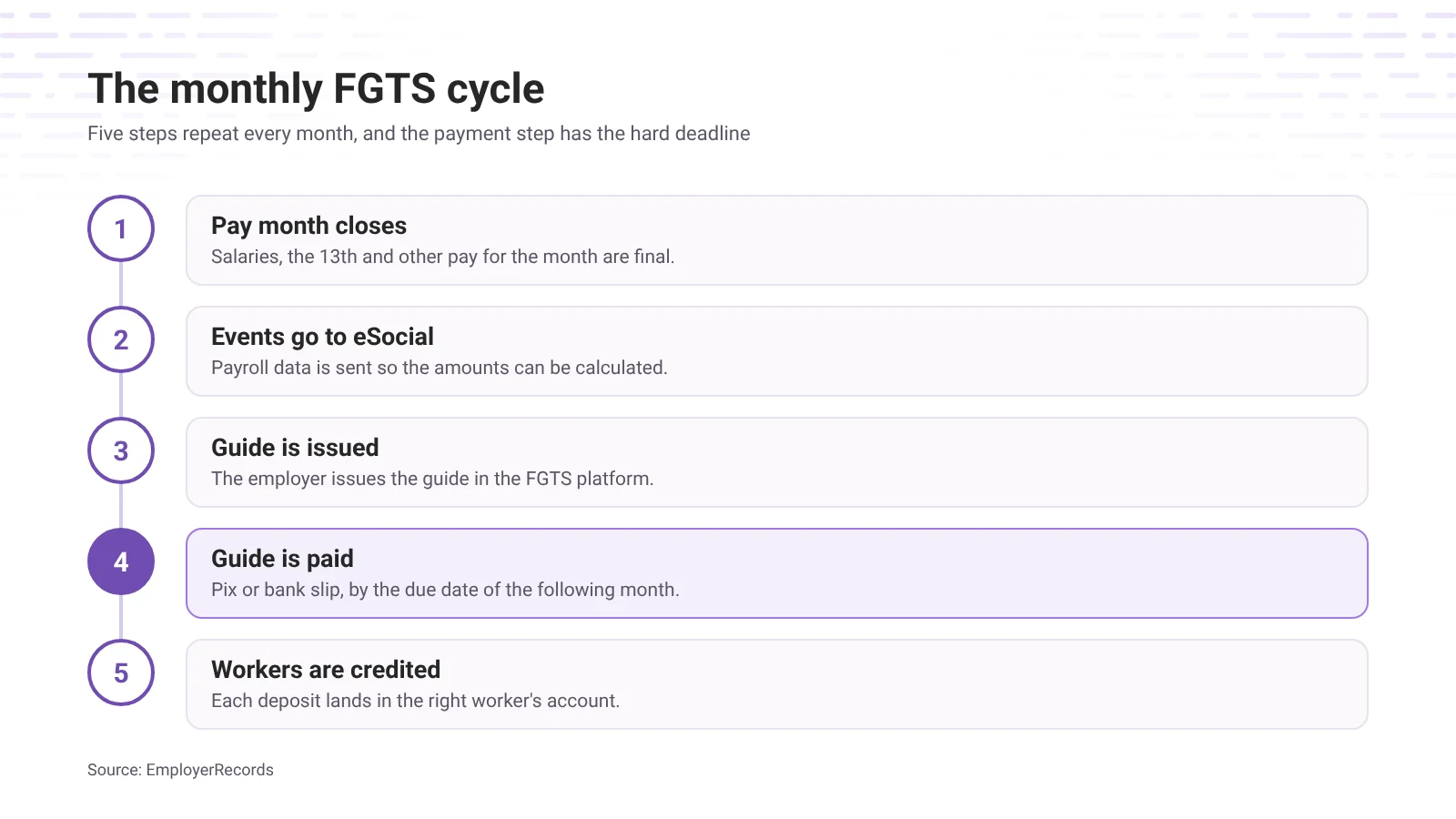
Issuing a guide early doesn’t bring the deadline forward. Leaving the issue until the due date is what trips up large payrolls.[5]
What we’d do: put the reminder on the 10th, not the 20th. A wrong base found on the 18th leaves no time to fix it.
How does FGTS work on the 13th salary?
Every real of the 13th carries the 8% too, because it’s part of the base.[1] It is paid in two instalments, with the last due by 20 December.[6] On R$8,100, the deposit on a full 13th is R$648, by our calculation.
Timing is where it gets fiddly. Under the Labour Ministry’s guidance, FGTS on the 13th is normally declared in the annual payroll and falls due on 20 January of the following year.[7]
A December termination changes that. The FGTS on the 13th then follows the termination deadline of ten days, so a contract ending on 16 December has a deadline of 26 December.[7]
Check the payroll set-up. Per the ministry’s note, the eSocial declaration may need adjusting when a contract ends in December.[7] Ask your provider how it handles that month.
How do deposits build up over a contract?
Balances are corrected on the parameters used for savings accounts and earn 3% a year, credited on the 21st of each month.[1] A deposit made on time counts in the balance from the month it was made, and a late one also pays the worker the correction and interest it missed.[1]
On R$8,100, deposits on 13 salaries a year come to R$8,424. Our calculation shows what that adds up to over time, before correction and interest.
Deposits built up on R$8,100, 13 salaries a year (our calculation, before correction and interest)
Our view: the 40% fine grows at the same speed as this balance. The longer someone stays, the more a dismissal costs, which is worth knowing before you promise an open-ended contract.
What does the FGTS fine cost?
A dismissal without cause costs a deposit equal to 40% of all deposits made during the contract, with correction and interest.[1] Reciprocal fault or force majeure recognised by the labour court halves it to 20%, and so does a mutual agreement.[1][8]
On top of the fine, the employer deposits the month of termination and the month before, if not yet paid.[1] The receipt has to list the amounts, and the release only covers what it lists.[1]
FGTS fine on R$8,100 by length of service (our calculation, rounded down, before correction and interest)
| Service | Deposits | Fine at 40% | Fine at 20% |
|---|---|---|---|
| 1 year | R$8,424 | R$3,369 | R$1,684 |
| 2 years | R$16,848 | R$6,739 | R$3,369 |
| 3 years | R$25,272 | R$10,108 | R$5,054 |
| 5 years | R$42,120 | R$16,848 | R$8,424 |
| 10 years | R$84,240 | R$33,696 | R$16,848 |
The fine goes into the worker’s account, not into payroll. The full termination package, with notice and final pay, is on our termination page.
What we’d do: carry a monthly provision of 3.2% of the FGTS pay base, which is 40% of the 8% deposit. It scales with pay and needs no guess about tenure.
When can a worker withdraw the balance?
Article 20 lists the situations.[1] Dismissal without cause is the first, followed by the mutual agreement route, retirement, the end of a fixed-term contract and death, among others, including some housing and health cases.[1]
A worker who resigns or is dismissed for cause isn’t on the list, so the balance stays in the account. That’s why the route written on the termination papers matters to the employee as much as to you.[1]
When a worker can withdraw the FGTS balance (our summary of the sources cited)
| Situation | Balance | Employer fine |
|---|---|---|
| Dismissal without cause, including indirect | Yes | 40% |
| Reciprocal fault or force majeure | Yes | 20% |
| Mutual agreement, art. 484-A | Up to 80%[8] | 20% |
| Fixed-term contract ends | Yes | None |
| Retirement | Yes | None |
| Resignation | Not a listed situation | None |
| Dismissal for cause | Not a listed situation | None |
What is the birthday withdrawal?
Workers can choose between two systems. Termination withdrawal is the default. The birthday withdrawal pays out a share of the balance each year.[1]
One system applies at a time to all of a worker’s accounts.[1] Under the birthday system the worker can’t use the withdrawals tied to dismissal or the end of a fixed term, but still receives the fine when dismissed without cause.[1] A request to go back takes effect on the first day of the 25th month after the request.[1]
For you as the employer. Nothing changes in what you deposit or what the fine is. It only changes what the worker can withdraw, and when.[1]
What happens if a deposit is late or wrong?
A late deposit adds the TR, interest and a fine, calculated on the amount plus the TR.[1] The labour authority checks compliance, calculates what’s owed and notifies the employer.[1]
Mistakes count as infringements, not just missing payments. The law lists leaving a pay component out of the base and sending wrong or missing information among them.[1]
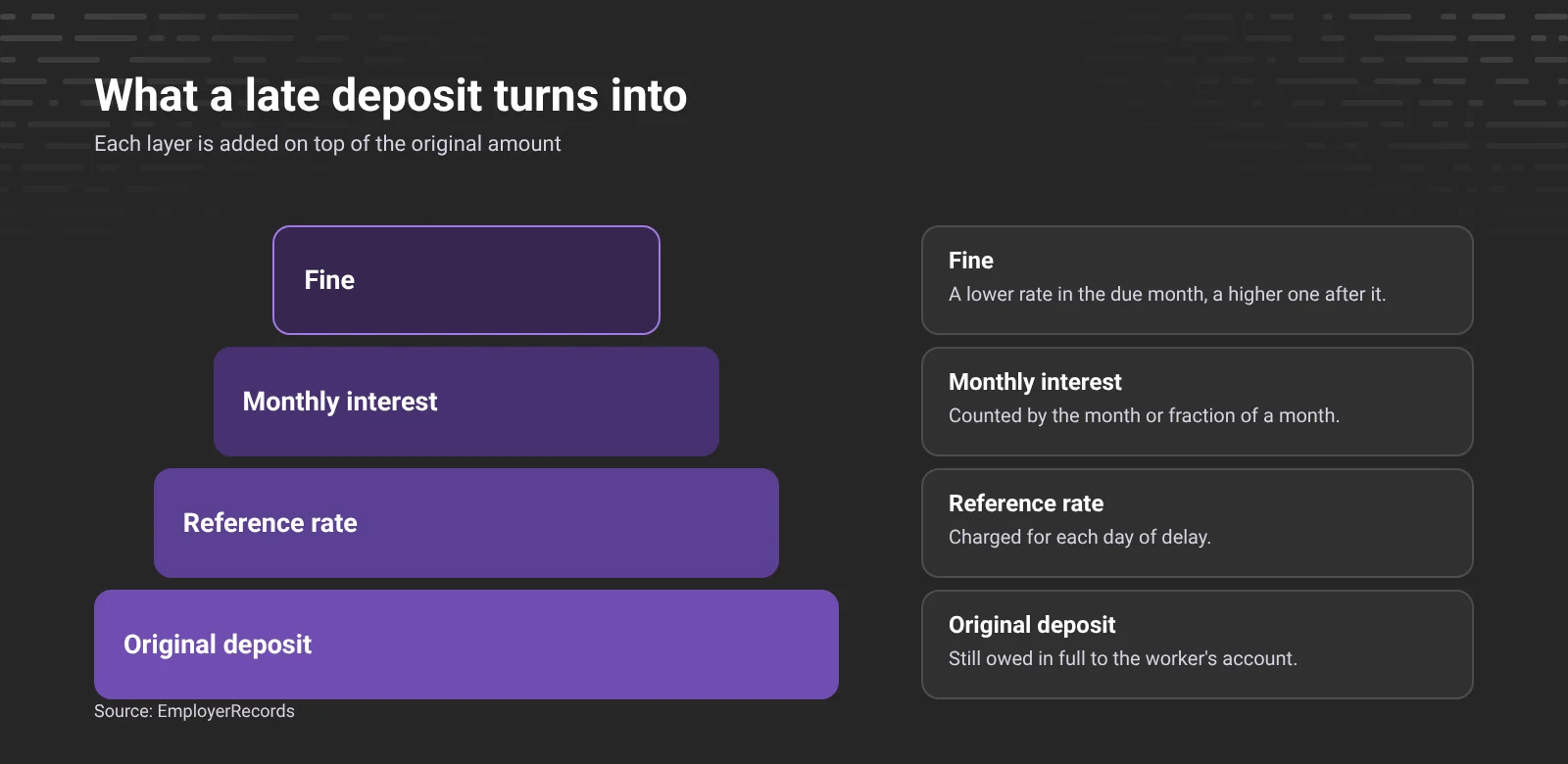
What a late deposit adds (our summary of art. 22)
| Charge | Rate |
|---|---|
| TR correction | Charged per day of delay |
| Interest | 0.5% a month or fraction |
| Fine in the month it fell due | 5% |
| Fine from the following month | 10% |
A R$648 deposit paid in the month after it fell due adds R$68 in interest and fine, or about 10.5%, before the TR. That’s our estimate, not a quote.
Debts can be paid in instalments, and employers can issue the FGTS Certificate of Regularity free of charge through the digital services.[1] Deposits that come from labour lawsuits go through FGTS Digital for judgments issued from 1 May 2026.[5]
What does the FGTS add to the cost of a hire?
The deposit is the largest single charge after INSS, and it’s the one you never recover. At R$8,100, the monthly deposit is R$648 on salary alone. Add the 13th and vacation accruals, and the cost on the employer costs page is R$720.
The fine provision isn’t part of that 50.9%. We carry it separately, because it only turns into a payment if you end the contract.
What FGTS adds to R$8,100 a month (our calculation)
| Item | Per month |
|---|---|
| Deposit on salary | R$648 |
| Deposit on the 13th accrual | R$54 |
| Deposit on the vacation third accrual | R$18 |
| FGTS in the monthly cost | R$720 |
| Fine provision at 3.2% of the pay base (our practice) | R$288 |
How much will the FGTS cost?
Enter the salary, rate, years of service and whether a deposit is late. Defaults reproduce the tables above, and each item is rounded before use.
Brazil FGTS deposits and fine per employee
An estimate. It assumes 13 salaries a year at a steady salary, rounds the fine down, and leaves out the TR, correction and interest on the account, the TR on late deposits and any EOR fee. Use 2% for apprentice contracts. For fees, currency and year-one costs, use the full Brazil cost calculator.
Where do FGTS budgets go wrong?
First comes the base. Teams deposit on salary alone and forget the 13th, the benefits in kind and other pay that belongs in the base. Each omission counts as an infringement under the law.[1]
Next is the fine. People apply 40% to salary instead of to the deposits, and the two numbers drift further apart with every year of service.
Last is the calendar. A guide issued on the 20th is a guide paid late if anything goes wrong that day.
Who handles FGTS with an EOR?
Your legal obligation is the same, because the deposit attaches to the employment contract. What changes is who sends the payroll events, issues the guide and pays it on time.
Ask providers three questions: whether the invoice includes the fine provision or bills it at dismissal, how they treat the 13th in December terminations, and who pays the penalty if a deposit is late. Our EOR cost calculator covers the fee side, and the Brazil EOR page compares providers.
Related rules sit in the employer costs guide, the 13th salary and vacation guide, the minimum wage guide, the average salary guide and the work visa guide. If you’re new to the model, what an employer of record does explains the split.
Questions about the FGTS in Brazil
Short answers to what employers ask most about the FGTS in Brazil, checked against Lei 8.036 and the FGTS Digital guidance on 18 November 2026.
What is the FGTS deposit rate in Brazil?
Employers deposit 8% of each employee’s monthly pay, and 2% for apprentice contracts.
When is the FGTS deposit due?
By the 20th of each month, on the previous month’s pay.
Is the FGTS deducted from the employee’s salary?
No. It’s paid by the employer on top of salary, into an account in the employee’s name.
Does the FGTS apply to the 13th salary?
Yes, the 13th is part of the base. It’s normally declared in the annual payroll, but a December termination brings the deadline forward to ten days.
How big is the FGTS fine?
Forty per cent of all deposits made during the contract for a dismissal without cause, and 20% for a mutual agreement or reciprocal fault.
Can an employee who resigns withdraw the balance?
No. Resignation isn’t one of the situations in the law, so the balance stays in the account.
What interest does the FGTS account earn?
Balances are corrected on savings parameters and earn 3% a year, credited each month.
What happens if I pay FGTS late?
You owe the TR, interest of 0.5% a month and a fine of 5% in the due month or 10% after it.
Is FGTS Digital mandatory?
Yes. It has been mandatory for employers since March 2024 and replaced the older SEFIP and GRRF routines.
References and sources
Every figure on this page comes from the sources below. Numbers in square brackets in the text link to the matching entry. Official statistics are used wherever they exist, and our own calculations are labelled as estimates. All sources were checked on 18 November 2026.
- ↑Lei nº 8.036, de 11 de maio de 1990. Câmara dos Deputados. www2.camara.leg.br. Retrieved 18 November 2026. Law
- ↑Lei nº 8.212, de 24 de julho de 1991. Câmara dos Deputados. www2.camara.leg.br. Retrieved 18 November 2026. Law
- ↑O que muda na rotina financeira das empresas com o FGTS Digital. Cora. www.cora.com.br. Retrieved 18 November 2026. Guide
- ↑FGTS Digital: como recolher em 2026. Contabilidade Zen. www.contabilidadezen.com.br. Retrieved 18 November 2026. Guide
- ↑FGTS Digital. Ministério do Trabalho e Emprego. www.gov.br. Retrieved 18 November 2026. Official
- ↑Lei nº 4.749, de 12 de agosto de 1965. Câmara dos Deputados. www2.camara.leg.br. Retrieved 18 November 2026. Law
- ↑Nota Orientativa FGTS Digital nº 11/2025: 13º salário e rescisão (Orientação nº 10/CGFGTS/DEFIT/SIT/MTE). Ministério do Trabalho e Emprego, 9 December 2025. www.gov.br. Retrieved 18 November 2026. Official
- ↑Decreto-Lei nº 5.452, de 1º de maio de 1943 (CLT). Câmara dos Deputados. www2.camara.leg.br. Retrieved 18 November 2026. Law
About the author

Emma Whitmore is an EOR and Global Employment Content Writer at EmployerRecords, where she researches and writes practical resources on Employer of Record (EOR) services, international hiring, global payroll, employment compliance, and workforce expansion across international markets. With more than 15 years of experience in B2B content and editorial research, Emma specializes in turning complex employment regulations into clear, actionable guidance for HR leaders, founders, and globally distributed teams. Her work focuses on helping businesses understand country-specific hiring requirements, compare global employment providers, and navigate compliance with confidence.
View all articles by EmmaPayroll and cost guides for other countries
Compare Brazil with the payroll charges and pay rules employers work with in other markets.
 Brazil13th Salary and Vacation13th Salary and Vacation Pay in Brazil (2026): Rules and CostHow the 13th salary and vacation pay are calculated, when each is due and what they add to the cost...Read the guideBrazilAverage salaryAverage Salary in Brazil (2026): R$3,790 a Month by Sector and RegionWhat Brazilian workers earn on average, why four official figures disagree, and what a hire costs on top.Read the guideBrazilEmployer costsEmployer Costs in Brazil (2026): 50.9% on Top of SalaryWhat a Brazil hire really costs: employer charges, the 13th and vacation accruals, FGTS and a worked R$8,100 example.Read the guideBrazilMinimum wageMinimum Wage in Brazil (2026): R$1,621 a Month, State Floors and 2027 OutlookWhat the national minimum wage is, who it covers, which states set higher floors and what a minimum wage hire...Read the guideBrazilTermination and SeveranceTermination in Brazil (2026): Notice, 40% FGTS Fine and Final PayHow notice, severance and the FGTS fine work in Brazil, and what ending a contract costs an employer.Read the guideBrazilWork VisaWork Visa in Brazil (2026): VITEM V Steps, Fees and the Two-Thirds RuleWho files, which ministry decides, what it costs, how long it takes and how many foreign staff a company can...Read the guide
Hiring in Brazil?
Contract rules, entity options, FGTS and the full cost of an employee are all in the hiring guide.