
13th Salary and Vacation Pay in Brazil (2026): Rules and Cost
How the 13th salary and vacation bonus work in Brazil: calculation, instalments, vacation days, late-grant penalties and the full employer cost, with a worked R$8,100 example and a calculator.
What do the 13th salary and vacation pay cost in Brazil?
Brazil requires a 13th salary equal to one month’s pay, settled by 20 December, and 30 days of paid vacation with a one-third bonus. On R$8,100 a month, our calculation puts both at R$10,800 a year before charges and R$14,666 with them.
- 13th salary: one month’s pay a year, balance due by 20 December
- Vacation: 30 days after 12 months, with a one-third bonus
- Late grant: pay doubles if vacation isn’t given within 12 months
Two annual payments catch foreign employers out more than any other part of Brazilian payroll. One is the 13th salary, a full extra month of pay. Vacation is the other, and it carries a bonus of one third on top of normal pay.[1][2]
We use one case throughout so the numbers match the Brazil hiring guide and the employer costs page: a monthly salary of R$8,100, a full year worked. You can change both in the tool further down.
Our estimate. Amounts on this page are our own calculation from the rules cited. They use the 35.8% payroll charge rate from the employer costs page and leave out collective agreement terms, income tax withheld from the employee and any EOR fee.
What are these two payments?
Neither is a bonus you can drop. Under a 1962 law, every employee gets a December payment,[2] and the constitution guarantees annual paid vacation with at least a third more than normal pay.[1] The CLT sets the detail on days, timing and payment.[3]
They run on different clocks. One follows the calendar year. Vacation follows the employee’s own anniversary.
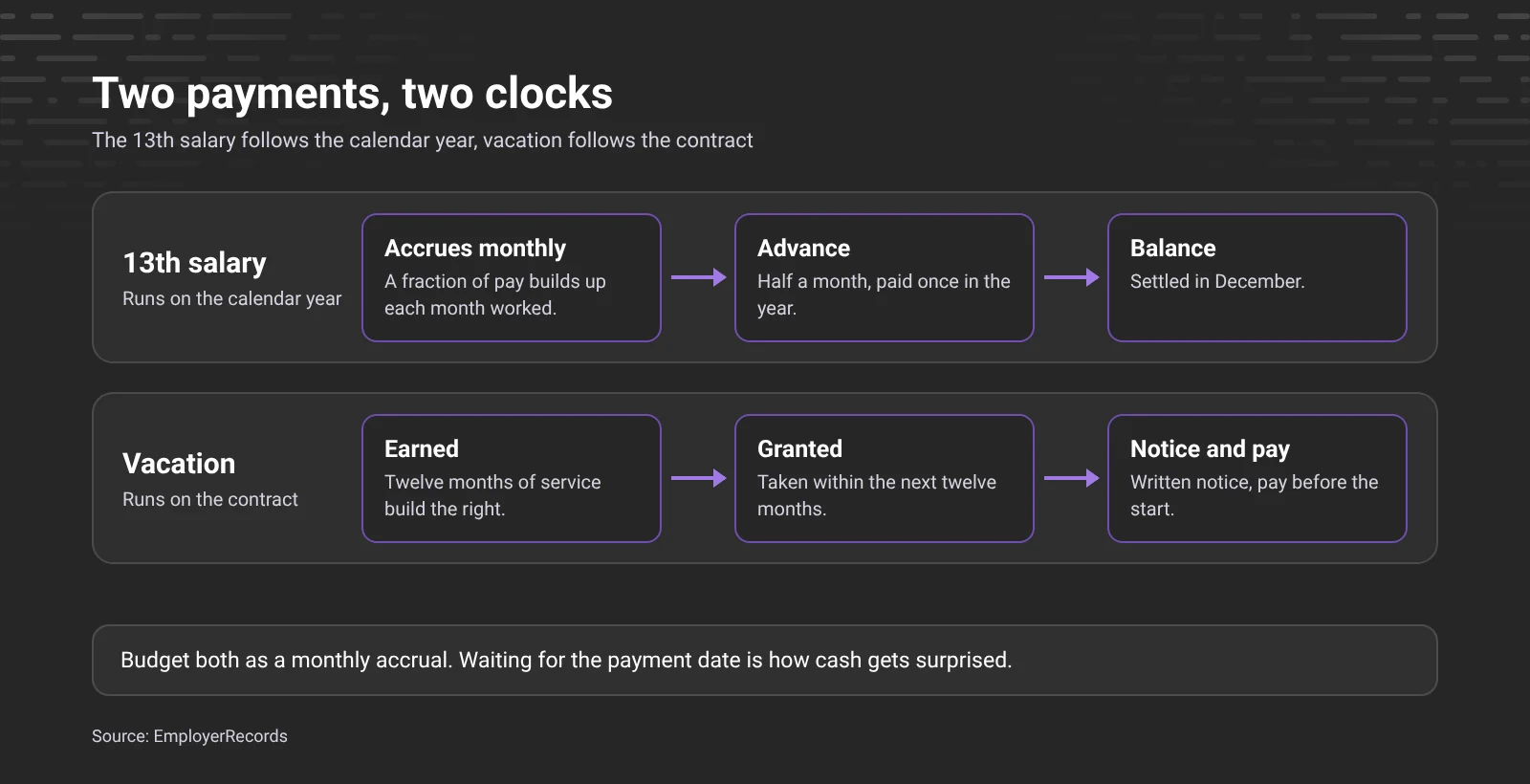
Our view: foreign teams tend to read the 13th salary as a bonus and plan for it in December. It’s closer to a deferred salary, and the cleanest way to budget it is a monthly accrual from the first payslip.
How is the 13th salary calculated?
Here’s the rule in one line: one twelfth of December pay for each month worked in the calendar year.[2] An employee on R$8,100 who worked all twelve months receives R$8,100.
Part-year employees get the months they worked. Any fraction of 15 days or more counts as a full month, and legal and justified absences aren’t deducted.[2] Our table shows what that means for four start dates.
Proportional 13th salary for an employee on R$8,100 by start date (our calculation)
| Start date in the year | Months counted | 13th salary |
|---|---|---|
| 1 January or earlier | 12 | R$8,100 |
| 1 July | 6 | R$4,050 |
| 16 September | 4 | R$2,700 |
| 20 October | 2 | R$1,350 |
December pay is the base, so a raise in October lifts the whole year’s 13th, not only the last months.[2] Budget for that when you plan a mid-year increase.
When is the 13th salary paid?
It’s paid in two parts. Between February and November the employer pays an advance of half the previous month’s salary, in one go, and the balance is due by 20 December.[4] Any advance is deducted from the final amount.[4]
If the contract ends before the December payment, the employer can set the advance off against what the employee is owed.[4]
When the 13th salary is paid on R$8,100 (our calculation)
| Instalment | Due | Amount |
|---|---|---|
| Advance | Any month from February to November | R$4,050 |
| Balance | By 20 December | R$4,050 |
| 13th salary | R$8,100 |
Each bar is the amount earned so far, at R$675 a month
Source: our calculation on a R$8,100 monthly salary, accruing one twelfth a month.
What we’d do: pay the advance in the middle of the window, not in November. It keeps the cash out of the same weeks as the balance, and it gives payroll one more month to spot a wrong base.
How many vacation days does an employee get?
After each period of 12 months on the contract, an employee has the right to vacation. With no more than five unjustified absences the entitlement is 30 calendar days.[3] More absences shrink it in steps, as the chart below shows.[3]
Not every absence counts. Maternity leave, absences listed in article 473 and time off for a work accident or illness certified by INSS are left out.[3] The employer can’t deduct absences from the vacation days themselves, and the vacation period counts as service time.[3]
Vacation days by number of unjustified absences in the 12 months (CLT article 130)
Three situations wipe out the right that was building up.[3] A fourth, long sickness or accident benefits paid by social security, does the same.[3]
What does vacation pay include?
Employees receive normal pay for the days off plus one third on top.[1] Pay uses the remuneration due on the date the vacation is granted, so a raise before the start applies.[3]
Variable pay needs an average. Hourly pay with changing hours is averaged over the earning period, task pay uses average output, and commission or travel pay uses the 12 months before the vacation.[3]
Vacation pay on R$8,100 for 30 days (our calculation)
| Item | Amount |
|---|---|
| Pay for the 30 days | R$8,100 |
| One-third bonus | R$2,700 |
| Paid before the vacation starts | R$10,800 |
Money must reach the employee at least two days before the vacation starts, and a signed receipt shows the first and last day.[3]
Our view: the one-third bonus is the part that gets missed when HR works from a salary spreadsheet. If your payroll shows the vacation month at plain salary, the bonus is missing.
When must vacation be taken?
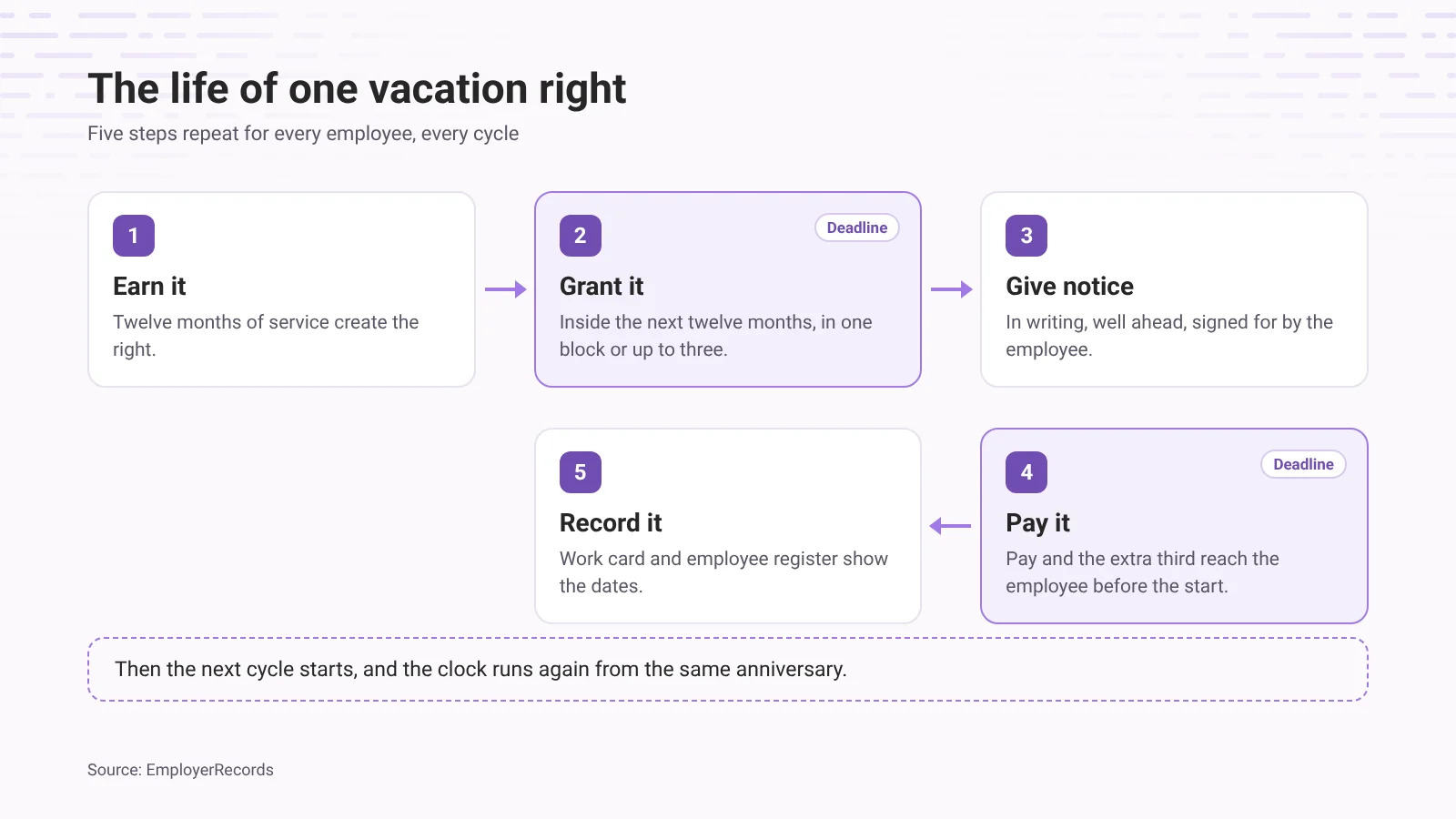
Employers grant vacation within the 12 months after the right is earned, in one period.[3] Timing is whatever suits the employer best.[3]
Written notice goes to the employee at least 30 days ahead, and the employee signs a receipt.[3] The vacation is then recorded on the work card and in the employee register.[3]
Splitting is allowed, with the employee’s agreement. Up to three periods are possible, one of at least 14 calendar days and the others of at least five.[3] A period can’t begin within two days before a holiday or weekly rest day.[3]
During vacation the employee can’t work for another employer, unless the work is under a contract that was already running.[3]
Can employees sell vacation days or take collective vacation?
Selling is the employee’s option, not the employer’s.[3] The cash value is the pay the employee would have received for those days, and it doesn’t count as remuneration for labour law purposes up to 20 days of salary.[3]
What we’d do: don’t offer selling as a default. Employees who sell lose rest, and the request still has to arrive on time.
What happens if vacation is granted late?
Vacation granted after the 12-month window is paid double.[3] The employee can also go to the labour court and ask a judge to fix the dates, and the judgment carries a daily penalty of 5% of the regional minimum wage until the employer complies.[3]
Once the decision is final, a copy goes to the labour authority for an administrative fine.[3]
Check the dates. That window starts when the right is earned, not when the employee asks. Flag each employee 60 days before it closes, in a simple calendar. It costs nothing and avoids the double payment.
What do the two payments cost the employer?
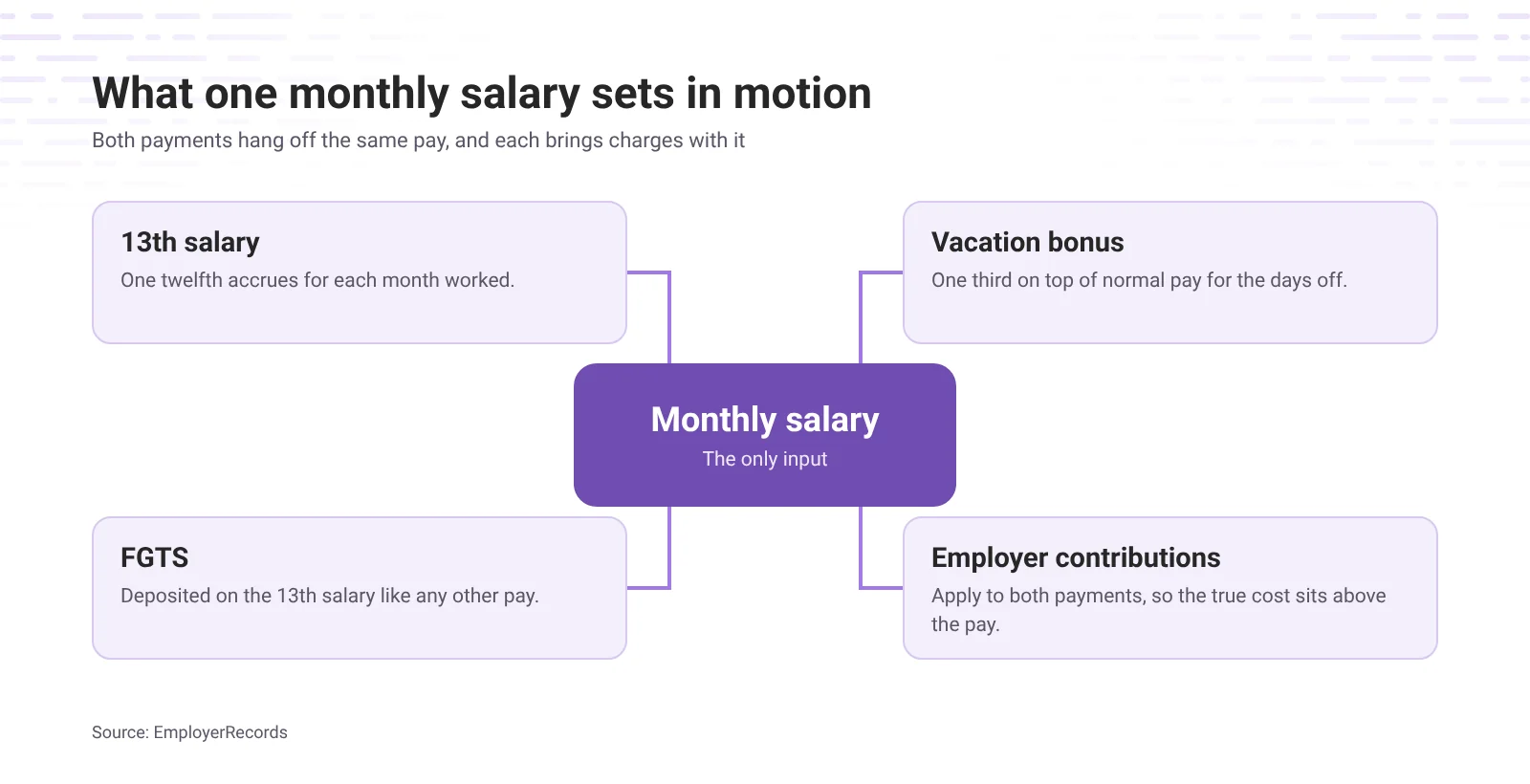
Both payments sit on top of twelve monthly salaries. The 13th adds one month a year, and the vacation bonus adds a third of a month, because the vacation days themselves are already inside the monthly salary.
Charges apply to both. FGTS is due on the 13th salary,[5] and the Supreme Court held that employer contribution applies to the vacation third when vacation is taken.[6] The law excludes it only when vacation is paid out as an indemnity.[7]
What the two payments add to a year on R$8,100 (our calculation)
| Item | Per year |
|---|---|
| 13th salary | R$8,100 |
| One-third vacation bonus | R$2,700 |
| Pay accrued in the year | R$10,800 |
| Charges at 35.8% on that pay | R$3,866 |
| Total employer cost | R$14,666 |
Accrued monthly, that’s R$900 before charges and R$1,222.20 with them. It explains the gap between 12 salaries plus 35.8% and the true cost on the employer costs page.
What happens to both payments when someone leaves?
Dismissal without cause pays the 13th on the pay of the month of termination.[2] Fixed-term contracts that end early and retirements also pay it in proportion.[2]
Resignation is settled by the Superior Labour Court (TST), whose case law treats the 13th as owed when the employee initiates the exit.[8] On vacation, an employee with more than 12 months of service who isn’t dismissed for cause is owed the incomplete period at one twelfth a month, and a fraction over 14 days counts.[3] Under 12 months, the CLT ties it to dismissal without cause or the end of a fixed term.[3]
For the full package, including notice and the FGTS fine, see our termination page and the FGTS guide.
What each exit route pays out of the two (our summary of the sources cited)
| Route | 13th salary | Vacation |
|---|---|---|
| Dismissal without cause | Proportional, on the pay of the month of termination | Earned periods plus proportional |
| Resignation | Proportional | Proportional, after 12 months of service |
| Fixed-term contract ends | Proportional | Proportional |
| Retirement | Proportional | Earned periods plus proportional, after 12 months of service |
| Dismissal for cause | Not covered by the statute’s wording; get advice | Earned periods only |
How much will the two payments cost?
Enter the salary, the months worked in the year and your charge rate. Defaults reproduce the table above, and each item is rounded before adding.
Brazil 13th salary and vacation bonus cost per employee
An estimate. It accrues one twelfth of salary a month for the 13th and one thirty-sixth for the vacation bonus, and applies one charge rate to both. It leaves out collective agreement terms, income tax withheld from the employee and any EOR fee. For fees, currency and year-one costs, use the full Brazil cost calculator.
Where do budgets for these payments go wrong?
First comes cash timing. Teams that budget the 13th in December are hit twice in one month, because the balance and the usual payroll fall together.
Next is the bonus. Vacation pay is normal pay plus a third, and the third is new money that sits outside the salary budget.
Last is letting a period lapse. Miss a 12-month window and the vacation pay is due twice, and no payroll system will warn you unprompted.
Who handles this with an EOR?
Statutory cost is the same, because the rules attach to the employment contract. What changes is who calculates, pays and tracks the vesting dates for each employee.
Ask providers three things before you hire: whether the 13th and vacation bonus are accrued in the monthly invoice or billed when paid, how they track vacation windows, and who pays a double-pay penalty if a window is missed. Our EOR cost calculator covers the fee side, and the Brazil EOR page compares providers.
Related rules sit in the minimum wage guide, the work visa guide and the employer costs guide. Every payment here also carries the 8% deposit, which the FGTS guide covers. If you’re new to the model, what an employer of record does explains the split.
Questions about the 13th salary and vacation pay in Brazil
Short answers to what employers ask most about the 13th salary and vacation pay in Brazil, checked against the CLT and the 13th salary laws on 18 November 2026.
Is the 13th salary mandatory in Brazil?
Yes. Every employee is entitled to a December payment of one twelfth of December pay for each month worked in the year.
When is the 13th salary paid?
In two parts: an advance in any month from February to November, and the balance by 20 December.
How much is the vacation bonus?
One third of normal pay for the vacation days. On R$8,100 a month, that’s R$2,700.
How many vacation days does an employee get?
Thirty calendar days after 12 months, if the employee had no more than five unjustified absences. More absences cut it to 24, 18 or 12 days.
Can an employee sell vacation days?
Yes, up to one third of the period, at the employee’s option. Requests must be made at least 15 days before the earning period ends.
What if I don’t grant vacation in time?
Vacation pay doubles, and the employee can ask a labour judge to fix the dates, with a daily penalty.
Do part-year employees get a 13th salary?
Yes, in proportion to the months worked. Any fraction of 15 days or more counts as a full month.
Does an employee who resigns still get the 13th?
Yes. Superior Labour Court case law treats the 13th as owed when the employee ends the contract.
References and sources
Every figure on this page comes from the sources below. Numbers in square brackets in the text link to the matching entry. Official statistics are used wherever they exist, and our own calculations are labelled as estimates. All sources were checked on 18 November 2026.
- ↑Constituição da República Federativa do Brasil de 1988, art. 7º. Senado Federal. legis.senado.leg.br. Retrieved 18 November 2026. Law
- ↑Lei nº 4.090, de 13 de julho de 1962. Câmara dos Deputados. www2.camara.leg.br. Retrieved 18 November 2026. Law
- ↑Decreto-Lei nº 5.452, de 1º de maio de 1943 (CLT). Câmara dos Deputados. www2.camara.leg.br. Retrieved 18 November 2026. Law
- ↑Lei nº 4.749, de 12 de agosto de 1965. Câmara dos Deputados. www2.camara.leg.br. Retrieved 18 November 2026. Law
- ↑Lei nº 8.036, de 11 de maio de 1990. Câmara dos Deputados. www2.camara.leg.br. Retrieved 18 November 2026. Law
- ↑Contribuição patronal incide sobre terço de férias, decide 2ª turma do STJ. Migalhas. www.migalhas.com.br. Retrieved 18 November 2026. News
- ↑Lei nº 8.212, de 24 de julho de 1991. Câmara dos Deputados. www2.camara.leg.br. Retrieved 18 November 2026. Law
- ↑Súmula 157: gratificação, 13º salário, rescisão por iniciativa do empregado. Tribunal Superior do Trabalho, via Meu Vade Mecum Online. www.meuvademecumonline.com.br. Retrieved 18 November 2026. Case law
About the author

Dhiraj Das is Co-Founder of EmployerRecords.com, where he leads content, research and partnerships. He has worked in content and online publishing for more than 15 years, and before EmployerRecords he founded a number of successful content brands. For the past six years he has specialised in HR technology, Employer of Record services and global hiring. His background in digital marketing and search shapes how EmployerRecords researches and presents its provider reviews, country hiring guides and cost data, so employers can compare their options and hire abroad with clear, checked information.
View all articles by DhirajLeave and pay guides for other countries
Compare Brazil with the leave rules and pay floors employers work with in other markets.
 BrazilAverage salaryAverage Salary in Brazil (2026): R$3,790 a Month by Sector and RegionWhat Brazilian workers earn on average, why four official figures disagree, and what a hire costs on top.Read the guideBrazilEmployer costsEmployer Costs in Brazil (2026): 50.9% on Top of SalaryWhat a Brazil hire really costs: employer charges, the 13th and vacation accruals, FGTS and a worked R$8,100 example.Read the guideBrazilFGTSFGTS in Brazil (2026): 8% Deposit, 40% Fine and Late PenaltiesHow much the monthly FGTS deposit is, what pay it covers, what the dismissal fine costs and what a late...Read the guideBrazilMinimum wageMinimum Wage in Brazil (2026): R$1,621 a Month, State Floors and 2027 OutlookWhat the national minimum wage is, who it covers, which states set higher floors and what a minimum wage hire...Read the guideBrazilTermination and SeveranceTermination in Brazil (2026): Notice, 40% FGTS Fine and Final PayHow notice, severance and the FGTS fine work in Brazil, and what ending a contract costs an employer.Read the guideBrazilWork VisaWork Visa in Brazil (2026): VITEM V Steps, Fees and the Two-Thirds RuleWho files, which ministry decides, what it costs, how long it takes and how many foreign staff a company can...Read the guide
Hiring in Brazil?
Contract rules, entity options, leave and the full cost of an employee are all in the hiring guide.