
Employer Costs in Brazil (2026): 50.9% on Top of Salary
What the law adds to a Brazilian salary: INSS, RAT, third-party levies, FGTS and the extra pay months, with a worked R$8,100 example and a calculator.
How much does an employee cost in Brazil?
A CLT employee in Brazil costs about 50.9% more than base salary in statutory employer charges, so a R$8,100 hire costs R$12,222 a month. INSS, RAT, third-party levies and FGTS have no ceiling and also apply to the 13th salary and vacation bonus. Dismissal costs and collective agreement benefits come on top.
- Employer cost: R$4,122 on a R$8,100 salary
- Range: 49.2% to 55.3% as RAT runs 0.5% to 6%
- Next change: 42-hour week from mid-December 2026
Rates here come from Lei 8.212 for employer INSS and RAT[1] and Lei 8.036 for FGTS[2], applied to the 2026 contribution table that the ministries published on 9 January 2026.[3] The next table lands in January 2027 with a new ceiling.
We use R$8,100 a month all the way through because it’s the middle salary in our Brazil hiring guide, so every number here matches the hub. If a figure on this page ever disagrees with it, the hub’s calculator is the one to trust until we’ve fixed us.
What the 50.9% covers. Four payroll charges with RAT at 2%, plus the accruals for the 13th salary and the one-third vacation bonus. It leaves out the dismissal fine, benefits set by a collective agreement and any EOR fee.
What does a R$8,100 salary cost the employer?
Twelve payslips of R$8,100 cost R$12,222 a month once everything the law adds is spread across the year. That’s R$4,122 more than the salary, and nearly half of it is INSS and RAT.
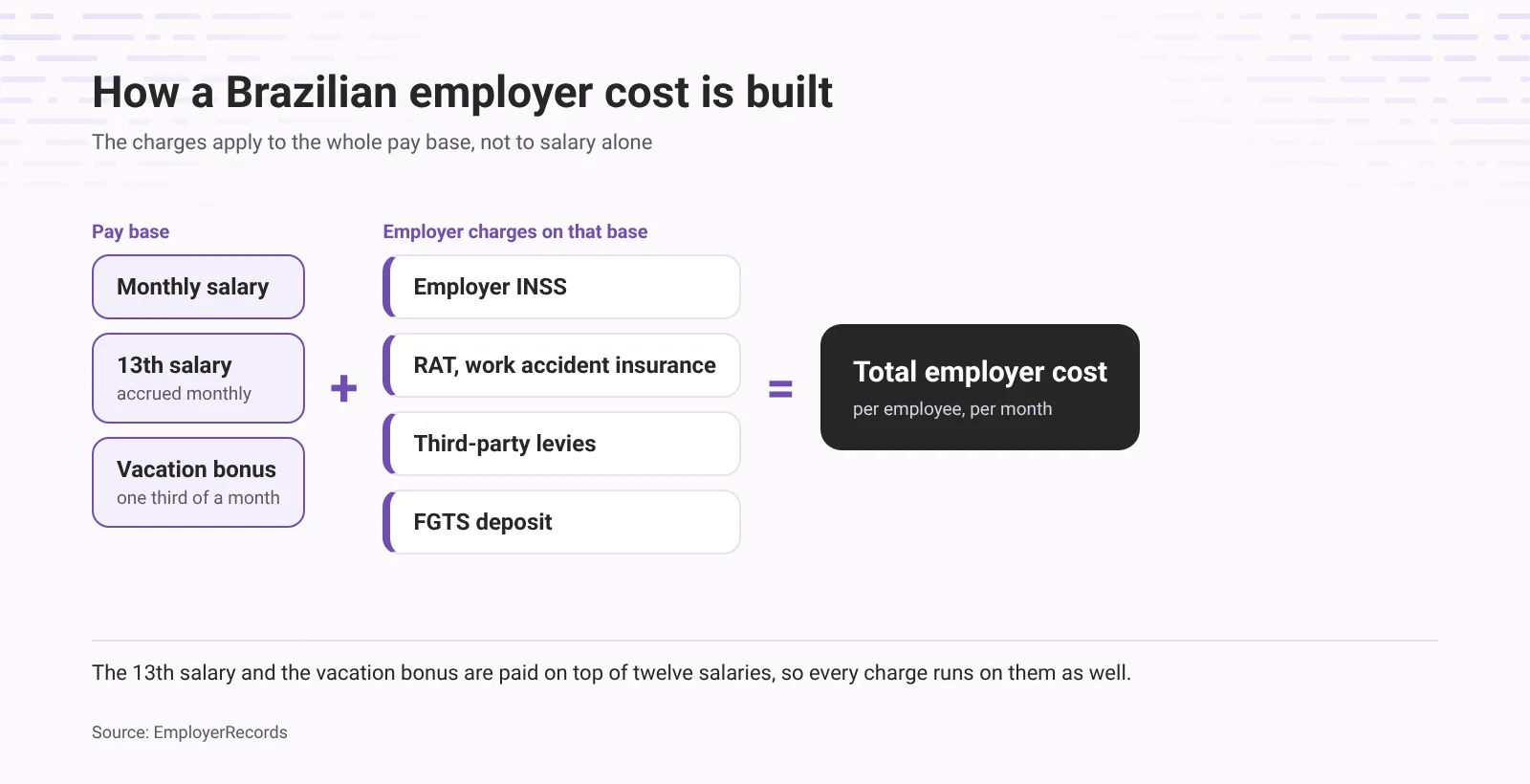
R$8,100 salary plus R$4,122 in charges and accruals.
50.9% on top of the salaryNearly everyone forgets the R$900 line. A Brazilian employee gets 13 salaries and a vacation bonus of a third, so the pay base is really 13.33 months. Spread over twelve, that’s an extra ninth of salary every month, before a single charge is applied to it.
Our view: when you compare a Brazil quote with a quote from anywhere else, ask for the 13th and the vacation bonus as separate lines. If they’re folded into ‘salary’, you can’t tell what you’re paying for.
Which employer charges does Brazil add to payroll?
Four charges do the work, and none of them comes out of the employee’s pay. Add them at RAT 2% and you get 35.8% of monthly pay. That’s our calculation, and it’s the number some guides stop at.
Employer payroll charges in Brazil, 2026[1]
| Charge | Rate | What it applies to | Legal basis |
|---|---|---|---|
| Employer INSS | 20% | All pay, no ceiling | Lei 8.212, art. 22 I |
| RAT (work accident insurance) | 1%, 2% or 3% times FAP | All pay | Lei 8.212, art. 22 II |
| Third-party levies, FPAS 515 | 5.8% | All pay | Eight-code table, eSocial[4] |
| FGTS | 8% | All pay, 13th salary included | Lei 8.036, art. 15[2] |
FGTS is different in kind. It’s a deposit into the employee’s own account, so you never get it back, but you can’t treat it as a tax either: it later sets the size of the dismissal fine.[2]
Wording matters on the INSS rule too. Article 22 applies the 20% to the total remuneration paid for the work, including habitual benefits in kind and tips, and says nothing about a ceiling.[1]
Why does the percentage stay flat at every salary?
Brazil never caps the employer side. That’s the whole answer.
In the 2026 table, the R$8,475.55 ceiling belongs to the employee’s INSS contribution.[3] Your 20%, your RAT and your FGTS keep running on every real of pay. So the junior hire and the senior hire both carry 50.9%, and each extra real of salary at the top still costs R$1.51 in total.
Monthly cost at three salaries, in reais (our calculation from the rates above)
| Base salary | INSS and RAT | Third-party levies | FGTS | 13th and bonus accrual | Total cost |
|---|---|---|---|---|---|
| R$2,700 | R$660 | R$174 | R$240 | R$300 | R$4,074 |
| R$8,100 | R$1,980 | R$522 | R$720 | R$900 | R$12,222 |
| R$27,000 | R$6,600 | R$1,740 | R$2,400 | R$3,000 | R$40,740 |
Our view: budget models built for countries with contribution ceilings will understate Brazil at the senior end, because they assume the percentage thins out. Here it doesn’t.
How do the 13th salary and vacation bonus add cost?
Take an employee on R$8,100. Between February and November you can pay half the previous month’s salary as the first 13th instalment, and the balance is due by 20 December.[5] In the month of leave, the one-third vacation bonus goes out with the vacation pay.
Each of those payments carries the four charges. FGTS applies to the 13th by statute.[2] For the vacation third, the Supreme Court held in Tema 985 that employer contribution applies when the vacation is taken,[6] and the law excludes it only where vacation is paid out as an indemnity, for example at termination.[1]
Here’s what that does to a budget. Five engineers at R$8,100 carry R$4,500 a month in accruals before any charge. With the charges on top, a team budgeted at twelve salaries plus 35.8% is short by R$6,111 a month, or R$73,332 a year.
Our calculation. Per hire, twelve salaries plus 35.8% is R$10,999.80 a month. Real cost is R$12,222. That gap of R$1,222.20 is the accrual of R$900 with the four charges applied to it, multiplied by five hires.
What moves RAT and the third-party levies?
RAT is the only charge in the 35.8% that differs between two employers doing identical work. By law it runs at 1%, 2% or 3% by the risk of the company’s main activity.[1] Then an accident-history factor multiplies it by anything from 0.5 to 2.0, so the effective rate runs from 0.5% to 6%.[7]
We assume 2% and a factor of 1.0, as the hub does. It’s a fair middle, not a promise.
Employer cost on top of pay at different RAT rates (our calculation, third-party levies at 5.8%)
| RAT after FAP | Payroll charges | Cost on top of pay |
|---|---|---|
| 0.5% | 34.3% | 49.2% |
| 1% | 34.8% | 49.8% |
| 2% | 35.8% | 50.9% |
| 3% | 36.8% | 52.0% |
| 6% | 39.8% | 55.3% |
Third-party levies look like alphabet soup and behave like one number. eSocial’s table sums them to 5.8% for FPAS 515, the commerce and services code,[4] while the Receita annex shows other codes at 5.2%, 4.5%, 2.7% or 2.5%, and one at 7.7%.[8]
Ask the EOR for the RAT rate and the FPAS code in writing. A two-point gap on RAT moves the answer by about 2.2 points, and nobody volunteers it.
Do Simples Nacional and CPRB employers pay less?
Yes, and that’s why you should ask which regime the employing entity uses before you compare quotes. A company on the Simples Nacional pays under different rules, and the percentages here don’t apply as written. Annex IV is the exception that still pays the 20% employer INSS on payroll.[7]
Some sectors pay CPRB instead. It’s a levy on gross revenue, between 1% and 4.5% depending on activity, that replaces the 20% on payroll.[9] The relief covers a list of activities and is being phased, so the answer depends on the entity’s code, not on the country.
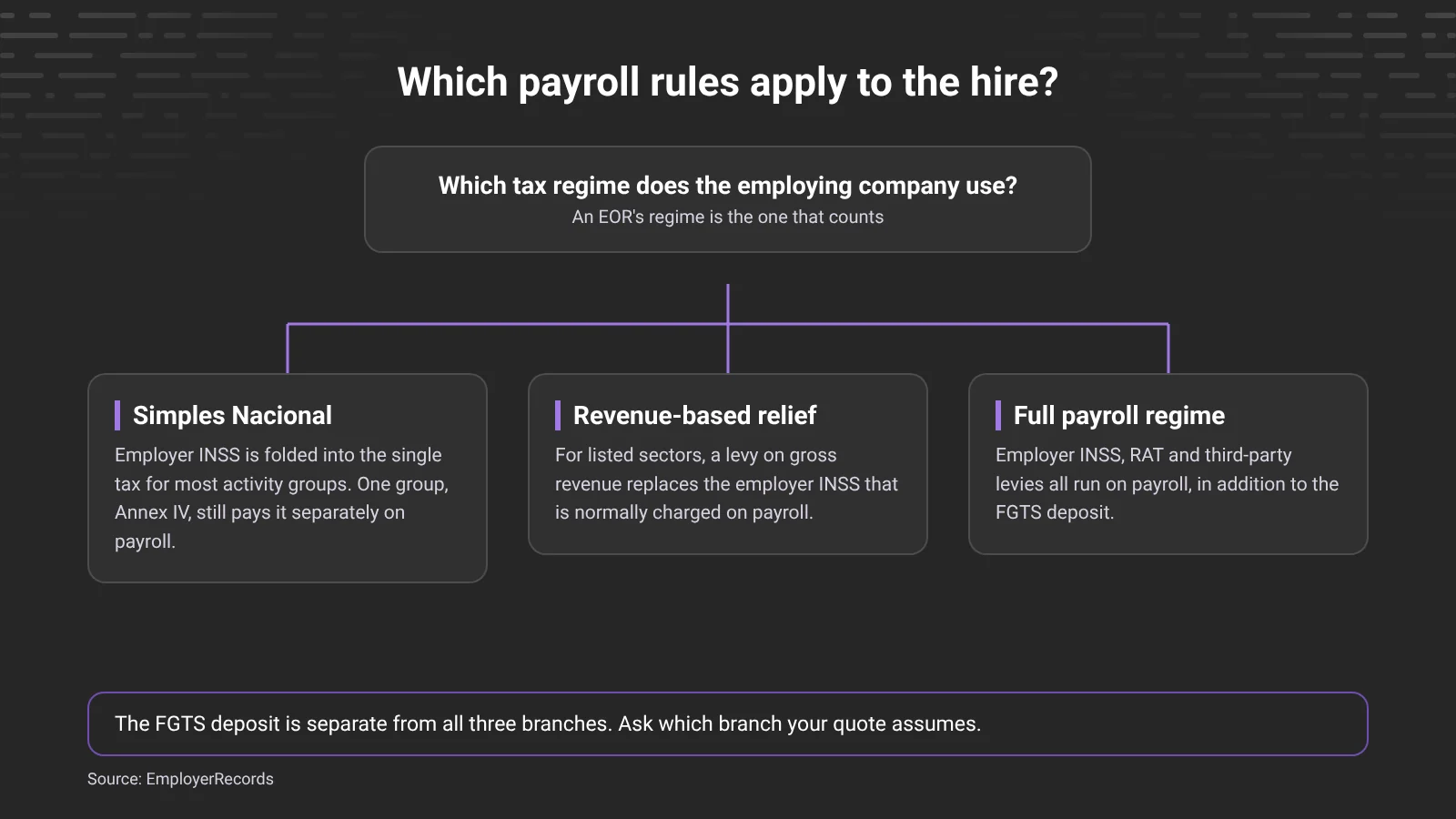
What this means for you. Hiring through an EOR, the entity’s regime decides which branch you’re on. Ask which one it uses, and ask whether it has changed since the quote was written.
When does the money actually leave your account?
Accrual and cash tell different stories. A finance team that smooths the cost across twelve months still has to find the money in the month it falls due.
November and December each cost R$5,500 more than an ordinary month, because half of the 13th salary lands in each with its charges. Vacation month adds R$3,667. FGTS itself is due by the 20th of the following month.[2]
Salary plus 35.8% charges, with the extra payments in the month they fall
Our calculation. Vacation is taken in July, the 13th is paid half in November and half in December, and due-date lags are ignored. The year adds up to R$146,664, which is twelve months at R$12,222.
What we’d do: hold the three heavy months as a reserve line from January. It’s the only way a Brazil payroll doesn’t surprise the people who approve the budget.
Which payments sit outside the 50.9%?
Article 28 of Lei 8.212 lists what does not enter the contribution base, and it says ‘exclusively’: the list is closed.[1] A few items matter to a foreign employer.
That difference is real money. Our calculation: R$1,000 of pay costs R$1,509 once charges and accruals follow it. R$1,000 of qualifying meal benefit costs R$1,000.
Treat that as a design choice for the collective agreement, not a way to relabel pay an employee already earns. Have the accountant sign off the programme before the first payslip.
What does the employee pay on the same salary?
Employee deductions don’t change what you pay. They change how an offer feels. Rates apply by band, so a R$8,100 salary pays R$935.55 of INSS, and the maximum at the ceiling is R$988.09. Both are our calculation from the table.
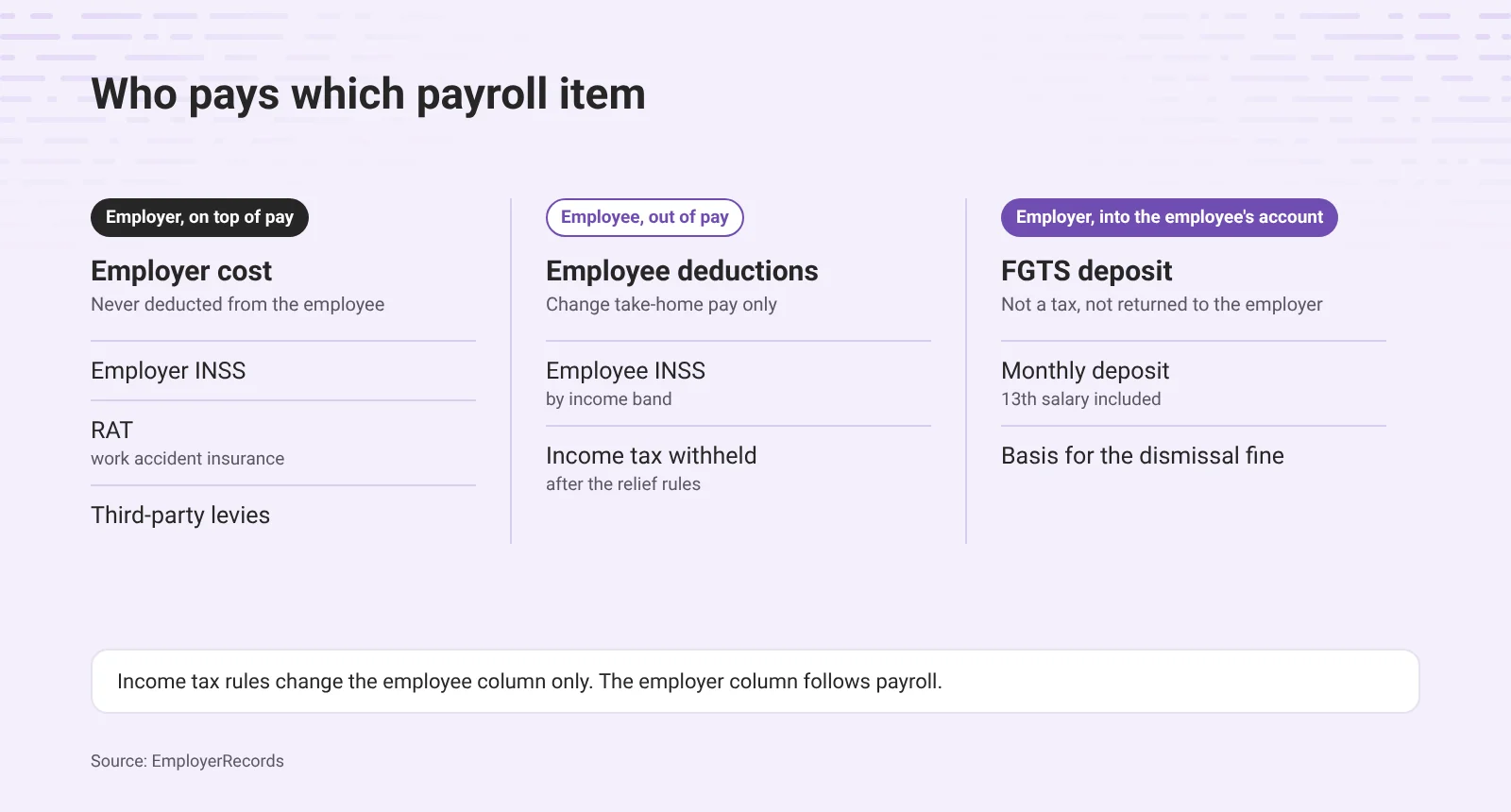
Employee INSS contribution table from 1 January 2026[3]
| Monthly pay band | Rate |
|---|---|
| Up to R$1,621.00 | 7.5% |
| R$1,621.01 to R$2,902.84 | 9% |
| R$2,902.85 to R$4,354.27 | 12% |
| R$4,354.28 to R$8,475.55 | 14% |
Income tax moved too. From January 2026 no income tax is withheld on monthly income up to R$5,000, there’s a sliding relief up to R$7,350, and above that the normal table of 7.5%, 15%, 22.5% and 27.5% applies.[10] None of it touches the employer’s cost.
If your offer letter quotes a net figure, you’ll need to gross it up, and the answer will differ by band.
Does the 42-hour week raise payroll cost?
Not the monthly bill. Constitutional Amendment 141, promulgated on 16 October 2026, cuts the maximum week from 44 to 42 hours after 60 days and to 40 hours twelve months later, with no pay cut.[11][12] For a salaried hire the 50.9% stays where it is.
Hourly rate is another matter. Our calculation: the same monthly salary spread over 42 hours lifts the hourly rate by 4.8%, and over 40 hours by 10%. Overtime at a premium and any hourly-paid role get dearer by the same factor.
A date to confirm. We use 16 December 2026 on the hub. Sources count the 60 days to 15, 16 or 17 December, so ask your payroll provider which date it has set before you plan rosters.
What should you accrue for ending a contract?
Nothing in the 50.9% covers dismissal. End a contract without cause and you owe a fine of 40% of every FGTS deposit made during the job, with correction and interest.[2] A mutual agreement halves it, to 20%.[13]
Three years at R$8,100 builds R$25,272 in deposits on salary and the 13th alone. Expect a fine of about R$10,108 before correction and interest. Our calculation.
Final pay is due within ten days of the end of the contract, and notice comes on top.[13]
Our estimate. A monthly provision of 3.2% of the FGTS pay base, which is 40% of the 8% deposit, funds the fine for a dismissal at any point. We use it because it scales with the pay and needs no tenure guess.
How much will your Brazil hire cost per month?
Enter a salary and the rates that apply to your entity. The defaults reproduce the R$8,100 example above, and the tool rounds each charge before adding, as the tables do.
Brazil payroll cost per employee, 2026 rules
An estimate. It assumes the full 20% employer INSS, so it does not fit Simples Nacional or CPRB employers, and it leaves out the dismissal fine, collective agreement benefits and any EOR fee. The 13th salary and vacation bonus are accrued at one ninth of salary, and each charge runs at 10/9 of its rate. For fees, currency and year-one costs, use the full Brazil cost calculator.
Where do Brazil cost estimates go wrong?
Most guides go wrong by stopping at the payroll charges. Some guides quote 35% to 40% on top of salary,[14] and that sits close to the 35.8% of payroll charges before the accruals. Those missing 15 points are the 13th salary and the vacation bonus.
Second, people treat the role as a salary and nothing else. A collective agreement for the employee’s category sets a salary floor, an annual raise and often a meal voucher, and none of that shows up in a statutory model. Before you sign, find the agreement: the hiring guide shows how.
Third comes the RAT assumption nobody states. Two quotes can differ by two points of cost for no reason except one assumed 1% and the other 3%.
What changes when an EOR employs the hire?
Statutory cost doesn’t change, because the charges attach to the employment and not to whoever holds it. What changes is that the EOR’s Brazilian entity is the employer, so its tax regime, RAT rate and FPAS code decide your percentage.
On top you pay the EOR’s service fee and, with some providers, a refundable deposit. Our EOR cost calculator adds both to the statutory figures, and the Brazil EOR page shows which providers own their entity. If you’re new to the model, what an employer of record does explains the split.
Hiring someone who isn’t a Brazilian national adds a visa step, covered in our work visa guide. The pay floor for the role sits in the minimum wage guide, and market pay by sector is in the average salary guide. Three line items in this bill have their own guides: termination and severance, 13th salary and vacation pay and the FGTS deposit.
Questions about employer costs in Brazil
Short answers to what employers ask most about the cost of a Brazilian hire, checked against Lei 8.212, Lei 8.036 and the 2026 INSS table on 18 November 2026.
Is 50.9% the total cost of a Brazilian employee?
It’s the statutory cost on top of base pay: INSS, RAT, third-party levies, FGTS and the accruals for the 13th salary and vacation bonus. It leaves out dismissal costs, collective agreement benefits and any EOR fee.
Does employer INSS stop at a salary ceiling?
No. The R$8,475.55 ceiling applies to the employee’s INSS table. Employer INSS runs at 20% on total pay.
Why do some guides say 35% instead?
Many stop at the four payroll charges, which come to 35.8% with RAT at 2%. They leave out the extra month and the third of a month that the law adds, and those carry charges of their own.
Do the 13th salary and vacation bonus attract INSS and FGTS?
Yes. FGTS applies to the 13th by statute, and the employer contribution applies to the 13th and to a vacation third that is taken. That’s why each charge runs at 10/9 of its headline rate in our model.
Does the new income tax exemption lower my payroll cost?
No. It changes the employee’s withholding, so take-home pay rises for salaries up to R$5,000. Employer charges stay where they are.
Can I hire in Brazil without setting up a company?
Yes, through an employer of record that already employs under the CLT. Statutory cost is the same, and the EOR adds its own fee.
References and sources
Every figure on this page comes from the sources below. Numbers in square brackets in the text link to the matching entry. Official statistics are used wherever they exist, and our own calculations are labelled as estimates. All sources were checked on 18 November 2026.
- ↑Lei nº 8.212, de 24 de julho de 1991. Câmara dos Deputados. www2.camara.leg.br. Retrieved 18 November 2026. Law
- ↑Lei nº 8.036, de 11 de maio de 1990. Câmara dos Deputados. www2.camara.leg.br. Retrieved 18 November 2026. Law
- ↑Portaria Interministerial MPS/MF nº 13, de 9 de janeiro de 2026. Ministério da Previdência Social and Ministério da Fazenda, published in the DOU on 12 January 2026. www.normaslegais.com.br. Retrieved 18 November 2026. Law
- ↑FPAS 515 (Tabela 04 do eSocial): código de terceiros 0115. Buscador NCM, from the eSocial table. buscadorncm.com.br. Retrieved 18 November 2026. Data
- ↑Lei nº 4.749, de 12 de agosto de 1965. Guia Trabalhista. www.guiatrabalhista.com.br. Retrieved 18 November 2026. Law
- ↑Contribuição patronal incide sobre terço de férias, decide 2ª turma do STJ. Migalhas. www.migalhas.com.br. Retrieved 18 November 2026. News
- ↑INSS patronal: como calcular para empresas em 2026. Contabilidade Zen. www.contabilidadezen.com.br. Retrieved 18 November 2026. Guide
- ↑Anexos II a VIII da Instrução Normativa RFB nº 2.110/2022 (Anexo III, totais de terceiros por FPAS). Receita Federal, reproduced by Normas Legais. www.normaslegais.com.br. Retrieved 18 November 2026. Law
- ↑O que é o INSS patronal e quem está obrigado a recolher. Tributo Devido. tributodevido.com.br. Retrieved 18 November 2026. Guide
- ↑Receita Federal orienta fontes pagadoras e contribuintes a calcular a redução do imposto de renda a partir de 1º de janeiro de 2026. Receita Federal, reproduced by COAD, 12 December 2025. coad.com.br. Retrieved 18 November 2026. Guide
- ↑Congresso promulga emenda que extingue a escala 6×1 e reduz jornada para 40 horas semanais. Fenacon. fenacon.org.br. Retrieved 18 November 2026. News
- ↑Promulgada: escala 5×2 passa a valer na semana anterior ao Natal. Brasil de Fato, 16 October 2026. www.brasildefato.com.br. Retrieved 18 November 2026. News
- ↑Decreto-Lei nº 5.452, de 1º de maio de 1943 (CLT). Câmara dos Deputados. www2.camara.leg.br. Retrieved 18 November 2026. Law
- ↑How to hire and pay employees in Brazil. Oyster. www.oysterhr.com. Retrieved 18 November 2026. Guide
About the author

Emma Whitmore is an EOR and Global Employment Content Writer at EmployerRecords, where she researches and writes practical resources on Employer of Record (EOR) services, international hiring, global payroll, employment compliance, and workforce expansion across international markets. With more than 15 years of experience in B2B content and editorial research, Emma specializes in turning complex employment regulations into clear, actionable guidance for HR leaders, founders, and globally distributed teams. Her work focuses on helping businesses understand country-specific hiring requirements, compare global employment providers, and navigate compliance with confidence.
View all articles by EmmaMinimum wage and salary guides for other countries
Compare Brazil with the pay floors and salary levels employers work with in other markets.
 Brazil13th Salary and Vacation13th Salary and Vacation Pay in Brazil (2026): Rules and CostHow the 13th salary and vacation pay are calculated, when each is due and what they add to the cost...Read the guideBrazilAverage salaryAverage Salary in Brazil (2026): R$3,790 a Month by Sector and RegionWhat Brazilian workers earn on average, why four official figures disagree, and what a hire costs on top.Read the guideBrazilFGTSFGTS in Brazil (2026): 8% Deposit, 40% Fine and Late PenaltiesHow much the monthly FGTS deposit is, what pay it covers, what the dismissal fine costs and what a late...Read the guideBrazilMinimum wageMinimum Wage in Brazil (2026): R$1,621 a Month, State Floors and 2027 OutlookWhat the national minimum wage is, who it covers, which states set higher floors and what a minimum wage hire...Read the guideBrazilTermination and SeveranceTermination in Brazil (2026): Notice, 40% FGTS Fine and Final PayHow notice, severance and the FGTS fine work in Brazil, and what ending a contract costs an employer.Read the guideBrazilWork VisaWork Visa in Brazil (2026): VITEM V Steps, Fees and the Two-Thirds RuleWho files, which ministry decides, what it costs, how long it takes and how many foreign staff a company can...Read the guide
Hiring in Brazil?
The hiring guide covers the CLT contract, entity options, notice and the full cost of an employee.