
Minimum Wage in Brazil (2026): R$1,621 a Month, State Floors and 2027 Outlook
What the national minimum wage is, who it covers, which states set higher floors, how the figure is set each year and what a minimum wage hire really costs.
What is the minimum wage in Brazil in 2026?
Brazil’s national minimum wage is R$1,621 a month from 1 January 2026, which works out at R$54.04 a day and R$7.37 an hour. Decree 12.797/2025 set it, a rise of 6.79% on R$1,518. A 2027 budget bill proposes R$1,741, and four states set higher floors for some trades.
- Real cost: R$2,445 a month with charges and accruals
- State floors: PR, RS, SC and SP set higher floors for some trades
- Next change: 42-hour week from 16 December 2026, same monthly pay
Three numbers come out of the decree: R$1,621 a month, R$54.04 a day and R$7.37 an hour.[1] It replaced R$1,518 on 1 January 2026, so the rise is R$103, or 6.79%.[1]
Under the formula the 2026 figure came out at R$1,620.99, and the law’s rounding rule lifted it to R$1,621.[1] That’s the national number. It isn’t the only one that can bind you. Several states keep higher floors for some trades, and collective agreements sit above both for most professional roles.
Editor’s note: for a professional hire the minimum wage rarely sets the pay. It marks the line you can’t go below, and it quietly moves a long list of other payments, which is why employers get caught out when it changes.
How is Brazil’s minimum wage set each year?
A decree sets the figure each December, and a formula does the arithmetic. It adds consumer inflation (the INPC index, measured to November) to real GDP growth from two years earlier.[2] A 2024 law then capped the real part at 2.5% a year between 2025 and 2030.[2]
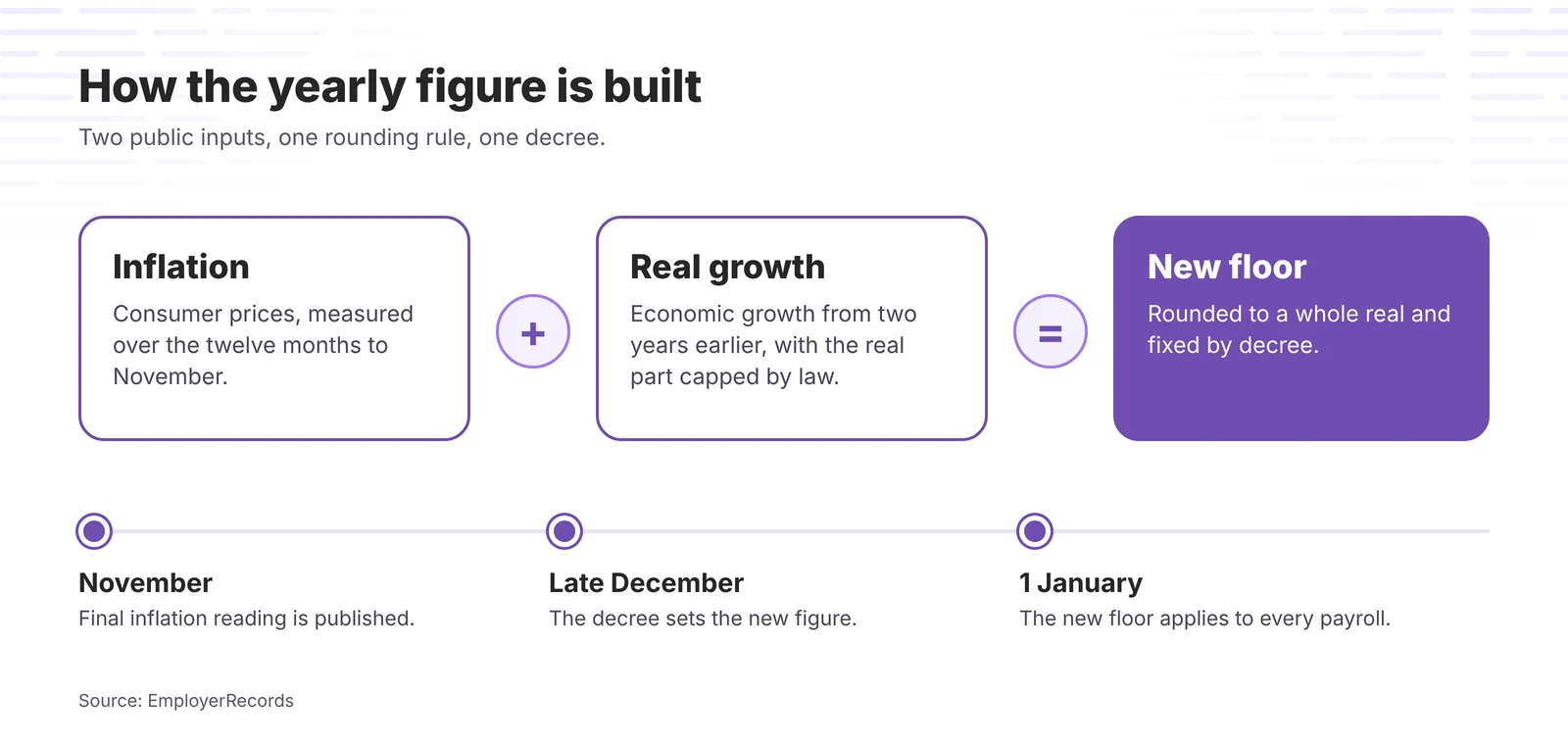
That makes the next rise predictable well before the decree. Our view. Employers who watch November inflation can budget the January change in the autumn, and the 2027 proposal below is best read as a budget input, not a decision.
Over ten years the floor has gone from R$880 to R$1,621, which is R$741 more, or 84.2%.[3]
Value in force at the end of each year
Source: federal decrees and laws as tabulated by NSC Total. 2023 shows the May value after a mid-year rise from R$1,302. *2027 is the budget bill proposal, not a decree. [3]
Real gains were thin mid-decade. 2018 brought just 1.8%, the smallest rise in the table, while 2022 saw 10.2% as inflation ran hot.[3]
What is the minimum wage per day and per hour?
Federal minimum wage values in force in 2026
| Basis | Amount (R$) | How it is used |
|---|---|---|
| Month | 1,621.00 | Full-time contract on a 44-hour week. |
| Day | 54.04 | Daily-paid work and proportional pay for part of a month.[1] |
| Hour | 7.37 | Hourly contracts, apprentices and part-time pay.[1] |
Hourly matters more than it looks. It’s the base for apprentices, hourly staff and any part-time contract priced at the minimum.
Hours are about to change too. EC 141/2026 cuts the normal week from 44 to 42 hours on 16 December 2026 and to 40 hours a year later, with two paid rest days and no pay cut.[4][5] Monthly pay can’t fall, so the hourly equivalent has to rise.
Hourly minimum as the legal week shortens (our calculation, monthly pay unchanged)
| Weekly hours | Start | Monthly hours | Hourly equivalent (R$) |
|---|---|---|---|
| 44 | In force now | 220 | 7.37 |
| 42 | 16 December 2026 | 210 | 7.72 |
| 40 | 16 December 2027 | 200 | 8.11 |
Check the start date. Sources differ by a day on when the 42-hour week starts, between 15 and 17 December. We use 16 December, two months after publication on 16 October 2026, and our Brazil hub does the same.[4] Monthly hours here are weekly hours times five, which is how the 220 figure arises. We found no official divisor for the shorter week, so confirm the one your payroll provider will use.
Who does the national minimum wage cover?
Employees are guaranteed a nationally uniform minimum wage by the Constitution, which extends it to domestic workers.[6] In practice it covers every employee on a CLT contract, whatever the sector. How it applies to other workers depends on the arrangement.
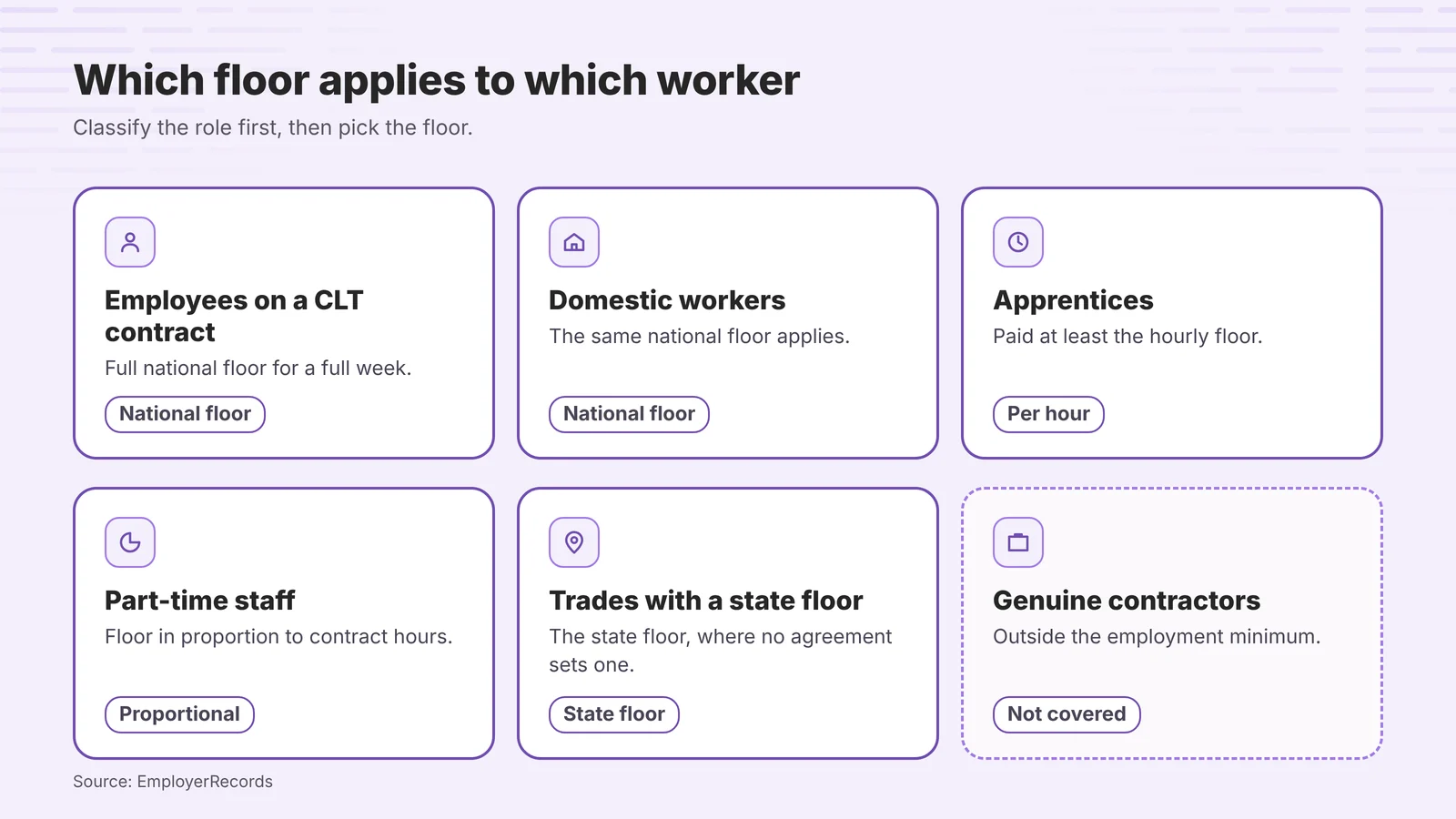
What applies to each type of worker
| Worker type | What applies | Note |
|---|---|---|
| Full-time employee on a CLT contract | National minimum | Based on a 44-hour week today. |
| Domestic worker | National minimum | The Constitution extends it to domestic work.[6] |
| Part-time or reduced hours | Proportional minimum | The TST accepts pay in proportion to contract hours.[7] |
| Apprentice | Minimum wage per hour | Unless the contract or an agreement gives more.[8] |
| Trade with a state floor | State floor | Only where no federal law, agreement or convention sets one.[9] |
| Genuine contractor | Outside the employment minimum | Misclassified staff are not outside it. |
Proportional pay has a practical edge. At the 44-hour basis, R$1,621 times 30 over 44 gives R$1,105.23 for a 30-hour contract (our calculation). Domestic workers on short weeks get the same treatment from the TST.[10]
Practical point: don’t price a part-time offer at the proportional minimum without reading the agreement. Most agreements set their own part-time rules, and a contract that looks cheap on paper tends to get reopened.
Open question. After 16 December the full-time week is 42 hours. We found no official guidance on whether the proportional minimum then divides by 44 or 42. For a 30-hour contract that is R$1,105.23 against R$1,157.86, a gap of R$52.63 a month. Ask counsel before you rely on the lower figure.
If you’re weighing a contractor arrangement for work that looks like a job, read our guide to the cost of employee misclassification first.
Which states set a higher minimum wage?
Federal law lets states set their own floors for trades that no federal law, convention or collective agreement covers.[9] The floors only ever sit above the national figure, and four states have confirmed 2026 values.
State minimum wage floors in 2026
| State | Lowest band (R$) | Highest band (R$) | Bands | In force |
|---|---|---|---|---|
| Paraná | 2,105.34 | 2,407.90 | 4 | 1 January 2026.[11] |
| Rio Grande do Sul | 1,884.75 | 2,388.50 | 5 | Published 21 May 2026.[12] |
| Santa Catarina | 1,842.00 | 2,106.00 | 4 | 1 January 2026, backdated.[13] |
| São Paulo | 1,874.36 | 1,874.36 | 1 | 1 June 2026.[14] |
Rio de Janeiro also has a regional floor on the books, but we found no 2026 table from an official source, and one tracker says it hasn’t moved since 2019.[15] Treat it as unconfirmed and ask the state labour office.
Precedence is simple. A collective agreement comes first, then the state floor, then the national minimum.[9] Where the employee lives, not where your company is registered, decides which floor applies.[16]
Editor’s take. A state floor rarely matters for an office or tech hire. Those roles sit well above it, and most trades with an agreement are already past it. Floors bite for domestic work, small retail and similar jobs, so check the agreement before you open this table.
Check a salary against the minimum wage
Enter a monthly salary and the contract hours. You’ll see whether the offer clears the floor and what it costs, and the tool starts at the national minimum so the first reading matches the cost table below.
Check a Brazil salary against the minimum wage
Estimate for one monthly payroll. The minimum for part-time hours is the full-week floor times your hours over 44, and monthly hours are your weekly hours times five. Enter a state or collective agreement floor to test against it. Net pay and employer cost use the 2026 INSS and income tax tables, a RAT of 2% and the 13th salary and vacation bonus accrued monthly. They leave out the 40% FGTS fine and benefits. For EOR fees, use the full Brazil cost calculator.
What does a minimum wage hire cost an employer?
A hire on R$1,621 costs R$2,445 a month, which is R$824 on top of the wage.[16] At about R$5.65 to the dollar that’s roughly US$433.[17]
R$1,621 wage plus R$824 in charges and accruals.
50.8% on top of the wageCharges follow the basis in our Brazil hub: INSS and RAT at 22%, third-party levies at 5.8% and FGTS at 8%, each run at 10/9 because they also fall on the 13th salary and vacation bonus accruals.[16] Rounding line by line gives 50.8% on this small base. Unrounded it’s the 50.9% the hub quotes.
RAT is assumed at 2%, and the 40% FGTS fine on a dismissal without cause sits outside the figure.[16] The employee pays 7.5% INSS and no income tax at this pay, so take-home is R$1,499.42.[18]
What we’d check first: the 13th salary and vacation accruals. They add R$180 here before any charge on them, and new employers tend to treat them as a year-end item instead of a monthly cost.
Which payments are tied to the minimum wage?
A change in the minimum wage reaches well past the payslip. About 45% of the benefits paid by the general social security regime are linked to it, which is why the figure is also a budget decision.[19]
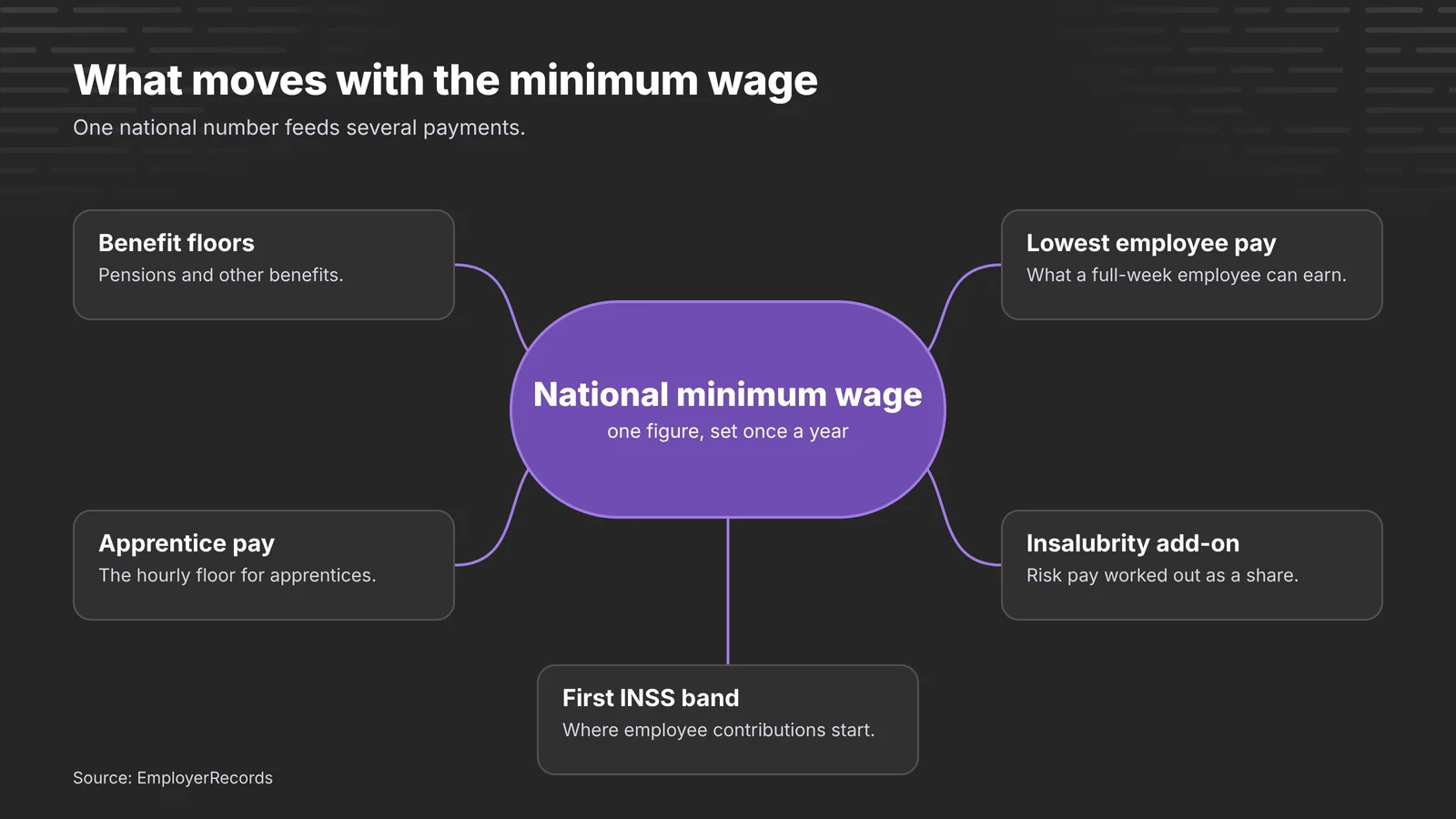
Insalubrity pay is the add-on employers meet most. Its base stays the minimum wage unless a collective agreement sets another, so an employee on high pay still receives the same fixed amount.[20]
A rise in the minimum wage costs more than the headline percentage on low-pay payrolls, because the floor, the add-on and the contribution bands move together. Run the full month, base salary and add-ons together.
How does the minimum wage compare with real pay and living costs?
New formal hires averaged R$2,429 in September 2026, so the minimum wage is about two thirds of what employers paid on new contracts (our calculation).[21] Our Brazil average salary guide covers the full pay picture.
DIEESE, the unions’ research institute, puts living costs far higher. It estimated that a family of four needed R$7,992.47 a month in October 2026, or 4.93 times the minimum wage.[22] A year earlier the ratio was 4.69, when the floor was R$1,518 and the estimate R$7,116.83.[22]
It’s an estimate built on the food basket of the most expensive capital, so read it as a ceiling and not a national average. It isn’t a legal benchmark and doesn’t change what you owe.
We include it because it shows how far the legal floor sits from a living wage. That gap is what collective agreements and employers fill, and it’s the reason a floor-level offer tends to lose candidates fast.
Can you hire in Brazil without setting up a company?
Yes, through an employer of record that already holds a Brazilian company registration. It becomes the legal employer on a CLT contract, and you direct the work.[16]
Fees are flat. Market rates run from $599 to $899 per employee per month, roughly 8% to 16% of gross pay on a typical salary.[16] At the minimum wage of about US$287, a $599 fee is roughly twice the wage it manages (our calculation).[17]
Flat-fee EOR hiring rarely pays off for floor-level roles, unless the person is hard to find. Start with the Brazil EOR providers page, read what an employer of record does, and price the role in the EOR cost calculator.
What changes for the minimum wage from 2027?
A budget bill sent on 31 August 2026 puts the 2027 minimum wage at R$1,741.[23] That’s R$120, or 7.4%, above today, and R$24 more than the R$1,717 pencilled in April.[24]
Decrees normally arrive in the last week of December, as on 24 December 2025, so the number can still move.[1]
Employer cost at today’s minimum and the 2027 proposal (our calculation)
| Item | R$1,621 | R$1,741 | Change |
|---|---|---|---|
| Monthly wage | 1,621 | 1,741 | +120 |
| Employer charges and accruals | 824 | 886 | +62 |
| Total monthly cost | 2,445 | 2,627 | +182 |
A shorter week lifts the hourly cost as well. Going from 44 to 42 hours raises each hour by about 4.8% at the same monthly pay.
If you run shift rosters, model the 42-hour week now. Monthly pay holds, but every hourly figure moves.
The floor sets the cheapest legal contract, but the cost sits in what is added to it. The employer costs guide lays out the charges, the 13th salary and vacation pay and FGTS guides explain the add-ons, and the termination guide covers ending a contract.
Questions about the minimum wage in Brazil
Short answers to what employers ask most, checked against the decree, the 2027 budget bill and the state laws on 17 November 2026.
What is the minimum wage in Brazil in 2026?
R$1,621 a month from 1 January 2026, which is R$54.04 a day and R$7.37 an hour. Decree 12.797/2025 set it, up 6.79% from R$1,518.
Does each state have its own minimum wage?
Not as a rule. Brazil has one national minimum wage. Paraná, Rio Grande do Sul, Santa Catarina and São Paulo also set higher floors for trades that have no federal, convention or agreement floor. Paraná’s top band, R$2,407.90, is the highest we found.
Can I pay a part-time employee less than R$1,621?
Yes, if the hours are reduced and the pay stays in proportion, as the TST allows. At today’s 44-hour basis, a 30-hour contract can be paid R$1,105.23. Read the collective agreement first: it may set its own part-time floor, and that one wins.
Does the minimum wage apply to domestic workers?
Yes. The Constitution extends it to domestic work, and the TST has accepted proportional pay for reduced hours.
How much does a minimum wage employee cost?
About R$2,445 a month: R$1,621 plus R$824 in charges and accruals. That’s 50.8% on this small base, and 50.9% before rounding, the figure our Brazil hub uses.
What will the minimum wage be in 2027?
Budget figures put 2027 at R$1,741, a rise of 7.4%. Nothing is final until the decree, which normally arrives in the last week of December.
Does the shorter working week change the minimum wage?
Monthly pay stays at R$1,621, because the amendment bars any pay cut. Hourly pay rises, to about R$7.72 at 42 hours from 16 December 2026 and R$8.11 at 40 hours from 16 December 2027. That’s our arithmetic, not official guidance.
Do contractors have to be paid the minimum wage?
A genuine independent contractor falls outside the employment minimum, because there’s no employment relationship. If the person works like an employee, the arrangement can be reclassified, and then the minimum wage and the charges apply from the start.
Is the minimum wage enough to live on?
DIEESE estimated that a family of four needed R$7,992.47 a month in October 2026, or 4.93 times the minimum wage. That’s a union research estimate and not a legal measure.
References and sources
Every figure on this page comes from the sources below. Numbers in square brackets in the text link to the matching entry. Official statistics are used wherever they exist, and our own calculations are labelled as such. All sources were checked on 17 November 2026.
- ↑Publicado decreto que reajusta salário mínimo para R$ 1.621 a partir de 1º de janeiro. Agência Gov, 24 December 2025. agenciagov.ebc.com.br. Retrieved 17 November 2026. Official
- ↑Salário mínimo 2025: qual o valor após reajuste?. BBC News Brasil via O Povo, 6 January 2025. opovo.com.br. Retrieved 17 November 2026. News
- ↑Salário mínimo aumentou menos de mil reais em 10 anos no país; confira lista. NSC Total, 2026. nsctotal.com.br. Retrieved 17 November 2026. News
- ↑Emenda Constitucional nº 141, de 16 de outubro de 2026. Presidência da República, Planalto. planalto.gov.br. Retrieved 17 November 2026. Official
- ↑Emenda Constitucional nº 141: jornada máxima semanal e dois dias de repouso, sem redução salarial. Senado Federal, Legis, 2026. legis.senado.leg.br. Retrieved 17 November 2026. Official
- ↑Constituição da República Federativa do Brasil, art. 7º (58ª edição). Câmara dos Deputados, 2022. bd.camara.leg.br. Retrieved 17 November 2026. Official
- ↑O salário deve ser proporcional à efetiva carga horária (texto da OJ 358 da SDI-1 do TST). Jus.com.br. jus.com.br. Retrieved 17 November 2026. Guide
- ↑Art. 428 da CLT: contrato de aprendizagem, § 2º. Petições Online. peticoesonline.com.br. Retrieved 17 November 2026. Guide
- ↑Estado sanciona lei que reajusta piso salarial paulista para R$ 1.874. DGABC, 28 May 2026. dgabc.com.br. Retrieved 17 November 2026. News
- ↑Doméstica que trabalha três dias na semana vai receber mínimo proporcional. SEDEP, reporting a TST ruling. sedep.com.br. Retrieved 17 November 2026. News
- ↑Salário mínimo regional 2026: pisos por estado. ValorFinal, checked 30 October 2026. valorfinal.com.br. Retrieved 17 November 2026. Guide
- ↑Reajuste do piso salarial regional já está em vigor após publicação no Diário Oficial do Estado. Governo do Estado do Rio Grande do Sul, 21 May 2026. estado.rs.gov.br. Retrieved 17 November 2026. Official
- ↑Santa Catarina estabelece novos pisos salariais para 2026. Trabalhista.blog, 27 March 2026. trabalhista.blog. Retrieved 17 November 2026. Guide
- ↑Aprovados na Alesp, novo Salário Mínimo Paulista e abono a servidores são sancionados. Assembleia Legislativa de São Paulo, 28 May 2026. al.sp.gov.br. Retrieved 17 November 2026. Official
- ↑Tabela de valores do salário mínimo e pisos regionais. Meutudo. meutudo.com.br. Retrieved 17 November 2026. Guide
- ↑How to Hire Employees in Brazil: Costs, CLT Rules and EOR Options. EmployerRecords, verified 23 October 2026. employerrecords.com. Retrieved 17 November 2026. Guide
- ↑Dólar fecha em R$ 5,65 após sessão de estabilidade. Brasil 61, 13 November 2026. brasil61.com. Retrieved 17 November 2026. News
- ↑Portaria Interministerial MPS/MF nº 13: nova tabela de contribuição do INSS para 2026. Portal de Exigências Legais (Senior), 12 January 2026. documentacao.senior.com.br. Retrieved 17 November 2026. Guide
- ↑Salário mínimo deverá subir para R$ 1.741 em 2027, afirma Durigan. Mercado & Consumo, citing Agência Brasil, 25 August 2026. mercadoeconsumo.com.br. Retrieved 17 November 2026. News
- ↑Adicional de insalubridade: graus, percentuais e base de cálculo. ValorFinal, 2026. valorfinal.com.br. Retrieved 17 November 2026. Guide
- ↑Brasil gera 121,3 mil empregos formais em setembro. Agência Gov, Ministry of Labour and Employment (Novo Caged), 4 November 2026. agenciagov.ebc.com.br. Retrieved 17 November 2026. Official
- ↑Pesquisa Nacional da Cesta Básica de Alimentos: resultados de outubro de 2026. DIEESE, 10 November 2026. dieese.org.br. Retrieved 17 November 2026. Data
- ↑Executivo envia Orçamento de 2027 ao Congresso com mínimo de R$ 1.741. Agência Senado, 31 August 2026. www12.senado.leg.br. Retrieved 17 November 2026. Official
- ↑Governo propõe salário mínimo de R$ 1.741 em 2027. Revista Oeste, August 2026. revistaoeste.com. Retrieved 17 November 2026. News
About the author

Manjuri Dutta is Co-Founder and Content Editor at EmployerRecords.com, covering Employer of Record providers and global hiring platforms. She evaluates providers on entity ownership, statutory compliance, and real pricing rather than vendor claims, and built the verification process used across EmployerRecords' country guides, checking vendor claims against government registries and public filings.
View all articles by ManjuriSalary and minimum wage guides for other countries
Compare Brazil with the pay floors and salary levels employers work with in other markets.
 Brazil13th Salary and Vacation13th Salary and Vacation Pay in Brazil (2026): Rules and CostHow the 13th salary and vacation pay are calculated, when each is due and what they add to the cost...Read the guideBrazilAverage salaryAverage Salary in Brazil (2026): R$3,790 a Month by Sector and RegionWhat Brazilian workers earn on average, why four official figures disagree, and what a hire costs on top.Read the guideBrazilEmployer costsEmployer Costs in Brazil (2026): 50.9% on Top of SalaryWhat a Brazil hire really costs: employer charges, the 13th and vacation accruals, FGTS and a worked R$8,100 example.Read the guideBrazilFGTSFGTS in Brazil (2026): 8% Deposit, 40% Fine and Late PenaltiesHow much the monthly FGTS deposit is, what pay it covers, what the dismissal fine costs and what a late...Read the guideBrazilTermination and SeveranceTermination in Brazil (2026): Notice, 40% FGTS Fine and Final PayHow notice, severance and the FGTS fine work in Brazil, and what ending a contract costs an employer.Read the guideBrazilWork VisaWork Visa in Brazil (2026): VITEM V Steps, Fees and the Two-Thirds RuleWho files, which ministry decides, what it costs, how long it takes and how many foreign staff a company can...Read the guide
Hiring in Brazil?
The Brazil hiring guide covers CLT costs, the 2026 working week changes, contractor risk and the EOR route.