
Annual Leave and Extra Pay in Spain (2026): 30 Days and Two Extra Payments
The statutory minimums for holiday, extra payments and paid leave, how prorating changes the exit bill, and what a real settlement owes.
How much annual leave and extra pay must an employer give in Spain?
Spanish law gives at least 30 calendar days of paid annual leave and two extra payments a year. Public holidays add up to 14 more days, two of them local. Each untaken leave day is worth about €107 at €39,200 of annual pay if it has to be paid out at exit (our calculation).
- Annual leave: 30 calendar days at least
- Extra payments: two a year, one at Christmas
- Dates: known two months ahead
Time off and extra payments come from the Workers’ Statute, and collective agreements build on that floor. Pay for both is already inside the annual salary, so neither shows up as a separate line in a budget.[1]
What does show up is the liability. Untaken holiday and unpaid shares of extra payments sit on the books until the day the employee leaves, and they land in the final settlement.
This guide sets out the statutory minimums, how extra payments are paid, who funds each type of leave, and a calculator for the amounts owed at exit.
What does the law guarantee?
Five rights matter for payroll planning, and all five come from the Workers’ Statute. Collective agreements can improve each of them but can’t go below.[1]
Time off and pay minimums under the Workers’ Statute[1]
| Item | Minimum | Article |
|---|---|---|
| Paid annual leave | 30 calendar days | 38 |
| Extra payments | Two a year, one at Christmas | 31 |
| Public holidays | Up to 14 a year, two of them local | 37.2 |
| Weekly rest | 1.5 uninterrupted days | 37.1 |
| Ordinary working week | 40 hours as an annual average | 34 |
| Rest between shifts | 12 hours | 34 |
Daily work is capped at nine hours unless an agreement says otherwise, and a break of at least 15 minutes applies once continuous work passes six hours.[1]
How does annual leave work?
The minimum is 30 calendar days, which is why Spanish holiday allowances are often quoted as 22 working days. Many agreements use that conversion.[1][2]
Dates are agreed between employer and employee, and the employee has to know them at least two months ahead. Leave can’t be swapped for cash during the employment, with one exception: cash is allowed when the contract ends.[1]
A new hire earns leave in proportion to service, generally 2.5 days for each month worked unless the agreement says otherwise.[3]
Say an employee starts on 1 March. By 31 October they’ve worked eight months and have earned 20 days. If they take 12, eight remain, and those eight days are a liability of about €859 on a €39,200 salary (our calculation).
Sickness during holiday has its own rule. Leave that overlaps with sickness can be taken within 18 months after the end of the year in which it arose, and leave that overlaps with pregnancy or birth-related incapacity can move even later.[1]
What we’d do. Run a holiday balance report every quarter. A balance of 20 untaken days on one payroll line is manageable, and the same balance across forty people is a cash call the finance team should see coming.
What are the extra payments?
Employees are entitled to two extra payments a year. One falls at Christmas, and the other falls in a month set by the collective agreement.[1]
Most contracts quote annual pay in 14 payments, so €39,200 means 14 payments of €2,800. Twelve are ordinary monthly payments and two are the extras.
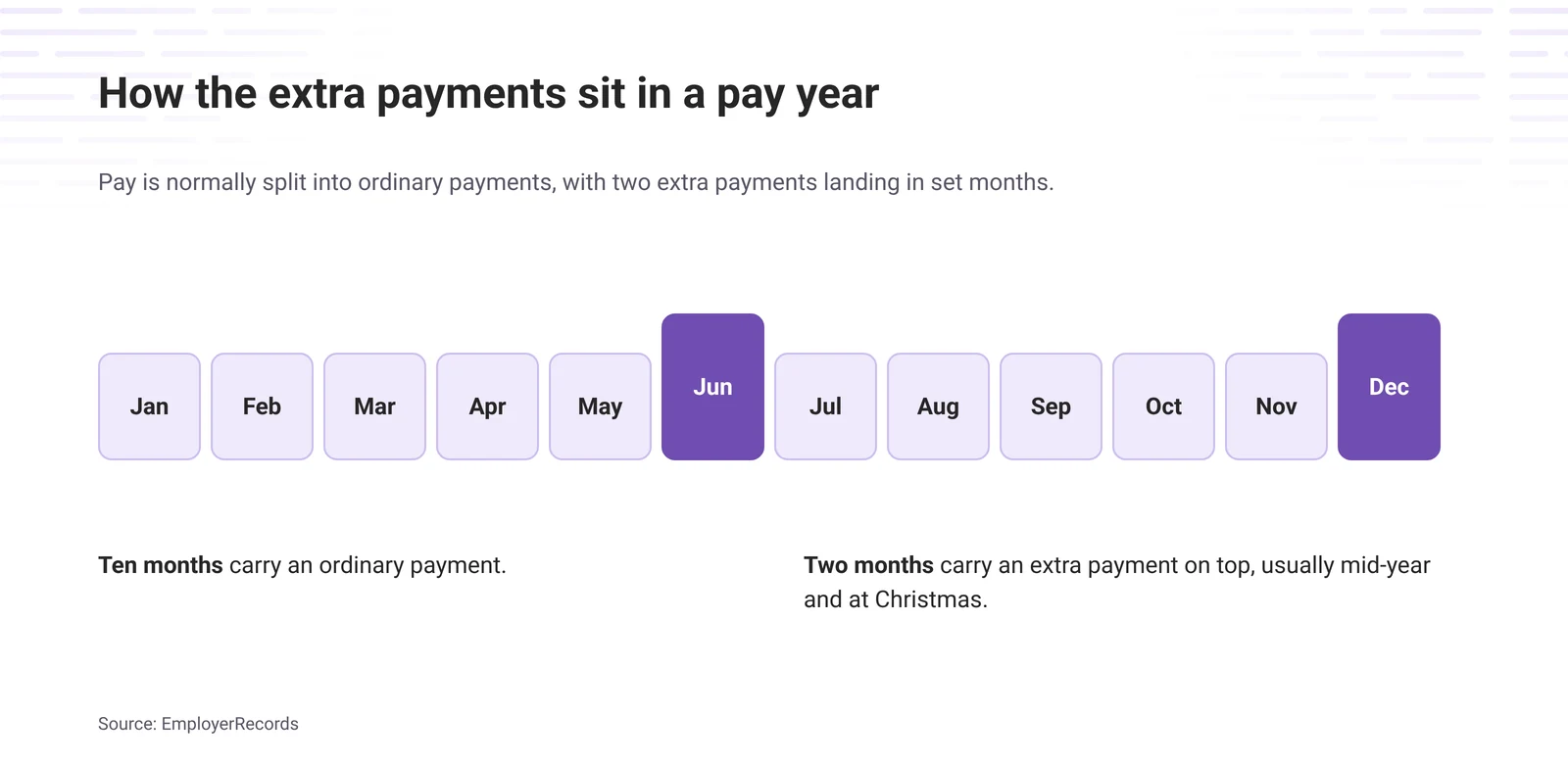
The amount of each extra payment is set by the collective agreement. In many contracts it equals one ordinary monthly payment, and that is what we assume in our examples.
What changes when extra payments are spread across twelve months?
A collective agreement can spread the extra payments across the twelve monthly payments, so that each payslip carries one-twelfth of them.[1] The employee earns the same over the year, but the monthly figure looks higher.
It matters most at exit. When extras are paid on their own dates, the employee may be owed a share of the next one. When they are spread, there’s nothing left to settle.[4]
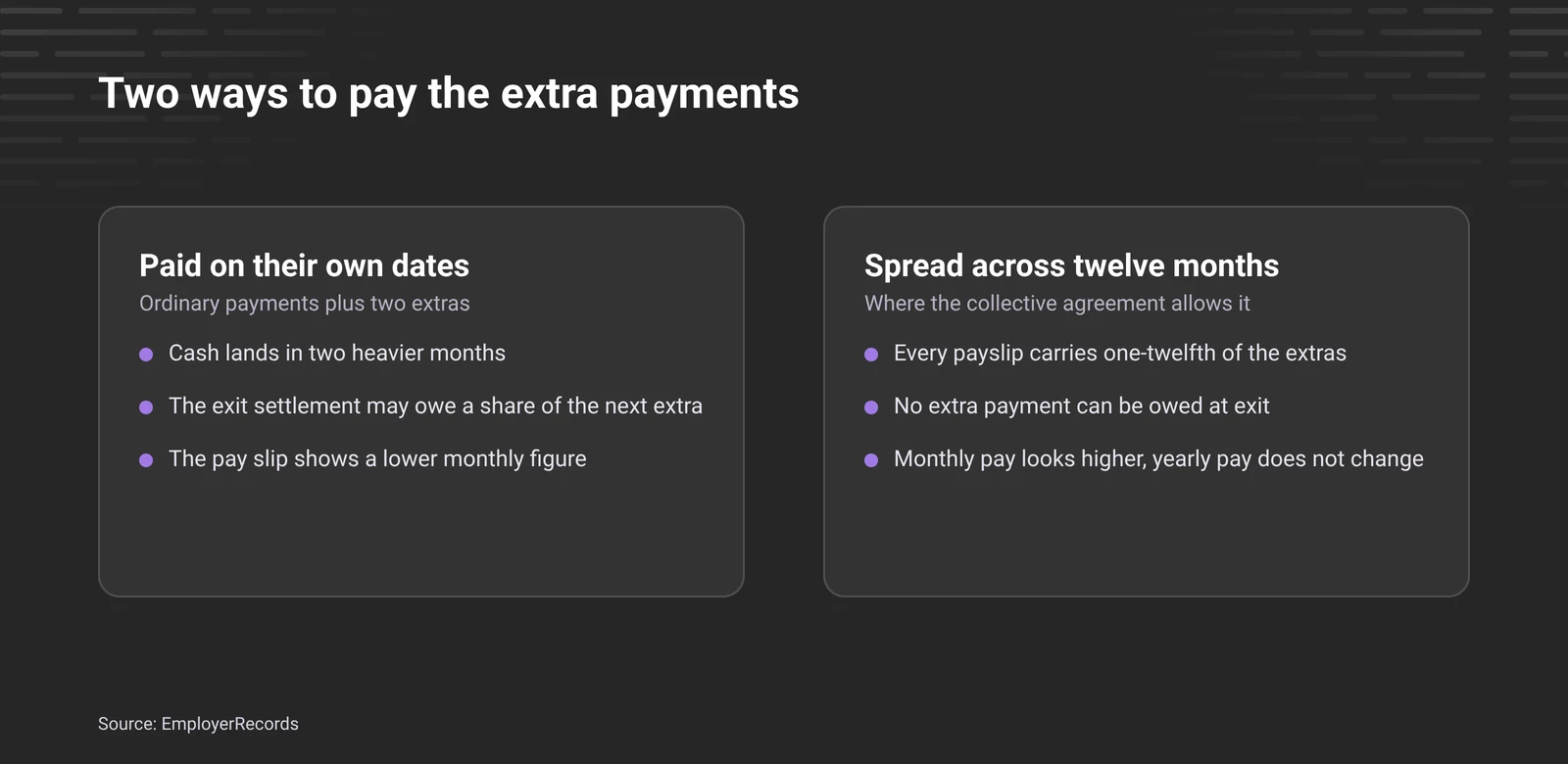
The share depends on how the agreement accrues the extra. Under annual accrual the employee earns it across the full year, and under half-yearly accrual across six months.[5]
Take the €39,200 salary. An employee who leaves after ten months of an annual accrual is owed ten twelfths of €2,800, which is €2,333. If the same extra accrues over half a year and four months have passed, the share is four sixths, or €1,867 (our calculation).
Watch this. The agreement decides the accrual period and the month of the second extra payment. Applying the statutory floor alone can leave a shortfall in the exit settlement, so read the agreement before you calculate.
Read the payroll basics in our employer costs guide to see how the extras feed the contribution base.
How many public holidays does an employer give?
The statute caps paid, non-recoverable public holidays at 14 a year, and two of them are local.[1] The government publishes the calendar each year, and the list for 2027 appeared in the BOE on 13 October 2026.[6]
Regions set their own days within the national frame, and councils add the local pair. A team in Madrid and a team in Barcelona can therefore have different calendars in the same year.
Which paid leave must an employer allow?
Short paid leave covers family events. The statute lists 15 calendar days for marriage or a registered partnership, 2 days for the death of a close relative with 2 more if travel is needed, 5 days for the serious illness of a close relative, and 1 day for moving home.[1]
Parental leave is different, because Social Security carries the cost. Each parent has 19 weeks of leave for a birth, adoption or foster placement, made up of 6 mandatory weeks, 11 flexible weeks up to the child’s first birthday, and 2 weeks that can be used until the child is 8.[7][8]
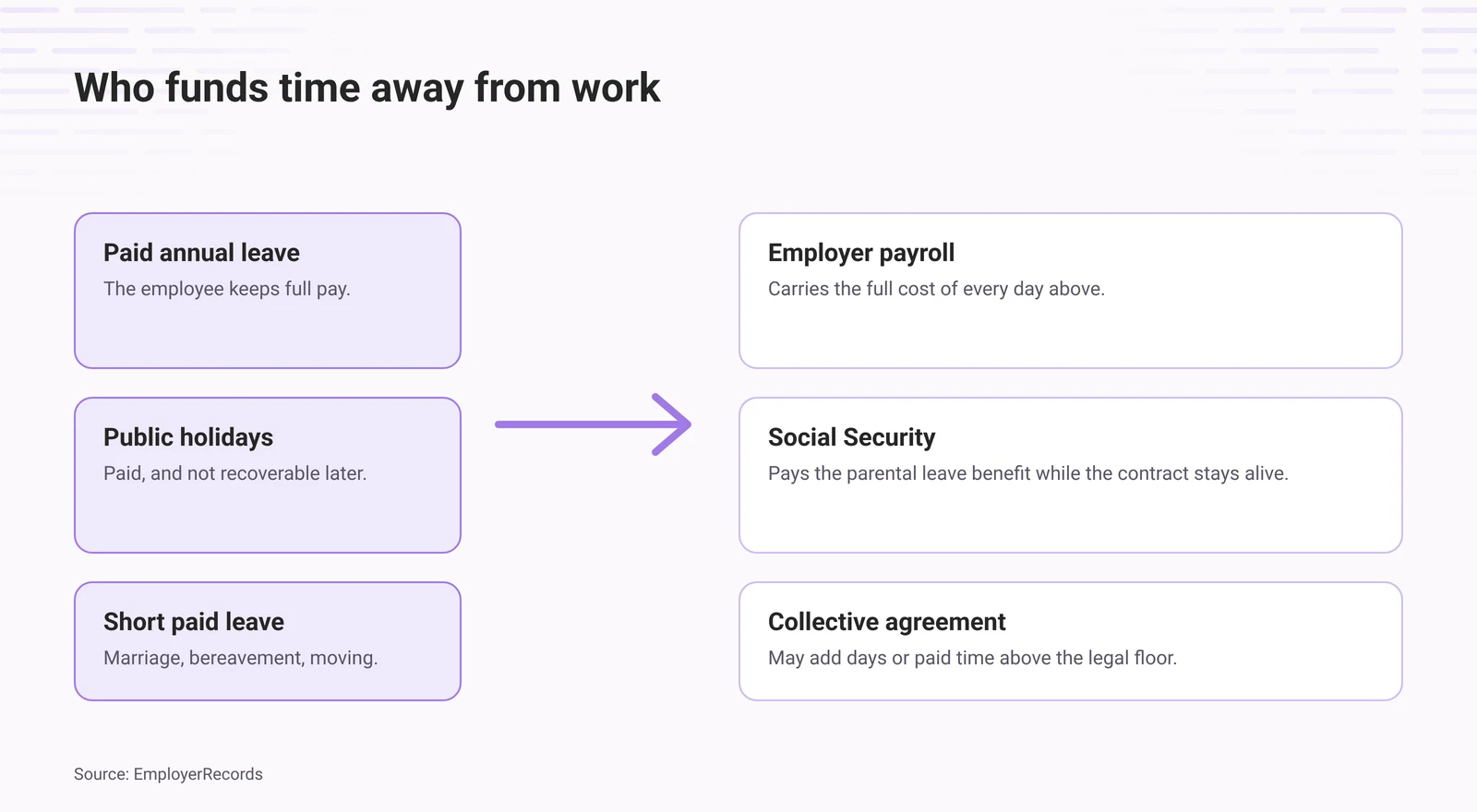
The benefit is paid by Social Security, so payroll doesn’t carry salary for those weeks, although the employer still has to arrange cover.[9] A separate parental leave of 8 weeks remains unpaid.[7]
Single-parent families have longer leave. For a global team that matters mainly in planning, because the cover costs fall on you even when the salary doesn’t.
What does the leave liability cost at exit?
Take the €39,200 salary from our employer costs guide, paid in 14 payments. Daily pay for leave is annual pay divided by 365, which comes to €107.40, because the extras are counted in.[10][4]
An employee who leaves in October with 25 untaken days carries €2,685 of holiday pay. With ten twelfths of an annual extra payment still unpaid, the settlement adds €2,333 (our calculation).
Leave and extra pay owed at exit, €39,200 pay, our calculation
| Item | Basis | Amount |
|---|---|---|
| Daily pay for leave | €39,200 divided by 365 | €107 |
| One untaken leave day | Daily pay | €107 |
| 25 untaken days | 25 times daily pay | €2,685 |
| Share of annual extra payment | 10 twelfths of €2,800 | €2,333 |
| Share of half-yearly extra payment | 4 sixths of €2,800 | €1,867 |
Both items sit on top of the salary for the month and of any indemnity covered in our termination and severance guide. Our estimate leaves out social security on these amounts, and the employer costs guide covers how contributions work.
Work out what you owe at exit
Enter annual pay, the number of payments, the untaken leave days and how far the next extra payment has accrued. Defaults match the €39,200 case, so the first result lines up with the tables above.
Spain exit pay for leave and extra payments
Our estimate. It values a leave day at annual pay divided by 365 and sets one extra payment at annual pay divided by the number of payments. It leaves out the salary for the month of exit, any indemnity, social security on these amounts and agreement rules that use another divisor or accrual period. Check the collective agreement before you pay out.
How does an employer of record handle leave and extra pay?
An employer of record runs payroll, tracks leave balances and pays the settlement when someone leaves, then passes the cost on to you. The provider applies the right collective agreement, which decides accrual and the extra payment month.
Ask how holiday liabilities are reported during the contract. Our EOR cost calculator prices the fee side, and the Spain EOR providers page compares the options.
Direct employment needs a Spanish entity. That route and its setup costs are in the Spain hiring guide.
Where do employers go wrong?
Three slips recur. One is treating 30 days as 30 working days, which overstates leave by about a third. Another is paying out untaken days during the employment, which the statute doesn’t allow.
A third is using the monthly salary divided by 30 for leave value when extras sit outside the monthly figure. Annual pay divided by 365 keeps the extras in.
Our view. Put the leave balance and the extra payment accrual on the same monthly report. They are the two numbers that surprise a finance team at exit, and both come straight from the payroll file.
For the pay levels behind these numbers, see our minimum wage guide and average salary guide.
Questions about annual leave and extra pay in Spain
Short answers to the questions employers ask most about leave and extra payments in Spain, checked against the BOE on 19 November 2026.
How many days of annual leave do employees get in Spain?
At least 30 calendar days a year, paid. Many collective agreements express that as 22 working days.
Can an employer pay cash instead of holiday?
Not during the employment. Cash in place of leave is allowed only when the contract ends.
How many extra payments are there?
Two a year, one at Christmas and the other in a month set by the collective agreement. They can be spread across the twelve monthly payments.
How many public holidays are there?
Up to 14 a year, two of which are local. The BOE publishes the calendar each year.
Who pays during parental leave?
Social Security pays the benefit for the 19 weeks of leave for a birth, so payroll does not carry salary for that period.
References and sources
Every figure on this page comes from the sources below. Numbers in square brackets in the text link to the matching entry. Official statistics are used wherever they exist, and our own calculations are labelled as estimates. All sources were checked on 19 November 2026.
- ↑Real Decreto Legislativo 2/2015, de 23 de octubre, por el que se aprueba el texto refundido de la Ley del Estatuto de los Trabajadores. Boletín Oficial del Estado, consolidated text. boe.es. Retrieved 19 November 2026. Law
- ↑Las vacaciones se pagan igual que el sueldo. PayFit. payfit.com. Retrieved 19 November 2026. Analysis
- ↑El derecho a vacaciones. Guía completa. Lo Entiendo. loentiendo.com. Retrieved 19 November 2026. Analysis
- ↑¿Cuánto tengo que cobrar de finiquito?. Cuestiones Laborales. cuestioneslaborales.es. Retrieved 19 November 2026. Analysis
- ↑Finiquito: cálculo, guía completa. Ikelma. ikelma.com. Retrieved 19 November 2026. Analysis
- ↑Publicado el calendario laboral de 2027: fiestas nacionales y autonómicas. Laboral Social, October 2026. laboral-social.com. Retrieved 19 November 2026. News
- ↑Las 2 semanas del permiso por nacimiento hasta los 8 años: cómo y cuándo pedirlas. Cuestiones Laborales. cuestioneslaborales.es. Retrieved 19 November 2026. Analysis
- ↑Nueva regulación del permiso de nacimiento, adopción, guarda y/o acogimiento. Fieldfisher. fieldfisher.com. Retrieved 19 November 2026. Analysis
- ↑Permiso por nacimiento en España en 2026: semanas, requisitos y cómo solicitarlo. Ayuda Social, 26 March 2026. ayuda-social.es. Retrieved 19 November 2026. Analysis
- ↑Cómo calcular las vacaciones no disfrutadas. Coverflex. coverflex.com. Retrieved 19 November 2026. Analysis
About the author

Emma Whitmore is an EOR and Global Employment Content Writer at EmployerRecords, where she researches and writes practical resources on Employer of Record (EOR) services, international hiring, global payroll, employment compliance, and workforce expansion across international markets. With more than 15 years of experience in B2B content and editorial research, Emma specializes in turning complex employment regulations into clear, actionable guidance for HR leaders, founders, and globally distributed teams. Her work focuses on helping businesses understand country-specific hiring requirements, compare global employment providers, and navigate compliance with confidence.
View all articles by EmmaMore Spain guides for employers
Pay, cost and contract guides from the same Spain cluster.
 SpainAverage salaryAverage Salary in Spain: €29,540 a Year (INE 2024 Data)Mean, median, sectors, regions and what an average-paid hire costs an employerRead the guideSpainEmployer costsEmployer Costs in Spain (2026): 30.65% Plus the Accident PremiumSocial security rates, contribution base limits, the solidarity charge, sick pay and what a real salary costsRead the guideSpainContracts and probationEmployment Contracts and Probation in Spain (2026): Contract Types, Limits and What to StateContract types, temporary limits, probation caps and what to stateRead the guideSpainMinimum wageMinimum Wage in Spain (2026): €1,221 a Month in 14 PaymentsSpain's minimum wage is €1,221 a month in 14 payments, with the rates, employer cost and 2027 rise explained.Read the guideSpainTermination and SeveranceTermination and Severance in Spain (2026): 20 and 33 Days a YearDismissal routes, indemnities, notice and caps, with a worked case and a severance calculator.Read the guide
 Czech RepublicAverage salaryAverage Salary in the Czech Republic (2026): CZK 50,650 a MonthAverage and median pay, regional gaps, gross to net and what employers add on top, from the Czech Statistical Office.Read the guide
Hiring in Spain?
Our Spain hiring guide covers employer costs, contracts, collective agreements and how an employer of record compares with your own entity.