
Termination and Severance in Spain (2026): 20 and 33 Days a Year
The dismissal routes, the indemnity for each, the formalities that make or break them, and what a real termination costs on a €39,200 salary.
How much does it cost to end an employment contract in Spain in 2026?
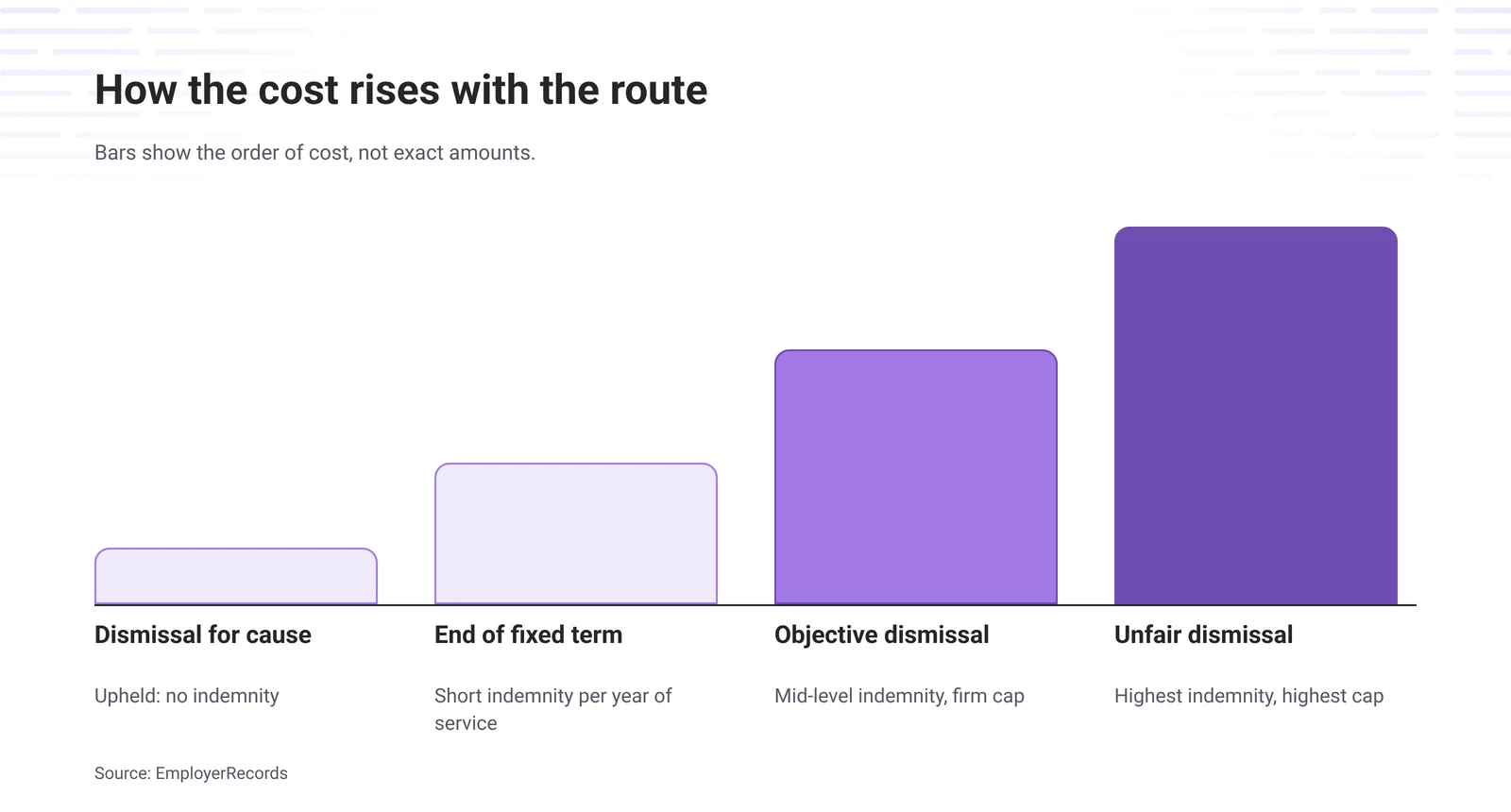
Spain prices a termination by route. An objective dismissal pays 20 days a year up to 12 months, and an unfair dismissal pays 33 days a year up to 24 months. On €39,200 of pay and four and a half years of service that is about €9,666 and €15,948 (our calculation).
- Fixed-term end: 12 days a year of service
- Notice: 15 days for an objective dismissal
- Challenge window: 20 working days
Spain has no dismissal at will. An employer needs a legal route, and each route carries its own indemnity, its own formalities and its own risk if a judge disagrees.[1]
Indemnities are set in days of pay for each year of service. That makes the bill easy to estimate and easy to underestimate, because the route you pick matters more than the salary.
This guide takes the routes one at a time, prices a real case, shows where the caps stop the bill from growing, and ends with a calculator you can run on your own numbers.
Which ways of ending a contract exist in Spain?
Five routes cover almost every exit. Two come from the employee’s conduct or the contract itself, two from the business, and one from a court’s view of the other four.[1]
Termination routes under the Workers’ Statute[1][2]
| Route | Pay per year of service | Cap | Main formality |
|---|---|---|---|
| Dismissal for cause, upheld | None | Not applicable | Written letter with the facts and the date |
| End of a fixed-term contract | 12 days | None in the text | Contract reaches its end |
| Objective dismissal, upheld | 20 days | 12 months | Written notice, 15 days, indemnity paid at once |
| Collective dismissal | 20 days, unless agreed otherwise | 12 months | Consultation with worker representatives |
| Unfair dismissal, as declared by a court | 33 days | 24 months | Employer chooses readmission or the indemnity |
Our reading is that the fifth row isn’t a route you choose. It’s the price of getting one of the other four wrong, and that is why the formalities in the next section matter as much as the reason.
How does an objective dismissal work?
Employers use it for business reasons such as a falling order book, a restructure or a role that no longer fits the company. Article 52 of the Workers’ Statute lists the reasons, and article 53 sets the procedure.[1]
Four things have to happen. Employers give written notice that names the cause, allows 15 days before the contract ends, puts the legal indemnity at the employee’s disposal at the same moment, and lets the employee take six paid hours a week during the notice to look for work.[1][3]
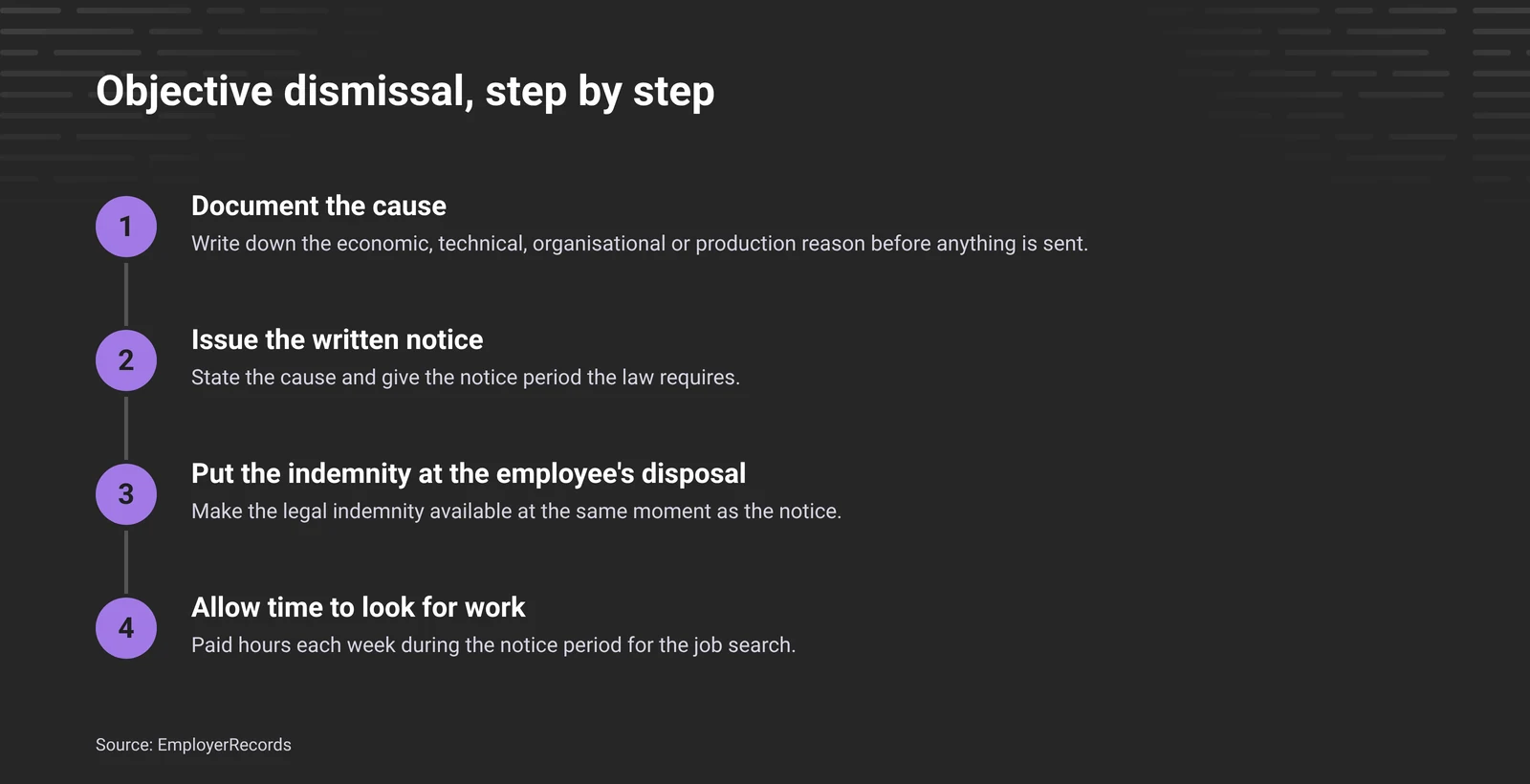
Here is a case. A company closes its Madrid support desk and ends the contract of a team member with four and a half years of service. On a Monday the letter goes out, and a transfer of the indemnity leaves the same morning. If the transfer waits until Friday, the formal step has already failed.
Whether a skipped notice is paid in place or counts as a defect is for local counsel to confirm before you act. We show the 15 days of pay in the calculator below so you can see the size of the exposure.
What we’d do. Treat the indemnity transfer as part of the notice, not a follow-up task. Ask payroll to prepare the amount before the letter is signed, and keep the bank confirmation with the file.
What happens if a dismissal is unfair?
A court declares a dismissal unfair when the employer can’t prove the cause, or when the letter or the procedure falls short of the law. Then the employer chooses between readmitting the employee and paying the indemnity of 33 days a year, with a cap of 24 months.[1]
That choice has to be made within five days. If the employer chooses readmission, back pay for the period of the dispute applies as well.[1]
Service before 12 February 2012 is counted differently. It earns 45 days a year, and the cap can rise to 42 months for those who built up long service before that date.[4][5]
Compared with the objective route, the gap is not small. Per year of service, 33 days is 65% more than 20 days (our calculation), and the cap doubles from 12 months to 24. A dismissal that looked cheap on paper can cost far more once a judge reviews the letter.
Watch this. Dismissal can also be void rather than merely unfair. Reasons that breach fundamental rights, or that hit protected situations such as maternity leave, lead to readmission and back pay instead of a choice.[1]
What does a real termination cost?
Take the €39,200 salary from our employer costs guide, paid in 14 instalments. Daily pay comes to €107.40, which is annual pay divided by 365, and the employee has four and a half years of service.
Four and a half years earns 90 days of pay on the objective route and 148.5 days on the unfair route. That’s €9,666 for the first and €15,948 for the second. A fixed-term contract ending at the same service would pay 54 days, or €5,799 (our calculation).
Indemnity at €39,200 pay and 4.5 years of service, our calculation
| Route | Days of pay | Indemnity | Extra |
|---|---|---|---|
| Dismissal for cause, upheld | 0 | €0 | None |
| End of a fixed-term contract | 54 | €5,799 | None |
| Objective dismissal | 90 | €9,666 | €1,611 if 15 days are paid instead of notice |
| Unfair dismissal | 148.5 | €15,948 | Back pay if readmission is chosen |
Pay in this calculation means the salary for work, including the extra payments spread across the year. Expenses and other items that aren’t salary are generally left out.[2]
Those numbers are the indemnity alone. Holiday and extra payments go on top in the final settlement, which we cover below.
Where do the caps stop the bill from growing?
Both indemnities stop at a cap. Objective dismissal ends at 12 months of pay and unfair dismissal at 24, so the cost grows with service only until the cap is reached.
At 20 days a year the 12-month cap is reached after 18 years. Under the 33-day rule the 24-month cap is reached after about 21.8 years (our calculation).
Indemnity by years of service at €39,200 pay, our calculation
| Years of service | Objective dismissal | Unfair dismissal |
|---|---|---|
| 1 | €2,148 | €3,544 |
| 3 | €6,444 | €10,632 |
| 5 | €10,740 | €17,721 |
| 10 | €21,479 | €35,441 |
| 18 | €38,663 | €63,794 |
| 25 | €39,200 (cap) | €78,400 (cap) |
Look at the 25-year row. On the objective route the indemnity is €39,200, exactly one year of pay, and on the unfair route it is €78,400, which is two. Longer service adds nothing to either figure.
This is why a budget built on a flat cost per year of service overstates the exit of a very senior employee. It also shows that the unfair route costs the most in the early and middle years, where the extra 13 days a year have not yet hit the cap.
What goes into the final settlement?
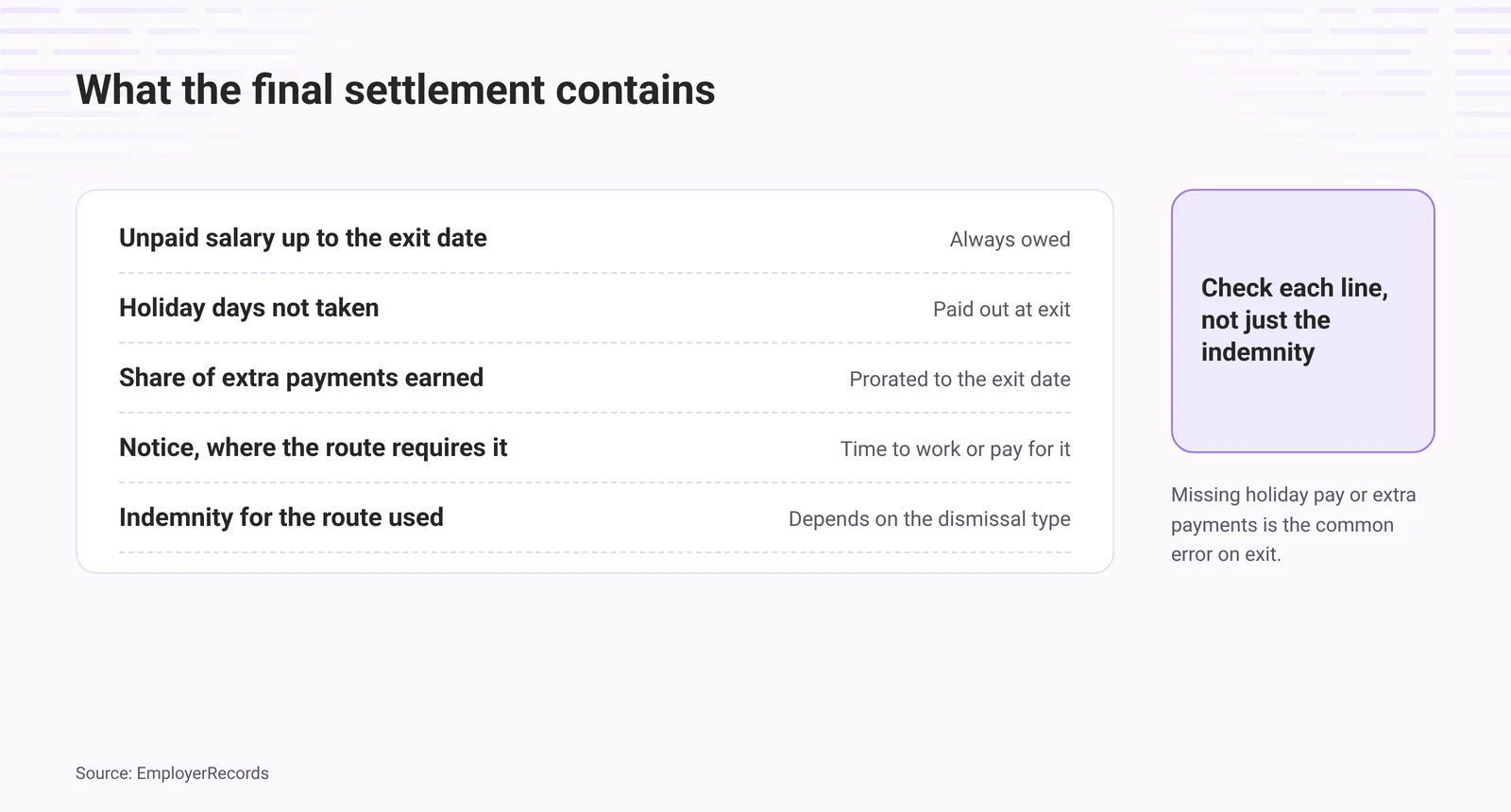
The indemnity is only one line. Unpaid salary up to the exit date is owed as well, along with any holiday not taken and the share of extra payments earned so far in the year.
Take an employee who leaves in September with ten holiday days still untaken. Those ten days are paid out on top of the indemnity, and the part of the year’s extra payments earned to that date goes in the same settlement (our example).
For how the 14 payments are built, read our average salary guide. The employer costs guide shows what they do to the contribution base. Holiday and extra payment lines get fuller treatment in our annual leave and extra pay guide.
Our view. Check the settlement line by line before it goes to the employee. Because the indemnity gets the attention, the holiday and extra payment lines are the ones most likely to carry an error, and they are cheap to fix before the employee sees them.
When does a collective dismissal apply?
It applies when a business ends a number of contracts for business reasons within 90 days. Thresholds are 10 employees in companies with fewer than 100, 10% of the workforce in companies with 100 to 300, and 30 employees in larger ones.[1]
A collective dismissal runs through a consultation process with worker representatives, and the indemnity is the same 20 days a year with a 12-month cap, although an agreement can improve it.[1][2]
Take a company with 80 staff that ends 9 contracts in one quarter. Those are individual objective dismissals. Add a tenth contract in the same 90 days and the whole exercise moves into the collective procedure, which surprises employers who count each exit on its own.
Estimate your own case
Enter annual pay with the extra payments included, the service in years and months, and the route. Defaults are the €39,200 case, so the first result matches the table above.
Spain termination cost estimate
Our estimate. It uses daily pay of annual pay divided by 365, the day rates of 12, 20 and 33 per year of service, and caps of 12 and 24 months of pay. It assumes service began after 12 February 2012 and leaves out back pay, holiday and extra payments in the settlement, collective agreement top-ups and tax. Ask Spanish counsel to confirm the figure before you act on a real case.
When is dismissal restricted or void?
Some dismissals aren’t just costly. They’re void. Under the Workers’ Statute a dismissal is void when it breaches fundamental rights or hits protected situations, and the remedy is readmission with back pay.[1]
Temporary limits sit on top. A decree-law of September 2026 bars companies that receive its direct aid from dismissing for force majeure or for economic, technical, organisational or production reasons until 31 December 2026. Any breach means repaying the aid, and the law qualifies the dismissal as void.[6][7]
Check whether your company took any of that aid before you plan a redundancy this quarter. Garrigues noted that the decree-law still needed Congress to validate it when it published its summary, so confirm its current status.[6]
A draft law approved by the Council of Ministers on 28 July 2026 goes further for whistleblowers. It would make any dismissal void if it follows a report of corruption or a breach of the rules, including dismissals during probation.[8] It is a draft, so it creates no duty today.
Is the unfair dismissal indemnity going to change?
Possibly, but we found no law in force that changes it. In June 2026 the Council of Europe’s Committee of Ministers told Spain again to reform its law so that the indemnity reflects the real harm suffered.[9]
Spain’s Ministry of Labour agreed in May 2026 to draft a legal text with the unions, and the employers’ confederation rejected the idea.[10] The unions’ proposal has three layers: a minimum floor, the fixed days-per-year amount, and room for extra compensation.[11]
In the meantime, Supreme Court rulings have kept the amount in article 56 as the fixed indemnity, without extra court-awarded sums in general.[12]
Our view. Budget the 33-day rule today and keep a margin. If a reform arrives, the likely direction is a higher floor and an added layer, so any plan to let people go in 2027 should be reviewed against the law as it stands that month, not as it stands now.
How does this compare with hiring through an employer of record?
With an employer of record, the provider is the legal employer in Spain. It runs the dismissal procedure and pays the indemnity, then bills you for it under the service agreement.
That makes the contract terms matter. Read how the agreement handles termination costs, who decides the route, and whether the indemnity is passed through at cost. Our EOR cost calculator prices the fee side, and the Spain EOR providers page compares the options.
Direct employment needs a Spanish entity. That route and its setup costs are in the Spain hiring guide.
Where do employers get terminations wrong?
Three mistakes recur. One is picking the route by its price, which only works if the cause and the formalities hold up, because an objective dismissal that fails becomes an unfair one.
Another is forgetting the 90-day count for collective dismissals. A third is treating the indemnity as the whole bill and leaving holiday and extra payments off the settlement.
What we’d do. Write the cost of the unfair outcome next to the cost of the objective route before you decide. If the gap is large and the cause is thin, the cheaper route is not the cheaper outcome.
For the pay figures behind these numbers, see our minimum wage guide, average salary guide and employer costs guide.
Questions about termination and severance in Spain
Short answers to the questions employers ask most about ending a contract in Spain, checked against the BOE on 19 November 2026.
How much severance does an employee get in Spain?
It depends on the route. An objective dismissal pays 20 days of pay per year of service up to 12 months, and an unfair dismissal pays 33 days per year up to 24 months.
Is severance owed when an employee is fired for cause?
Not if a judge upholds the dismissal. If the dismissal is declared unfair, the 33-day indemnity applies.
How much notice does an employer give?
An objective dismissal needs 15 days of notice. Employees also have six paid hours a week during the notice to look for work.
How long does an employee have to challenge a dismissal?
Twenty working days. Saturdays, Sundays, holidays and 24 and 31 December do not count.
What is the indemnity when a fixed-term contract ends?
Twelve days of pay for each year of service, prorated. Some contract types are excepted, so check the contract type.
Is there a cap on severance?
Yes. Objective dismissal is capped at 12 months of pay and unfair dismissal at 24 months, with a higher cap for service built up before 12 February 2012.
What counts as pay when calculating severance?
Salary for work, including the extra payments spread over the year. Expenses and other items that are not salary are generally left out.
Can an employer simply end a contract during probation?
Probation has its own rules, which we cover in our contracts and probation guide, and a draft law would make dismissal void if it follows a whistleblower report.
Has the unfair dismissal indemnity changed?
Not as far as we found. Reform is under discussion in 2026, so check the current law before a real dismissal.
References and sources
Every figure on this page comes from the sources below. Numbers in square brackets in the text link to the matching entry. Official statistics are used wherever they exist, and our own calculations are labelled as estimates. All sources were checked on 19 November 2026.
- ↑Real Decreto Legislativo 2/2015, de 23 de octubre, por el que se aprueba el texto refundido de la Ley del Estatuto de los Trabajadores. Boletín Oficial del Estado, consolidated text. boe.es. Retrieved 19 November 2026. Law
- ↑Indemnización por despido: tipos, cálculo y ejemplos. Skello. skello.es. Retrieved 19 November 2026. Analysis
- ↑Manual de despido individual (plazos y despido objetivo). Legalitas. legalitas.com. Retrieved 19 November 2026. Analysis
- ↑El despido improcedente. Cuestiones Laborales. cuestioneslaborales.es. Retrieved 19 November 2026. Analysis
- ↑Manual de despido individual. Legalitas. legalitas.com. Retrieved 19 November 2026. Analysis
- ↑El Gobierno prorroga la prohibición de despedir hasta diciembre de 2026 y exige la devolución de las ayudas en ese caso. Garrigues. garrigues.com. Retrieved 19 November 2026. Analysis
- ↑Continúan las medidas por la crisis de Oriente Medio vinculadas al mantenimiento del empleo y a la movilidad sostenible. Laboral Social. laboral-social.com. Retrieved 19 November 2026. Analysis
- ↑Los juzgados de lo social declararán nulos los despidos de denunciantes de corrupción tras el nuevo anteproyecto de ley. Moncloa.com, 29 July 2026. moncloa.com. Retrieved 19 November 2026. News
- ↑El Consejo de Europa reitera que España debe reformar el despido improcedente. elDiario.es, 17 June 2026. eldiario.es. Retrieved 19 November 2026. News
- ↑Trabajo diseñará con los sindicatos la reforma legal del despido en contra de la CEOE. Europa Press, via Bolsamanía, 29 May 2026. bolsamania.com. Retrieved 19 November 2026. News
- ↑Trabajo ultima una propuesta para reformar el despido bajo la presión de los sindicatos y las críticas de la patronal. Público. publico.es. Retrieved 19 November 2026. News
- ↑Labour News: novedades laborales, enero 2026. Grant Thornton Spain. grantthornton.es. Retrieved 19 November 2026. Analysis
About the author

Dhiraj Das is Co-Founder of EmployerRecords.com, where he leads content, research and partnerships. He has worked in content and online publishing for more than 15 years, and before EmployerRecords he founded a number of successful content brands. For the past six years he has specialised in HR technology, Employer of Record services and global hiring. His background in digital marketing and search shapes how EmployerRecords researches and presents its provider reviews, country hiring guides and cost data, so employers can compare their options and hire abroad with clear, checked information.
View all articles by DhirajMore Spain guides for employers
Pay, cost and contract guides from the same Spain cluster.
 SpainAnnual Leave and Extra PayAnnual Leave and Extra Pay in Spain (2026): 30 Days and Two Extra PaymentsStatutory leave, extra payments, public holidays and the exit pay they create, with a calculator.Read the guideSpainAverage salaryAverage Salary in Spain: €29,540 a Year (INE 2024 Data)Mean, median, sectors, regions and what an average-paid hire costs an employerRead the guideSpainEmployer costsEmployer Costs in Spain (2026): 30.65% Plus the Accident PremiumSocial security rates, contribution base limits, the solidarity charge, sick pay and what a real salary costsRead the guideSpainContracts and probationEmployment Contracts and Probation in Spain (2026): Contract Types, Limits and What to StateContract types, temporary limits, probation caps and what to stateRead the guideSpainMinimum wageMinimum Wage in Spain (2026): €1,221 a Month in 14 PaymentsSpain's minimum wage is €1,221 a month in 14 payments, with the rates, employer cost and 2027 rise explained.Read the guide
 Czech RepublicAverage salaryAverage Salary in the Czech Republic (2026): CZK 50,650 a MonthAverage and median pay, regional gaps, gross to net and what employers add on top, from the Czech Statistical Office.Read the guide
Hiring in Spain?
Our Spain hiring guide covers employer costs, contracts, collective agreements and how an employer of record compares with your own entity.