
Employer Costs in Spain (2026): 30.65% Plus the Accident Premium
The social security rates, the contribution base and its limits, the solidarity charge, sick pay, and what a real salary costs once everything is added.
How much does it cost to employ someone in Spain in 2026?
Employer social security in Spain costs 30.65% of the contribution base on an open-ended contract in 2026, before the work accident premium. Add a 1.5% office accident rate and you reach 32.15%, which means a €39,200 salary costs about €51,800 a year in total (our calculation).
- Fixed-term: unemployment rises from 5.50% to 6.70%
- Ceiling: no growth above €5,101.20 a month
- Sick pay: employer pays the early weeks of leave
The cost has two parts. Salary comes first, and the employer contributions that sit on top of it come second. Spain’s contribution order for 2026 sets every rate, floor and ceiling the second part depends on.[1]
That second part isn’t one flat percentage. It follows a contribution base, which has a floor by job group and a ceiling for everyone, and it moves with the type of contract and the accident rate of your activity.
This guide takes the pieces in the order a payroll team meets them, then prices a real salary and checks how the add-on changes as pay rises.
Which employer social security rates apply in 2026?
Five rates hit the payroll on an open-ended contract, plus the accident premium. Common contingencies carry the most weight, at 23.60%, and the intergenerational equity mechanism (MEI) adds 0.75% on top of the same base.[1][2]
Take a €3,000 base. Common contingencies and MEI cost €730.50 at 24.35%, and unemployment, FOGASA and training cost €189 at 6.30%. That’s €919.50 before the accident premium (our calculation).
Social security rates, Spain, 2026[1]
| Item | Employer | Employee |
|---|---|---|
| Common contingencies | 23.60% | 4.70% |
| Intergenerational equity mechanism (MEI) | 0.75% | 0.15% |
| Unemployment, open-ended contract | 5.50% | 1.55% |
| Unemployment, fixed-term contract | 6.70% | 1.60% |
| FOGASA (wage guarantee fund) | 0.20% | None |
| Vocational training | 0.60% | 0.10% |
| Work accidents and occupational disease | Tariff, employer only | None |
| Total, open-ended contract, before accident premium | 30.65% | 6.50% |
Our own sum of the rows above gives the totals row. Employee shares come out of gross pay, so they never raise your cost.
What is the contribution base, and how is it capped?
Base means monthly pay with the extra payments spread across twelve months. In practice you take annual gross pay, divide by 12, and test the result against the floor for the job group and the ceiling.[1][3]
A receptionist offered €1,300 in 12 payments earns €15,600 a year, so the base would be €1,300. It sits under the €1,424.40 floor, so you pay contributions on €1,424.40. That costs about €437 a month at 30.65% (our calculation).
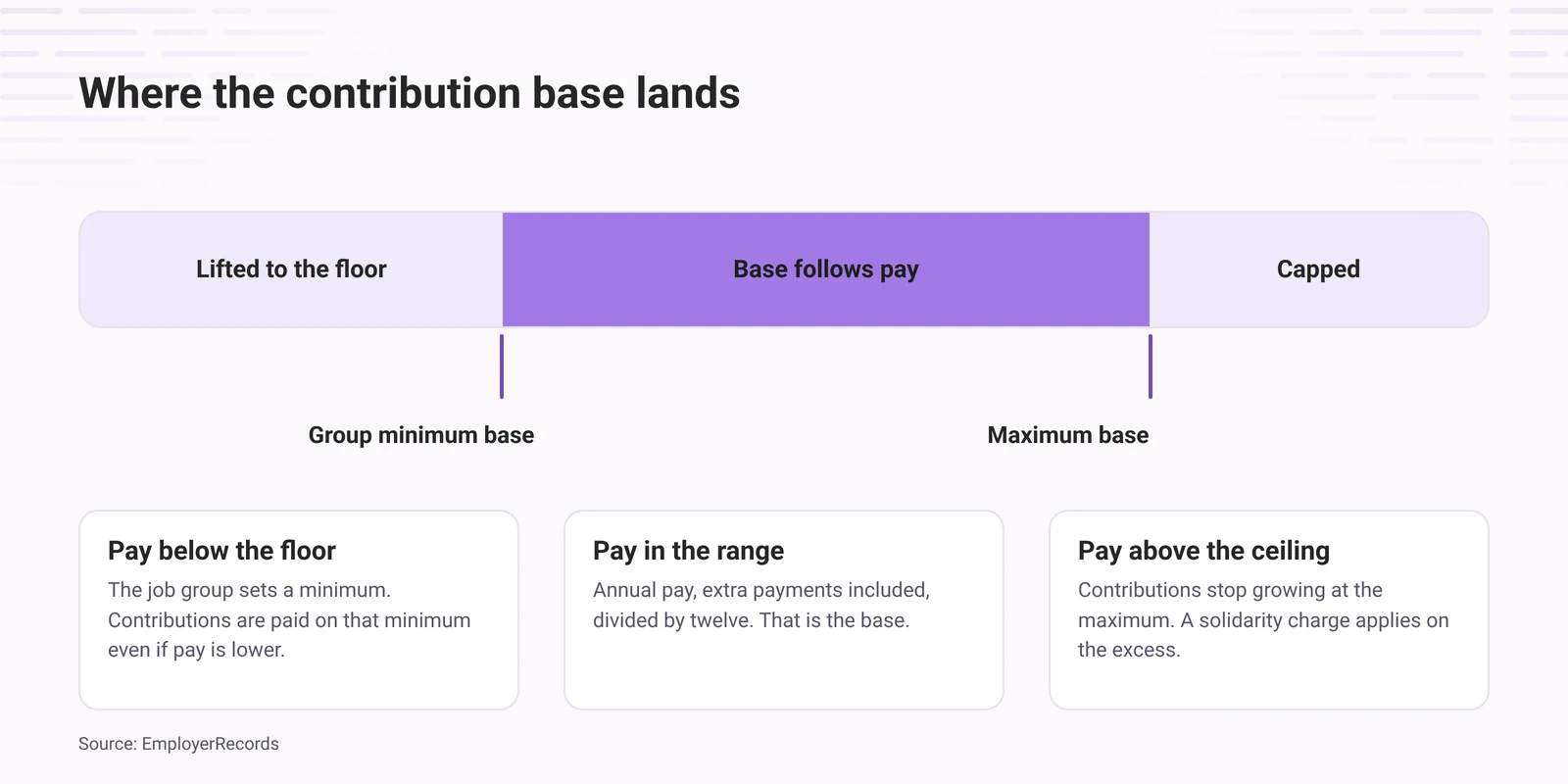
Monthly contribution bases by group, Régimen General, 2026[1]
| Group | Who it covers | Minimum | Maximum |
|---|---|---|---|
| 1 | Engineers, graduates and senior management | €1,989.30 | €5,101.20 |
| 2 | Technical engineers, experts and assistants | €1,649.70 | €5,101.20 |
| 3 | Administrative and workshop managers | €1,435.20 | €5,101.20 |
| 4 to 7 | Assistants, administrative officers, subordinates, clerks | €1,424.40 | €5,101.20 |
Groups 8 to 11 contribute on daily bases, from €47.48 to €170.04 a day.[1] Part-time contracts have hourly minimum bases for each group, so a short contract can’t contribute below its own hourly floor.[4]
What we’d do. Check the contribution group in the contract before you check the salary. A junior engineer in group 1 has a higher floor than the pay level suggests, and it lifts your cost even when the offer is modest.
What does a €39,200 salary cost in total?
Take a developer offered €2,800 in 14 payments, which is €39,200 a year. Its monthly base is €3,266.67, well inside the range, so every rate applies to the full amount.
Common contingencies and MEI come to €795 a month, unemployment, FOGASA and training add €207, and the 1.5% accident rate adds €49, which makes €1,051 a month or €12,612 a year (our calculation).
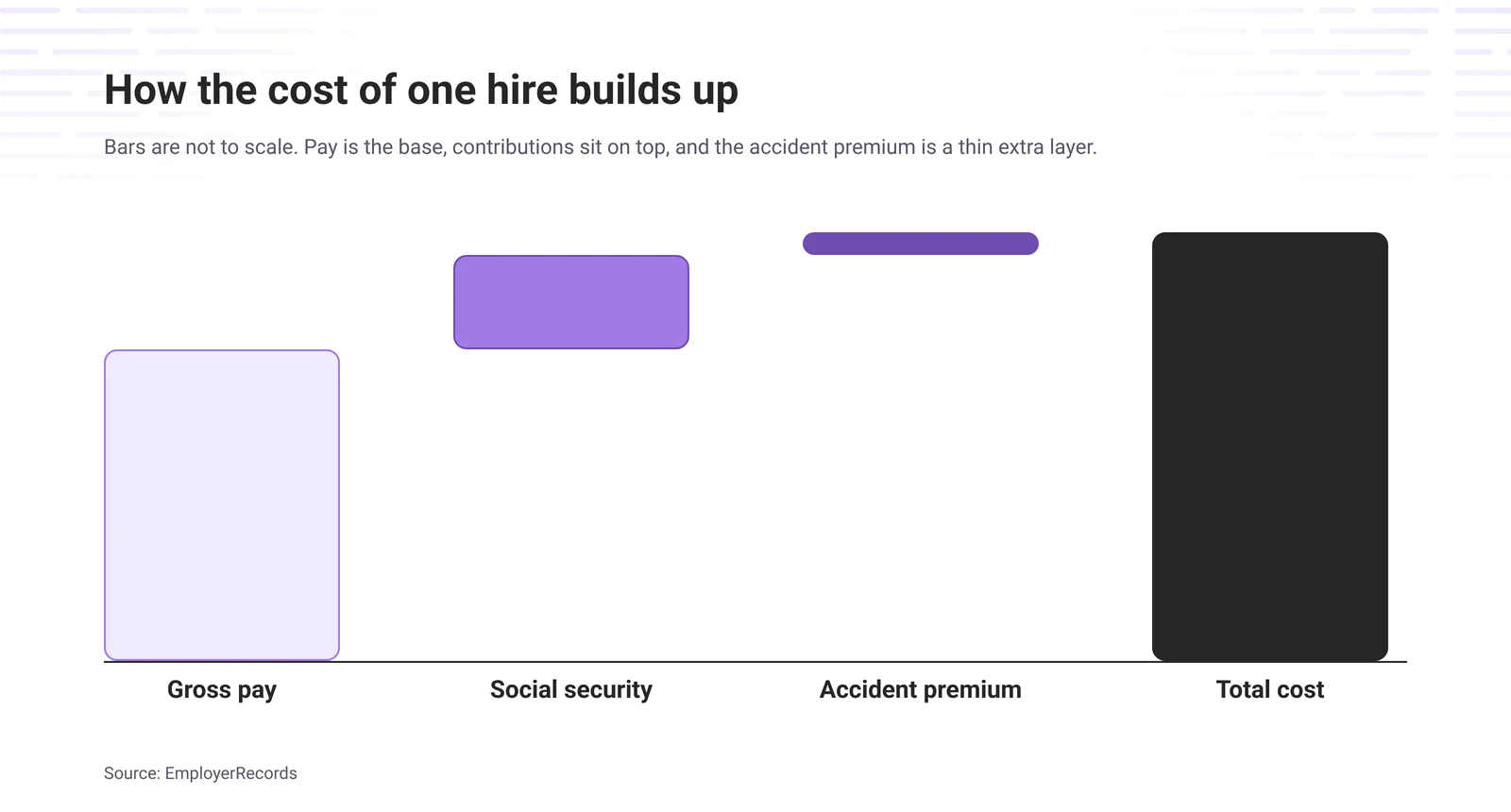
€39,200 pay plus €12,612 in employer contributions.
32.2% on top of the wageThat 32.2% is the add-on on annual pay. Each item is rounded to the euro per month, which is why it sits a tenth above the 32.15% rate. Our Spain hiring guide uses the 32.15% figure.
What costs sit on top of social security?
Two items don’t appear in the rate table but still land on your budget. First comes the pay for extra payments. Spanish pay is normally 14 payments, so €2,800 twice a year in June and December is already inside the €39,200, and the Workers’ Statute requires two extra payments a year.[3]
Next is sick pay. For ordinary illness the first days carry no statutory benefit. Employers pay the benefit from their own funds in the early weeks of leave, and Social Security takes over after that.[5][6]
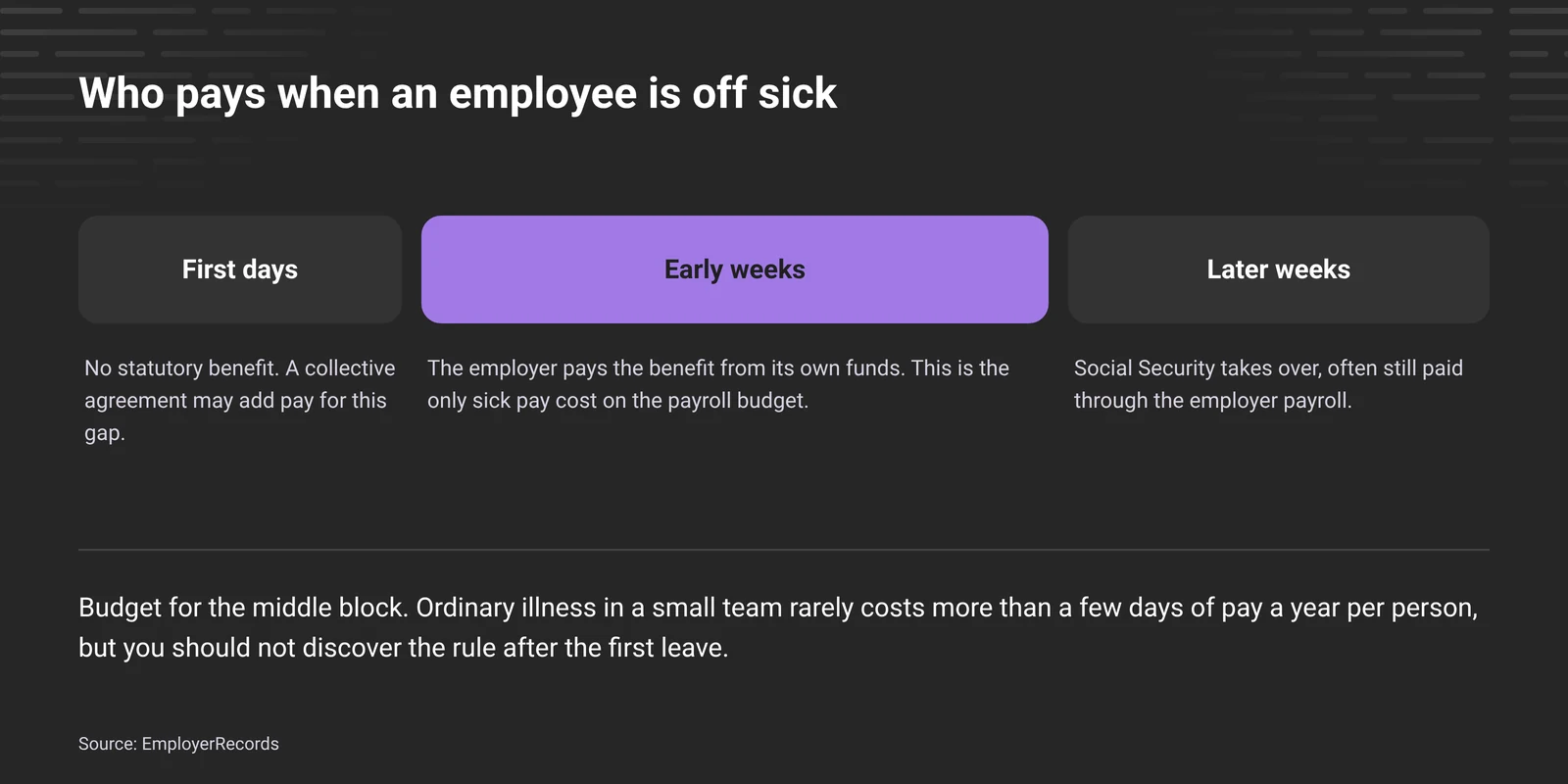
A collective agreement can add pay for the unpaid first days, so check the agreement for your sector before you promise anything in the offer letter.
Take an employee on €3,267 a month who is off for ten days. Employers carry days 4 to 10 at 60% of the regulatory base. Seven days of that is a few hundred euros, not a budget line to fear, but it isn’t zero (our estimate).
Watch this. Severance isn’t a monthly cost, but it is a real liability that builds with service, so it belongs in the budget before anyone signs a long-term plan. Our termination and severance guide prices each route.
How is the work accident premium set?
It’s the one rate you can’t read off the contribution order. Accident and occupational disease contributions follow a premium tariff in the General Social Security Law, and the employer pays all of it.[1]
A new tariff took effect in 2026, built on the CNAE-2025 activity classification. It replaced a much older one.[2] It also has a rule for work done only in a company’s own offices, which is the usual route for office and software staff.[7]
We use 1.5% as a planning rate for office roles. That’s an assumption, not a figure we’ve matched to a tariff line, so find the code for your own activity before you budget.
Take a warehouse hire and an analyst in the same company. Analysts fall under the office rule and warehouse workers don’t, so the two can carry different premiums on the same contribution base.
What happens when pay goes above the maximum base?
Contributions stop growing at €5,101.20 a month, but a solidarity contribution applies to pay above it. It has three bands, and each band has its own split between employer and employee.[1]
Take €6,000 a month. Excess over the base is €898.80. Of that, the first €510.12 carries the 0.96% employer rate and the rest the 1.04% rate, so the employer pays about €9 a month extra (our calculation).
Solidarity contribution on pay above the maximum base, 2026[1]
| Band of pay a month | Total rate | Employer | Employee |
|---|---|---|---|
| €5,101.21 to €5,611.32 | 1.15% | 0.96% | 0.19% |
| €5,611.33 to €7,651.80 | 1.25% | 1.04% | 0.21% |
| Above €7,651.80 | 1.46% | 1.22% | 0.24% |
Next to the 30.65% below the ceiling, this effect is small. It matters mainly for senior hires, where the ceiling means your add-on falls as pay rises.
Do fixed-term and short contracts cost more?
Yes, slightly. Unemployment is 6.70% on fixed-term contracts, against 5.50% on open-ended ones.[1] On a €3,000 base that’s €36 a month more, and across a team of ten it becomes €360 a month (our calculation).
Contracts under 30 days carry a flat extra charge of €33.62 on top of the normal rates.[8] For a project hire that’s trivial. For a run of short contracts to the same person it adds up and tends to attract attention.
Special contract types, such as training contracts, can follow their own rules, so read the contract type before you apply the higher rate.
How does the add-on change as pay rises?
Not the way most budgets assume. Percentages stay near 32% up to the ceiling, then fall, because contributions stop growing while pay keeps going.
Five pay levels are priced in the table, on an open-ended contract, with the 1.5% accident rate and group 4 to 7 floors. Minimum wage level uses the 2026 annual floor, and the mean uses the INE 2024 average from our average salary guide.[9][10]
Employer cost at five pay levels, open-ended contract, our calculation
| Pay level | Annual gross | Monthly base | Contributions a year | Total cost | Add-on |
|---|---|---|---|---|---|
| Minimum wage level | €17,094 | €1,424.50 | €5,496 | €22,590 | 32.2% |
| National mean | €29,540 | €2,461.67 | €9,492 | €39,032 | 32.1% |
| Senior professional | €45,000 | €3,750.00 | €14,472 | €59,472 | 32.2% |
| Above the ceiling | €70,000 | €5,101.20 | €19,776 | €89,776 | 28.3% |
| Director level | €120,000 | €5,101.20 | €20,352 | €140,352 | 17.0% |
At €120,000 a year the add-on is 17.0%, against 32.2% for the €45,000 salary. A flat 32% would overstate the senior hire by more than €18,000 a year, which is the kind of gap a finance team notices at the first quarterly review.
Price your own hire
Enter the pay per payment, the number of payments and the contract type. Defaults are the €39,200 case from the worked example, so the first result matches the cost table.
Spain employer cost, 2026 rules
Our estimate. It applies the 2026 employer rates from the table, the group floors and the €5,101.20 ceiling, with the base set at annual pay divided by 12 and the solidarity bands applied to that monthly figure. It leaves out the €33.62 charge on contracts under 30 days, part-time hourly floors, benefits in kind, sick pay and any EOR fee. Read the full Spain cost calculator for fees and year-one costs.
How does this compare with hiring through an employer of record?
An employer of record becomes the legal employer in Spain, pays every item in this guide and passes the cost to you. Its fee goes on top.
Contributions don’t change with the route. What changes is who files them and who carries the compliance risk. Our EOR cost calculator prices the fee side, and the Spain EOR providers page compares the options.
Direct employment needs a Spanish entity. That route and its setup costs are in the Spain hiring guide.
Where do employers get Spanish costs wrong?
Three mistakes recur. One is using a flat 30% for every salary. Look at the table above to see why that fails at both ends of the pay scale.
Another is ignoring the group floor. A low offer in a high group still pays on the floor. A third is pricing the accident rate at zero because it isn’t in the contribution order.
Our view. Build the budget from the base, not the salary. Work out the base first, apply the rates, then add the accident premium and any sick pay allowance, and keep the working in a sheet so the next hire starts from a checked template. It takes ten minutes. Most surprises disappear.
For the pay levels themselves, see our minimum wage guide and average salary guide.
Questions about employer costs in Spain
Short answers to the questions employers ask most about Spanish payroll costs, checked against the BOE on 19 November 2026.
What is the employer social security rate in Spain?
On an open-ended contract it is 30.65% of the contribution base in 2026, plus the work accident premium. Fixed-term contracts are 31.85% before the accident premium.
Is the work accident premium included in that rate?
No. It follows a separate tariff by activity and the employer pays all of it. We use 1.5% as a planning figure for office roles.
Is there a ceiling on employer contributions?
Yes. The base is capped at €5,101.20 a month in 2026. Pay above it carries a smaller solidarity contribution in three bands.
Do I pay contributions on the 14 payments?
Yes, through the base. Annual pay including the two extra payments is divided by 12, so the extras are already counted.
Who pays sick pay in Spain?
For ordinary illness the first days carry no statutory benefit, the employer pays the early weeks, and Social Security pays after that.
How much does a €39,200 salary cost an employer?
About €51,812 a year at a 1.5% accident rate, which is €12,612 in contributions on an open-ended contract. That is our calculation.
References and sources
Every figure on this page comes from the sources below. Numbers in square brackets in the text link to the matching entry. Official statistics are used wherever they exist, and our own calculations are labelled as estimates. All sources were checked on 19 November 2026.
- ↑Orden PJC/297/2026, de 30 de marzo, por la que se desarrollan las normas legales de cotización a la Seguridad Social, desempleo, protección por cese de actividad, Fondo de Garantía Salarial y formación profesional para el ejercicio 2026. Boletín Oficial del Estado, 31 March 2026. boe.es. Retrieved 19 November 2026. Law
- ↑Claves de la Orden de Cotización 2026 para las empresas. Cuatrecasas. cuatrecasas.com. Retrieved 19 November 2026. Analysis
- ↑Real Decreto Legislativo 2/2015, de 23 de octubre, por el que se aprueba el texto refundido de la Ley del Estatuto de los Trabajadores. Boletín Oficial del Estado, consolidated text. boe.es. Retrieved 19 November 2026. Law
- ↑Boletín Noticias RED 5/2026: aclaraciones sobre la orden de cotización 2026. Iberley, summarising the Seguridad Social bulletin, 7 April 2026. iberley.es. Retrieved 19 November 2026. Official
- ↑Sick Leave in Spain (Baja Laboral): Who Pays, How Much, and Your Job Protection. Recording Law, 23 July 2026. recordinglaw.com. Retrieved 19 November 2026. Analysis
- ↑Real Decreto Legislativo 8/2015, de 30 de octubre, por el que se aprueba el texto refundido de la Ley General de la Seguridad Social. Boletín Oficial del Estado, consolidated text. boe.es. Retrieved 19 November 2026. Law
- ↑Disposición final 1. Real Decreto-ley 3/2026, de 3 de febrero (tarifa de primas por accidentes de trabajo y enfermedades profesionales). Iberley. iberley.es. Retrieved 19 November 2026. Law
- ↑Bases y tipos de cotización 2026. Asepeyo, mutua colaboradora con la Seguridad Social. asepeyo.es. Retrieved 19 November 2026. Official
- ↑Real Decreto 126/2026, de 18 de febrero, por el que se fija el salario mínimo interprofesional para 2026. Boletín Oficial del Estado, 19 February 2026. boe.es. Retrieved 19 November 2026. Law
- ↑Encuesta Anual de Estructura Salarial (EAES). Año 2024. Datos definitivos. Instituto Nacional de Estadística, 28 May 2026. ine.es. Retrieved 19 November 2026. Data
About the author

Emma Whitmore is an EOR and Global Employment Content Writer at EmployerRecords, where she researches and writes practical resources on Employer of Record (EOR) services, international hiring, global payroll, employment compliance, and workforce expansion across international markets. With more than 15 years of experience in B2B content and editorial research, Emma specializes in turning complex employment regulations into clear, actionable guidance for HR leaders, founders, and globally distributed teams. Her work focuses on helping businesses understand country-specific hiring requirements, compare global employment providers, and navigate compliance with confidence.
View all articles by EmmaEmployer cost and salary guides for other countries
Compare Spain with the labour costs and salary levels employers work with in other markets.
 SpainAnnual Leave and Extra PayAnnual Leave and Extra Pay in Spain (2026): 30 Days and Two Extra PaymentsStatutory leave, extra payments, public holidays and the exit pay they create, with a calculator.Read the guideSpainAverage salaryAverage Salary in Spain: €29,540 a Year (INE 2024 Data)Mean, median, sectors, regions and what an average-paid hire costs an employerRead the guideSpainContracts and probationEmployment Contracts and Probation in Spain (2026): Contract Types, Limits and What to StateContract types, temporary limits, probation caps and what to stateRead the guideSpainMinimum wageMinimum Wage in Spain (2026): €1,221 a Month in 14 PaymentsSpain's minimum wage is €1,221 a month in 14 payments, with the rates, employer cost and 2027 rise explained.Read the guideSpainTermination and SeveranceTermination and Severance in Spain (2026): 20 and 33 Days a YearDismissal routes, indemnities, notice and caps, with a worked case and a severance calculator.Read the guide
 Czech RepublicAverage salaryAverage Salary in the Czech Republic (2026): CZK 50,650 a MonthAverage and median pay, regional gaps, gross to net and what employers add on top, from the Czech Statistical Office.Read the guide
Hiring in Spain?
Our Spain hiring guide covers employer costs, contracts, collective agreements and how an employer of record compares with your own entity.