
UK Employment Rights Act 2025: What Changes for Employers and When
Every measure of the Employment Rights Act that affects a UK employer, with dates, what is already in force, the unfair dismissal change from 1 January 2027 and how to prepare for it.
Employment Rights Act changes at a glance
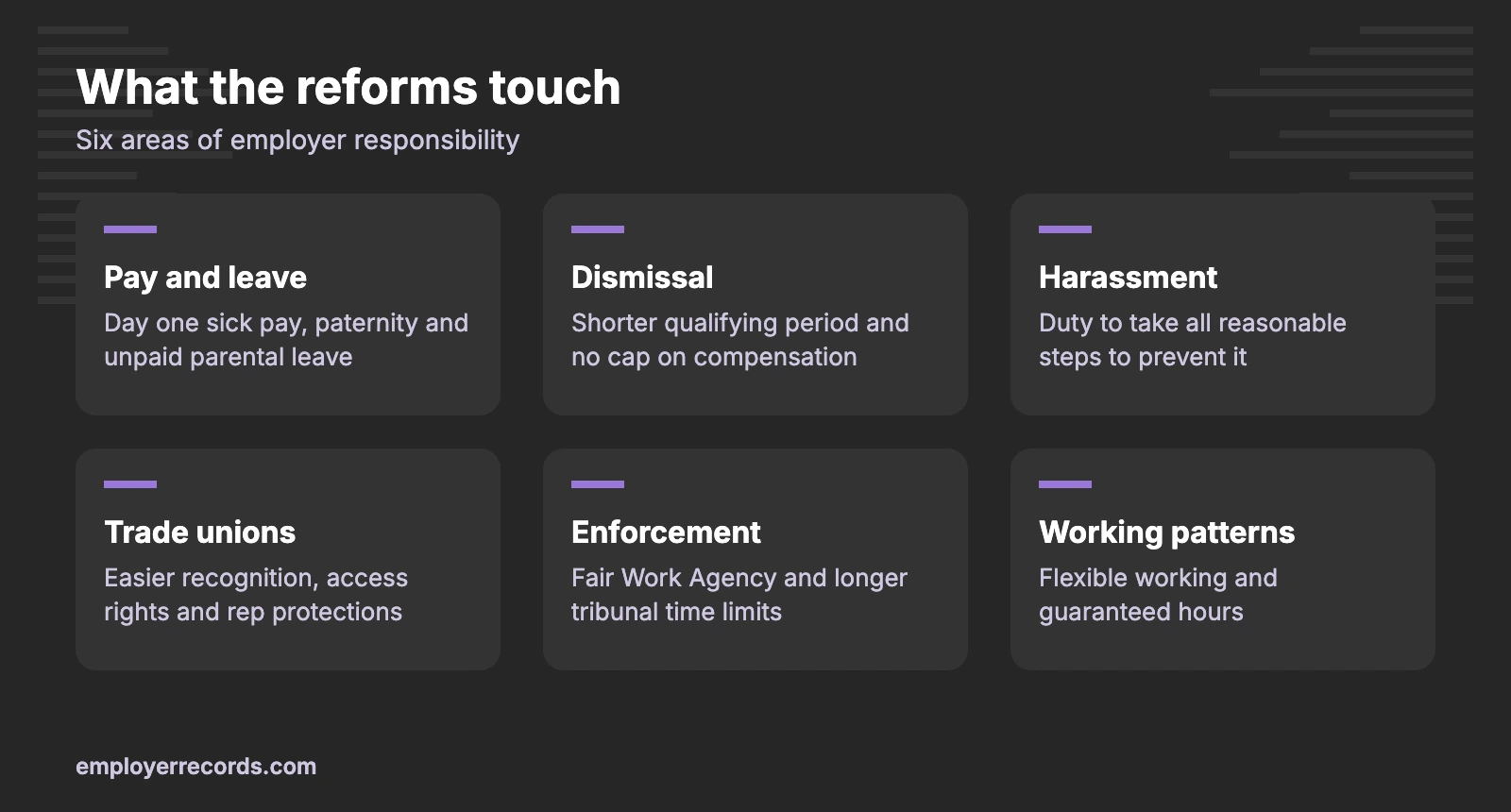
The Employment Rights Act 2025 is phased in through 2027. Day one sick pay and paternity leave started in April 2026, and the tribunal time limit doubled to six months in October 2026. From 1 January 2027, unfair dismissal claims need six months of service instead of two years, with no compensation cap.
- Now in force: day one SSP, paternity leave and the 6 month tribunal limit
- 1 January 2027: six month unfair dismissal rule and no compensation cap
- 2027 and later: bereavement leave, flexible working, fire and rehire
The Employment Rights Act 2025 is a package of changes to UK employment law. The government is delivering it in phases, so some measures are in force and others have dates running through 2027.[1]
This page tracks each measure that matters to an employer, with the date it applies. Dates follow the government’s timeline as published on GOV.UK in November 2026. Dates can move, so check GOV.UK before you act on a specific one.
Timeline of changes for employers
Employment Rights Act 2025 dates that affect employers
| Date | Measure | Status |
|---|---|---|
| 6 April 2026 | Day one paternity leave and unpaid parental leave, day one Statutory Sick Pay, doubled protective award | In force |
| 7 April 2026 | Fair Work Agency established | In force |
| 1 October 2026 | Tribunal claim time limit rises from 3 to 6 months | In force |
| 30 October 2026 | Duty to prevent sexual harassment, union access and recognition changes | In force |
| 1 January 2027 | Unfair dismissal after 6 months, compensation cap removed, tipping law, duty to inform workers of union rights | Coming |
| March 2027 | Fire and rehire protections | Coming |
| April 2027 | Bereavement leave, mandatory action plans, blacklisting rules, collective redundancy threshold | Coming |
| October 2027 | Dismissal protection for pregnant women and new mothers, flexible working | Coming |
| Not set | Guaranteed hours, reasonable shift notice, payment for short notice cancellations | To be confirmed |
Changes already in force
Unfair dismissal from 1 January 2027
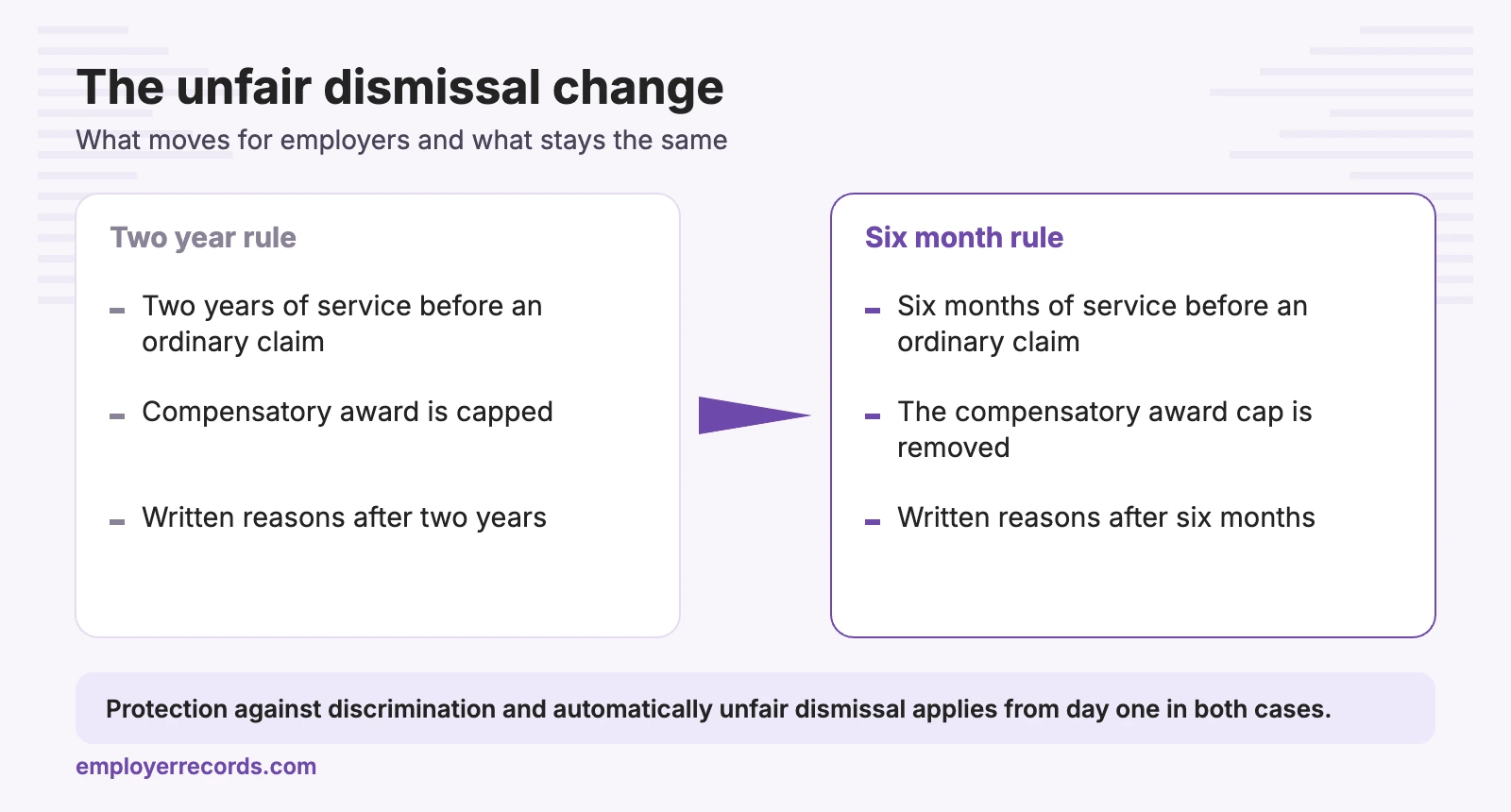
From 1 January 2027 the qualifying period for ordinary unfair dismissal falls from two years to six months. It applies to dismissals from that date.[1][6] The change is made by section 25 of the Act.[7][8]
The cap on compensatory awards is removed completely. The right to request written reasons for dismissal also moves to six months, and protection against dismissal for spent convictions applies from day one.[6]
Protection against discrimination and automatically unfair dismissal was already a day one right, and that does not change.[9]
Higher cost of a wrong dismissal. With the cap removed, a tribunal can award full compensatory loss. Our reading: an employee with six months of service dismissed on or after 1 January 2027 can claim. The Act sets the exact rules, so take advice on borderline cases.
Preparing for the six month rule
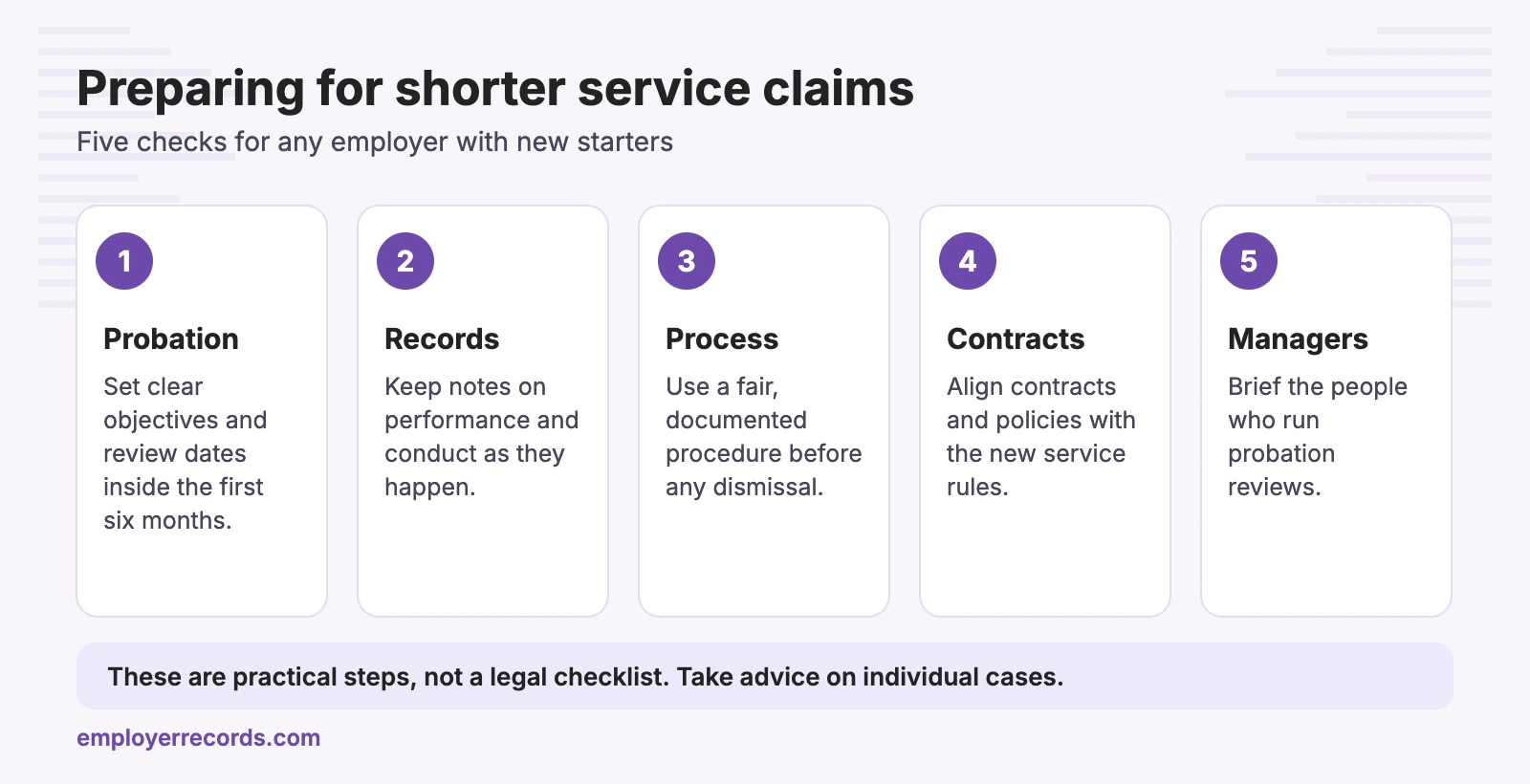
Our reading: the first six months of employment stay the lower risk window for ending a contract, so probation reviews matter more. A probation period that is not documented gives little protection.
The practical response is mostly process. Set clear objectives at the start. Record feedback as it happens. Use a fair procedure before any dismissal, and make sure the managers who run probation know the new threshold.
Sexual harassment prevention duty
From 30 October 2026 employers must take all reasonable steps to prevent sexual harassment of their employees. They must also not permit third party harassment of employees, for example by customers.[1]
The minister can set out evidence based steps through later regulations.[1] Our reading: a written policy, manager training and a clear reporting route are the obvious starting points, and the required steps may be defined more tightly over time.
Tribunal time limits and enforcement
The time limit for bringing most employment tribunal claims rose from 3 to 6 months on 1 October 2026.[2] For breach of employment contract claims in Scotland the change applies from 9 November 2026.[1] A longer window means a claim can arrive later, so keep personnel records for longer.
The Fair Work Agency was established on 7 April 2026.[1] The doubled protective award of up to 180 days’ pay applies to failures to consult on collective redundancies.[4]
Trade union changes
From 6 April 2026, recognition rules were simplified by removing the likely majority test and the 40% support threshold.[1] From 30 October 2026 union rights of access are stronger, recognition and derecognition rules change, and union representatives get new protections.[1]
From 1 January 2027 employers must inform workers of their right to join a trade union.[1] Add that notice to your onboarding documents before the date.
Changes due in 2027
Measures with 2027 dates
| Date | Measure |
|---|---|
| March 2027 | Fire and rehire protections |
| April 2027 | Bereavement leave including pregnancy loss; mandatory gender equality and menopause action plans for private and voluntary sector employers; extended blacklisting protections; organisation wide collective redundancy threshold |
| August 2027 | Electronic balloting for statutory recognition and derecognition ballots |
| September 2027 | Regulations on misuse of non-disclosure agreements in harassment and discrimination cases |
| October 2027 | Enhanced dismissal protection for pregnant women and new mothers; flexible working |
| December 2027 | Regulation of umbrella companies |
These dates come from the government timeline.[1] Several are still moving through regulations, so treat them as the current plan and not as final.
Changes with no date yet
Guaranteed hours, reasonable notice of shifts and payment for short notice shift cancellations or changes have no confirmed date. The government says timing will be updated after consultation.[1] Employers who rely on zero hours or variable shift contracts should watch this area.
Employer of Record hires and the Act
These duties fall on the legal employer. If you hire through an Employer of Record, it is the employer for dismissal procedure, the harassment duty and sick pay. Your own managers still shape probation feedback and day to day conduct, so the practical risk is shared. This is our reading, so check the service agreement for who handles disciplinary and dismissal decisions.
Compare providers in our UK EOR provider guide, or see the UK hiring guide.
Common mistakes
Our view
The unfair dismissal change is the one to plan around. Most other measures add process. This one changes the risk on every new hire.
Employers from outside the UK often treat the first months of a contract as flexible. After 1 January 2027 that assumption needs a structured probation review behind it, with records.
Employment Rights Act FAQ
When does the six month unfair dismissal rule start?
From 1 January 2027, for dismissals on or after that date. The qualifying period falls from two years to six months.
Is the compensation cap for unfair dismissal removed?
Yes. The cap on the compensatory award is removed from 1 January 2027.
Is sick pay payable from day one now?
Yes, since 6 April 2026. SSP is £123.25 a week or 80% of average weekly earnings if lower, with no earnings floor and no waiting days.
What is the new tribunal time limit?
Six months for most claims from 1 October 2026, up from three months.
What must employers do about sexual harassment?
From 30 October 2026 they must take all reasonable steps to prevent it and must not permit third party harassment of employees.
When do flexible working and pregnancy dismissal protections change?
The government timeline lists both for October 2027.
Does an Employer of Record handle these duties?
The legal employer carries them, so an Employer of Record should handle dismissal procedure, the harassment duty and sick pay. This is our reading, so check the service agreement.
References and sources
Every figure on this page comes from the sources below. Numbers in square brackets in the text link to the matching entry. Official statistics are used wherever they exist, and our own calculations are labelled as estimates. All sources were checked on 24 October 2026.
- ↑Plan to Make Work Pay and Employment Rights Act: timeline update. GOV.UK. gov.uk. Retrieved 16 November 2026. Official
- ↑The Employment Rights Act 2025 (Commencement No. 5 and Transitional Provisions) (Amendment) Regulations 2026. UK Government. legislation.gov.uk. Retrieved 16 November 2026. Law
- ↑April 2026 issue of the Employer Bulletin. HM Revenue and Customs. gov.uk. Retrieved 16 November 2026. Official
- ↑Factsheet: Employment Rights Act 2025. Department for Business and Trade. assets.publishing.service.gov.uk. Retrieved 16 November 2026. Official
- ↑New employment rights: guidance for businesses and workers. business.gov.uk. business.gov.uk. Retrieved 16 November 2026. Official
- ↑Factsheet: Unfair Dismissal. Department for Business and Trade. assets.publishing.service.gov.uk. Retrieved 16 November 2026. Official
- ↑Employment Rights Act 2025, section 25. UK Parliament. legislation.gov.uk. Retrieved 16 November 2026. Law
- ↑The Employment Rights Act 2025 (Commencement No. 4 and Transitional and Saving Provisions) Regulations 2026. UK Government. legislation.gov.uk. Retrieved 16 November 2026. Law
- ↑An update on the Employment Rights Bill. GOV.UK. gov.uk. Retrieved 16 November 2026. Official
About the author

Manjuri Dutta is Co-Founder and Content Editor at EmployerRecords.com, covering Employer of Record providers and global hiring platforms. She evaluates providers on entity ownership, statutory compliance, and real pricing rather than vendor claims, and built the verification process used across EmployerRecords' country guides, checking vendor claims against government registries and public filings.
View all articles by ManjuriRelated guides for employers
Other United Kingdom guides from this hiring guide, plus pay floors and salary levels in other markets.
 United KingdomIR35IR35 for Foreign Employers (2026): Off-Payroll Rules, Costs and RiskWhen UK off-payroll rules reach a foreign company, who decides status, what inside IR35 costs and how an EOR removes...Read the guideUnited KingdomMaternity and Paternity LeaveMaternity and Paternity Leave in the UK (2026): Pay, Rules and Employer CostUK family leave for employers in 2026/27: maternity, paternity and shared parental leave, the £194.32 statutory rate, HMRC recovery and...Read the guideUnited KingdomSkilled Worker VisaSkilled Worker Visa Sponsorship in the UK (2026): Rules, Fees and CostWhich jobs qualify, salary thresholds, sponsor licence and visa fees, sponsor duties and the real cost of one sponsored hire,...Read the guideUnited KingdomAverage salaryUK Average Salary 2026: Median Pay, Hourly Rates and Employer CostUnited Kingdom · Pay benchmarks 2026← Part of the United Kingdom hiring guide UK Average Salary 2026: Median Pay, Hourly...Read the guideUnited KingdomEmployer costsUK Employer Costs 2026/27: National Insurance, Pension and Other On-CostsWhat a UK employer pays on top of salary in 2026 to 2027: National Insurance, Employment Allowance, pension, sick pay,...Read the guideUnited KingdomMinimum wageUK Minimum Wage 2026 and 2027: Rates, Apprentices and Employer PenaltiesUK minimum wage rates for 2026 and 2027 by age band, apprentice rules, what counts toward pay, the accommodation offset...Read the guide
Hiring in the United Kingdom?
See what a UK hire costs at any salary, with employer NI, pension, contracts, notice rules and the providers that employ in Britain.