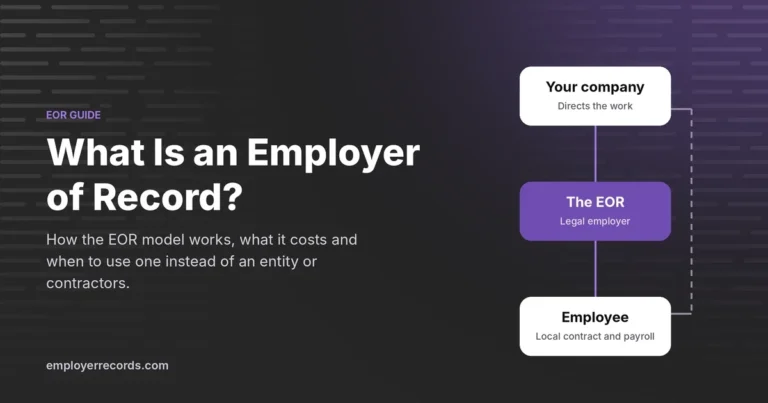
A global PEO is an employer of record under a different name. The provider employs your hire through its own local entity, runs payroll and carries the legal duties, and you manage the work.

Our take
Every provider here will tell you it is the easy way to hire abroad. The useful question is narrower: does it own the entity that employs your hire in your country, or hand you to a partner? Ask that before you compare price.
Manjuri Dutta, Co-Founder & Editor, EmployerRecordsWhat is a global PEO?
A global PEO is a service that becomes the legal employer of your staff in another country, so you can hire there without setting up your own company.
It signs the local employment contract, runs payroll, pays employer taxes and social contributions, and provides the statutory benefits. You pick the person, set the work and manage them day to day.
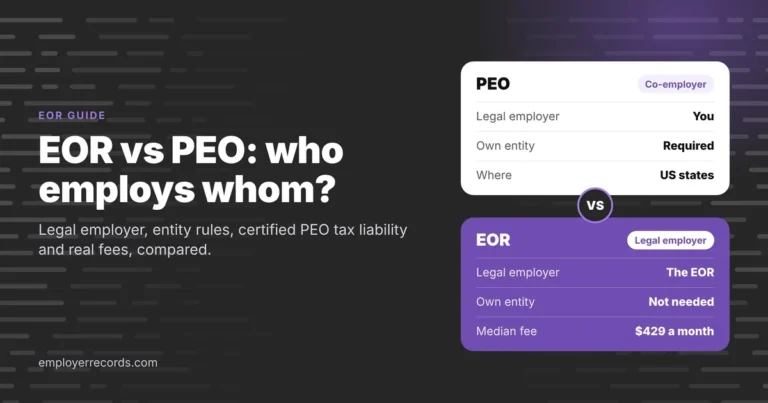
The name comes from the US. A professional employer organization (PEO) takes over HR, payroll and benefits administration for a company that already has a registered business, and the two share employer duties. That arrangement is called co-employment, and most countries have no equivalent.
Abroad, the provider has to be the employer outright. That is why the same service is also sold as an employer of record (EOR), and in older material as global employment outsourcing (GEO).
When you compare vendors, treat global PEO, international PEO and EOR as one thing.
How a global PEO hire works
What a global PEO covers
What stays with you: choosing and directing the hire, the quality of their work and your own tax position.
An EOR does not remove permanent establishment risk if your hire negotiates or concludes contracts for you, so read what creates a permanent establishment before you place someone in a country.
Best global PEO companies compared
Fees are the per-employee monthly EOR rates in our pricing index. Where a provider does not publish a rate the table shows Quote. Scroll down for a full card on each provider.
| Provider | EOR fee | Countries | Entities | ER rating | Positioning |
|---|---|---|---|---|---|
| Multiplier | $459/mo | 160+ | Owned | 4.2 | Best value among owned-entity providers |
| Remote | $599/mo | 90+ | Owned | 4.2 | Best for owned entities and clear country guides |
| Deel | $599/mo | 130+ | Owned | 4.0 | Best for month-to-month contracts |
| Pebl | $399/mo | 185+ | Mixed | 4.0 | Best for the lowest fee at wide coverage |
| Papaya Global | $499/mo | 180+ | Mixed | 4.0 | Best for consolidating payroll across entities |
| Globalization Partners | $599/mo | 180+ | Mixed | 4.0 | Best for enterprise rollouts across many countries |
| Rippling | Quote | 80+ | Mixed | 3.8 | Best if you already use a US PEO |
| Oyster HR | $699/mo | 120+ | Mixed | 3.8 | Best for distributed teams that want guidance |
| Safeguard Global | Quote | 187 | Mixed | 3.4 | Best for the widest country footprint |
| Justworks | $599/mo | 40+ | Partner | 3.4 | Best for US small teams with a few overseas hires |
Best global PEO providers reviewed
Ten providers, ordered by our review rating and then by fee. Each card shows the numbers we hold, what stands out and what to check before you sign. Open the full review for country notes and contract terms.

Multiplier
Best value among owned-entity providers
Multiplier employs through its own entities across 160+ countries, so the contract your hire signs is with Multiplier itself, not a local partner.
A flat $459 a month per employee makes each added hire easy to forecast, and it is the lowest price among the owned-entity providers here.
Best for: Small and mid-size teams hiring in several countries
What stands out
- Flat $459 fee, well below the $599 many rivals charge
- Owned entities and one of our highest ratings
Watch out
- Confirm country-specific benefits and support hours before you sign.

Remote
Best for owned entities and clear country guides
Remote’s pitch to a company with no local entity is clarity. It employs through entities it owns and publishes country guides on local employment rules, so you can see what a contract, leave and notice look like before you commit.
That helps when a hiring manager has to explain the arrangement to finance or legal. The price is an annual contract at $599 a month, with 90+ countries on the list rather than 180+.
Best for: Teams that want clarity on local rules before hiring
What stands out
- Owned entities across its footprint
- Published country guides and a top rating
Watch out
- Coverage stops at 90+ countries, and the $599 rate is on an annual contract.

Deel
Best for month-to-month contracts
Deel bills EOR month to month, so you can employ someone through its owned entities in a new country and walk away if the market does not work out.
Outside the US it acts as the legal employer, not a co-employer, which is the usual shape of a global PEO. The same account can pay contractors and run global payroll, which helps once you employ people under several arrangements.
The $599 fee is high for a service with no lock-in.
Best for: Teams testing a market before committing
What stands out
- Month-to-month billing, no annual contract
- EOR, contractors and payroll in one login
Watch out
- $599 is among the highest published EOR rates.

Pebl
Best for the lowest fee at wide coverage
Pebl, formerly Velocity Global, acts as the employer in 185+ countries through a mix of its own entities and partners.
It says it does not charge for employee termination, though it asks for 30 days’ notice to offboard a client, which matters if you expect to move staff to your own entity later.
At $399 a month it is the cheapest broad-coverage option here.
Best for: Cost-led teams hiring in many countries
What stands out
- Lowest published fee for 185+ countries
- Local experts for pay and benefits questions
Watch out
- Entities are mixed, so check who employs your hire in each country.

Papaya Global
Best for consolidating payroll across entities
Think of Papaya Global as a payroll platform that also does EOR.
If you already run entities in some countries, you can pay those employees and your EOR hires from one system, and use Papaya as the legal employer only where you have no entity.
The EOR fee is $499 a month across 180+ countries, with a mix of owned and partner entities.
Best for: Companies with a mix of own entities and EOR hires
What stands out
- One payroll view across your entities and EOR hires
- 180+ countries at $499
Watch out
- If you only need EOR in a few countries, a pure EOR is simpler.

Globalization Partners
Best for enterprise rollouts across many countries
Globalization Partners, now G-P, built its name as an early EOR and says it has 100+ wholly owned entities across 180+ countries.
For a company rolling out many hires at once, that means one contract structure and one compliance process in every country.
There is no minimum term at $599 a month, but larger programmes should still ask for the full fee schedule.
Best for: Larger programmes rolling out across many countries
What stands out
- 180+ countries with 100+ wholly owned entities
- No minimum contract term
Watch out
- The base rate is not the whole bill, so ask for a full fee schedule.

Rippling
Best if you already use a US PEO
Rippling is a US PEO first, so it makes most sense when your headcount is mainly American and a few hires sit abroad.
Those overseas employees join the same HR and IT system as the US team, with devices and apps managed alongside payroll.
Outside the US the employment itself runs as an EOR, and the 80+ country list is shorter than the specialists’.
Best for: US companies already on or considering a Rippling PEO
What stands out
- US PEO and international hiring in one system
- Device and app management included in the same platform
Watch out
- 80+ countries is narrower than the specialist EORs.

Oyster HR
Best for distributed teams that want guidance
Oyster employs through a mix of its own entities and vetted partners in 120+ countries. You pay $699 a month, or less on annual billing, and part of that fee buys guidance for managers who are hiring abroad for the first time.
Best for: Distributed teams that value hands-on guidance
What stands out
- Owned entities plus vetted partners in 120+ countries
- Annual billing brings the rate down
Watch out
- At $699 a month it is the most expensive provider in this guide.

Safeguard Global
Best for the widest country footprint
Safeguard Global covers 187 countries, the widest list here, and sells payroll, mobility and entity setup alongside EOR.
It is blunt about terminology: it says co-employment is not available in most countries and is considered illegal in some, such as France and Switzerland, so an “international PEO” is in practice an EOR.
If you expect to open entities later, having entity setup under the same provider can ease the handover.
Best for: Multi-country programmes that may need entities later
What stands out
- Widest country footprint in this guide
- Payroll, mobility and entity setup under one provider
Watch out
- Pricing is not published in our index, and our rating trails the platform-first providers.

Justworks
Best for US small teams with a few overseas hires
Justworks is a US PEO, and its international option exists mainly for customers already on the platform.
Overseas employees are handled through partner entities in 40+ countries, so treat it as a convenience for a few hires rather than a route to a global team.
Best for: US small teams adding a few overseas hires
What stands out
- One HR and benefits system for US and overseas staff
- Familiar set-up for existing Justworks clients
Watch out
- At 40+ countries it has the narrowest coverage here.
Global PEO vs EOR vs co-employment
The three terms describe two structures. Co-employment needs your own entity, and the PEO shares duties with you. An EOR is the sole legal employer in a country where you have no entity.
Our EOR vs PEO guide sets out the difference in full, and our Global PEO review covers one provider that uses the name.
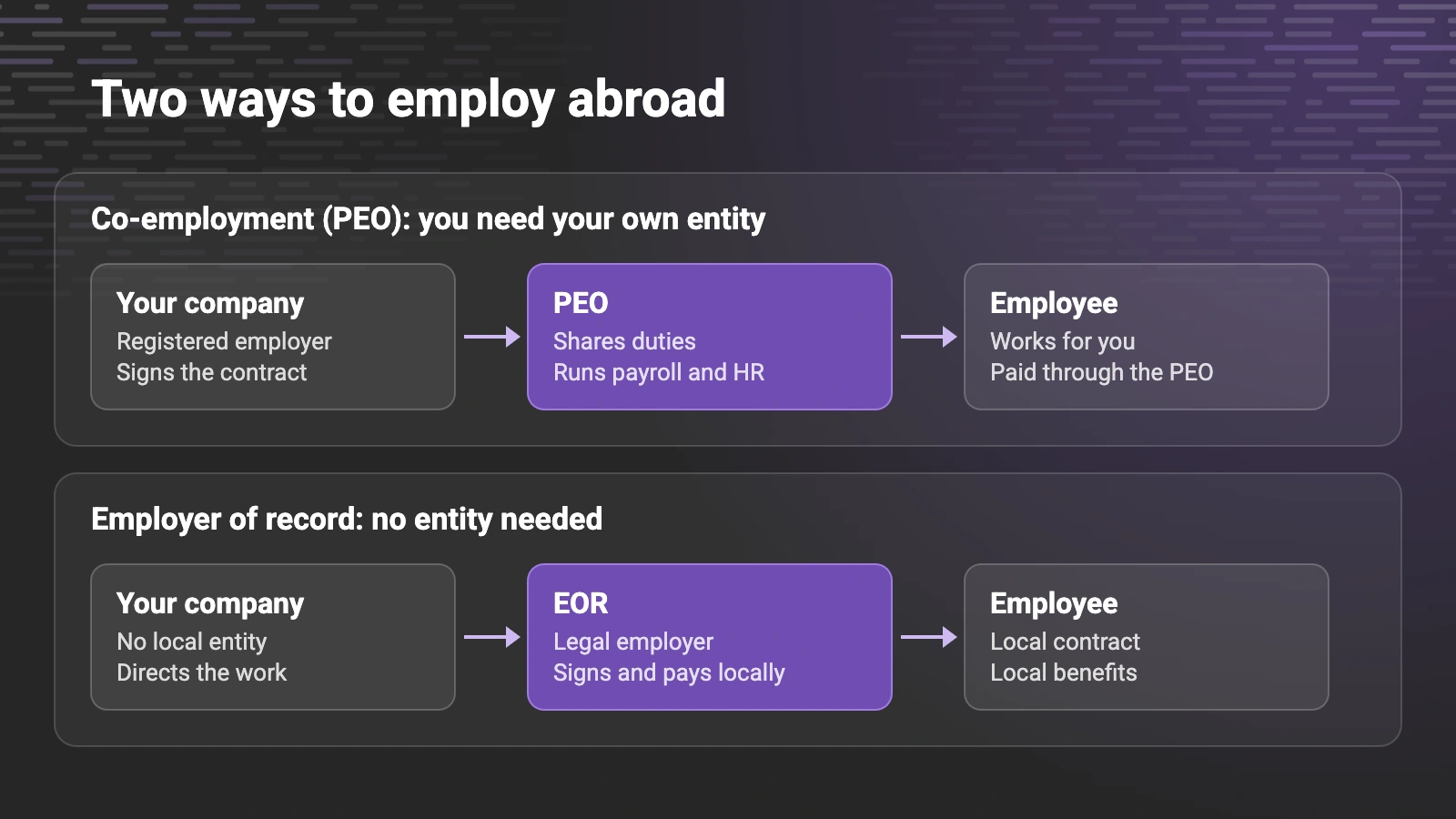
| Factor | Co-employment (PEO) | EOR |
|---|---|---|
| Your own entity in the country | Required | Not needed |
| Who signs the employment contract | You | The provider |
| Who runs payroll and files taxes | PEO, under shared terms | Provider, under its local entity |
| Where it works | Mainly the US | Most countries a provider covers |
Some jurisdictions restrict or prohibit sharing the employer role between two companies, and France is the one buyers hit most often. That is another reason providers outside the US use the EOR model.
When a global PEO makes sense
It fits when you want to hire one to a few people in a country quickly and have no entity there.
Common cases are testing a market before committing, hiring a specialist who lives abroad, and building a distributed team across many countries without opening an entity in each.
It stops making sense once the monthly fees in a country add up to more than the running cost of your own entity. In our pricing index that point comes at roughly three employees in Germany, and later in cheaper markets.
At that stage you move staff to your own entity, and the provider should help with the transfer.
How to choose a global PEO
Ask every shortlisted provider for the same items so you can compare answers side by side: the legal name of the employing entity, a full fee schedule, the indemnity clause, how local benefits and statutory leave are handled, and the pay date.
If you plan to hire in several countries, our global hiring strategy guide covers how to sequence markets.
What a global PEO costs
The headline fee is only part of the bill. The total for one employee is salary, employer taxes and benefits in that country, the provider fee, and any one-off charges.
Our EOR pricing index shows published EOR fees from $99 to $699 per employee a month, with a median of $429. The providers in this guide sit above the median because they cover broad country lists.
Model your country before you commit. The EOR cost calculator adds employer contributions to each fee so you see the real monthly cost.
Questions about global PEO companies
Short answers to what employers ask most, checked against our provider reviews and pricing index.
What is a global PEO?
A global PEO is a service that legally employs your staff in another country so you do not need your own entity there. It signs the local contract, runs payroll and carries the statutory duties while you manage the work. Outside the US it is an employer of record.
Is a global PEO the same as an EOR?
In practice, yes. Outside the US, the structure most providers call a global PEO is an employer of record. The provider employs your hire through a local entity, runs payroll and carries the statutory duties while you direct the work.
What does a global PEO not do?
It does not choose your hires, set their targets or take on your tax position as a company. If a hire negotiates contracts for you, your own permanent establishment risk can remain, so read our guide to permanent establishment before you start.
Which global PEO is cheapest?
Among providers here with a published fee, Pebl is lowest at $399 a month, then Multiplier at $459 and Papaya Global at $499. Compare full fee schedules, since setup and offboarding charges differ.
Can a US PEO hire employees in other countries?
Not through co-employment. US PEOs work on top of your own registered US business. Rippling and Justworks add an international service, but abroad it is delivered as an EOR or through a partner.
Do I need my own entity to use a global PEO?
With an EOR, no. The provider hires through its entity. A classic PEO arrangement needs your own entity in that country, and few countries allow co-employment at all.
How much does a global PEO cost?
Published EOR fees in our pricing index run from $99 to $699 per employee per month, with a median of $429. The providers here sit between $399 and $699 before salary, employer contributions, benefits and any setup or offboarding fees.
Who carries the risk if the provider gets it wrong?
The employer in law carries first-line liability, which is the EOR. Your contract should still say who pays if a misclassification claim, payroll error or dismissal dispute lands on you. Read the indemnity clause before you sign.
When should I open my own entity instead?
When the monthly fees for a country add up to more than the running cost of your own entity. In our pricing index that point comes at roughly three employees in Germany, and later in cheaper markets.
How long does onboarding take?
Providers advertise days for the first hire. Plan on one to three weeks for contract drafting, background checks, right-to-work checks and benefits enrolment, longer where works councils or collective agreements apply.
About the author
Manjuri Dutta is Co-Founder and Content Editor at EmployerRecords.com, covering Employer of Record providers and global hiring platforms. She evaluates providers on entity ownership, statutory compliance, and real pricing rather than vendor claims, and built the verification process used across EmployerRecords' country guides, checking vendor claims against government registries and public filings.
View all articles by Manjuri