
Payroll in the Czech Republic (2026): Deadlines and Monthly Reporting
Pay dates, contribution deadlines, the new monthly employer report, tax withholding and sick pay for employers.
How does payroll work in the Czech Republic?
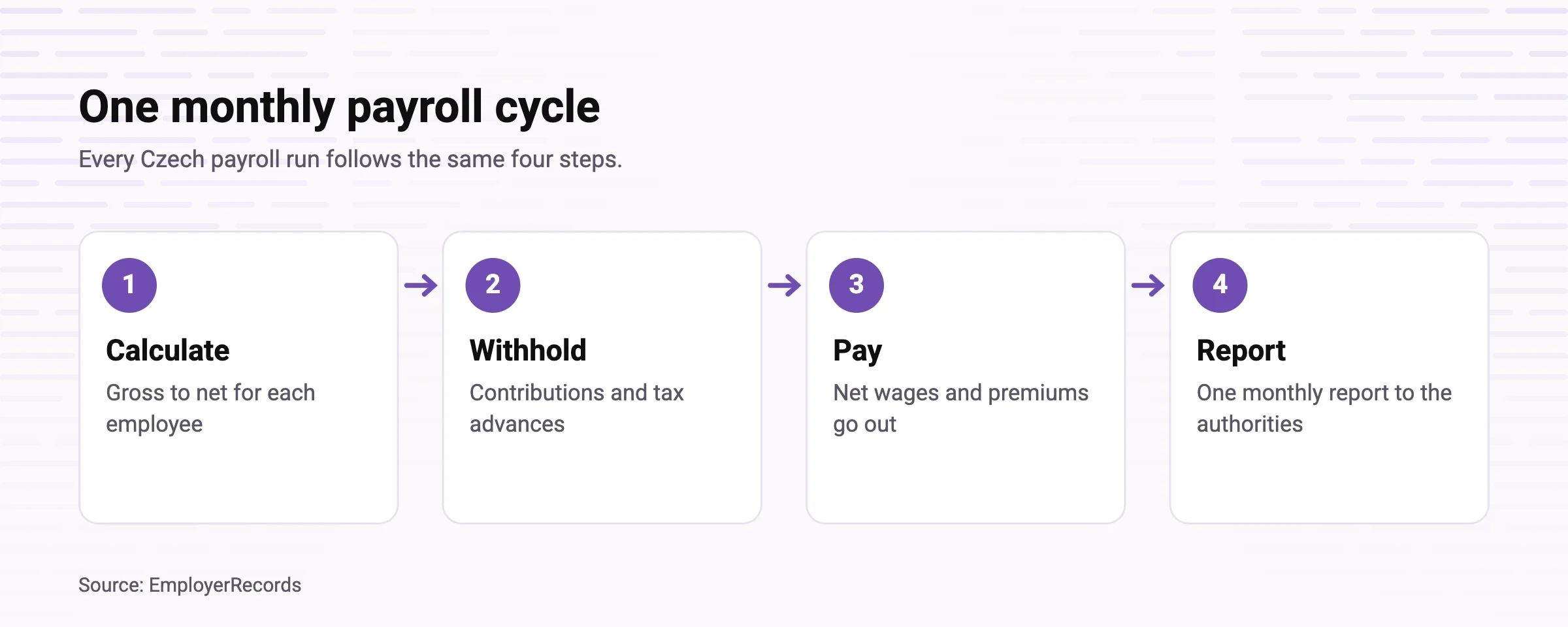
Czech payroll runs monthly. Wages for a month are due by the end of the next month. Social security is paid, and the Single Monthly Employer Report filed, between the 1st and 20th of that same next month. Employers add 33.8% in contributions and withhold 11.6% from pay, plus income tax.
- Wages: Due by end of next month
- Social security: Paid 1st to 20th of next month
- Employer on top: 33.8% of gross wage
Monthly, and in arrears. You calculate pay after the month closes. Wages are due by the end of the following month, and the contributions for the month are paid in the first 20 days of that same following month.[1][2]
Four parties get paid out of every run, and each runs on its own clock.
Where each payroll amount goes
| Recipient | What it covers | When |
|---|---|---|
| Employee | Net wage | By the end of the following month |
| Social security administration | Social security and the state employment contribution | 1st to 20th of the following month |
| Health insurers | Health insurance, reported to each insurer separately | Outside the single monthly report |
| Tax authority | Income tax advances | Reported through the monthly report |
Health insurers stay outside the new report, so each one still gets its own notifications.[3]
When must wages be paid?
By the last day of the month after the work was done. January wages are due by the end of February.[2] That’s the legal ceiling, and a contract can set an earlier payday.[2]
Labour Code rules expect a fixed payday, agreed in the contract or set in an internal policy.[2] Before work starts, the employer gives a written wage statement covering how pay is calculated, when it’s paid and where.[4] Pay goes out in Czech koruna, and bank transfer needs the employee’s agreement.[2][4]
Our view. Treat the last day of the following month as a hard stop, not a target. Fifteen days past it, an employee can resign with immediate effect.[5]
What is the Single Monthly Employer Report?
One electronic report each month, replacing a stack of separate filings. Act 323/2025 took effect on 1 January 2026, and any person employing at least one employee has to file, whatever the size or legal form.[6][7]
It goes in by the 20th of the following month through payroll software, the ČSSZ portal or a data box.[3] Each calendar month gets its own report.[7]
April 2026 was the first live report, due by 20 May. Reports for January to March could be filed retroactively until the end of June.[8][7]
How the rollout ran
| Date | Step |
|---|---|
| 1 January 2026 | Act in force |
| 1 April 2026 | Reporting duties begin |
| 20 May 2026 | First report due, for April |
| 30 June 2026 | Retroactive reports for January to March due |
| 1 July 2026 | Third stage of employer duties starts |
How do you register a new employee?
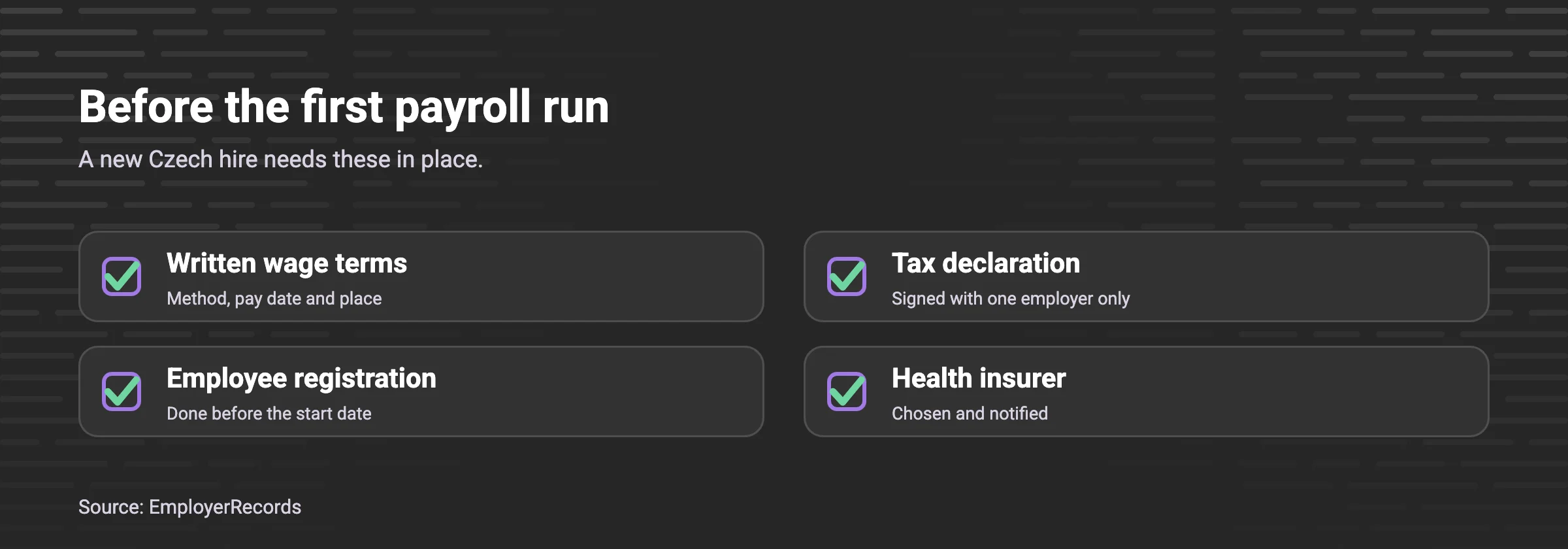
Before the start date, for a non-Czech employee. Deloitte’s payroll team notes such a hire has to be fully registered between one and eight days ahead.[3] Nobody uses the old ONZ form now.[3]
Beyond that, set the file up before day one: wage terms in writing, the taxpayer declaration, the health insurer and bank details.
What are the contribution rates?
Employers pay 33.8% on top of gross pay, and employees have 11.6% withheld.[9] Social security stops at an annual cap of CZK 2,350,416 in 2026. Health insurance has no cap.[10]
Contribution rates, 2026
| Contribution | Employee | Employer |
|---|---|---|
| Social security | 7.1% | 24.8% |
| Health insurance | 4.5% | 9% |
| Total | 11.6% | 33.8% |
Inside the 24.8% employer rate sits the state employment contribution, paid together with social security.[1]
How is income tax withheld?
Monthly, as an advance, at 15% up to CZK 146,901 of pay and 23% above it.[10][11] A basic taxpayer credit of CZK 2,570 a month reduces the advance, but only once the employee has signed the taxpayer declaration with you.[11][12]
Someone with several employers can sign with only one of them.[12] At the others the advance runs higher.[12]
What happens at year end?
Employees who worked only for you can ask for an annual settlement. For tax year 2025, requests were due by 16 February 2026, the employer settled by 31 March, and any overpayment above CZK 50 was paid out by 30 April.[15]
2026 is the last year employers file the annual reconciliation. Employer filing is due to be dropped from the 2027 tax year, when the tax authority works from the monthly report.[8]
How does sick pay run through payroll?
Employers pay first. For the first 14 calendar days of illness you pay wage compensation, 60% of reduced average earnings, for the working days missed.[16][17] From day 15 the social security administration pays sickness benefit.[18]
Compensation can be cut or withheld only for a breach of the treatment regime, such as going out when told to stay in.[17]
Watch this one. A minister has backed bringing back a three day unpaid waiting period, which would move cost onto employees.[19] We found no enacted change, so budget on the 14 day rule.
What does a typical Czech payroll cost?
Take a CZK 35,000 salary. Employer contributions add CZK 11,830, so the monthly cost is CZK 46,830.[9]
CZK 35,000 salary plus CZK 11,830 in employer contributions.
33.8% on top of the salaryTake-home pay is CZK 28,260 after contributions and tax, our estimate with the basic credit and no children.
What happens when payroll runs late?
Two clocks, two penalties. Late social security premiums carry a penalty of 0.05% of the unpaid amount for every calendar day.[20] Late wages give the employee an exit: if pay stays unpaid 15 days past the due date, they can end the job with immediate effect.[5]
On a CZK 159,500 premium payment the penalty is about CZK 80 a day, our calculation. Bigger cost: the employee who can walk.
Estimate a social security payment and late penalty
Czech social security payment and late penalty
Estimate only. It treats the whole payroll as one base at 31.9%, and ignores the annual social security cap, minimum bases and rounding. The 0.05% a day penalty is the rate published on the Czech government business portal. Health insurers apply their own rules.
Where do payroll teams slip?
Registration comes first, and it’s where foreign hires go wrong.
Our view. Rules assume the employee is registered before day one. If a hire starts on Monday and the paperwork starts the same Monday, you’re already behind.[3]
Next, the declaration. It can sit with only one employer, so check whether your hire already signed one elsewhere.[12]
Running Czech payroll without a local entity
An employer of record registers as the employer, files the monthly report and pays the premiums, while you manage the work. Compare providers in our Czech Republic EOR ranking and price a hire with the EOR cost calculator.
Questions about payroll in the Czech Republic
Short answers to what employers ask most about payroll in the Czech Republic, checked against the social security administration and tax advisers on 26 November 2026.
When must wages be paid in the Czech Republic?
By the last day of the month after the work was done. January pay is due by the end of February, and a contract can set an earlier date.
When are social security contributions due?
Between the 1st and 20th of the following month. Monthly reporting closes by the 20th as well.
What is the Single Monthly Employer Report?
One electronic report each month, in force since 1 January 2026, that replaces several separate filings. Health insurance is not part of it.
How much do employers pay on top of wages?
33.8%, made up of 24.8% social security and 9% health insurance. Employees have 11.6% withheld.
Who pays sick pay?
Employers pay 60% of reduced average earnings for the first 14 calendar days. From day 15 the social security administration pays sickness benefit.
What happens if payroll is late?
Late premiums carry a penalty of 0.05% a day on the unpaid amount. An employee left unpaid 15 days past the due date can resign with immediate effect.
Does a Czech employee need to sign a tax declaration?
Only to get the monthly tax credit. It can be signed with one employer at a time, so check for other jobs.
Will employers still file an annual tax reconciliation?
For 2026, yes. Employer filing is due to be dropped from the 2027 tax year, when the tax authority will use the monthly report data.
References and sources
Every figure on this page comes from the sources below. Numbers in square brackets in the text link to the matching entry. Official statistics are used wherever they exist, and our own calculations are labelled as estimates. All sources were checked on 26 November 2026.
- ↑Payment of social security contributions and state employment policy contributions by employers. Czech Government Portal. portal.gov.cz. Retrieved 26 November 2026. Data
- ↑What are the consequences of late wage payments via cashless transfer?. LYNX Legal. lynx.legal. Retrieved 26 November 2026. Guide
- ↑Payroll newsletter, winter 2026. Deloitte Czech Republic, 2026. deloitte.com. Retrieved 26 November 2026. Guide
- ↑Minimum wage regulations in the Czech Republic. WageIndicator Foundation, 2025. wageindicator.org. Retrieved 26 November 2026. Guide
- ↑Working conditions of employees in the Czech Republic. State Labour Inspection Office, January 2023. suip.cz. Retrieved 26 November 2026. Data
- ↑Single Monthly Employer Report. Czech Social Security Administration, 2026. cssz.cz. Retrieved 26 November 2026. Data
- ↑Submission of a Single Monthly Report. Czech Social Security Administration, 2026. cssz.cz. Retrieved 26 November 2026. Data
- ↑Single Monthly Employer Reporting effective from 1 January 2026. Forvis Mazars Czech Republic, 2026. forvismazars.com. Retrieved 26 November 2026. Guide
- ↑Czech Republic: individual, other taxes. PwC Worldwide Tax Summaries, 2026. taxsummaries.pwc.com. Retrieved 26 November 2026. Data
- ↑Czech Republic: new thresholds for tax and social security in 2026. KPMG, 27 February 2026. kpmg.com. Retrieved 26 November 2026. Guide
- ↑Changes to wage rates, limits and decisive amounts from 2026. Forvis Mazars Czech Republic, 2026. forvismazars.com. Retrieved 26 November 2026. Guide
- ↑Personal income tax advance for employees in 2026. Dostupný advokát, 2026. dostupnyadvokat.cz. Retrieved 26 November 2026. Guide
- ↑Important tax deadlines for 2026. PKF Apogeo, 16 April 2026. pkfapogeo.cz. Retrieved 26 November 2026. Guide
- ↑Accompanying law to SMER: key changes in the Income Tax Act. Forvis Mazars Czech Republic, 2026. forvismazars.com. Retrieved 26 November 2026. Guide
- ↑Annual tax settlement in 2026: procedure and deadlines. Dostupný advokát, 7 February 2026. dostupnyadvokat.cz. Retrieved 26 November 2026. Guide
- ↑Sickness benefits. Czech Social Security Administration. cssz.cz. Retrieved 26 November 2026. Data
- ↑Managing repeated employee sick leave. ARROWS Law Firm. arws.cz. Retrieved 26 November 2026. Guide
- ↑Sickness insurance. Ministry of Labour and Social Affairs. mpsv.gov.cz. Retrieved 26 November 2026. Data
- ↑Czech workers could lose sick pay for first three days under new proposal. Expats.cz. expats.cz. Retrieved 26 November 2026. News
- ↑General information on social security contributions. Business Info Czech Republic. businessinfo.cz. Retrieved 26 November 2026. Data
About the author

Manjuri Dutta is Co-Founder and Content Editor at EmployerRecords.com, covering Employer of Record providers and global hiring platforms. She evaluates providers on entity ownership, statutory compliance, and real pricing rather than vendor claims, and built the verification process used across EmployerRecords' country guides, checking vendor claims against government registries and public filings.
View all articles by ManjuriPayroll and pay guides for other countries
Compare Czech Republic with payroll rules, pay dates and employer costs in other markets.
 Czech RepublicAverage salaryAverage Salary in the Czech Republic (2026): CZK 50,650 a MonthAverage and median pay, regional gaps, gross to net and what employers add on top, from the Czech Statistical Office.Read the guideCzech RepublicEmployment ContractsCzech Employment Contracts 2026: Probation, Notice, SeveranceContract form, probation, fixed-term limits, notice and severance under the Czech Labour Code.Read the guideCzech RepublicEmployee CardEmployee Card in the Czech Republic (2026): Employer GuideHow to register the vacancy, file the application and meet your duties as the employer of a non-EU hire.Read the guideCzech RepublicMinimum wageMinimum Wage in the Czech Republic (2026): CZK 22,400 a MonthThe monthly and hourly minimum wage for 2026, the increase for 2027, overtime and what employers add on top.Read the guide
 VietnamAverage salaryAverage Salary in Vietnam (2026): ₫9.0 Million a Month, by Sector and TaxWhat Vietnamese workers earn on average, how pay differs by sector and city, how gross becomes net, and what an...Read the guideVietnamMinimum wageMinimum Wage in Vietnam (2026): ₫3.7 to ₫5.31 Million a Month by RegionRegional minimum wages for 2026, the 2027 increase, hourly floors and what employers add on top.Read the guide
Hiring in Czech Republic?
The Czech Republic hiring guide covers employer cost, notice rules and work permits in one place.