
Employee Card in the Czech Republic (2026): Employer Guide
How to register the vacancy, file the application and meet your duties as the employer of a non-EU hire.
What is the Czech Employee Card?
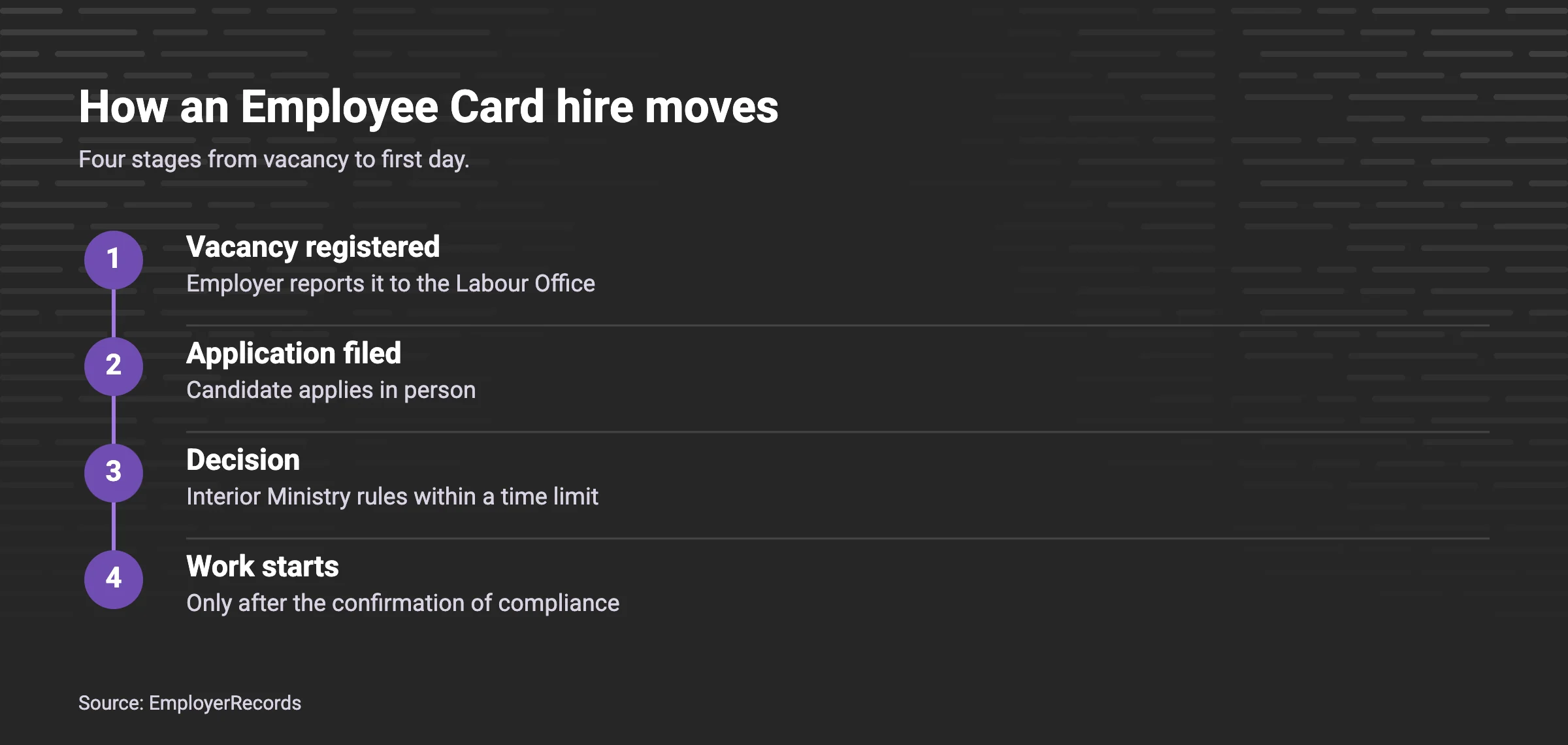
Czech Employee Cards are long-term residence permits that also work as work permits, for non-EU hires without a degree requirement. Employers first register the vacancy with the Labour Office. Filing costs CZK 2,500 in Czechia, and the Interior Ministry decides within 60 days, or 90 in complex cases.
- Fee: CZK 2,500 in Czechia
- Decision: 60 days, 90 if complex
- First step: Vacancy registered by employer
It’s a long-term residence permit that doubles as a work permit. It lets a non-EU national live and work in Czechia for more than three months, and it carries no qualification requirement.[1][2]
EU, EEA and Swiss citizens don’t need one.[2]
Which hires can use it?
Non-EU nationals who have no other route to work. Citizens of Australia, Canada, Israel, Japan, New Zealand, South Korea, Singapore, the United Kingdom and the United States have had free access to the labour market since 1 July 2024, and Taiwan was added on 1 March 2025.[3][4]
Free access removes the vacancy reporting duty for those hires. It also lets them start work without waiting for the confirmation of compliance.[3][1]
How does the vacancy get registered?
Employers report it to the regional Labour Office first. That vacancy has to appear in the central register of vacancies open to Employee Card holders before the candidate can apply.[2][5]
Since 1 July 2024 there’s no waiting period in between. Vacancies still have to be reported and published, but the old 30 day test is gone.[4][6]
Check first. Ministry guidance says a vacancy can be refused or removed after a recent fine for illegal work, in bankruptcy, or after labour law fines above CZK 50,000. That page was last updated in 2019, so confirm the current list with the Labour Office.[2]
What wage and hours must the vacancy offer?
At least 15 hours a week, and a monthly wage no lower than the basic minimum wage, whatever the hours.[2] That’s CZK 22,400 in 2026 and CZK 24,900 from 2027.[7][8]
Card holders moving to a new job can be exempt from the floor, with the Interior Ministry’s consent.[2] Our Czech minimum wage guide has the full rate history.
What contract does the applicant need?
Written, or at least a letter of intent. Proof of the work relationship can be an employment contract, a contract for work or a preliminary contract.[2][1] Czech employment contracts name the type of work, the place of work and the start date, and employees receive a copy.[9]
Where an embassy asks for a foreign document, it must be authenticated and translated into Czech.[10] Our Czech employment contracts guide covers the contract itself.
How does the application run?
In person. From inside Czechia that means a Ministry of the Interior office, and from abroad a Czech embassy or consulate.[1] An employer can file for the candidate under a power of attorney only inside a government approved programme.[1]
The file holds a travel document, a photograph, proof of accommodation, proof of the work relationship and the vacancy ID. A criminal record extract is required, and a medical report on request.[1] Supporting documents shouldn’t be older than 180 days, passport and photo aside.[11] Applicants from abroad also need travel medical insurance until public insurance starts.[1]
When can the employee start work?
After the confirmation of compliance, for first-time applicants. Interior Ministry issues it first, unless the person holds a work permit or has free access to the labour market.[1]
Arrival brings deadlines of its own. Registration falls due within 30 calendar days on a long-stay visa, or within 3 days for visa-free entrants. The biometric card has to be collected within 60 days of the scan.[1] For the first card they also show the employer’s confirmation that work has started.[1]
Employee Card or Blue Card?
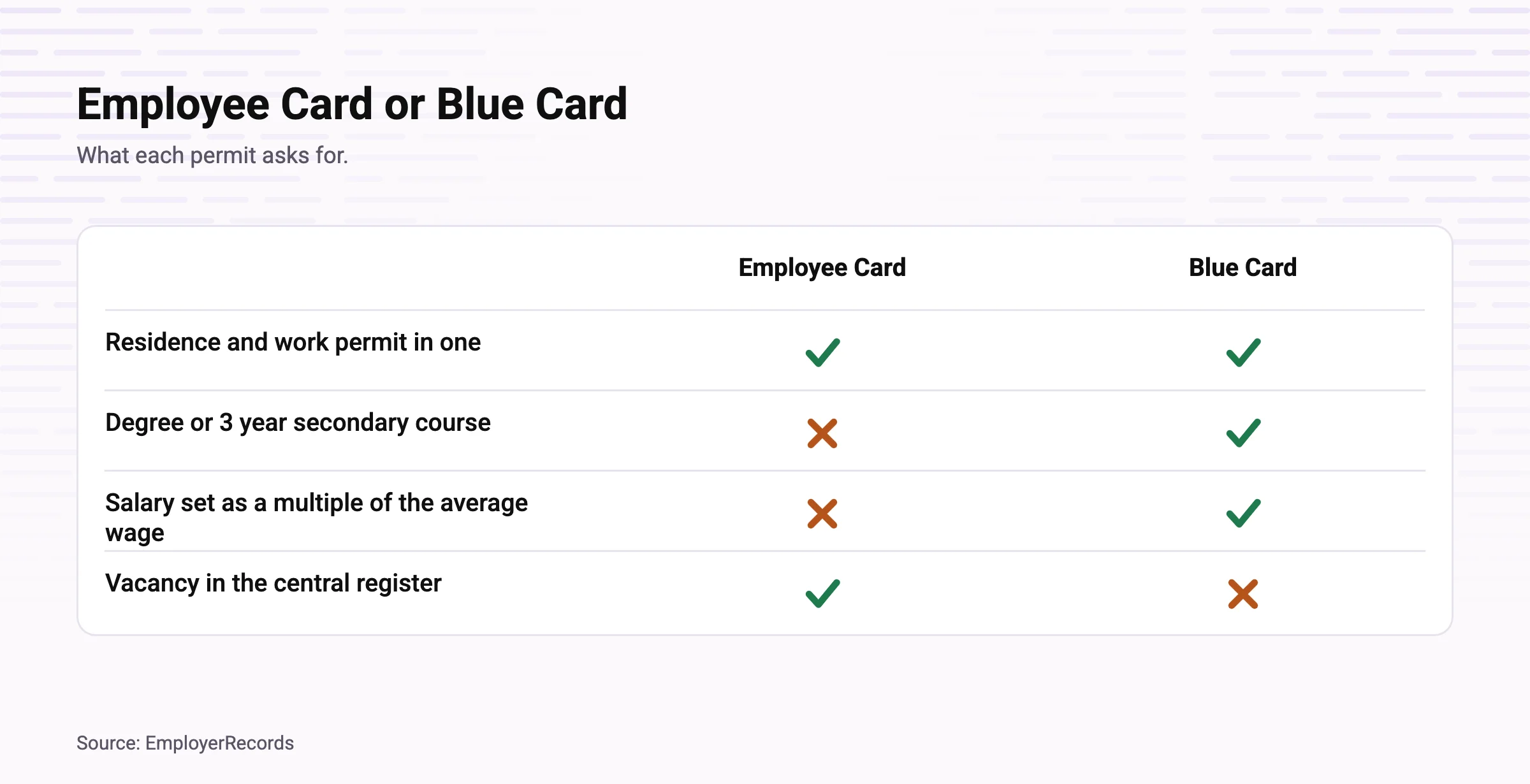
Blue Card hires need a degree or a three year secondary course, and a gross salary of at least 1.5 times the average annual wage.[2][12] From 1 May 2026 to 30 April 2027 that’s CZK 73,823 a month.[13][14] The Employee Card asks for neither.
Blue Card vacancies come from a separate EU Blue Card database.[12] Our Czech average salary guide shows how the threshold is built.
What does the employer owe after hiring?
Notices, mostly. You tell the Labour Office when the vacancy is filled, quoting the card reference number, and in writing if the foreigner hasn’t started within 45 calendar days. When employment ends, you notify within 10 calendar days.[2]
Ending a job for certain Labour Code reasons can also leave you covering the employee’s healthcare costs until departure.[2] Since 1 July 2024 the Labour Office has used a notice and information card system for a foreign employee’s start and end.[15]
How does renewal work?
Can the employee change jobs?
What does an Employee Card hire cost?
Fees are small next to payroll. Hiring at the Blue Card floor of CZK 73,823 costs about CZK 98,775 a month once the employer’s 33.8% is added.[16]
CZK 73,823 salary plus CZK 24,952 in employer contributions, before rounding.
33.8% on top of the salaryLower Employee Card salaries follow the same percentage. Use the calculator below to test your own offer.
Check an offer against the permit salary floors
Czech permit salary check
Estimate only. Employee Card floor equals the 2026 minimum wage, which rises to CZK 24,900 on 1 January 2027. Blue Card floor applies from 1 May 2026 to 30 April 2027. Employee Card hires also need at least 15 working hours a week. Cost line ignores the social security cap, which does not bind at these levels.
Where do employers slip?
Timing. Allow for 60 to 90 days of decision time plus travel and registration, and don’t promise a start date before the confirmation of compliance.[1]
Our take. Employers treat the vacancy listing as the long step. With the waiting period gone, the decision is the long step, and it’s the one you can’t shorten.[4]
The wage floor catches people too. Part-time offers can look fine on hours and still fail the monthly minimum, because the floor applies whatever the hours.[2]
Hiring non-EU talent without a Czech entity
The vacancy, the contract and the follow-up notices all sit with the employer, so a hire without a Czech entity usually goes through an employer of record. Our Czech Republic EOR ranking shows which providers handle permits, and the visas and work permits guide covers the wider picture.
Questions about the Czech Employee Card
Short answers to what employers ask most about the Czech Employee Card, checked against the Ministry of the Interior and labour authorities on 26 November 2026.
How long does Employee Card processing take?
60 days, or 90 days in especially complicated cases or when the Labour Office gives a binding opinion.
How much does the Employee Card cost?
The administrative fee is CZK 2,500 at a Ministry of the Interior office in Czechia, and for extensions. Applying abroad adds a CZK 5,000 consular fee.
Is there still a labour market test?
No fixed waiting period applies since 1 July 2024. The vacancy must still be reported and published before the candidate applies.
Can the employee start before the card is issued?
Generally no. A first-time applicant starts after the Interior Ministry issues the confirmation of compliance, unless they hold a work permit or have free access to the labour market.
What is the difference between the Employee Card and the Blue Card?
Blue Card hires need a degree or a three year secondary course and a salary of at least 1.5 times the average wage, CZK 73,823 a month until 30 April 2027. The Employee Card has no qualification rule.
References and sources
Every figure on this page comes from the sources below. Numbers in square brackets in the text link to the matching entry. Official statistics are used wherever they exist, and our own calculations are labelled as estimates. All sources were checked on 26 November 2026.
- ↑Employee Card. Ministry of the Interior. ipc.gov.cz. Retrieved 26 November 2026. Data
- ↑Employee card: information for employers. Labour Office of the Czech Republic, Last updated 4 April 2019. up.gov.cz. Retrieved 26 November 2026. Data
- ↑Free access to the labour market. Ministry of Foreign Affairs of the Czech Republic, 2024. mzv.gov.cz. Retrieved 26 November 2026. Data
- ↑Czech Republic: current trends in immigration. Baker McKenzie. resourcehub.bakermckenzie.com. Retrieved 26 November 2026. Guide
- ↑Employed worker: Czechia. European Commission, EU Immigration Portal. home-affairs.ec.europa.eu. Retrieved 26 November 2026. Data
- ↑Payroll newsletter, spring 2024. Deloitte Czech Republic, 2024. deloitte.com. Retrieved 26 November 2026. Guide
- ↑Minimální mzda (minimum wage). Ministry of Labour and Social Affairs (MPSV), 2026. mpsv.gov.cz. Retrieved 26 November 2026. Data
- ↑Minimální mzda v roce 2027 vzroste na 24 900 korun. Ministry of Labour and Social Affairs (MPSV), 2026. mpsv.gov.cz. Retrieved 26 November 2026. Data
- ↑Labour law in Czech Republic. CMS Expert Guides, 2025. cms.law. Retrieved 26 November 2026. Guide
- ↑Employee card application requirements. Embassy of the Czech Republic in Nairobi. mzv.gov.cz. Retrieved 26 November 2026. Data
- ↑Employee card. Embassy of the Czech Republic in London. mzv.gov.cz. Retrieved 26 November 2026. Data
- ↑Highly qualified worker: Czechia. European Commission, EU Immigration Portal. home-affairs.ec.europa.eu. Retrieved 26 November 2026. Data
- ↑EU Blue Card salary threshold from 1 May 2026. Danovky.cz, 2026. danovky.cz. Retrieved 26 November 2026. Guide
- ↑Wage increase for Blue Cards (Announcement 44/2026). EY Czech Republic, March 2026. ey.com. Retrieved 26 November 2026. Guide
- ↑Changes in employment law in the Czech Republic from 1 July 2024. Accace, 2024. accace.com. Retrieved 26 November 2026. Guide
- ↑Czech Republic: individual, other taxes. PwC Worldwide Tax Summaries, 2026. taxsummaries.pwc.com. Retrieved 26 November 2026. Data
About the author

Emma Whitmore is an EOR and Global Employment Content Writer at EmployerRecords, where she researches and writes practical resources on Employer of Record (EOR) services, international hiring, global payroll, employment compliance, and workforce expansion across international markets. With more than 15 years of experience in B2B content and editorial research, Emma specializes in turning complex employment regulations into clear, actionable guidance for HR leaders, founders, and globally distributed teams. Her work focuses on helping businesses understand country-specific hiring requirements, compare global employment providers, and navigate compliance with confidence.
View all articles by EmmaWork permit and visa guides for other countries
Compare Czech Republic with permit routes, fees and employer duties in other markets.
 Czech RepublicAverage salaryAverage Salary in the Czech Republic (2026): CZK 50,650 a MonthAverage and median pay, regional gaps, gross to net and what employers add on top, from the Czech Statistical Office.Read the guideCzech RepublicEmployment ContractsCzech Employment Contracts 2026: Probation, Notice, SeveranceContract form, probation, fixed-term limits, notice and severance under the Czech Labour Code.Read the guideCzech RepublicMinimum wageMinimum Wage in the Czech Republic (2026): CZK 22,400 a MonthThe monthly and hourly minimum wage for 2026, the increase for 2027, overtime and what employers add on top.Read the guideCzech RepublicPayroll GuidePayroll in the Czech Republic (2026): Deadlines and Monthly ReportingPay dates, contribution deadlines, the new monthly employer report, tax withholding and sick pay for employers.Read the guide
 VietnamAverage salaryAverage Salary in Vietnam (2026): ₫9.0 Million a Month, by Sector and TaxWhat Vietnamese workers earn on average, how pay differs by sector and city, how gross becomes net, and what an...Read the guideVietnamMinimum wageMinimum Wage in Vietnam (2026): ₫3.7 to ₫5.31 Million a Month by RegionRegional minimum wages for 2026, the 2027 increase, hourly floors and what employers add on top.Read the guide
Hiring in Czech Republic?
The Czech Republic hiring guide covers employer cost, notice rules and work permits in one place.