
Average Salary in Singapore (2026): Median, Mean and Take-Home Pay
Median and mean income, growth by industry, bonuses and gross to net pay, with the basis behind each figure.
What is the average salary in Singapore?
The median full-time resident earns S$5,775 a month including employer CPF, measured in mid-2025. The mean is higher, at S$6,442 in the fourth quarter, because a few very large salaries pull it up. Use the median to price a role and the mean to read the wider economy.
- Median: S$5,775 a month, mid-2025, with employer CPF
- Mean: S$6,442 a month, 4Q 2025, bonus excluded
- Growth: Total wages up 4.9% in 2025, 4.0% after inflation
Singapore has no single average salary. MOM publishes several, each on a different base, and the two headline ones sit more than S$600 a month apart.
Which one you use depends on the job in hand. Setting an offer calls for the median or an occupation figure. Judging the wider economy calls for the mean. We also work out what a typical employee takes home and what the same job costs you, because the headline numbers include employer CPF.
Pass holders are a separate story, covered in the work passes guide.
Which figures should you quote?
Why do published averages disagree?
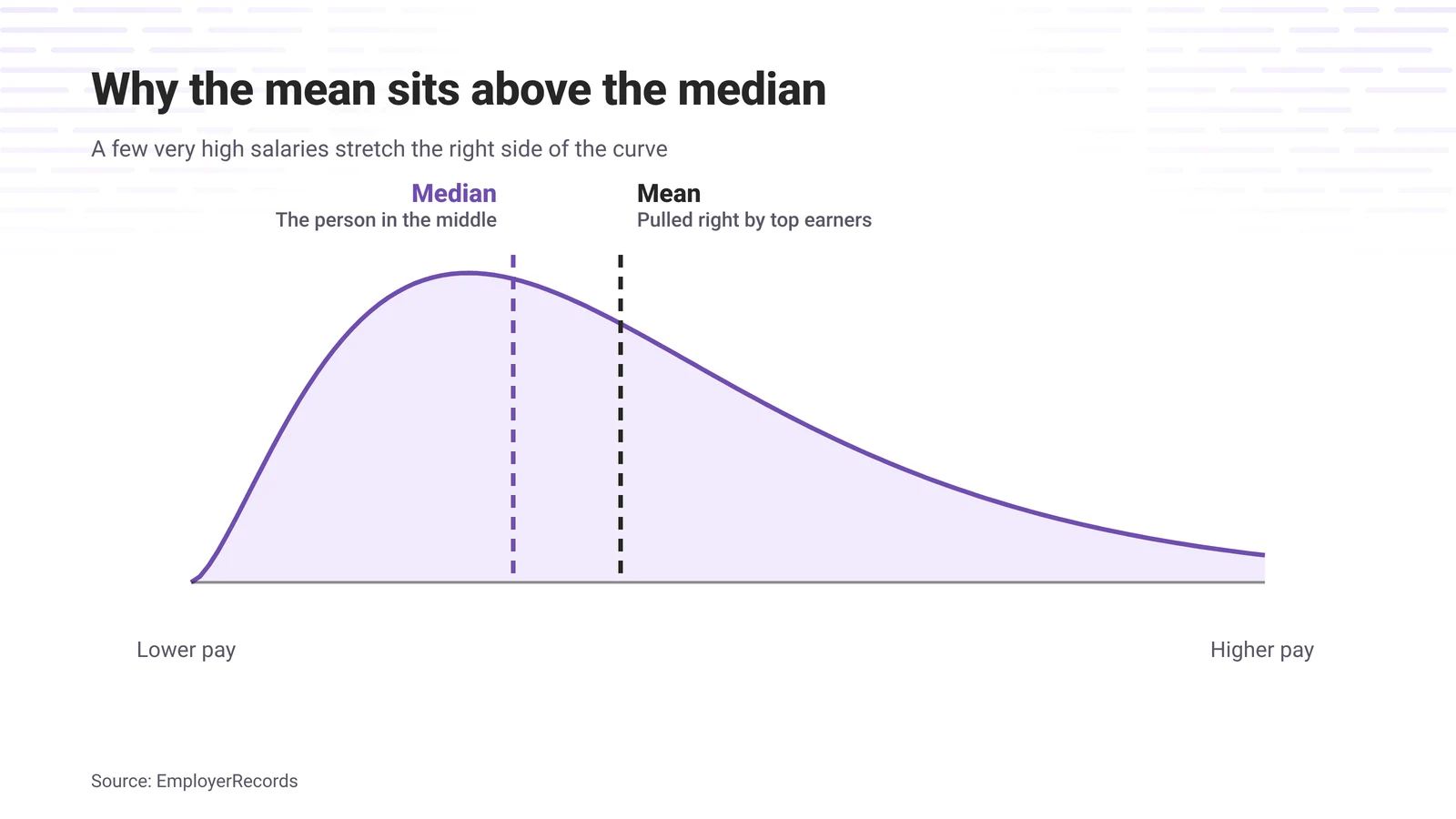
They count different people on different dates. The median is the pay of the person in the middle once everyone is ranked.[3] Add every income up and divide, and you get the mean. A handful of very large salaries drag it above the median.
MOM’s median covers full-time employed residents: citizens and permanent residents working at least 35 hours a week, measured in June.[4] Mean income covers all employed residents, self-employed included, and leaves out bonus.[2][3]
Both count residents only. Work pass holders sit in neither number.[4]
Our view. Quote the median when you set an offer, and write the basis beside it. A figure that says S$5,775 with no mention of employer CPF overstates what reaches the payslip by about S$840 a month, on our calculation.
How has the median moved since 2015?
It rose from S$3,949 to S$5,775 in ten years, about 3.9% a year in nominal terms and 2.1% after inflation.[2] Growth since 2020 is faster on paper, 5.0% a year nominal, but only 1.6% a year in real terms.[2]
2020 was the one year of decline. A jump of 8.3% in 2022 followed it.
Median gross monthly income of full-time employed residents, mid-year, including employer CPF
| Mid-year | Median | Change on prior year, our calculation |
|---|---|---|
| 2015 | S$3,949 | Not applicable |
| 2016 | S$4,056 | +2.7% |
| 2017 | S$4,232 | +4.3% |
| 2018 | S$4,437 | +4.8% |
| 2019 | S$4,563 | +2.8% |
| 2020 | S$4,534 | -0.6% |
| 2021 | S$4,680 | +3.2% |
| 2022 | S$5,070 | +8.3% |
| 2023 | S$5,197 | +2.5% |
| 2024 | S$5,500 | +5.8% |
| 2025 | S$5,775 | +5.0% |
Read it this way. Nominal growth since 2020 looks strong, and it is. Inflation took most of it, so a team that got a 5% rise each year is only a little better off in purchasing power.
How wide is the spread?
At the 20th percentile, pay is S$3,164 against a median of S$5,775. That’s a ratio of 0.55, up from 0.52 in 2020 and 0.51 in 2015, so the bottom has been catching up.[1][5]
In 2025 the median grew 5.0% in nominal terms and the 20th percentile 4.6%. A year earlier the order reversed, at 5.8% and 7.1%.[5]
For an employer, the practical reading is simple. A candidate who asks for S$3,200 is in the lowest fifth of resident earners, not an outlier.
How fast are wages growing?
Total wages rose 4.9% in 2025, down from 5.6% in 2024. After inflation the rise was 4.0%, up from 3.2%.[6] That series covers full-time resident employees who stayed with the same employer for a year, and it counts basic pay, the annual variable component and employer CPF.[6]
Fewer firms gave raises. 72.4% of establishments did, against 78.3% a year earlier, and 24.5% held pay flat. Another 3.1% cut wages, by 3.7% on average. Where raises were given, the average was 5.8%.[6]
MOM expects growth to stay positive but moderate in 2026 and gives no figure.[6] We don’t have one either, so we’d budget a raise pool a little under the 2025 level for most roles and above it for finance and administrative support, which ran well ahead.[7]
Which industries raise pay the most?
Administrative and support services led in both years, at 8.7% and then 7.5%. Insurance accelerated to 6.6% in 2025, and financial services held at 5.9%.[7]
Accommodation and food and beverage services trailed at 3.9% each, with construction at 4.0%.[7]
Nominal total wage growth and annual variable component by industry
| Industry | Growth 2024 | Growth 2025 | Bonus months, 2025 |
|---|---|---|---|
| All industries | 5.6% | 4.9% | 1.80 |
| Manufacturing | 5.1% | 4.1% | 1.78 |
| Construction | 5.5% | 4.0% | 1.13 |
| Services | 5.6% | 5.2% | 1.88 |
| Wholesale trade | 4.2% | 4.4% | 1.81 |
| Retail trade | 5.5% | 4.4% | 1.21 |
| Transportation and storage | 5.5% | 4.9% | 2.92 |
| Accommodation | 5.5% | 3.9% | 1.96 |
| Food and beverage services | 4.8% | 3.9% | 0.59 |
| Information and communications | 5.1% | 4.7% | 1.63 |
| Financial services | 6.7% | 5.9% | 3.11 |
| Insurance services | 4.9% | 6.6% | 2.28 |
| Real estate services | 5.3% | 5.3% | 2.02 |
| Professional services | 5.3% | 5.1% | 1.53 |
| Administrative and support services | 8.7% | 7.5% | 0.88 |
| Community, social and personal services | 5.7% | 5.0% | 2.03 |
How much of pay is bonus?
Annual variable pay averaged 1.80 months of basic wage in 2025, a little under the 1.83 of 2024. Financial services paid the most at 3.11 months and food and beverage services the least at 0.59.[7]
Variable pay was 13.0% of total private sector wages, against 13.2% a year earlier. 73.2% of establishments run an annual variable component.[7]
There’s no legal bonus in Singapore, so ‘a 13th month’ is a contract term, not an entitlement. An offer that lists a bonus as a target should say so in the letter.
What do the top-paid jobs earn?
Diagnostic radiologists, financial derivatives dealers and flying instructors each have a gross median monthly salary of S$20,000 in the private sector, from MOM’s occupational wage survey run from July to December 2025.[8]
MOM’s occupational tables are the right place to price a single role. They give median, 25th and 75th percentile pay for common occupations by industry, and they’re also cut by sex and establishment size.[9] They cover full-time resident employees and exclude bonuses.[9] More than 500 occupations are listed.[10]
What does an employee actually take home?
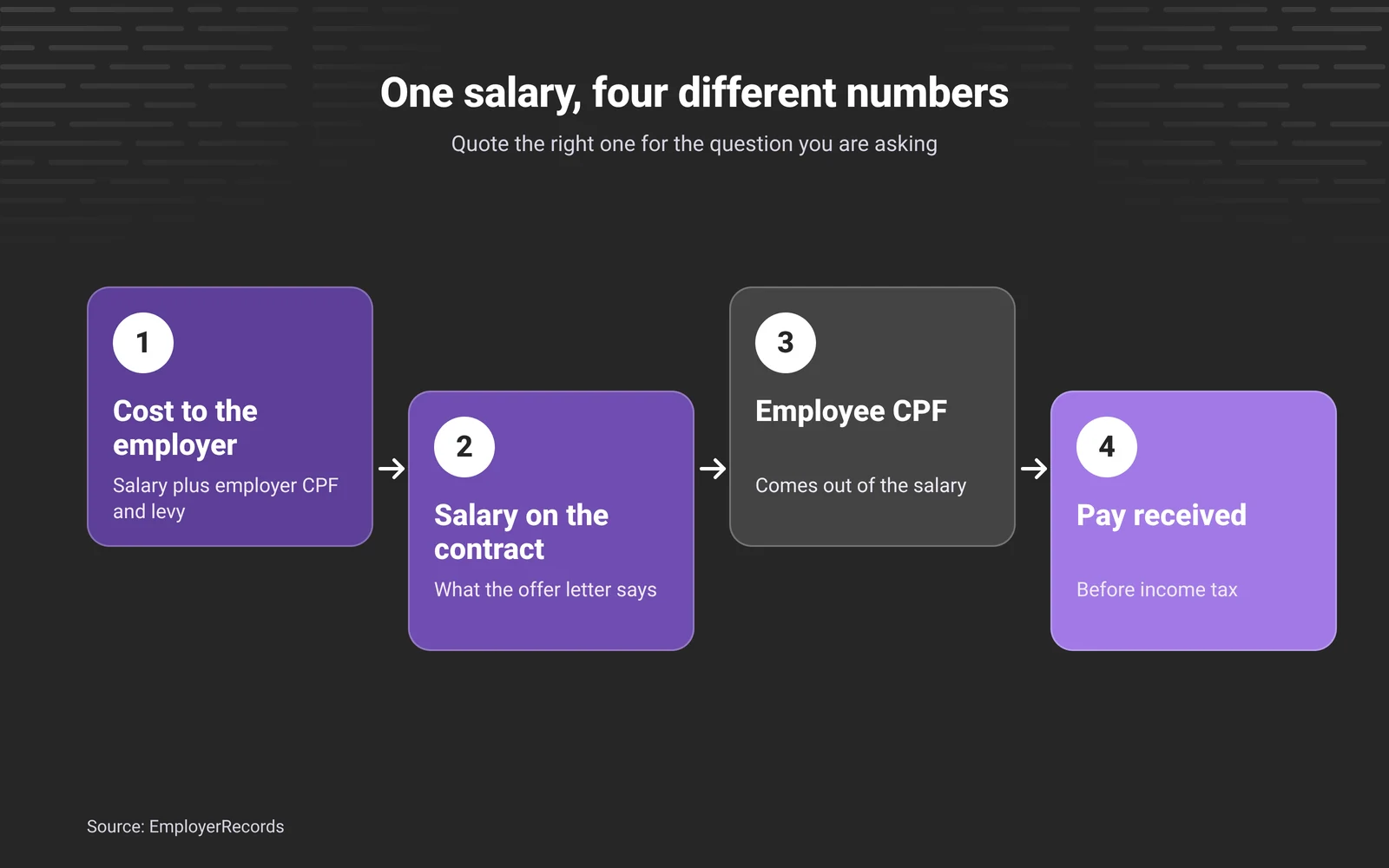
For a citizen or permanent resident aged 55 or younger, employee CPF takes 20% of wages up to the S$8,000 monthly ceiling, and the employer adds 17%.[11][12] Take-home before tax is salary minus that 20%. Tax comes after.
Work pass holders pay no CPF, so their salary is also their pre-tax pay.[12] That’s why a pass holder and a citizen on the same salary compare differently.
How is salary taxed?
Residents pay progressive rates, from 0% on the first S$20,000 to 24% above S$1 million.[13] The base is chargeable income, meaning income after allowable expenses, donations and reliefs.[14] Someone who stays or works 183 days or more in a calendar year is a resident for tax.[15]
Non-residents pay 15% flat or the resident rates on employment income, whichever gives more tax.[16]
Before reliefs, the median resident salary in our worked example is S$59,232 a year, which falls in the 7% band. Reliefs pull chargeable income down, so the tax is lower than the band suggests.
Resident income tax rates, year of assessment 2026 onward
| Chargeable income | Rate | Tax on the band |
|---|---|---|
| First S$20,000 | 0% | S$0 |
| Next S$10,000 | 2% | S$200 |
| Next S$10,000 | 3.5% | S$350 |
| Next S$40,000 | 7% | S$2,800 |
| Next S$40,000 | 11.5% | S$4,600 |
| Next S$40,000 | 15% | S$6,000 |
| Next S$40,000 | 18% | S$7,200 |
| Next S$40,000 | 19% | S$7,600 |
| Next S$40,000 | 19.5% | S$7,800 |
| Next S$40,000 | 20% | S$8,000 |
| Next S$180,000 | 22% | S$39,600 |
| Next S$500,000 | 23% | S$115,000 |
| Above S$1,000,000 | 24% | Not applicable |
How do pass salary floors compare?
On a like-for-like basis, the Employment Pass floor sits above what the median resident earns. Strip employer CPF out of the S$5,775 median and you get about S$4,936 a month, our calculation, against a floor of S$5,600.[17]
S Pass applicants need S$3,300, which is above the 20th percentile figure of S$3,164, and that figure still includes employer CPF.[17][1] Both floors rise on 1 January 2027 for new applications, to S$6,000 and S$3,600.[17]
Rules, points test and fees are in the work passes guide.
What does a typical hire cost you?
About S$5,786 a month at the median, on our calculation. Median income already includes employer CPF, so the salary actually paid is lower and the levy is the only extra.[18]
Our workings assume a citizen aged 55 or younger and that all income is ordinary wages. A different age band or a bonus changes the CPF line. Treat the result as an estimate. The employer costs and CPF page covers those cases.
If you hire a Singapore resident through an EOR, the provider’s fee goes on top. See EOR providers in Singapore for options, or read whether an EOR can sponsor a work visa for foreign hires.
Our estimate: cost and take-home at the 2025 median
| Line | Per month |
|---|---|
| Median income including employer CPF | S$5,775 |
| Salary paid to the employee | S$4,936 |
| Employer CPF at 17% | S$839 |
| Skills Development Levy | S$11.25 |
| Total employer cost | S$5,786 |
| Employee CPF at 20% | S$987 |
| Take-home before tax | S$3,949 |
How should you benchmark an offer?
Start with the occupation, not the national average. Pull the median and the 25th to 75th percentile range for the role and industry from MOM’s tables, then check the establishment size cut.[9]
Then fix the basis. MOM’s tables show basic and gross wages without bonus, while national medians include employer CPF.[9][1] Put both on the same footing before you compare a candidate’s ask. Bonus is separate.
We’d set the offer at the median for a hire you can train and at the 75th percentile for one you can’t afford to lose. Both are judgement calls, and MOM’s data doesn’t make either for you.
Singapore take-home and employer cost calculator
Enter the salary you pay and the type of employee. The default is the median example above and returns the same take-home and the same employer cost.
Singapore take-home and employer cost
Estimate only. It uses 17% employer CPF, 20% employee CPF, the S$8,000 monthly ceiling and the Skills Development Levy at 0.25% with a S$2 floor and S$11.25 cap. It leaves out bonuses, income tax, the S Pass levy, insurance and EOR fees.
Where do salary benchmarks go wrong?
Most bad offers trace back to one of four mismatches between the number and the job.
First check. Before you sign off a benchmark, ask what the number includes. If nobody on the team can say whether employer CPF, bonus and the self-employed are in it, it isn’t ready for a budget. The minimum wage and wage floors guide marks the bottom of the range, and notice and termination covers what an exit costs once a salary is agreed. Everything else on hiring in Singapore sits in the Singapore hiring guide.
Questions about salaries in Singapore
Short answers to what employers ask most before pricing a Singapore hire, checked against the MOM and IRAS pages cited below on 24 November 2026.
What is the average salary in Singapore?
The median full-time resident earned S$5,775 a month in mid-2025, including employer CPF. Mean income for the fourth quarter of 2025 was S$6,442.
Should I use the median or the mean?
Use the median to price a role. A few very high salaries lift the mean above what a typical person earns.
Does the median include employer CPF?
Yes. MOM’s headline median counts employer CPF contributions, so the pay a worker receives before their own CPF is lower, about S$4,936 on our calculation.
How much does a median earner take home?
About S$3,949 a month before tax, on our calculation for a citizen aged 55 or younger. That’s the S$4,936 salary less 20% employee CPF.
What is the highest paying job in Singapore?
Diagnostic radiologists, financial derivatives dealers and flying instructors share the top median in the private sector, at S$20,000 a month in MOM’s latest occupational wage survey.
Are foreign workers included in the average?
No. MOM’s income series cover residents, meaning citizens and permanent residents. Work pass holders are not counted.
How much will salaries rise in 2026?
MOM expects wage growth to stay positive but moderate, and it hasn’t published a figure. Total wages rose 4.9% in 2025.
References and sources
Every figure on this page comes from the sources below. Numbers in square brackets in the text link to the matching entry. Our own calculations are labelled. Where a MOM page would not open in full, we used a practitioner summary and say so. All sources were checked on 24 November 2026.
- ↑Labour Force in Singapore Advance Release 2025. Ministry of Manpower, 28 November 2025. mom.gov.sg. Retrieved 24 November 2026. Primary
- ↑Income summary table. Ministry of Manpower, Statistics. stats.mom.gov.sg. Retrieved 24 November 2026. Primary
- ↑Gross monthly income from employment 2025. Ministry of Manpower, Statistics. stats.mom.gov.sg. Retrieved 24 November 2026. Primary
- ↑Median gross monthly income from employment of full-time employed residents by age and sex. data.gov.sg, Ministry of Manpower, 27 March 2026. data.gov.sg. Retrieved 24 November 2026. Primary
- ↑Labour Force in Singapore 2025: survey highlights. Ministry of Manpower, 2026. stats.mom.gov.sg. Retrieved 24 November 2026. Primary
- ↑Real wages continued to grow in 2025. Ministry of Manpower, 28 May 2026. mom.gov.sg. Retrieved 24 November 2026. Primary
- ↑Report on Wage Practices 2025. Ministry of Manpower, May 2026. stats.mom.gov.sg. Retrieved 24 November 2026. Primary
- ↑Derivative dealers among best paid in city-state. The Star, 29 July 2026. thestar.com.my. Retrieved 24 November 2026. News
- ↑Occupational wages 2025. Ministry of Manpower, Statistics, 30 June 2026. stats.mom.gov.sg. Retrieved 24 November 2026. Primary
- ↑Occupational wages 2024. Ministry of Manpower, Statistics, 7 August 2025. stats.mom.gov.sg. Retrieved 24 November 2026. Primary
- ↑CPF contribution rates (2026): what employees and employers pay. Endowus. endowus.com. Retrieved 24 November 2026. Guide
- ↑How much CPF contributions to pay. CPF Board. cpf.gov.sg. Retrieved 24 November 2026. Primary
- ↑Individual income tax rates. Inland Revenue Authority of Singapore. iras.gov.sg. Retrieved 24 November 2026. Primary
- ↑Working out your tax residency. Inland Revenue Authority of Singapore. iras.gov.sg. Retrieved 24 November 2026. Primary
- ↑Singapore expat income tax guide. Hawksford. hawksford.com. Retrieved 24 November 2026. Guide
- ↑Singapore: taxes on personal income. PwC Tax Summaries. taxsummaries.pwc.com. Retrieved 24 November 2026. Guide
- ↑Partnering businesses and workers to thrive in a changed world. Ministry of Manpower, 3 March 2026. mom.gov.sg. Retrieved 24 November 2026. Primary
- ↑How do I calculate and pay the Skills Development Levy (SDL)?. CPF Board. cpf.gov.sg. Retrieved 24 November 2026. Primary
About the author

Emma Whitmore is an EOR and Global Employment Content Writer at EmployerRecords, where she researches and writes practical resources on Employer of Record (EOR) services, international hiring, global payroll, employment compliance, and workforce expansion across international markets. With more than 15 years of experience in B2B content and editorial research, Emma specializes in turning complex employment regulations into clear, actionable guidance for HR leaders, founders, and globally distributed teams. Her work focuses on helping businesses understand country-specific hiring requirements, compare global employment providers, and navigate compliance with confidence.
View all articles by EmmaSalary and pay guides for other countries
See how other markets set pay floors and salary levels.
 SingaporeEmployer costsEmployer Costs and CPF in Singapore (2026): What You Pay on Top of SalaryEmployer CPF by age, the Skills Development Levy, foreign worker levies and pass salary floors, priced for five real salaries.Read the guideSingaporeMinimum wageMinimum Wage in Singapore (2026): PWM, LQS and Employer CostSingapore has no universal minimum wage: what employers must pay under PWM, the S$1,800 LQS and work pass floors, plus...Read the guideSingaporeNotice and TerminationNotice Period and Termination in Singapore 2026Notice lengths, dismissal and retrenchment steps, final pay, pass cancellation and the cost of ending a hire in Singapore, with...Read the guideSingaporeWork PassesWork Passes in Singapore 2026Which Singapore work pass a foreign hire needs: Employment Pass, S Pass, Work Permit and ONE Pass, with COMPASS points,...Read the guide
 Czech RepublicAverage salaryAverage Salary in the Czech Republic (2026): CZK 50,650 a MonthAverage and median pay, regional gaps, gross to net and what employers add on top, from the Czech Statistical Office.Read the guide
 VietnamAverage salaryAverage Salary in Vietnam (2026): ₫9.0 Million a Month, by Sector and TaxWhat Vietnamese workers earn on average, how pay differs by sector and city, how gross becomes net, and what an...Read the guide
Hiring in Singapore?
The hiring guide covers pay, employer costs and your EOR options in one place.