
Notice Period and Termination in Singapore (2026): Rules, Pay and Costs
Notice lengths, dismissal and retrenchment steps, final pay and the cost of ending a hire, with the source for each rule.
How much notice must an employer give in Singapore?
It depends on the contract first. If the contract names a notice period, that period applies to both sides. If it is silent, the Employment Act sets 1 day, 1 week, 2 weeks or 4 weeks by length of service. The Act sets no severance formula, though retrenchment norms apply.
- Contract silent: 1 day, 1 week, 2 weeks or 4 weeks by service
- Form: Written notice from either side, reason not required
- Claims: Wrongful dismissal claim within 1 month of the last day
Singapore leaves most of the notice question to the contract. The Employment Act steps in only when the contract says nothing, and it then applies a four-step ladder tied to how long the person has worked for you.[1]
Notice is the easy part. A dismissal can still be challenged as wrongful, a misconduct dismissal needs a proper inquiry first, and a redundancy triggers a filing with MOM once you employ ten people or more.[2][3][4]
This page covers all three, plus what an exit costs. For the cost of employing someone in the first place, see the employer costs and CPF page. Pass rules sit in the work passes guide.
We checked every rule against MOM, TADM and IRAS pages on 24 November 2026. Where a point rests on a law firm summary and not on an official page, the reference says so.
The default notice ladder when the contract is silent
If the contract has no notice clause, length of service decides how much notice either side owes.[1]
Statutory notice when the contract is silent
| Length of service | Notice period |
|---|---|
| Less than 26 weeks | 1 day |
| 26 weeks to less than 2 years | 1 week |
| 2 years to less than 5 years | 2 weeks |
| 5 years or more | 4 weeks |
The ladder is the same for employer and employee. A worker who resigns after three years owes you two weeks, and you owe them the same.[1] It also applies during probation.[5]
Four weeks is the ceiling of the ladder. A manager with ten years’ service gets no more than that if nobody wrote a longer clause.
Our view. We’d treat the ladder as a fallback and never as a plan. Four weeks is thin cover for a handover, so fix the period in the contract. Write it in days, weeks or months, whichever you mean.
Written notice, reasons and what the contract controls
Notice has to be in writing, whoever gives it. A termination letter or an email counts.[1] The letter should state the date of termination, the last day of employment and the length of notice.[6]
You don’t have to give a reason when you give proper notice. Neither does the employee.[1] Either side can waive notice by mutual consent, and MOM says to put the waiver in writing.[1]
Counting the notice period and finding the last day
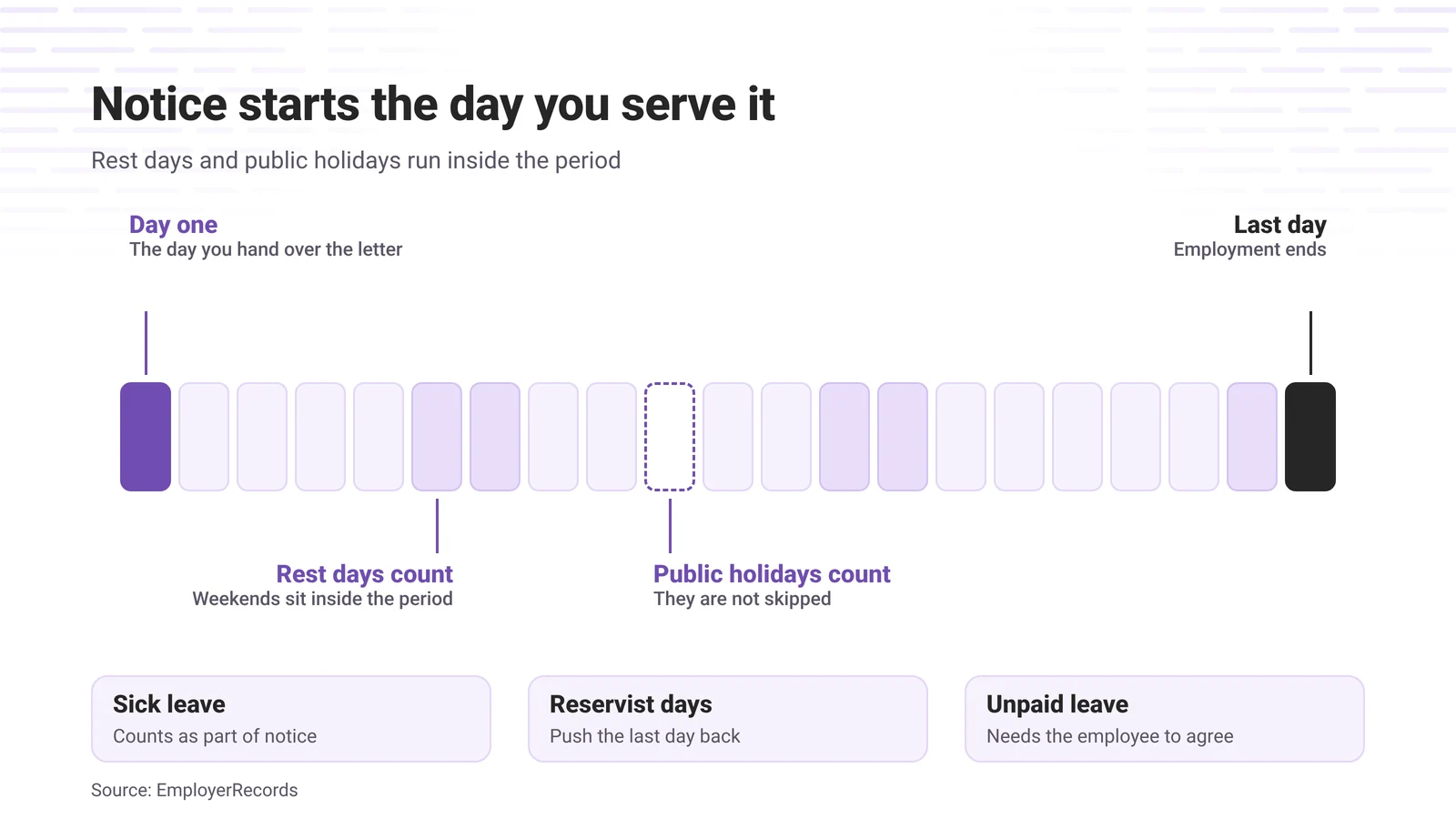
Day one is the day notice is given. Public holidays, rest days and non-working days all count inside the period.[1]
Months are where HR teams slip. One month from 15 July ends on 14 August, not 15 August. A notice given on 29, 30 or 31 January ends on the last day of February.[1]
MOM’s counting examples for one month’s notice
| Notice given | Notice length | Last day of employment |
|---|---|---|
| 15 July 2025 | 1 month | 14 August 2025 |
| 29, 30 or 31 January 2025, or 1 February 2025 | 1 month | 28 February 2025 |
Weeks and days follow the same rule. Two weeks’ notice handed over on Monday 1 June 2026 ends on Sunday 14 June 2026, on our calculation of MOM’s counting method.
The calculator below does the date arithmetic for any notice length.
Notice date and exit pay calculator
Enter the date notice is served, the notice in the contract and the pay details. The defaults match the worked example in the cost section, so the first result is the same as the table there.
Notice date and exit pay
Estimate only. It follows MOM’s counting rule and gross-rate-of-pay formula. A notice period written in the contract overrides the ladder. Overtime, bonuses and annual wage supplements are outside the gross rate, so leave them out of the salary you enter. The retrenchment figure is the advisory norm of 2 weeks to 1 month of salary per year of service for people with at least 2 years of service, and it is not a legal entitlement. The tool does not test whether a dismissal is wrongful.
Salary in lieu of notice and the final payslip
Either side can skip the notice period by paying for it.[7] The payment is the money the person would have earned during the notice period.[1] No CPF is due on it. Salary earned while a notice period is worked does carry CPF.[1]
For a monthly-rated employee, MOM puts the gross rate of pay for one day at 12 times the monthly gross rate, divided by 52 times the days the person works in an average week.[8] Contractual allowances count. Overtime, bonuses, annual wage supplements, productivity incentives and travel, food or housing allowances don’t.[8]
On our calculation, a S$6,000 salary on a five-day week gives a daily rate of S$276.92. Four weeks is 20 working days, so salary in lieu comes to S$5,538.
When the final salary falls due
| Situation | Final salary due |
|---|---|
| Employee resigns and serves the notice | On the last day of employment |
| Employee resigns without serving notice | Within 7 days of the last day of employment |
| Employer terminates the contract | On the last day of employment, or within 3 working days of termination if that is not possible |
Unused annual leave is paid at the gross rate of pay when employment ends, unless the person is dismissed for misconduct, in which case it is forfeited.[1] Foreign hires add one step: the employer withholds money due to them while tax clearance runs, covered under work passes below.
Payroll check. Run the leave balance before you cut the final payslip, and put the last day in a written letter. MOM’s claims data generally ties notice-pay disputes to terminations done verbally, with no letter naming the last day.[9]
Probation doesn’t shorten notice by itself
A new hire isn’t working out in month two. The offer letter mentions a six-month probation, so you assume you can end it that day. Usually you can’t.
The Employment Act has no probation rules. Where the contract has no specific notice terms, the section 10 minimums apply during probation just as they do afterwards.[5]
In September 2026 MOM told Parliament that a probation clause doesn’t automatically make a contract fixed-term, and that it had no amendment planned.[5] The High Court took the same line in [2026] SGHC 171, which asked whether a probation clause turns a contract into a fixed-term one.[10]
How we draft it. A probation clause needs two parts: the notice during probation, and what happens at the end (confirm, extend or end by notice). Leave out the second part and you invite the argument that was in front of the High Court. Spell it out and the question doesn’t arise.
Ending a fixed-term contract early
A fixed-term contract still needs notice if either side wants out before the end date, and the notice has to be in writing.[11] Employees on fixed terms can resign at any time by serving the contractual notice or paying salary in lieu.[1]
Some contracts also require a payment for ending early, over and above notice pay. The Employment Act doesn’t cover those terms. MOM points employers to legal advice and, if needed, civil court proceedings.[7]
If you’re drafting a fixed-term offer, price any early-exit payment into the budget when you set it. It’s a debt the day you sign.
Dismissing without notice for misconduct
Misconduct is the only reason that allows dismissal without notice, and only after a due inquiry.[12] MOM expects a formal inquiry before any disciplinary action.[3] If the inquiry finds no misconduct, the employer must restore any salary withheld during a suspension in full.[3]
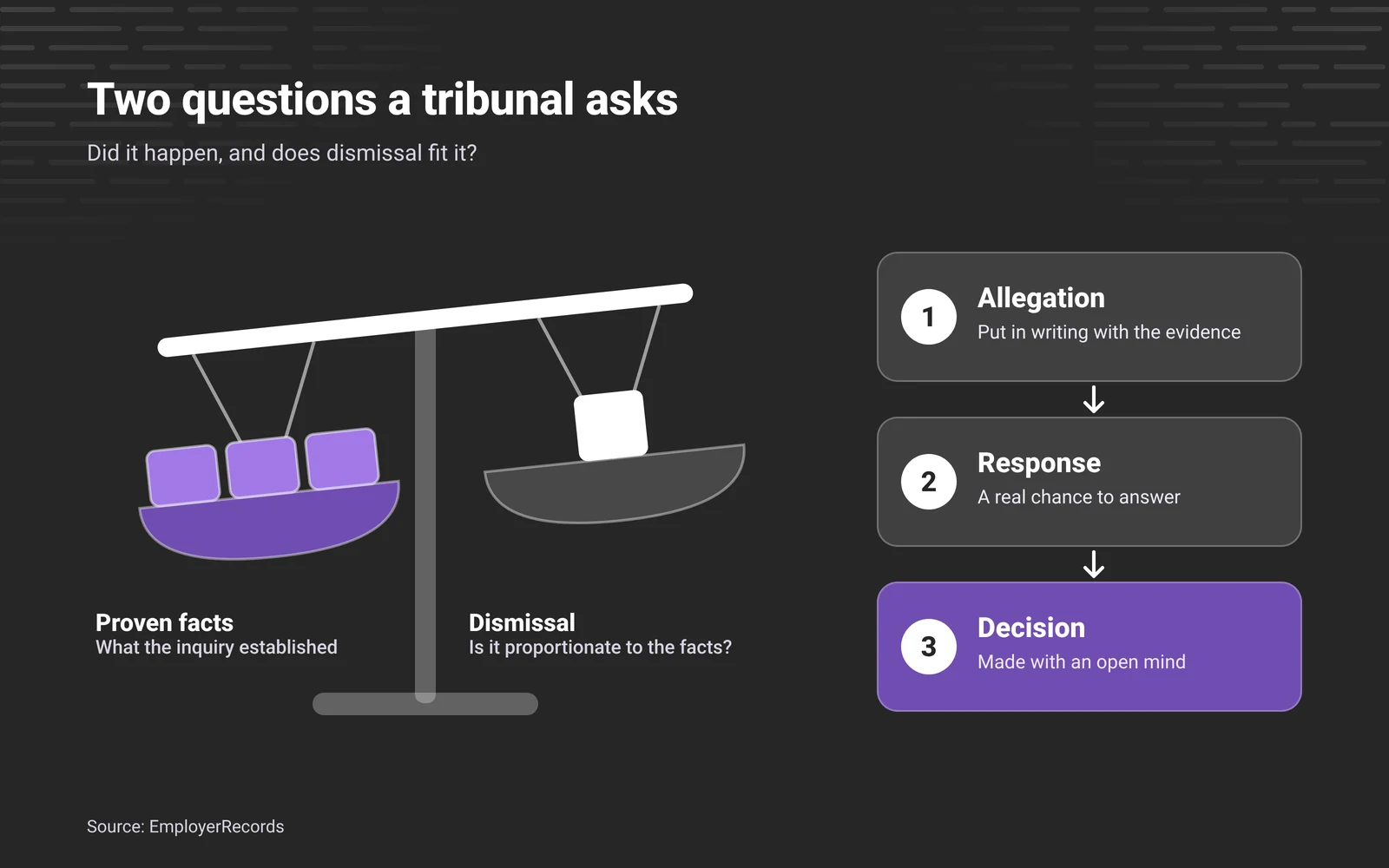
What does a due inquiry need? Tell the employee the allegations and the evidence, give a real chance to respond, and weigh the response with an open mind. It isn’t a courtroom trial, and there is no legal right to an internal appeal.[13]
In JGP v JGQ [2026] SGECT 1, the first published decision of the Employment Claims Tribunals, the tribunal added a second test: even when the facts are proven, is dismissal proportionate to them? All six claims heard in that group went against the employer, and the representative claim ended with an order to pay S$18,402 in total.[13] That figure comes from a law firm summary, not from the judgment.
Paying notice doesn’t replace the inquiry. If you allege misconduct, you still have to prove it.[13]
Two other grounds let an employer end the contract without notice. An employee absent for more than two consecutive working days without approval and a good excuse, or without telling you why, is in breach. Public holidays don’t count as working days in MOM’s examples.[7] The reverse also holds: an employee may leave without notice if salary stays unpaid seven days after it was due.[7]
How we would run it. Run the inquiry even when the case looks obvious, and write the termination letter to state only what the inquiry proved. A letter that alleges dishonesty needs proof of dishonest intent, and a summary that overstates the file is the first thing a tribunal will test.[13]
Terminating without giving a reason
On MOM’s guidance, neither side has to give a reason when proper notice is served.[1] That’s the contractual route, and it holds until someone challenges it.
A wrongful dismissal claim asks whether the dismissal was without just cause or excuse. TAFEP’s examples include dismissal soon after an employee disclosed a pregnancy without paying maternity benefits, and dismissal after the employee filed a mediation request over unpaid salary.[14]
Where an employer cites misconduct or poor performance, it carries the burden of proving that ground.[12] Where it dismisses without notice, it must show the dismissal wasn’t wrongful.[2] Commentators say it isn’t settled how far silence protects an employer once a termination is challenged.[13]
Plain advice. Give a short, accurate reason in writing even where the law doesn’t ask for one. A one-line reason you can prove costs less than a tribunal asking you for one.
Wrongful dismissal claims: deadlines, caps and outcomes
An employee who believes a dismissal was wrongful files at TADM within one month of the last day of employment.[2] If TADM can’t resolve it, the claim moves to the Employment Claims Tribunals.[2]
Managers and executives dismissed with notice or salary in lieu can file only after six months’ service.[2] If the tribunal finds the dismissal wrongful, it can order reinstatement with pay for the income lost, or a sum as compensation.[2]
The money is capped. A claim at the tribunal can’t exceed S$20,000, or S$30,000 where a union assists the employee. Lost income is capped at three months’ salary, and a separate harm award typically starts at two months’.[13]
Mediation does most of the work. In 2024, more than 80% of employment claims were resolved through TADM mediation, and 86% of wrongful dismissal claims were concluded there within two months.[15]
Read the cap carefully. The cap looks low next to a senior salary, and that can mislead. The cost sits in the process: management time, a file to defend, and tribunal decisions that are now being published.[13]
Retrenchment: notifying MOM and the benefit norm
If you employ ten people or more and retrench any one of them, you must notify MOM within five working days of telling that person.[4]
The Employment Act sets no severance formula. The tripartite advisory points first to the collective agreement or the contract, and tells the parties to negotiate where neither covers it.[16] It then gives a norm.
Retrenchment benefit norm in the Tripartite Advisory
| Situation | Norm |
|---|---|
| Two or more years of service | 2 weeks to 1 month of salary per year of service, depending on the company’s finances and industry norms |
| Under two years of service | No norm. The employer could grant an ex gratia payment |
| A collective agreement sets the amount | Follow it. In that case the norm is 1 month of salary per year of service |
| Retrenchment soon after a salary cut | Work out the benefit on the salary before the cut |
Tell the union early, before affected employees hear. Where a collective agreement provides for it, the norm is one month before telling employees.[16] Employees still get contractual or statutory notice, and the advisory encourages longer notice where the company can manage it.[16]
On the norm. An advisory isn’t a statute, but it’s the yardstick unions, TAFEP and MOM will hold you to. Budget at the low end of the range only if you can show the company’s finances support it.
Alternatives to retrenchment, and how to choose who goes
The advisory lists options to try before cutting jobs. Some involve no pay cut, such as redeploying people within the company or to other companies. Others do.[16]
If jobs do go, selection criteria must be objective: ability, experience and skills. Apply them consistently. Don’t select on age, race, gender, religion, marital status and family responsibility, or disability, and don’t pick older, re-employed or pregnant employees unfairly.[16]
The advisory also says retrenchment shouldn’t generally reduce the proportion of local employees.[16]
Local headcount. That last point matters to foreign employers. If your Singapore team is mostly local and you cut local roles while keeping pass holders, expect questions, so document why each role was chosen.
Age, pregnancy and discrimination limits
Employers can’t dismiss an employee because of age.[17] The minimum retirement age rose to 64 on 1 July 2026 for people born on or after 1 July 1963, and the re-employment age rose to 69.[17] Employers must offer re-employment to eligible employees up to that age.[17]
Pregnancy is a common trap. TAFEP’s published examples include a dismissal soon after an employee disclosed a pregnancy, without maternity benefits being paid, treated as wrongful.[14]
The Workplace Fairness Act will add a statutory route. MOM aims for it to take effect at the end of 2027.[18] It will bar employers from making adverse employment decisions based on a set of protected characteristics.[18] Until it is in force, the tripartite fair employment guidelines and the wrongful dismissal framework carry the weight.
Ending employment for a work pass holder
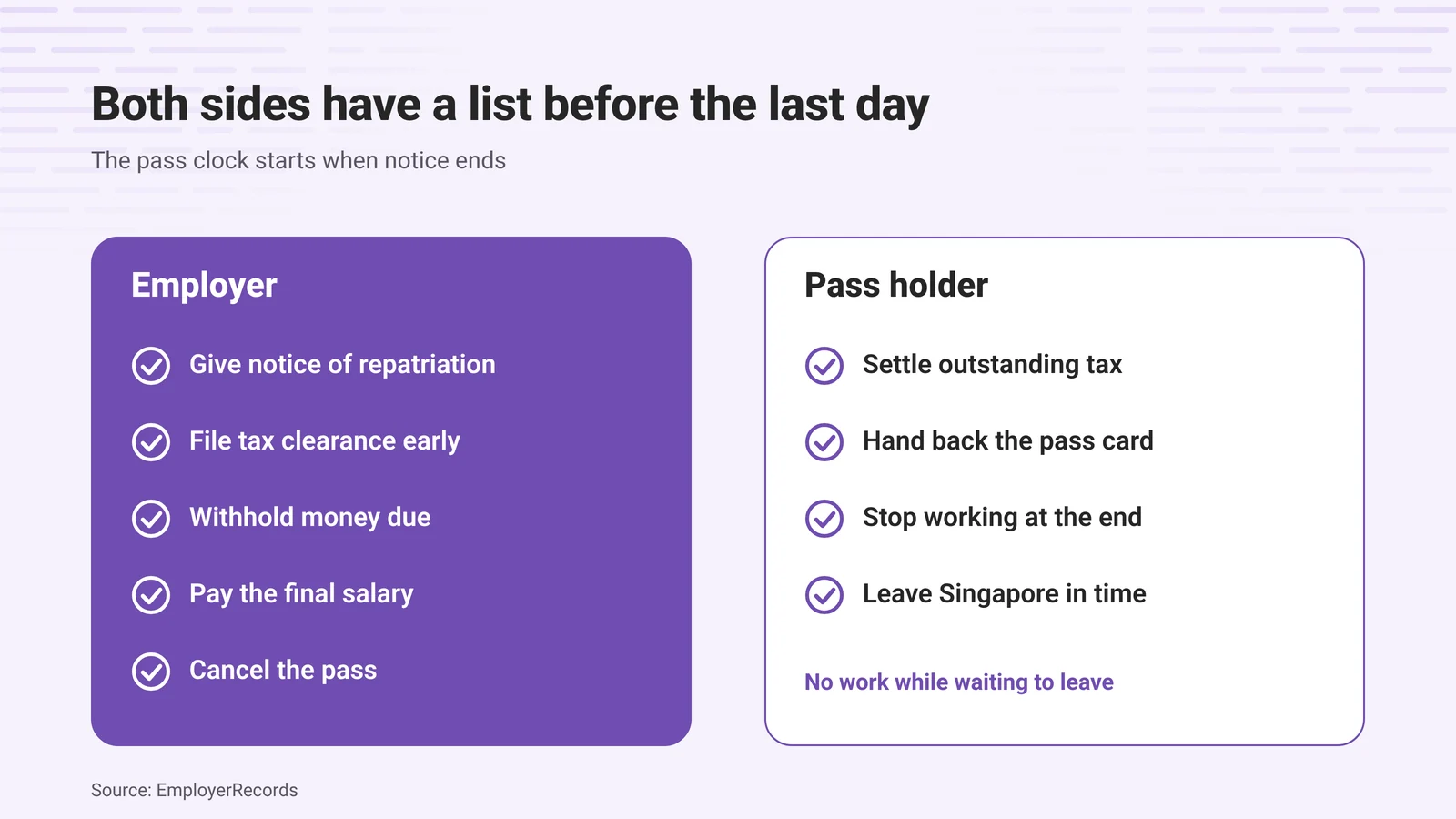
You have one week. A work pass has to be cancelled within a week of employment ending, and the holder can’t work while waiting to leave.[19][20]
Pass cancellation at a glance
| Pass | When to cancel | Also |
|---|---|---|
| Employment Pass | Within 1 week after the last day of notice, or within 1 week of departure if the holder left for good.[20] | Family passes are cancelled with it and can’t be reinstated.[20] |
| S Pass | Within 1 week after employment ends. Cancellation is immediate unless you file an advance request.[19][21] | Levy stops the day before cancellation. A Short-Term Visit Pass can cover up to 30 days of stay.[21] |
| Work Permit | Within 1 week after employment ends, or within 1 week of the worker’s departure.[22] | Departure must fall within 2 weeks of cancellation, and levy runs until the day before cancellation.[22] |
Before cancelling, give the holder reasonable notice of repatriation, seek IRAS tax clearance and settle everything outstanding, including salary.[20] A refusal to cancel can’t be used as a threat in an employment dispute.[19]
Tax clearance is its own clock. File Form IR21 at least one month before the last day, with a 10-day grace period, and withhold all money due to the employee from the day either side gives notice. Check first whether clearance is needed at all, using IRAS’s calculator.[23]
Short notice, long clock. A one-week notice for an Employment Pass holder collides with the one-month IRAS window. File the form the day notice is served and state the reason. If you can’t withhold all the money, say so on the form, because otherwise you may be liable for the tax owed.[23] For who sponsors the pass in an EOR set-up, read whether an EOR can sponsor a work visa.
What it costs to end a Singapore hire
About S$7,754 for a plain exit, and S$24,369 to S$43,754 when the role is made redundant. That’s our calculation for a S$6,000 job with six years’ service, a contract silent on notice, a five-day week and eight unused leave days.
Working the notice costs more than paying it out. A worked notice carries employer CPF on the salary paid, at 17% up to the S$8,000 monthly ceiling for citizens and permanent residents, and salary in lieu doesn’t.[24][1] Pass holders carry no CPF either way.
A wrongful dismissal award would sit on top: up to three months of lost income plus a separate harm award, inside the S$20,000 cap per claim.[13] Our cost estimate leaves it out, because it only arises if the dismissal goes wrong.
Our estimate: cost of ending a S$6,000 hire with six years’ service
| Line | Amount |
|---|---|
| Salary in lieu of 4 weeks (20 days at S$276.92) | S$5,538 |
| Unused annual leave, 8 days at S$276.92 | S$2,215 |
| Exit without redundancy | S$7,754 |
| Retrenchment benefit at 2 weeks per year, 6 years | S$16,615 |
| Retrenchment benefit at 1 month per year, 6 years | S$36,000 |
| Exit with redundancy, low to high | S$24,369 to S$43,754 |
For the cost of keeping a hire on payroll, see the employer costs and CPF page. To price a Singapore hire through an EOR, use the EOR cost calculator.
Who does what when an EOR is the employer
Under an employer of record arrangement the provider is the legal employer. In our reading of how these agreements work, that means it issues the written notice, runs the due inquiry, files any retrenchment notification and cancels the pass. You make the business decision and supply the facts.
Two points deserve a close read before you sign. The first is the exit clause: how much notice the EOR needs from you, and what it charges to run a termination. We haven’t priced exit fees across Singapore providers for this page, so ask each one for its terms in writing.
The second is evidence. An inquiry or a performance dismissal runs on your records, and the EOR can only act on what you hand over. Weak records mean a weak file at the tribunal.
For background, see what an employer of record is. Compare providers under EOR providers in Singapore, and check pass sponsorship in whether an EOR can sponsor a work visa.
A termination in sequence
Each step below has a deadline or a document behind it.
Read the contract
Find the notice clause, the probation terms and any early-exit payment, because those override everything else. Silent contract? Use the ladder.
Pick the route and record the reason
Notice, salary in lieu, misconduct or redundancy. Each has a different file behind it, and the reason goes in writing.
Run the inquiry or the selection
Misconduct needs a due inquiry before any penalty.[3] A redundancy needs objective selection criteria and, at ten employees or more, an MOM filing.[16][4]
Serve written notice
State the date of termination, the last day and the notice length.[6] Start counting from the day you serve it.[1]
Start tax clearance for foreign hires
IRAS wants Form IR21 one month before the last day.[23]
Pay on time
Final salary is due on the last day, or within three working days where that isn’t possible, with unused leave unless the exit is for misconduct.[25][1]
Cancel the pass and notify MOM
Where do Singapore exits go wrong?
Most disputes trace back to four avoidable slips.
First check. Before you serve anything, ask who will read the file in a year: the person, a union officer or a tribunal. If the file wouldn’t convince them, it isn’t ready.
Rule changes to watch
The Workplace Fairness Act is the big one, with MOM aiming for the end of 2027.[18]
On probation, MOM announced no change to the notice rules after the 2026 High Court decision and said it would keep reviewing employment rules with its tripartite partners.[5]
Pass salary floors rise from 1 January 2027, so a replacement hire can cost more than the person you let go. The work passes guide has the figures. Notice pay and salary in lieu depend on pay level, so benchmark against the Singapore average salary and check the wage floors for lower-paid roles. The rest of the Singapore rules are collected in the Singapore hiring guide.
Questions about ending a job in Singapore
Short answers to what employers ask most before they end a hire in Singapore, checked against the MOM, TADM and IRAS pages cited below on 24 November 2026.
What is the notice period in Singapore?
Whatever the contract says, and the same for both sides. If the contract is silent, the Employment Act sets 1 day under 26 weeks of service, 1 week up to 2 years, 2 weeks up to 5 years and 4 weeks beyond that.
Does Singapore have statutory severance pay?
No. The Employment Act sets no severance formula. For a redundancy, MOM’s advisory gives a norm of 2 weeks to 1 month of salary per year of service for people with at least 2 years’ service, and the contract or collective agreement comes first.
Can I dismiss someone on probation without notice?
Not unless they have committed misconduct that justifies dismissal without notice after a due inquiry. The Act has no probation rules, so the contract’s notice terms apply, or the ladder where the contract is silent.
Do I have to give a reason when I dismiss someone?
Not when you give proper notice or pay salary in lieu. Misconduct is different, because you must hold an inquiry first. A reason you can prove is safer if the dismissal is challenged later.
How long does an employee have to bring a wrongful dismissal claim?
One month from the last day of employment, at TADM. A manager or executive dismissed with notice needs at least six months’ service to file.
When do I tell MOM about a retrenchment?
Within five working days of telling the employee, if you employ at least ten people. Employers with fewer than ten people aren’t required to.
How soon must I cancel a work pass after someone leaves?
Within one week after employment ends. Tax clearance for a foreign hire has to start at least one month before the last day.
Is unused annual leave paid out when someone leaves?
Yes, at the gross rate of pay, unless the person is dismissed for misconduct, in which case it is forfeited.
References and sources
Every figure on this page comes from the sources below. Numbers in square brackets in the text link to the matching entry. Our own calculations are labelled. Where a point rests on a law firm or news summary, the tag beside the reference says so. All sources were checked on 24 November 2026.
- ↑Termination with notice. Ministry of Manpower. mom.gov.sg. Retrieved 24 November 2026. Primary
- ↑File a wrongful dismissal claim. Ministry of Manpower. mom.gov.sg. Retrieved 24 November 2026. Primary
- ↑Termination due to employee misconduct. Ministry of Manpower. mom.gov.sg. Retrieved 24 November 2026. Primary
- ↑Mandatory retrenchment notifications. Ministry of Manpower. mom.gov.sg. Retrieved 24 November 2026. Primary
- ↑Written answer to PQ on termination during probation period. Ministry of Manpower, 9 September 2026. mom.gov.sg. Retrieved 24 November 2026. Primary
- ↑Is a termination letter always required?. Ask Gov.sg, Ministry of Manpower. ask.gov.sg. Retrieved 24 November 2026. Primary
- ↑Termination without notice. Ministry of Manpower. mom.gov.sg. Retrieved 24 November 2026. Primary
- ↑Monthly and daily salary. Ministry of Manpower. mom.gov.sg. Retrieved 24 November 2026. Primary
- ↑Annex: Employment standards report. Ministry of Manpower, 19 November 2020. mom.gov.sg. Retrieved 24 November 2026. Primary
- ↑[2026] SGHC 171. eLitigation, Singapore Courts, 2026. elitigation.sg. Retrieved 24 November 2026. Primary
- ↑If I signed a fixed-term contract, is notice needed to terminate my employment before the contract expires?. Ask Gov.sg, Ministry of Manpower. ask.gov.sg. Retrieved 24 November 2026. Primary
- ↑Tripartite Guidelines on Wrongful Dismissal. Ministry of Manpower, NTUC, SNEF, 2019. mom.gov.sg. Retrieved 24 November 2026. Primary
- ↑Singapore: a new framework for misconduct dismissals. Baker McKenzie, July 2026. bakermckenzie.com. Retrieved 24 November 2026. Guide
- ↑Dismissals. Tripartite Alliance for Fair and Progressive Employment Practices. tal.sg. Retrieved 24 November 2026. Primary
- ↑Employment standards report 2024. Ministry of Manpower, 26 August 2025. mom.gov.sg. Retrieved 24 November 2026. Primary
- ↑Tripartite Advisory on Managing Excess Manpower and Responsible Retrenchment. Ministry of Manpower, NTUC, SNEF, 20 January 2023. mom.gov.sg. Retrieved 24 November 2026. Primary
- ↑Re-employment. Ministry of Manpower. mom.gov.sg. Retrieved 24 November 2026. Primary
- ↑Workplace Fairness (Dispute Resolution) Bill provides framework for resolving workplace discrimination disputes. Ministry of Manpower, 4 November 2025. mom.gov.sg. Retrieved 24 November 2026. Primary
- ↑Can an employer refuse to cancel an EP, S Pass or Work Permit?. Ministry of Manpower. mom.gov.sg. Retrieved 24 November 2026. Primary
- ↑Cancel an Employment Pass. Ministry of Manpower. mom.gov.sg. Retrieved 24 November 2026. Primary
- ↑Cancel an S Pass. Ministry of Manpower. mom.gov.sg. Retrieved 24 November 2026. Primary
- ↑Cancel a Work Permit. Ministry of Manpower. mom.gov.sg. Retrieved 24 November 2026. Primary
- ↑Getting tax clearance: a step-by-step guide. Inland Revenue Authority of Singapore. iras.gov.sg. Retrieved 24 November 2026. Primary
- ↑How much CPF contributions to pay. CPF Board. cpf.gov.sg. Retrieved 24 November 2026. Primary
- ↑Paying salary. Ministry of Manpower. mom.gov.sg. Retrieved 24 November 2026. Primary
About the author

Manjuri Dutta is Co-Founder and Content Editor at EmployerRecords.com, covering Employer of Record providers and global hiring platforms. She evaluates providers on entity ownership, statutory compliance, and real pricing rather than vendor claims, and built the verification process used across EmployerRecords' country guides, checking vendor claims against government registries and public filings.
View all articles by ManjuriNotice and termination guides for other countries
See how other markets set notice, severance and dismissal rules.
 SingaporeAverage salaryAverage Salary in Singapore 2026Median and mean income in Singapore, wage growth by industry, bonuses, take-home pay and the cost of a typical hire,...Read the guideSingaporeEmployer costsEmployer Costs and CPF in Singapore (2026): What You Pay on Top of SalaryEmployer CPF by age, the Skills Development Levy, foreign worker levies and pass salary floors, priced for five real salaries.Read the guideSingaporeMinimum wageMinimum Wage in Singapore (2026): PWM, LQS and Employer CostSingapore has no universal minimum wage: what employers must pay under PWM, the S$1,800 LQS and work pass floors, plus...Read the guideSingaporeWork PassesWork Passes in Singapore 2026Which Singapore work pass a foreign hire needs: Employment Pass, S Pass, Work Permit and ONE Pass, with COMPASS points,...Read the guide
 Czech RepublicAverage salaryAverage Salary in the Czech Republic (2026): CZK 50,650 a MonthAverage and median pay, regional gaps, gross to net and what employers add on top, from the Czech Statistical Office.Read the guideCzech RepublicMinimum wageMinimum Wage in the Czech Republic (2026): CZK 22,400 a MonthThe monthly and hourly minimum wage for 2026, the increase for 2027, overtime and what employers add on top.Read the guide
Hiring in Singapore?
The hiring guide covers pay, employer costs and your EOR options in one place.