
Work Passes in Singapore (2026): Who Needs Which Pass and What It Takes
Employment Pass, S Pass, Work Permit and ONE Pass compared, with the COMPASS points test, salary floors and the rules for hiring from abroad.
Which work pass does a foreign hire need in Singapore?
Foreign professionals need an Employment Pass: a fixed salary of at least S$5,600 a month and 40 COMPASS points, unless they earn S$22,500 or more. Mid-skilled staff need an S Pass from S$3,300, within a quota. Everyone else needs a Work Permit.
- Employment Pass: S$5,600 floor, 40 COMPASS points
- S Pass: S$3,300 floor, quota of 10% to 15%
- ONE Pass: S$30,000 fixed salary from one employer
Singapore decides the pass from the salary and the job, then checks the employer. Pick the wrong one and the application fails after weeks of waiting.
Two things catch foreign companies out. The salary floors rise on 1 January 2027 for new applications, and an EOR can’t sponsor a foreign worker’s pass for a company without a Singapore entity.[1][2] We cover both below, with the rest of the process in order.
For what a pass holder costs once hired, see the employer costs and CPF page.
How do the main Singapore passes compare?
Salary is the sorting hat. An Employment Pass starts at S$5,600 a month for most sectors, an S Pass at S$3,300, and the ONE Pass at S$30,000 a month from a single employer.[2][3][4]
The Employment Pass has no quota but needs 40 COMPASS points. S Pass employers face a quota and a levy, with no points test.[5][6] The Work Permit is a sector-by-sector pass for other workers, with its own quota and levy.[7]
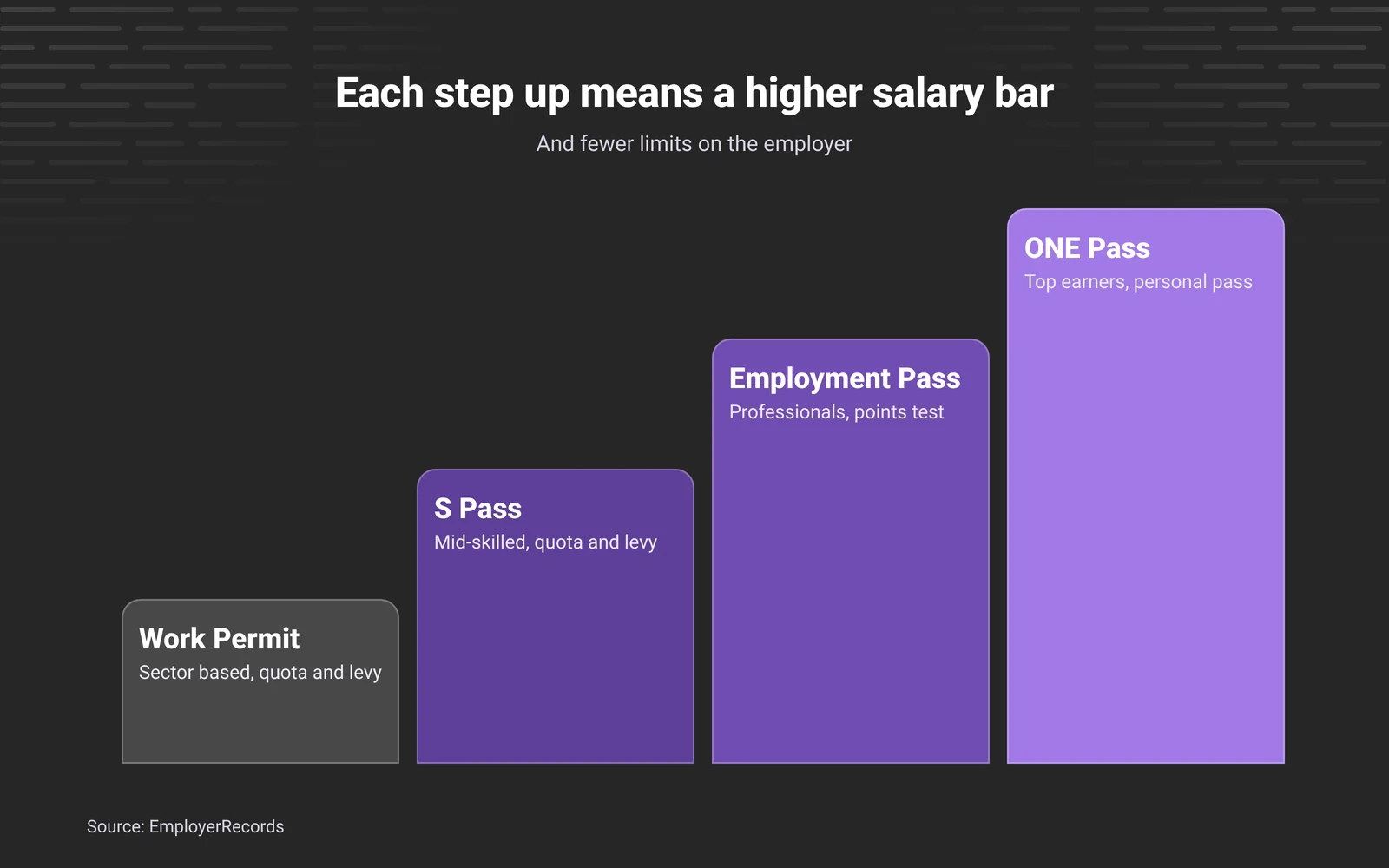
Which pass fits which hire, 2026
| Pass | Who it is for | Salary floor | Employer limits |
|---|---|---|---|
| Employment Pass | Professionals, managers and executives | S$5,600, S$6,200 in finance | COMPASS points, no quota |
| S Pass | Mid-skilled technicians | S$3,300, S$3,800 in finance | Quota and S$650 monthly levy |
| Work Permit | Sector-based skilled and basic-skilled workers | No salary floor | Quota and sector levy |
| ONE Pass | Top earners and outstanding achievers | S$30,000 from one employer | Personal pass, not tied to an employer |
What does an Employment Pass require?
A job offer, a fixed monthly salary above the qualifying floor, and 40 COMPASS points. The floor is S$5,600 for most sectors and S$6,200 in financial services until the end of 2026.[2][8]
It rises with age. By the mid-career bands the 2027 floor reaches up to S$11,500, and S$12,700 in financial services.[9]
A new pass lasts up to two years, and a renewal up to three.[10] The employer or an appointed agent applies, and the candidate doesn’t need to be in Singapore when you submit.[11]
How does COMPASS scoring work?
An application needs 40 points. Each of four criteria gives 0, 10 or 20, so a typical pass comes from a mix: strong salary and degree, plus a middling employer score.[5]
Salary earns 20 points at or above the 90th percentile for the sector and 10 from the 65th to below the 90th.[5] Qualifications give 20 for top-ranked institutions and 10 for other degree-equivalent ones.[5]
Diversity depends on your own team. A candidate whose nationality is under 5% of your PMETs earns 20, from 5% to under 25% earns 10, and 25% or more earns zero.[12] Local employment compares your local PMET share with sector peers: 20 at or above the 50th percentile, 10 from the 20th, otherwise zero.[5]
Firms with fewer than 25 PMETs get 10 points by default on both firm criteria.[5] Bonus points exist for shortage occupations and certain programmes, and we leave them out of the examples.
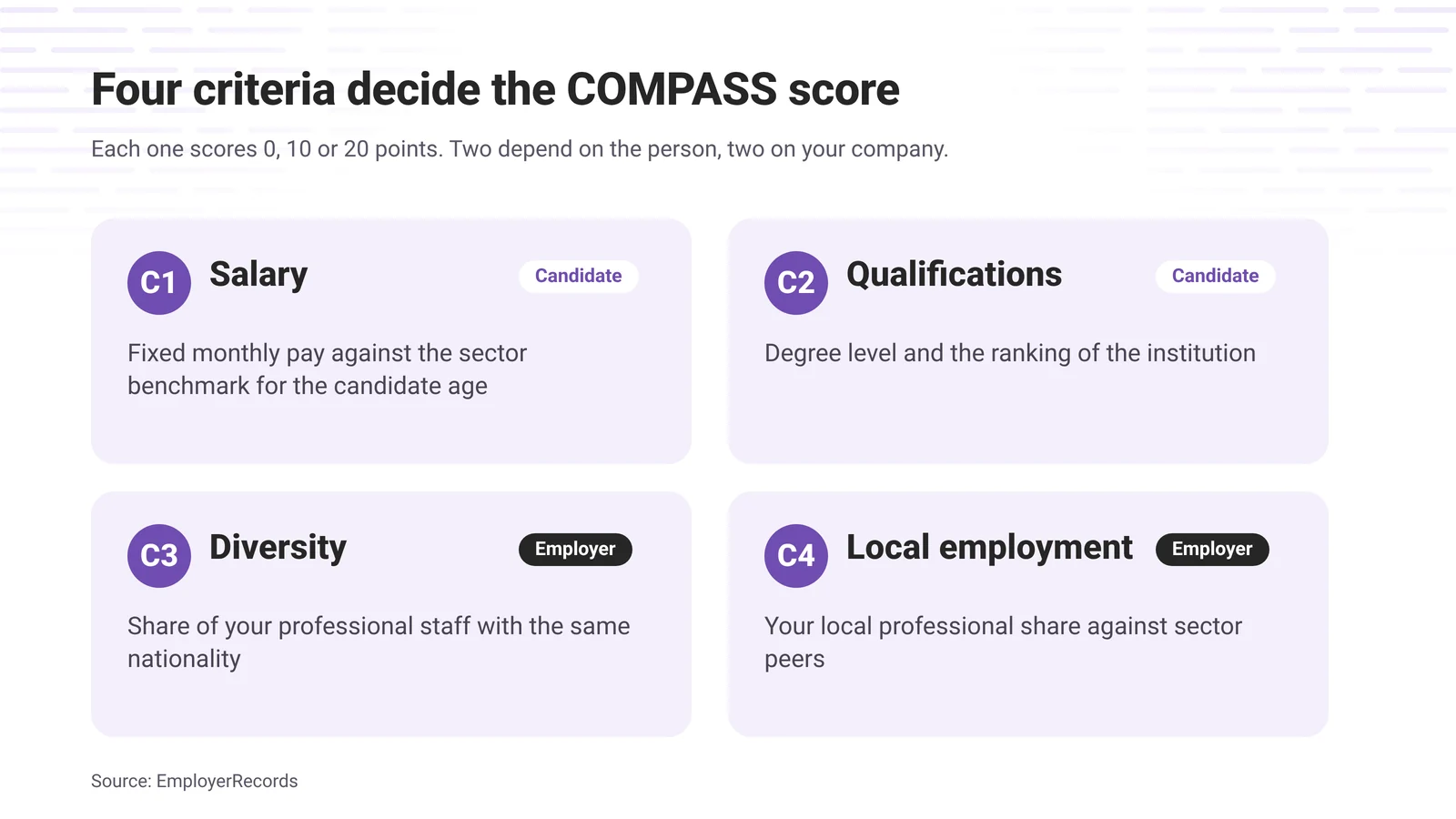
COMPASS foundational criteria and points
| Criterion | What it measures | Points |
|---|---|---|
| C1 Salary | Fixed salary against the sector benchmark by age | 20, 10 or 0 |
| C2 Qualifications | Degree level and institution | 20, 10 or 0 |
| C3 Diversity | Candidate’s nationality share among your PMETs | 20, 10 or 0 |
| C4 Support for local employment | Your local PMET share against sector peers | 20, 10 or 0 |
Our view. Run the score before the offer goes out, not after. A hire who lands 10 on three criteria and zero on diversity fails by ten points, and you’ll lose the two weeks you spent on the advertisement.
Who skips COMPASS?
Do you have to advertise the job first?
Yes, in most cases. Before submitting an Employment Pass or S Pass application, you advertise the job on MyCareersFuture for at least 14 consecutive days.[14][15]
Don’t make the offer during that window.[15] If you change the job title, salary or vacancy count, the advertisement has to run another 14 days before you can apply.[15] An ad that closed more than three months ago can’t be reused.[15]
Some employers are exempt. For S Pass applications, a company with fewer than ten employees doesn’t have to advertise, though it still has to hire fairly.[16]
What are the S Pass rules?
An S Pass candidate needs a fixed monthly salary at or above the age-based floor, which starts at S$3,300 for the youngest candidates and reaches S$4,800 at 45.[3] MOM’s self-assessment tool says a candidate who passes it has around a 90% chance of approval.[3]
The employer is capped by a quota of 10% of the workforce in services and 15% in construction, manufacturing, marine shipyard and process. It is based on your average local headcount over the last three months.[6]
On top of that, the levy is S$650 a month per holder.[6]
S Pass minimum qualifying salary by age, new applications
| Age | Until 31 December 2026 | From 1 January 2027 | Finance, 2027 |
|---|---|---|---|
| 23 or below | S$3,300 | S$3,600 | S$4,000 |
| 30 | S$3,777 | S$4,077 | S$4,525 |
| 40 | S$4,459 | S$4,759 | S$5,275 |
| 45 or above | S$4,800 | S$5,100 | S$5,650 |
Where does the Work Permit fit?
It’s the sector-based route for workers who don’t meet the S Pass floor, in construction, manufacturing, marine shipyard, process and services. There’s no salary floor, but each sector has a quota and the monthly levy runs from S$200 to S$900 a worker on the 2026 schedule.[7]
We cover it briefly because most foreign companies hiring remotely won’t use it. A knowledge worker on a Singapore payroll will sit on an Employment Pass or S Pass.
What is the ONE Pass?
A personal pass for top earners. The candidate needs a fixed monthly salary of at least S$30,000 under an established company based in Singapore, drawn from a single employer. The pass isn’t tied to that employer.[4]
It’s valid for five years and renewable for five more.[4] A new AI and Tech track opens in January 2027, replacing the Tech.Pass, with a lower salary bar of S$22,500 combined with other conditions that MOM hasn’t fully published.[2][17]
Can pass holders bring their family?
What do passes cost and how long do they take?
The MOM fees are small beside the salary floor. An Employment Pass costs S$105 to apply for and S$225 on issue, plus S$30 for each Multiple Journey Visa where one applies.[11]
Timing is where plans slip. Online Employment Pass applications get a result or an update within ten business days, but an overseas company without a Singapore office waits up to six weeks.[11] The ONE Pass carries the same two fees and takes about four weeks.[19]
Application fees and processing times from MOM
| Pass | Application fee | Issuance fee | Processing time |
|---|---|---|---|
| Employment Pass | S$105 | S$225 | Within 10 business days online |
| EP, company not registered in Singapore | S$105 | S$225 | Within 6 weeks |
| ONE Pass | S$105 | S$225 | 4 weeks for most cases |
| Dependant’s Pass | S$105 | Not stated here | 3 weeks for most cases |
What changes from January 2027?
The Employment Pass floor rises from S$5,600 to S$6,000 for new applications, and the S Pass floor rises from S$3,300 to S$3,600. Renewals for passes expiring from 1 January 2028 follow.[2]
Finance has its own floors: S$6,600 for an Employment Pass and S$4,000 for an S Pass.[8] MOM also updates the COMPASS salary benchmarks for 2027, though candidates at S$22,500 or more stay exempt.[8]
In 2028, work permit levy rates change. For R2 workers they rise by S$100 and S$150, and some sector tiers merge.[2]
Can an EOR sponsor the pass for a foreign hire?
Not for a company that has no Singapore entity. MOM told the market in 2024 that a non-Singapore company can’t use an EOR to sponsor a work pass for a foreign national.[1][20]
An EOR can still employ Singaporean citizens and permanent residents for you. That’s the part of the model that survives.[21]
A foreign candidate who already holds a pass tied to another employer is a different case, and the pass rules still decide it. Check the pass type before you sign anything. For the wider picture, read can an EOR sponsor a work visa.
If the hire needs a pass and you’ve no entity, the realistic routes are a local subsidiary that sponsors the pass or a different country for that role. We’d price the subsidiary against the employer costs and CPF page before deciding.
What we see. Most foreign founders ask about the EOR route first and the salary floor second. Reverse that order. A candidate priced under the floor doesn’t need a sponsor, they need a different offer.
Will an Employment Pass candidate clear the bar?
Enter the salary and your best estimate for each criterion. The tool applies the base floor and the 40-point rule, and nothing else.
Treat a pass as a screen, not a verdict. MOM’s own tools give the binding answer.
Employment Pass quick check
Estimate only. It checks the base salary floor and adds the four COMPASS criteria you pick. The real floor rises with age, up to S$11,500 for ages 45 and over, and bonus points are not included. Candidates at S$22,500 or more are exempt from COMPASS.
Where do Singapore pass plans go wrong?
Four slips account for most failed or delayed applications we see discussed in the guidance.
Order of work. Check the floor, then the points, then advertise, then apply. Running them in any other order costs you the 14 days twice. Local salary floors sit alongside the pass thresholds in the minimum wage and wage floors guide, and the average salary page shows where offers actually land. If a pass holder leaves, notice and termination covers notice, cancellation and final pay. For the wider picture on hiring in Singapore, start from the Singapore hiring guide.
Questions about work passes in Singapore
Short answers to what employers ask most before sponsoring a hire, checked against the MOM pages cited below on 24 November 2026.
How many COMPASS points does an Employment Pass need?
40 out of a possible 80 across four criteria, unless the candidate earns S$22,500 or more a month, which exempts them.
Is there a quota for Employment Passes?
No. The Employment Pass has no quota, but it does have the COMPASS points test and the salary floor.
What is the S Pass quota?
10% of the workforce in services, and 15% in construction, manufacturing, marine shipyard and process. It’s based on your average local headcount over the last three months.
Can my family join a pass holder?
Yes, if the holder earns a fixed S$6,000 a month or more. Spouses and children apply for a Dependant’s Pass at S$105 an application.
Can I use an EOR to hire a foreigner in Singapore?
Not if your company has no Singapore entity. MOM has said an EOR can’t sponsor a work pass for a foreign company’s non-Singaporean worker.
References and sources
Every figure on this page comes from the sources below. Numbers in square brackets in the text link to the matching entry. Where MOM pages would not open in full, we used law firm or practitioner summaries and say so. All sources were checked on 24 November 2026.
- ↑Singapore: Employers of Record can no longer sponsor Employment Passes for foreign entities’ workers. Jackson Lewis, 5 August 2024. jacksonlewis.com. Retrieved 24 November 2026. Law firm
- ↑Partnering businesses and workers to thrive in a changed world. Ministry of Manpower, 3 March 2026. mom.gov.sg. Retrieved 24 November 2026. Primary
- ↑Eligibility for S Pass. Ministry of Manpower, 1 September 2026. mom.gov.sg. Retrieved 24 November 2026. Primary
- ↑Eligibility for Overseas Networks and Expertise Pass. Ministry of Manpower. mom.gov.sg. Retrieved 24 November 2026. Primary
- ↑Eligibility for Employment Pass. Ministry of Manpower. mom.gov.sg. Retrieved 24 November 2026. Primary
- ↑S Pass levy and quota requirements. Ministry of Manpower. mom.gov.sg. Retrieved 24 November 2026. Primary
- ↑Singapore Foreign Worker Levy (FWL) 2026: complete guide for employers. Sleek. sleek.com. Retrieved 24 November 2026. Guide
- ↑Singapore announces further updates to foreign workforce policies. Newland Chase. newlandchase.com. Retrieved 24 November 2026. Guide
- ↑Singapore Budget 2026: EP threshold to S$6,000, S Pass to S$3,600. People Matters. sea.peoplemattersglobal.com. Retrieved 24 November 2026. News
- ↑Key facts on Employment Pass. Ministry of Manpower. mom.gov.sg. Retrieved 24 November 2026. Primary
- ↑Apply for an Employment Pass. Ministry of Manpower. mom.gov.sg. Retrieved 24 November 2026. Primary
- ↑Foreign workforce updates factsheet, Budget 2023. Ministry of Manpower, 2023. mom.gov.sg. Retrieved 24 November 2026. Primary
- ↑COMPASS C1 salary benchmarks. Ministry of Manpower. mom.gov.sg. Retrieved 24 November 2026. Primary
- ↑Must my company advertise for at least 14 days for positions that must be filled urgently?. Ministry of Manpower, 14 March 2024. mom.gov.sg. Retrieved 24 November 2026. Primary
- ↑Consider all candidates fairly before you apply for an S Pass. Ministry of Manpower. mom.gov.sg. Retrieved 24 November 2026. Primary
- ↑Employment assignments, Singapore. Baker McKenzie Resource Hub. resourcehub.bakermckenzie.com. Retrieved 24 November 2026. Law firm
- ↑Singapore: new ONE Pass (AI and Tech) track to be available in January 2027. Fragomen. fragomen.com. Retrieved 24 November 2026. Law firm
- ↑Apply for a Dependant’s Pass. Ministry of Manpower. mom.gov.sg. Retrieved 24 November 2026. Primary
- ↑Apply for an Overseas Networks and Expertise Pass. Ministry of Manpower. mom.gov.sg. Retrieved 24 November 2026. Primary
- ↑Non-Singaporean companies need to consider alternatives to using an Employer of Record. DLA Piper, 28 August 2024. knowledge.dlapiper.com. Retrieved 24 November 2026. Law firm
- ↑Singapore restricts use of EORs by foreign companies and increases Employment Pass qualifying salary. Lockton. global.lockton.com. Retrieved 24 November 2026. Guide
About the author

Manjuri Dutta is Co-Founder and Content Editor at EmployerRecords.com, covering Employer of Record providers and global hiring platforms. She evaluates providers on entity ownership, statutory compliance, and real pricing rather than vendor claims, and built the verification process used across EmployerRecords' country guides, checking vendor claims against government registries and public filings.
View all articles by ManjuriPay and hiring guides for other countries
See how other markets set pay floors and salary levels.
 SingaporeAverage salaryAverage Salary in Singapore 2026Median and mean income in Singapore, wage growth by industry, bonuses, take-home pay and the cost of a typical hire,...Read the guideSingaporeEmployer costsEmployer Costs and CPF in Singapore (2026): What You Pay on Top of SalaryEmployer CPF by age, the Skills Development Levy, foreign worker levies and pass salary floors, priced for five real salaries.Read the guideSingaporeMinimum wageMinimum Wage in Singapore (2026): PWM, LQS and Employer CostSingapore has no universal minimum wage: what employers must pay under PWM, the S$1,800 LQS and work pass floors, plus...Read the guideSingaporeNotice and TerminationNotice Period and Termination in Singapore 2026Notice lengths, dismissal and retrenchment steps, final pay, pass cancellation and the cost of ending a hire in Singapore, with...Read the guide
 Czech RepublicAverage salaryAverage Salary in the Czech Republic (2026): CZK 50,650 a MonthAverage and median pay, regional gaps, gross to net and what employers add on top, from the Czech Statistical Office.Read the guideCzech RepublicMinimum wageMinimum Wage in the Czech Republic (2026): CZK 22,400 a MonthThe monthly and hourly minimum wage for 2026, the increase for 2027, overtime and what employers add on top.Read the guide
Hiring in Singapore?
The hiring guide covers pass rules, employer costs and your EOR options in one place.