
Employer Costs and CPF in Singapore (2026): What You Pay on Top of Salary
Employer CPF by age, the Skills Development Levy, foreign worker levies and pass salary floors, priced for five real salaries.
What does an employer pay on top of salary in Singapore?
Employers pay 17% CPF on wages up to S$8,000 a month for citizens and PRs aged 55 and under, plus the Skills Development Levy of 0.25%, capped at S$11.25. Employment Pass holders attract the levy only. S Pass holders add a S$650 monthly levy and mandatory medical insurance.
- Citizen or PR: 17% CPF plus a small levy
- Employment Pass: levy only, no CPF
- S Pass: levy plus S$650 a month
Singapore has no general payroll tax. What you add to a salary depends on who you hire, and the gap between the cheapest and the dearest case is wide.[1]
A citizen costs you about a sixth more than their pay. An Employment Pass holder costs you almost nothing more. A mid-skilled foreign hire on an S Pass sits in between, with a flat monthly levy instead of a percentage.
We take each charge in turn, then price five real salaries side by side. The Singapore hiring guide covers the rest of the hiring process.
Which charges apply to which hire?
It depends on immigration status first and salary second. CPF? Citizens and permanent residents only. Nearly everyone carries the Skills Development Levy, pass holders included. Only S Pass and Work Permit holders attract the foreign worker levy and medical insurance.[1][2]
Work injury insurance follows pay and job type instead of status, so it can reach any of the three groups.[3]
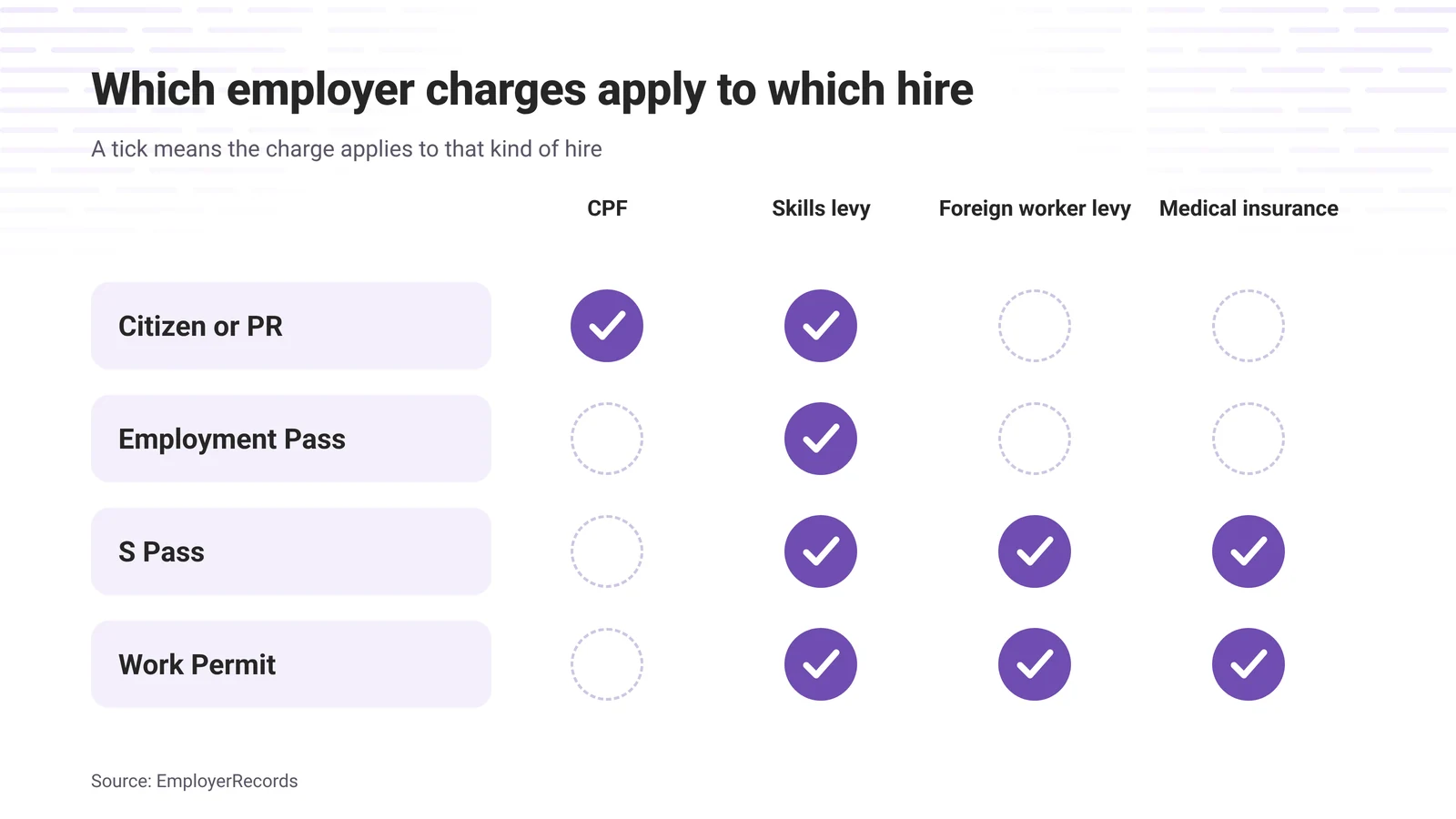
Employer charges by type of hire, 2026
| Charge | Citizen or PR | Employment Pass | S Pass |
|---|---|---|---|
| Employer CPF | Yes, by age | No | No |
| Skills Development Levy | Yes | Yes | Yes |
| Foreign worker levy | No | No | Yes, monthly |
| Work injury insurance | Manual work, or pay at or under S$2,600 | Same test | Same test |
| Mandatory medical insurance | No | No | Yes |
How we read this. Most budget errors we see come from using one blended percentage for a mixed team. Split the headcount by status first, price each group, then add them up.
What employer CPF rate applies by age?
For citizens and PRs in their third year of PR status onward, the employer pays 17% of wages while the employee is 55 or younger, and the employee pays another 20% out of their own pay.[4][5] The rate steps down with age.
Our derivation gives the 2026 employer shares for older staff: we take the 2027 shares from CPF Board and remove the published half-point increases.[5]
Rates apply in full to monthly wages above S$750. Wages between S$500 and S$750 are phased in, and the Skills Development Levy is charged separately.[5] Contributions start once total wages pass S$50 a month.[6]
Employer CPF share by age, as a percentage of wages above S$750 a month
| Employee age | 2026 | From 1 January 2027 | Change |
|---|---|---|---|
| 55 and below | 17% | 17% | None |
| Above 55 to 60 | 16% | 16.5% | +0.5 |
| Above 60 to 65 | 12.5% | 13% | +0.5 |
| Above 65 to 70 | 9% | 9% | None |
| Above 70 | 7.5% | 7.5% | None |
Where does employer CPF stop?
At S$8,000 a month. On 1 January 2026 the Ordinary Wage ceiling rose from S$7,400 to S$8,000, so 17% of the ceiling, S$1,360, is the most a citizen’s monthly pay can cost you in employer CPF.[4][7]
Bonuses sit under a separate cap. Bonuses are capped at S$102,000 minus the ordinary wages that were subject to CPF in the year, worked out per employer.[8]
Take someone on S$6,000 a month. Their ordinary wages for the year are S$72,000, so the ceiling for bonuses is S$30,000. A S$40,000 bonus attracts employer CPF only on the first S$30,000, which is S$5,100 at 17%. That’s our calculation using the CPF formula.
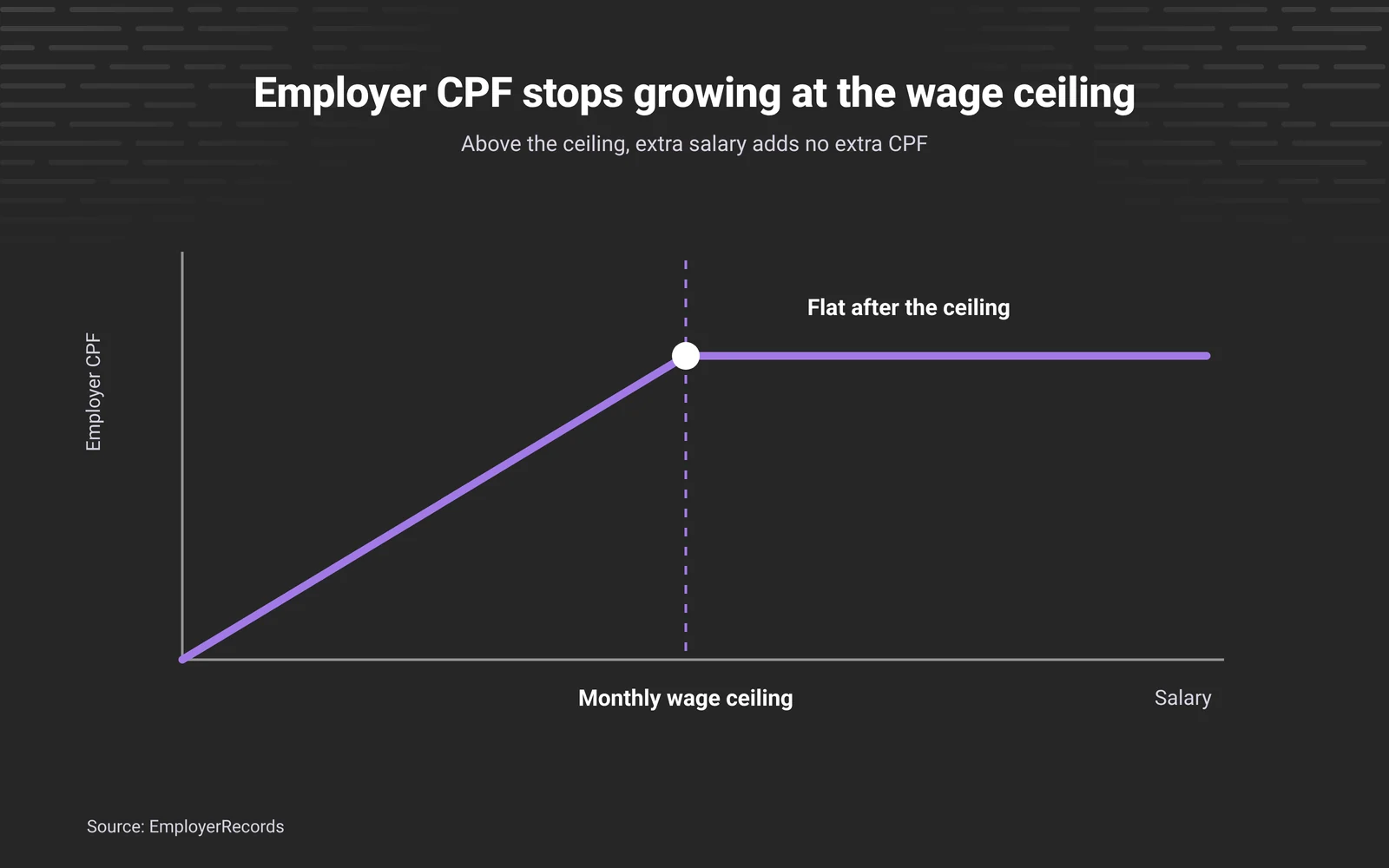
CPF wage ceilings in 2026
| Ceiling | Amount | What it caps |
|---|---|---|
| Ordinary Wage | S$8,000 a month | Monthly pay that attracts CPF |
| Annual salary | S$102,000 | Ordinary plus additional wages in a year |
| Additional Wage | S$102,000 minus ordinary wages | Bonuses and other non-monthly pay |
What do new permanent residents cost?
Less in the first two years, if you both agree. New PRs can contribute at graduated rates for their first two years of PR status, or at the full citizen rates if employer and employee both choose that.[9]
Graduated rates total 9% in year one and 24% in year two, against 37% from the third year.[10] Employers carry the smaller part of that total in year one.
Confirm the PR start date before you set up payroll, because the rate changes at the start of year three.
How is the Skills Development Levy worked out?
It’s 0.25% of each employee’s monthly wages, with a floor of S$2 and a cap of S$11.25. You pay all of it, and nothing comes out of the employee’s pay.[11][12]
It bites at S$4,500, so for any salary above that the levy is a flat S$11.25 a month.[2] It applies to local and foreign staff, which makes it the one employer charge an Employment Pass holder carries.[1]
Pay it with the CPF contributions for local employees. For foreign employees, it goes to the skills agency instead.[11]
What is the foreign worker levy?
A monthly charge on each S Pass and Work Permit holder, paid by the employer and never deducted from the worker’s pay.[13] The S Pass levy is S$650 a month across all sectors and tiers since 1 September 2025.[13]
Work Permit levies vary by sector, tier and skill level, from S$200 to S$900 a month on the 2026 schedule, and some rates change in 2028.[13]
Employment Pass holders pay no levy. That’s often the real reason a role at the border between the two passes goes to an EP.
Foreign worker levy examples, monthly per worker in 2026
| Pass and sector | Higher-skilled (R1) | Basic-skilled (R2) |
|---|---|---|
| S Pass, all sectors | S$650 | S$650 |
| Work Permit, services tier 1 | S$300 | S$450 |
| Work Permit, services tier 3 | S$600 | S$800 |
| Work Permit, manufacturing tier 1 | S$250 | S$370 |
| Work Permit, construction, Malaysia and North Asia | S$300 | S$700 |
What salary does a pass holder have to be paid?
From 1 January 2027 the Employment Pass floor for new applications rises from S$5,600 to S$6,000, and the S Pass floor rises from S$3,300 to S$3,600.[14][15] Renewals follow a year later.[16]
Financial services has higher floors: S$6,600 for an Employment Pass and S$4,000 for an S Pass from 2027.[16] The floor also rises with age for older candidates.[16]
These floors set the minimum salary base of your cost for a pass holder, so check them before you fix an offer. A S$3,300 S Pass offer made in December works. Made in January, the same offer doesn’t.
Minimum qualifying salary for new applications
| Pass | Until 31 December 2026 | From 1 January 2027 |
|---|---|---|
| Employment Pass, most sectors | S$5,600 | S$6,000 |
| Employment Pass, financial services | S$6,200 | S$6,600 |
| S Pass, most sectors | S$3,300 | S$3,600 |
| S Pass, financial services | S$3,800 | S$4,000 |
Which insurance is compulsory?
Two policies are compulsory, and neither depends on CPF. Work injury compensation insurance covers all employees doing manual work, plus non-manual employees earning S$2,600 or less a month, leaving out overtime, bonuses and allowances in that pay test.[3]
Then there’s medical insurance for each migrant worker, meaning S Pass and Work Permit holders. You buy it, you can’t pass the cost on, and it has to run for the full period of the pass.[17] Guides put the minimum annual coverage at S$60,000.[18]
We found no single premium figure from an official source, so we haven’t put one on this page. Get a quote from a designated insurer.
What does a hire actually cost each month?
Take a citizen on S$7,000. Employer CPF is S$1,190 and the levy is S$11.25, so you pay S$1,201.25 on top, or 17.2% of salary. On S$18,000 the same person costs you S$1,371.25 on top, only 7.6% of pay, because CPF stops at the ceiling.
A foreign professional on the same S$7,000 under an Employment Pass costs just the levy, S$11.25. An S Pass holder at the new-applicant floor of about S$4,000 costs S$660.00 on top, which is 16.5% and nearly as much as a citizen.
Monthly employer cost on top of salary, our calculation from 2026 rules
| Hire | Salary | CPF | SDL | Levy | Total on top | Share of salary |
|---|---|---|---|---|---|---|
| Citizen or PR, 55 and below | S$3,500 | S$595.00 | S$8.75 | – | S$603.75 | 1725.0% |
| Citizen or PR, 55 and below | S$7,000 | S$1,190.00 | S$11.25 | – | S$1,201.25 | 1716.1% |
| Citizen or PR, 55 and below | S$18,000 | S$1,360.00 | S$11.25 | – | S$1,371.25 | 761.8% |
| Employment Pass holder | S$7,000 | – | S$11.25 | – | S$11.25 | 16.1% |
| S Pass holder | S$4,000 | – | S$10.00 | S$650.00 | S$660.00 | 1650.0% |
Our view. Don’t pick an S Pass over a citizen to save on cost. The levy and the insurance wipe out most of the gap, and quotas can wipe out the rest. Choose on skills and availability, then price it.
What costs sit outside the statutory numbers?
Treat the formulas above as the floor. A 13th month, usually called an annual wage supplement, is customary in Singapore but not legally required, and a full month adds employer CPF on that pay.[8]
Private health cover, recruitment fees and relocation are discretionary. An EOR also adds a monthly fee on top, which our hub lists at US$399 to US$650 per employee at provider list prices. Our EOR cost calculator prices the whole stack.
What changes in 2027 and 2028?
Three things. CPF rates rise for staff above 55 to 65 from wages earned on 1 January 2027, with the employer share up by half a point in both bands.[5] The Employment Pass and S Pass floors rise for new applications on the same date.[14]
CPF Board also says the Ordinary Wage ceiling will be raised from 1 January 2027 but the page we read gives no new amount, so we haven’t printed one.[5] Check the CPF rate tables before you budget 2027.
In 2028, work permit levies rise for the marine shipyard and process sectors, and some manufacturing and services tiers merge.[13]
Does an EOR change the cost?
When the hire sits with an employer of record, the EOR is the employer and pays CPF and the levy through its Singapore payroll, then invoices you the cost plus its fee.
For a foreign hire the pass is a separate question, covered in the work permits guide. Ask the provider whether it sponsors the pass itself or expects you to bring a holder. Our EOR providers in Singapore page compares providers.
Singapore employer cost calculator
Enter a monthly salary and the type of hire. Defaults return S$1,201.25 for a citizen on S$7,000, which is the same figure as the example above.
Singapore employer cost on top of salary
Estimate only. It uses 2026 employer CPF rates, the S$8,000 monthly ceiling, the Skills Development Levy and the S$650 S Pass levy. It leaves out bonuses, insurance premiums, EOR fees, new PR graduated rates and wages under S$750.
Where do Singapore payroll budgets go wrong?
Four slips cause most of the gaps between a budget and the first invoice.
What we’d do first. Rebuild the budget from the status of each person, not from a company-wide rate. If the headcount includes a mix of passes, a spreadsheet with one line per person takes ten minutes and saves a month of corrections. Pay level drives every figure here, so read it alongside the average salary data and the minimum wage and wage floors guide. Foreign hires add the levy covered in work passes, and exit costs are in notice and termination.
Questions about employer costs and CPF in Singapore
Short answers to what employers ask most before budgeting a Singapore hire, checked against CPF Board and MOM pages cited below on 24 November 2026.
Is CPF compulsory for foreign employees in Singapore?
No. CPF applies to citizens and permanent residents. Employment Pass, S Pass and Work Permit holders aren’t covered, though the Skills Development Levy still applies.
What is the employer CPF rate for a 30-year-old citizen?
17% of wages up to S$8,000 a month, so at most S$1,360 a month. Employees pay another 20%.
Do I pay CPF on bonuses?
Yes, up to the Additional Wage ceiling, which is S$102,000 minus the ordinary wages subject to CPF that year.
What is the Skills Development Levy for a S$5,000 salary?
S$11.25 a month. It’s 0.25% of wages with a cap of S$11.25, reached at S$4,500.
How much is the S Pass levy?
S$650 a month for every S Pass holder across sectors, paid by the employer.
Does the employer pay the foreign worker levy for an Employment Pass?
No. Employment Pass holders attract no foreign worker levy, only the Skills Development Levy.
When does the Employment Pass salary floor rise?
On 1 January 2027 for new applications, from S$5,600 to S$6,000, or S$6,600 in financial services. Renewals follow from 2028.
Is work injury insurance mandatory?
Yes for employees doing manual work and for non-manual staff earning S$2,600 or less a month. Higher earners doing non-manual work aren’t required by the rule.
What do new PRs cost in the first two years?
Less than citizens if both sides choose graduated rates. Totals run 9% in year one and 24% in year two, then the full rate from year three.
Is there a 13th month by law in Singapore?
No. An annual wage supplement is customary, not required, and a full month adds employer CPF as additional wages.
References and sources
Every figure on this page comes from the sources below. Numbers in square brackets in the text link to the matching entry. Several rates rest on payroll guides where the agency page would not open in full, and our own calculations are labelled. All sources were checked on 24 November 2026.
- ↑Employer taxes and social security contributions in Singapore. Boundless. boundlesshq.com. Retrieved 24 November 2026. Guide
- ↑Singapore payroll, benefits and tax regulations in 2026. Second Talent. secondtalent.com. Retrieved 24 November 2026. Guide
- ↑Work injury compensation insurance. Ministry of Manpower. mom.gov.sg. Retrieved 24 November 2026. Primary
- ↑CPF contribution rates (2026): what employees and employers pay. Endowus. endowus.com. Retrieved 24 November 2026. Guide
- ↑Increase in CPF Contribution Rates from 1 January 2027. CPF Board. cpf.gov.sg. Retrieved 24 November 2026. Primary
- ↑How much CPF contributions to pay. CPF Board. cpf.gov.sg. Retrieved 24 November 2026. Primary
- ↑CPF Contribution Rates in Singapore: Rates by Age and Wage Ceilings [2026]. StashAway, 19 October 2026. stashaway.sg. Retrieved 24 November 2026. Guide
- ↑Examples for computation of Additional Wage (AW) ceiling. CPF Board. cpf.gov.sg. Retrieved 24 November 2026. Primary
- ↑CPF changes 2026 for employers and employees. Singapore Legal Advice. singaporelegaladvice.com. Retrieved 24 November 2026. Law firm
- ↑Employee CPF contribution in Singapore: rates, calculations and employer guide in 2026. Aspire, 10 August 2026. aspireapp.com. Retrieved 24 November 2026. Guide
- ↑How do I calculate and pay the Skills Development Levy (SDL)?. CPF Board. cpf.gov.sg. Retrieved 24 November 2026. Primary
- ↑Singapore CPF, SDL, and CDAC contribution rates 2026: employer guide. Slasify. slasify.com. Retrieved 24 November 2026. Guide
- ↑Singapore Foreign Worker Levy (FWL) 2026: complete guide for employers. Sleek. sleek.com. Retrieved 24 November 2026. Guide
- ↑Partnering businesses and workers to thrive in a changed world. Ministry of Manpower, 3 March 2026. mom.gov.sg. Retrieved 24 November 2026. Primary
- ↑Budget statement: build a resilient and skilled workforce. Singapore Budget 2026, February 2026. singaporebudget.gov.sg. Retrieved 24 November 2026. Primary
- ↑Singapore announces further updates to foreign workforce policies. Newland Chase. newlandchase.com. Retrieved 24 November 2026. Guide
- ↑Medical insurance requirements for migrant workers. Ministry of Manpower. mom.gov.sg. Retrieved 24 November 2026. Primary
- ↑An employer’s guide: WIC insurance and FWMI. Liberty Insurance, 15 May 2024. libertyinsurance.com.sg. Retrieved 24 November 2026. Guide
About the author

Dhiraj Das is Co-Founder of EmployerRecords.com, where he leads content, research and partnerships. He has worked in content and online publishing for more than 15 years, and before EmployerRecords he founded a number of successful content brands. For the past six years he has specialised in HR technology, Employer of Record services and global hiring. His background in digital marketing and search shapes how EmployerRecords researches and presents its provider reviews, country hiring guides and cost data, so employers can compare their options and hire abroad with clear, checked information.
View all articles by DhirajMinimum wage and salary guides for other countries
Compare Singapore with the pay floors and salary levels employers work with in other markets.
 SingaporeAverage salaryAverage Salary in Singapore 2026Median and mean income in Singapore, wage growth by industry, bonuses, take-home pay and the cost of a typical hire,...Read the guideSingaporeMinimum wageMinimum Wage in Singapore (2026): PWM, LQS and Employer CostSingapore has no universal minimum wage: what employers must pay under PWM, the S$1,800 LQS and work pass floors, plus...Read the guideSingaporeNotice and TerminationNotice Period and Termination in Singapore 2026Notice lengths, dismissal and retrenchment steps, final pay, pass cancellation and the cost of ending a hire in Singapore, with...Read the guideSingaporeWork PassesWork Passes in Singapore 2026Which Singapore work pass a foreign hire needs: Employment Pass, S Pass, Work Permit and ONE Pass, with COMPASS points,...Read the guide
 Czech RepublicAverage salaryAverage Salary in the Czech Republic (2026): CZK 50,650 a MonthAverage and median pay, regional gaps, gross to net and what employers add on top, from the Czech Statistical Office.Read the guideCzech RepublicMinimum wageMinimum Wage in the Czech Republic (2026): CZK 22,400 a MonthThe monthly and hourly minimum wage for 2026, the increase for 2027, overtime and what employers add on top.Read the guide
Hiring in Singapore?
The hiring guide covers employer costs, CPF rules and your EOR options in one place.