Key takeaways
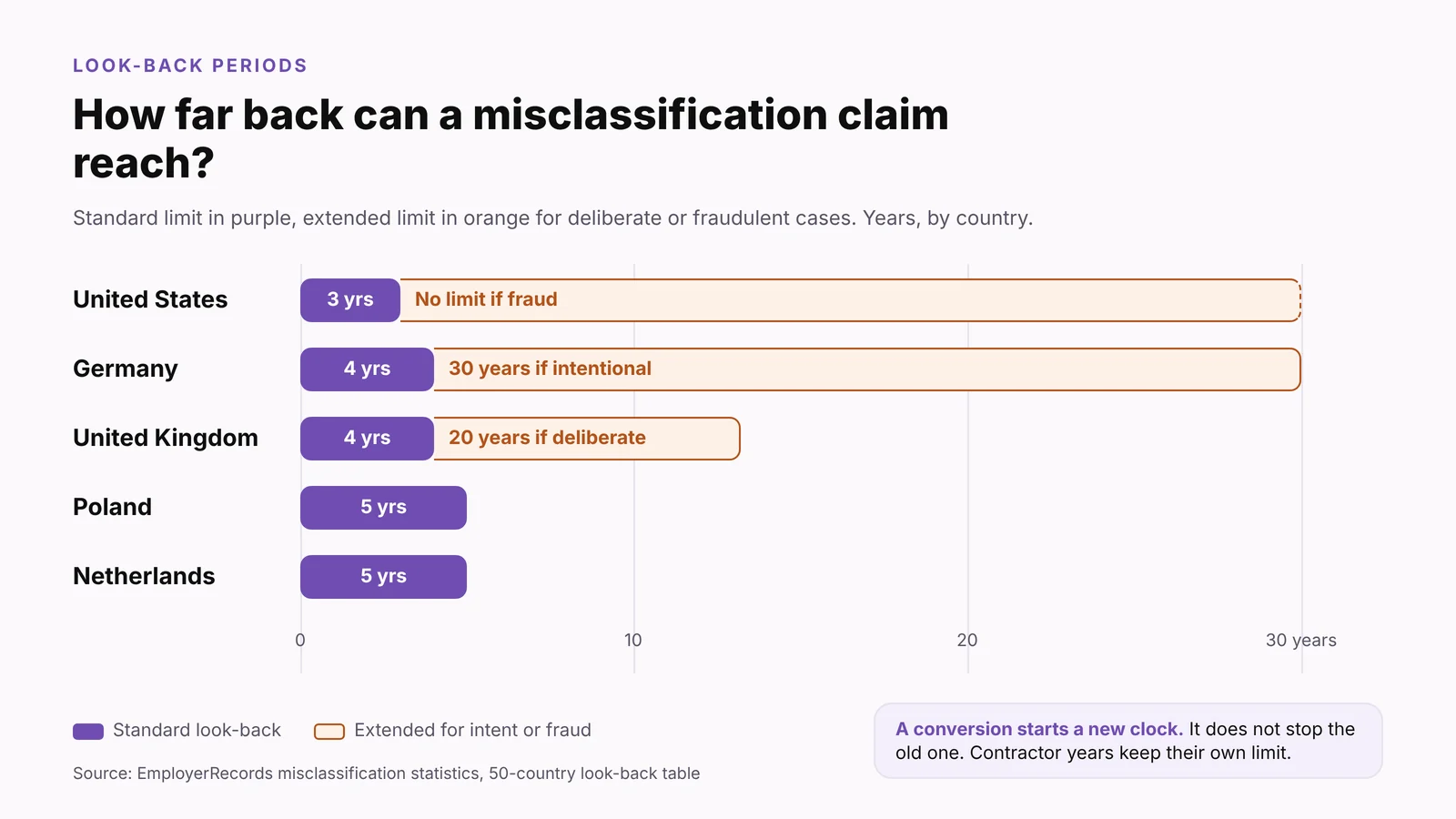
- An EOR fixes the future, not the past. It employs the worker from the start date, while the contractor years stay with you. In Germany that can mean 4 years, or 30 if intentional.
- Test the facts first. Eight of 50 countries presume employment, and ten run status rulings. The label in the contract carries little weight.
- Plan for four to six weeks. In the US, file Form 8952 for the VCSP at least 120 days before the employment start date.
- Price total employer cost. An £85,000 UK salary costs £103,721 with employer NI, pension and an illustrative EOR fee, against a £104,500 invoice.

Our take
Treat a conversion as a clean-up of the contractor history, not an HR promotion. The employment contract is the easy part. The decision that costs money is what you do about the years before it, so settle the VCSP question and the IP assignment before you send the offer.
Emma Whitmore, EOR and global employment writerWhat does converting a contractor through an EOR involve?
Converting a contractor through an EOR means the EOR becomes the legal employer from an agreed start date. It issues a local employment contract, runs payroll and pays employer taxes and benefits, while your company keeps directing the daily work. The contractor years stay your liability. The EOR does not clean them up.
Providers typically quote four to six weeks for a conversion when the country is covered and the terms are agreed. Most of that time goes on the contract and local registrations, not on the platform. If the model is new to you, start with what an employer of record does.
When has a contractor relationship already become employment?
A contractor has become an employee in practice when you control how, when and where the work is done, not only what is delivered. Tax authorities and courts look at the facts of the relationship, and the label in the contract carries little weight.
Eight of the 50 countries we track presume employment once certain facts are present, and ten run formal status rulings. Check where your contractor sits in our rules by country before you plan the switch.
The US rule is still a proposal. The Department of Labor proposed a new independent contractor test on 26 February 2026 and comments closed on 28 April 2026. We found no final rule as of 13 October 2026, so treat the DOL rulemaking page as pending, not law.
What does an EOR fix, and what stays with you?
An EOR fixes the future. From the start date the worker is a documented employee, with payroll, employer contributions and statutory leave handled by a local employer. It does nothing for the contractor years, so the tax and social security exposure for that period stays with you.
How long that exposure lasts depends on the country. In Germany the social security limit is four years, or 30 if the underpayment was intentional, under section 25 of SGB IV. The chart draws on our 50-country look-back table.
The EOR takes on from the start date
- A local employment contract and payroll
- Employer tax and social security contributions
- Statutory leave, notice rules and benefits
- Local termination procedure and records
Stays with you
- Tax and social security for the contractor years
- Directing the day-to-day work
- Any claim about how the contractor was treated before the switch
- Ownership of work made before the new contract, until assigned in writing
Closing the US exposure with the VCSP
The IRS Voluntary Classification Settlement Program (VCSP) lets you reclassify workers going forward for 10% of the most recent year’s employment tax liability, worked out at the reduced section 3509(a) rates. There is no interest or penalty, and the IRS does not audit the prior classification of those workers for employment tax. You must have filed Forms 1099 for the workers for the previous three years and not be under an IRS, Department of Labor or state classification audit.
File Form 8952 at least 120 days before the date you want to treat the worker as an employee. That gap is why the VCSP decision comes before you fix the EOR start date. It covers federal employment tax only. California separately fines wilful misclassification $5,000 to $15,000 per violation, and $10,000 to $25,000 for a pattern, under Labor Code section 226.8.
Should you use an EOR, keep the contractor or open an entity?
Use an EOR when you have a handful of workers in a country, no plan to register a local company soon, and a contractor who already works like an employee. Open an entity when headcount and permanence justify the fixed cost. Keep contracting only when the relationship passes the facts test above.
An EOR fits if
- You have one to five workers in the country
- You want employment status without setting up a company
- The worker needs a local contract for a visa, mortgage or benefits
- The role will last 12 months or more
Look at alternatives if
- You already have an entity there, or will within a year
- A larger team in the country is planned soon
- The work is project-based and the person has other clients
- The country caps EOR use and your timeline runs past it
Compare the numbers before you choose. Our guide to measuring EOR ROI sets fees against entity setup and running costs. EOR versus PEO only matters if you already have a US entity.
Which country rules change a conversion in 2026?
Several rules change between July 2026 and January 2028, and the timing differs by market. The first thing to check is whether a deadline falls inside your conversion window.
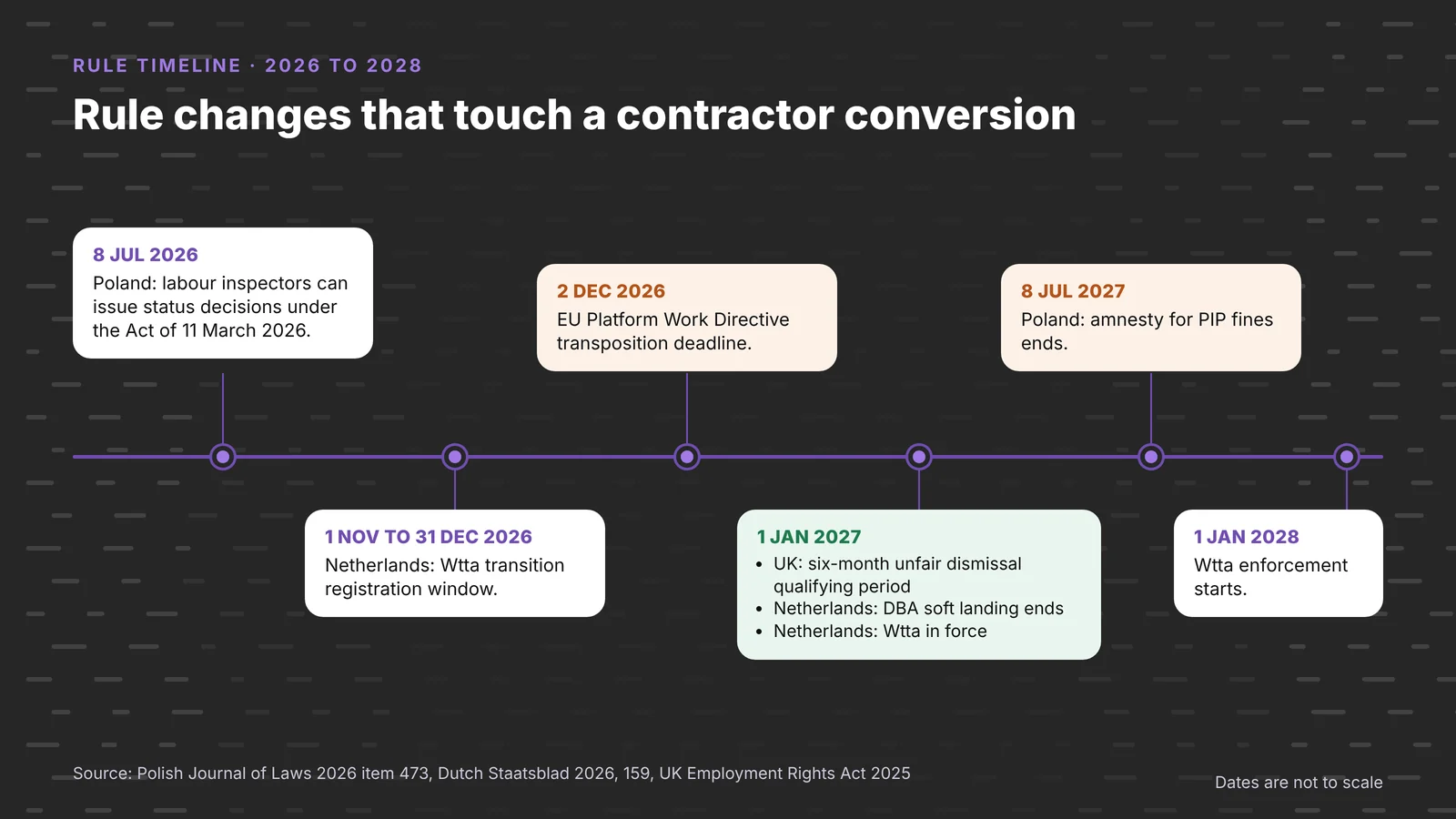
Conversion rules to check by market, as of October 2026
| Market | What changes or applies |
|---|---|
| United States | The DOL contractor test is still a proposal. The VCSP needs 120 days’ notice. California adds penalties of $5,000 to $25,000 per violation. |
| United Kingdom | Employer NI is 15% above £5,000. For dismissals from 1 January 2027 the unfair dismissal qualifying period drops to six months and the compensation cap is removed (Employment Rights Act 2025). IR35 rules still decide status for contractors working through a company. |
| Germany | Status is decided through the DRV procedure under section 7a. Staff lending, which an EOR relies on, is capped at 18 months under the AÜG. |
| Netherlands | Wet DBA assessments run back to 1 January 2025. Fines of 10% to 100% are possible for intent or gross negligence, default penalties are paused in 2026, and the soft landing ends on 1 January 2027. The Wtta licensing regime starts 1 January 2027, with enforcement from 1 January 2028. |
| Poland | The Act of 11 March 2026 took effect on 8 July 2026 (Journal of Laws 2026 item 473, full text). Inspectors can decide employment status from the date of the decision, and you can appeal to a labour court. Fines run from PLN 2,000 to 60,000, and the amnesty to 8 July 2027 covers inspectorate fines only. |
| Brazil | The Supreme Court has not ruled on the merits in Tema 1389. Lower courts resumed cases on 18 June 2026, while labour court (TST) cases stay suspended. |
We cover the other markets in our European rules by country. If your contractor is in a country not listed here, ask your provider for its written position before you set a start date.
How do you convert a contractor to an EOR employee, step by step?
Convert in six steps, and do the first three before you contact an EOR. The order matters because the VCSP notice, the contract terms and the history all affect the start date.
- Test the facts and list the historyScore the relationship against the six signals and list the contractor years by country.You
- Settle the pastIn the US decide on the VCSP. Elsewhere ask local counsel about back contributions before the start date is set.You
- Agree the termsAgree salary, tenure, IP assignment, probation and notice with the contractor.You
- Pick the EOR and order the hireCompare providers on country coverage and fees. Start with our ranking of EOR providers.You
- Contract and registerThe EOR issues the local contract, registers for payroll and tax, and enrols benefits.EOR
- Cut over on a fixed dateEnd the contractor agreement the day before. Employment starts the next day, with no gap and no overlap.EOR
Do you employ through your own entity in this country, or a partner?
Your own entity usually means one contract and one price. A partner adds a layer.Have you converted existing contractors in this country before?
Listen for specifics on contract wording and start dates.What will you say in writing about the contractor period?
You want a clear statement that the EOR takes no liability for it.What does a termination cost and who decides?
Exit terms are where EOR contracts differ most.How should you price the offer after conversion?
Price the offer from total employer cost, not from the contractor’s day rate. In our UK example a contractor billing £475 a day for 220 days invoices £104,500 a year, excluding VAT. An £85,000 salary costs the employer £103,721 once employer NI, pension and an illustrative EOR fee are added.
£85,000 salary plus £18,721 in employer NI, pension and EOR fee.
22.0% on top of the salaryThe rates come from GOV.UK employer rates for 2026 to 2027. Pension is the 3% minimum on qualifying earnings between £6,240 and £50,270. The £450 fee is an assumption, so check live fees in the EOR pricing index and run your own numbers in the EOR cost calculator.
Expect the take-home question. The £19,500 gap between the invoice and the salary pays for leave, sick pay and pension that the contractor used to fund. Show the full package of salary, pension and leave, not just the salary figure.
Which contract terms should you settle before the offer?
Settle four terms before the offer goes out: tenure, prior-work IP, probation and notice, and equity. Each one is cheap to agree now and expensive to dispute later.
How should you present the switch to the contractor?
Present the switch as a trade, not a promotion. The contractor gains protections and benefits, and gives up the freedom to invoice other clients and run their own business costs.
What the contractor gains
- Paid leave and sick pay
- Employer pension or social security contributions
- Employment protection after the qualifying period
- Proof of employment for mortgages, visas and rentals
What the contractor gives up
- Other clients and side projects
- Business expense deductions
- Control over their own working time
- Any company or intermediary structure
Plan for a no. Some contractors decline, often because they run a company with other clients. If the facts still say employee, changing the paperwork will not fix it. Reduce your control over the work or end the arrangement.
Permanent establishment and right to work
Converting a contractor who works from abroad does not remove a permanent establishment risk by itself. If the person negotiates or signs contracts for you, the risk can follow them onto the EOR payroll. Read what permanent establishment means and confirm the right to work in their country before the start date.
Which mistakes turn a conversion into a claim?
Six mistakes account for most conversion problems we see, and all six are avoidable with the order of steps above.
Six conversion mistakes and the fix
| Mistake | What goes wrong | Fix |
|---|---|---|
| Backdating the start date | Creates an employment record for months when no payroll ran, so contributions cannot be filed correctly. | Start on the signing date and deal with the past separately. |
| Overlapping agreements | The contractor invoices and draws a salary at the same time. | End the contract the day before employment starts. |
| Skipping the IP assignment | Past work stays with the contractor. | Sign a confirmatory assignment with the contract. |
| Missing the VCSP window | Filing less than 120 days ahead or after an audit starts removes the option. | File Form 8952 before you fix the start date. |
| Cutting pay without warning | The contractor sees the take-home gap late and leaves or claims. | Show the full package in the offer. |
| Assuming the EOR takes the history | The contractor years stay with you. | Get the EOR’s scope in writing. |
Questions about converting a contractor to an EOR employee
Short answers to what employers ask most, checked against the IRS, GOV.UK and the German and Polish statutes in October 2026.
Can you convert a contractor to an employee through an EOR?
Yes. The EOR employs the person locally from an agreed start date and you direct the work. The contractor years are not covered, so settle them separately.
Does converting a contractor admit misclassification?
Not by itself. Many companies convert because the role grew into a full-time one. Do not backdate the start date or describe the past as employment in writing without legal advice.
Will the contractor’s take-home pay go down?
Often the headline figure does. The salary is lower than the invoice, but the employer now pays NI or equivalent contributions, leave and pension. Compare total package value, not the day rate.
How long does a conversion take?
Providers typically quote four to six weeks when the country is covered and the terms are agreed. In the US, add the 120-day notice if you file for the VCSP.
Does the EOR cover the contractor’s past years?
No. The EOR becomes the employer from the start date only. Tax and social security exposure for the contractor period stays with your company.
Does conversion trigger an IR35 investigation in the UK?
Conversion does not trigger one by itself. IR35 concerns contractors working through their own company, and moving to employment ends that arrangement from the start date. Past engagements can still be reviewed within the look-back period.
What if the contractor refuses to convert?
You cannot force it. If the facts say the person is an employee, reduce your control over hours, tools and methods, or end the arrangement.
When should you open an entity instead of using an EOR?
When you expect a larger team in the country soon, or you already have an entity there. For one to five workers with no plan to register a company, an EOR is usually the faster route.
About the author
Emma Whitmore is an EOR and Global Employment Content Writer at EmployerRecords, where she researches and writes practical resources on Employer of Record (EOR) services, international hiring, global payroll, employment compliance, and workforce expansion across international markets. With more than 15 years of experience in B2B content and editorial research, Emma specializes in turning complex employment regulations into clear, actionable guidance for HR leaders, founders, and globally distributed teams. Her work focuses on helping businesses understand country-specific hiring requirements, compare global employment providers, and navigate compliance with confidence.
View all articles by Emma