
I’ve spent the better part of a decade building engineering teams across multiple countries. I co-founded Freshokartz in India, RosterGrid in Australia, and Yuzu Labs in the United States, and before all of that I spent years as a lead engineer inside a Tier-1 Australian bank, where the cost of a wrong hire was measured in audit findings, not just velocity.
Ten years of hiring across three very different labour markets, and India is the one foreign founders ask me about most, usually some version of: “Is it as good as everyone says, and what am I going to get wrong?”
Here’s the honest answer: India offers genuine senior-level engineering depth at real value, but whether it works for you comes down to two things most founders underestimate, managing the cultural differences in how Indian teams operate, and rigorously verifying who you actually hire before they touch your systems.
Get those two right and India is the best engineering-talent decision you can make; get them wrong and the cost advantage evaporates.
So this isn’t a guide to which structure to use, entity, contractor, or otherwise. That decision deserves its own article. This is the upstream stuff: why I keep coming back to India for engineering talent, what about the working culture genuinely differs, and the one mistake that cost me a clean onboarding and changed how I hire forever.
Why I keep hiring engineers in India
The talent pool argument is usually made lazily, “India has lots of developers,” so let me be specific about what actually keeps me coming back.
Depth, not just headcount.
India produces an enormous volume of engineering graduates every year, but the number that matters to me is the depth of the senior and staff-level pool.
When I needed someone who had operated a high-throughput payments system in production, I had a real shortlist in India, not one reluctant candidate. That depth at the senior end is what most “cheap offshore” narratives miss.
Genuine value, not just a low rate.
The arbitrage is real, but the reason it works is that you’re not trading down on quality to get it. A strong mid-to-senior engineer in Bangalore or Pune costs a fraction of the Sydney or San Francisco equivalent, and the gap holds up once you load the true employer cost, statutory contributions, benefits, the lot.
If you want to sanity-check the real number rather than the headline rate, it’s worth understanding what an India engineer actually costs once loaded, because the loaded figure is what your runway model should use, not the gross salary.
English fluency and documentation culture.
Engineering in India runs in English by default, code reviews, design docs, tickets, standups. For an Australian or US founder this removes an entire category of friction. Indian engineering teams tend to over-document relative to my Western teams, which is a feature when you’re managing across a time zone.
Time-zone position that works whichever way you need it.
This one is underrated, and it cuts in your favour either way. If you want live, real-time overlap, India Standard Time sits in a sweet spot for Asia, the wider APAC region, Australia, and the Middle East and Africa, a genuine shared working window most of the day.
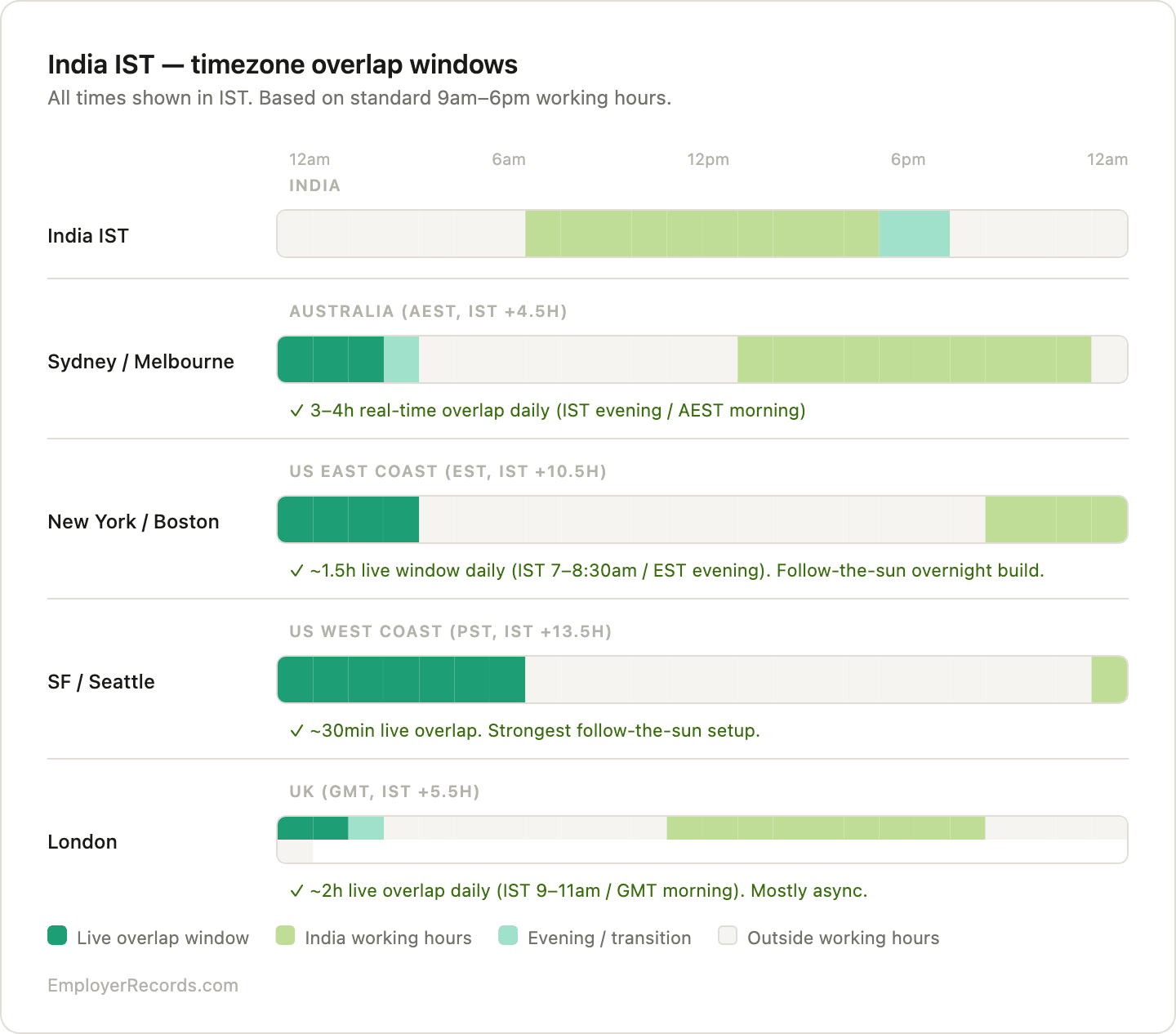
For RosterGrid that mattered with Australia specifically: IST sits roughly four-and-a-half hours behind AEST, and that overlap was the difference between asynchronous hand-offs and actual real-time collaboration.
The same geometry works for Singapore and the Gulf. And if your team is in the US, the offset becomes a follow-the-sun advantage: your India engineers are heads-down building while the US team sleeps, daily end-of-day handoffs keep the build moving around the clock, and you still get a usable window, US morning, India evening, for live sync whenever you want it. Either way, real-time overlap or overnight progress, India’s position is an asset.
Work ethic.
I’ll say it plainly because it’s been consistently true in my experience: the engineers I’ve hired in India have been hardworking and committed in a way that shows up in the work. That’s a genuine strength, but it comes with a cultural operating model you have to manage deliberately, which I’ll get to next.
What’s different about the working culture, and how to manage it well
The technical bar in India is not the thing that trips up foreign employers. The cultural operating model is. None of what follows is a criticism; it’s a set of defaults that differ from US/UK/AU norms, and managing them well is mostly about awareness.
The “yes” culture is real, and you have to design around it.
In many Indian workplaces there’s a strong cultural pull toward agreement, saying “yes, it’s possible” or “yes, on track” out of respect and optimism, sometimes ahead of the reality. If you ask “can this be done by Friday?” you’ll often get a yes.
The fix isn’t to distrust your team; it’s to stop asking yes/no questions. Ask “what’s the riskiest part of this and what would slip first?” Ask people to walk you through the plan rather than confirm a date. Once you change how you ask, the information you need surfaces.
Hierarchy and directness.
Western engineering cultures, especially Australian and American, prize blunt, flat, challenge-the-boss communication. Indian workplace norms tend to be more hierarchical and more deferential to seniority.
A junior engineer who spots a flaw in your architecture may not say so in a group call. You have to actively create the safety and the channels, 1:1s, anonymous retros, explicitly inviting dissent, or you’ll miss signal you’d have gotten for free at home.
Notice periods.
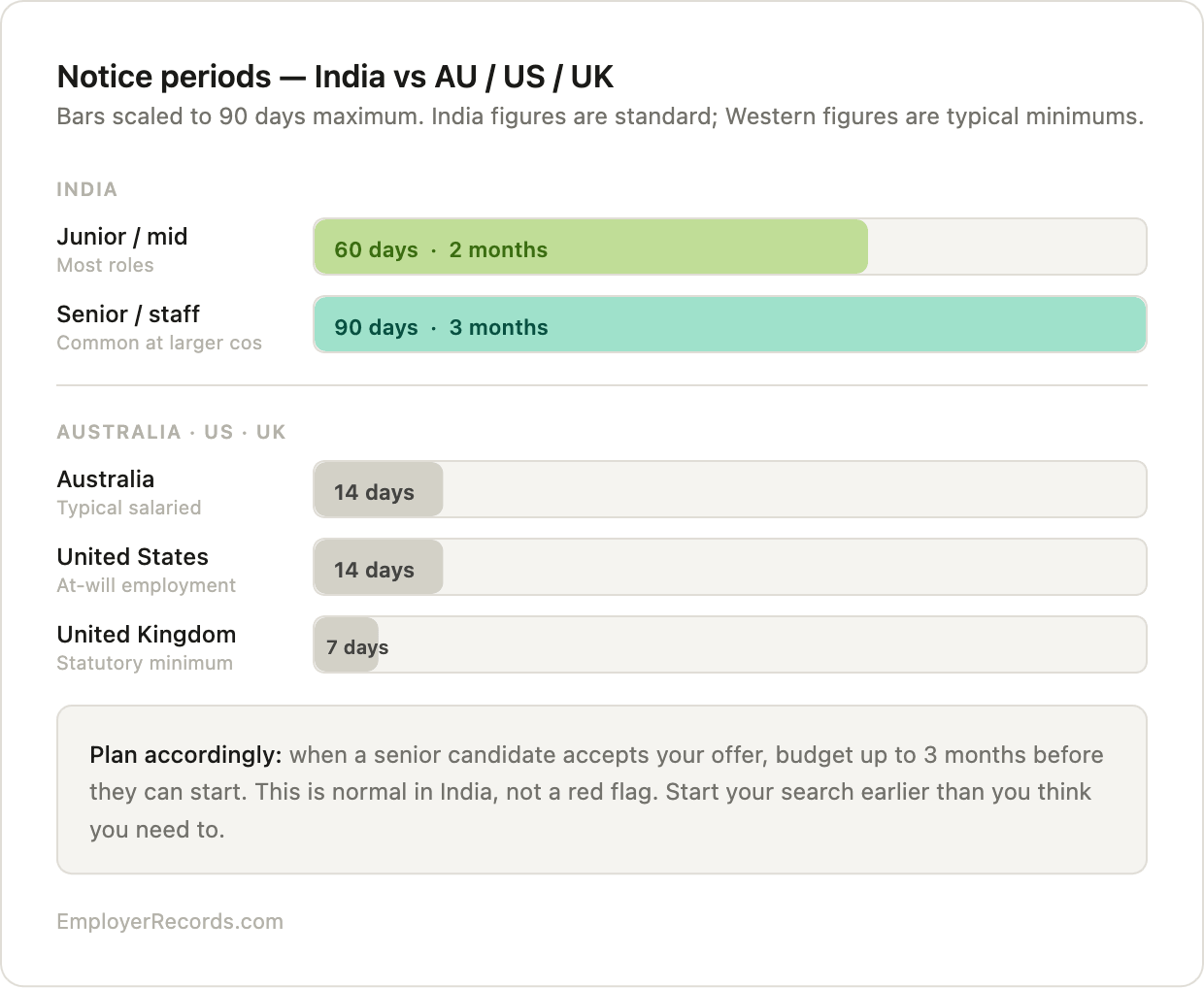
This catches every first-time foreign employer. Indian notice periods are long by Western standards, 60 to 90 days is common, and senior people may be serving out a three-month notice at their current employer when you make an offer. Plan your start dates accordingly, and don’t panic when your dream candidate can’t start for ten weeks. It’s normal.
Festivals and holidays.
India’s holiday calendar is regional and dense, Diwali, Holi, Pongal, Eid, and a long list of state-specific days. A Bangalore team and a team in another state may observe genuinely different calendars.
Map this at the start of the year, respect it fully, and you’ll earn a lot of goodwill. Schedule a launch over Diwali without checking and you’ll learn the hard way.
Employ people properly.
Culture and compliance are connected: nothing erodes trust with an Indian team faster than an arrangement that feels informal or precarious. Hiring people as proper employees, with the statutory benefits they’re legally owed, is both the compliant path and the one that earns loyalty.
If you don’t want to stand up your own legal entity to do it, an Employer of Record in India lets you employ talent compliantly without one, with PF, ESI, gratuity and TDS handled correctly from day one. Whatever route you choose, do it properly. The cultural dividend of a clean, compliant employment relationship is real.
What not to do, the lesson that changed how I hire
Now the warning. This is the most important section, and it comes from a hire that went wrong on day one.
At RosterGrid we interviewed an engineer who was genuinely excellent in the process, sharp, fast, clearly strong. We were thrilled he agreed to join, and to join immediately. Then day one arrived. His camera was off, “connectivity issues,” he said. Something felt off straight away: the voice didn’t sound like the person we’d interviewed. I pushed him to turn the camera on. He wouldn’t.
So we scheduled a later call and insisted on camera. This time it was the man who’d interviewed, same face, but his voice was clearly different from the person who’d shown up that morning. What had happened slowly became clear: the person who interviews is not the person who does the work.
He ran his own little team of developers behind him who did the actual building. He’d ace your interview, win the seat, and quietly subcontract your role to someone you never met and never vetted.
Here’s the uncomfortable nuance: he delivered the first task on time. The real developer behind him may well be perfectly competent. But that was never the point. He’d misrepresented who would have access to my codebase, my systems, and my customers’ data.
Competence doesn’t survive the discovery that someone lied to you about who they are. We terminated the employment that same day and removed all of his system access immediately, every credential, repository permission, and account had to go before we did anything else.
The honest lesson is that this was my failure, not just his. I should have run background, identity, and reference checks before onboarding, not after. I’d been so pleased he agreed to start fast that I let speed override verification.
Ever since, every single hire in every country goes through thorough background checks, criminal-record checks, identity verification, and real reference calls with people I actually reach on the phone, before day one.
If you take one thing from this article, take this: do not skip background, identity, and reference checks when you hire remotely in India, or anywhere you can’t shake the person’s hand.
A background check is a small, one-time cost. The cost of skipping it, a stranger inside your systems, work you can’t attribute, a same-day termination and a frantic scramble to revoke access, is far higher. Verify before day one so you never have to find out who has your credentials after you’ve already handed them over. I learned that the expensive way so you don’t have to.
India has given me some of the best engineers I’ve ever worked with. Go hire them. Just verify who they are first.
Pre-onboarding checklist — hiring developers in India
Complete all steps before granting system access on day one
Identity verification
Government ID check
Aadhaar, PAN card, or passport — verify the document is genuine and matches the candidate’s name
Live video call confirmation
Camera-on call before day one — confirm the face matches the person who interviewed
Employment history cross-check
Verify stated employers and roles against LinkedIn and direct confirmation from past employers
Background checks
Criminal record check
India police clearance certificate or third-party BGV provider (AuthBridge, SpringVerify, etc.)
Education verification
Confirm degree and institution — degree fraud is common; verify directly with the university where possible
Address verification
Physical address confirmed — required for statutory compliance and important for fraud prevention
Reference checks
Phone call with past manager
Live call only — written references are easy to fabricate; speak to the person directly
Second reference from a peer or skip-level
A second source outside the candidate’s chosen referee gives a more complete picture
System access protocol
Staged access rollout
No full codebase access on day one — grant read access first, expand after the first 2 weeks
Access revocation plan documented
All credentials, repo permissions, and accounts listed and owned — revocation must be same-day if needed
Pre-onboarding checklist — hiring developers in India
Complete all steps before granting system access on day one
Identity verification
Government ID check
Aadhaar, PAN card, or passport — verify the document is genuine and matches the candidate’s name
Live video call confirmation
Camera-on call before day one — confirm the face matches the person who interviewed
Employment history cross-check
Verify stated employers and roles against LinkedIn and direct confirmation from past employers
Background checks
Criminal record check
India police clearance certificate or third-party BGV provider (AuthBridge, SpringVerify, etc.)
Education verification
Confirm degree and institution — degree fraud is common; verify directly with the university where possible
Address verification
Physical address confirmed — required for statutory compliance and important for fraud prevention
Reference checks
Phone call with past manager
Live call only — written references are easy to fabricate; speak to the person directly
Second reference from a peer or skip-level
A second source outside the candidate’s chosen referee gives a more complete picture
System access protocol
Staged access rollout
No full codebase access on day one — grant read access first, expand after the first 2 weeks
Access revocation plan documented
All credentials, repo permissions, and accounts listed and owned — revocation must be same-day if needed