
EOR Legal Risks in India (2026): Contract Labour, Liability and Compliance
What the OSH Code, the courts and the tax rules mean for an employer using an EOR in India, and what to ask a provider before you sign.
What does Indian law say about EORs and contract labour?
No Indian law names or regulates an employer of record. The nearest rules are the contract labour provisions of the OSH Code, 2020, in force since 21 November 2025, and no court has yet tested an EOR model. The risk sits in core work: Section 57 bars contract labour in core activities except in three narrow cases.
- A principal employer can be liable for wages, provident fund and ESI, then recover the cost from the provider.
- None of the 15 providers we checked publishes its OSH Code position or an EPFO code, so ask for the licence answer in writing.
- The contractor licence threshold is 50 workers.
India has no statute that names or regulates an employer of record. The nearest rules are the contract labour provisions of the Occupational Safety, Health and Working Conditions (OSH) Code, 2020, and the tests courts use to decide who an employer really is.[1]
The four labour codes have been in force since 21 November 2025, with central rules from 8 May 2026. One practitioner roadmap we read still describes the state rules, which carry the contractor licensing detail, as forthcoming.
No EOR ruling yet. We found no Indian judgment that tests an EOR model directly. The risks below come from contract labour law and employer tests applied to similar arrangements, so read this page as analysis, not settled law.
When does the OSH Code make you a principal employer?
When a contractor supplies workers to your establishment. Registration and licensing thresholds sit in the Code, and the licence is the contractor’s to hold.[2]
The licence carries a security deposit, and unpaid wages can be recovered from it. Where the contractor lacks a licence, the contravention lands on you as principal employer.
Can you use contract labour for core work in India?
Only in narrow cases. Section 57 of the OSH Code prohibits contract labour in core activities unless the work is ordinarily done through a contractor, does not need full-time staff for the major portion of the day, or faces a sudden surge that must be finished in a set time.[3]
Section 2(p) defines core work as the activity the establishment exists for, plus work essential to it. Sanitation, housekeeping, security and catering are generally treated as non-core.
How activities are usually classed
| Activity | Usual class | Why |
|---|---|---|
| Assembly-line operations | Core | The establishment exists to do this work. |
| Product testing and quality control | Core | Essential to the primary activity, so an exception must apply. |
| Warehousing and packaging | Grey area | Depends on how tightly it is integrated with core work. |
| Housekeeping, security, catering | Non-core | Support functions, unless the business exists to provide them. |
Our view. Most EOR hires work in the client’s core activity. In our check of 15 providers, none publishes how it classes that work under the Code, which is why we mark every provider as Confirm.
What are you liable for if the contractor defaults?
A lot of it, though you can usually recover the cost afterwards. The principal employer sits behind the contractor on wages, provident fund and ESI.[4]
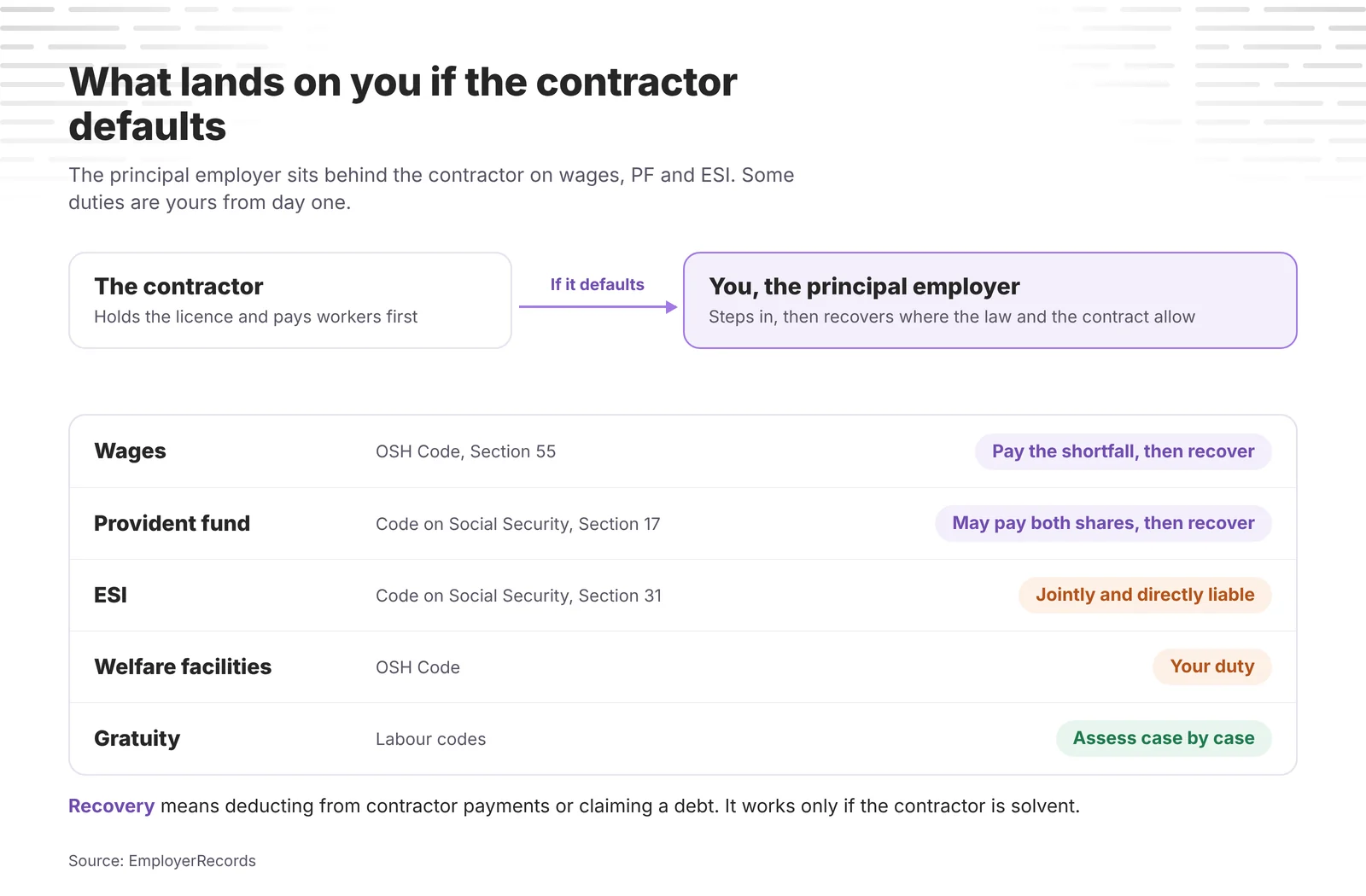
Principal employer liability when a contractor defaults
| Head | Provision | Position |
|---|---|---|
| Wages | OSH Code, Section 55 | You pay any shortfall and recover it from the contractor. |
| Provident fund | Code on Social Security, Section 17 | You may pay both shares and recover. |
| ESI | Code on Social Security, Section 31 | Jointly and directly liable for both shares. |
| Welfare facilities | OSH Code | Canteen, first aid, creche and drinking water are your duty. |
| Gratuity | Labour codes | Automatic liability no longer assured; assess case by case. |
Recovery means deducting from contractor payments or claiming a debt. That helps only if the contractor is solvent and the contract allows it.
Our view. Treat the contractor’s solvency as your risk. The principal employer sits behind the contractor on wages, PF and ESI, and recovery only works if the contractor can pay and the contract lets you deduct.
How do Indian courts decide who the real employer is?
By looking past the paper. In General Manager, U.P. Cooperative Bank v. Achchey Lal, decided on 11 September 2025, the Supreme Court reviewed the control, integration and multifactor tests. It held that a bank was not the employer of canteen workers it subsidised.[5]
The same ruling confirms that sham or camouflage contracts can be pierced. The court asks who pays and who controls, a test drawn from Bengal Nagpur Cotton Mills v. Bharat Lal.
Does an EOR arrangement count as contract labour?
It depends on how the arrangement works, and nobody has tested it in court. If the provider is the genuine employer, with its own registrations, payroll and HR control, the contract labour rules fit poorly. If it only supplies people who work under your direction in your core activity, a regulator could look at it as labour supply.[6]
The provider’s licence position decides which side you are on. Ask for it in writing before you sign.
Our view. Treat the OSH Code answer as a due diligence item, not a given. Ask each provider whether it holds a contractor licence and how it classes your role. The answers we have on file for 15 providers are blank.
Who is the legal employer, and does it have an EPFO code?
The entity decides whose EPFO code covers the hire’s provident fund. Only Deel names its Indian EOR entity in writing, and none of the 15 providers we checked publishes an EPFO establishment code.
Multiplier, Pebl and Papaya Global have Indian subsidiaries on the register but do not say they employ through them. The full table is on the India EOR providers page.
Can an EOR hire create a taxable presence in India?
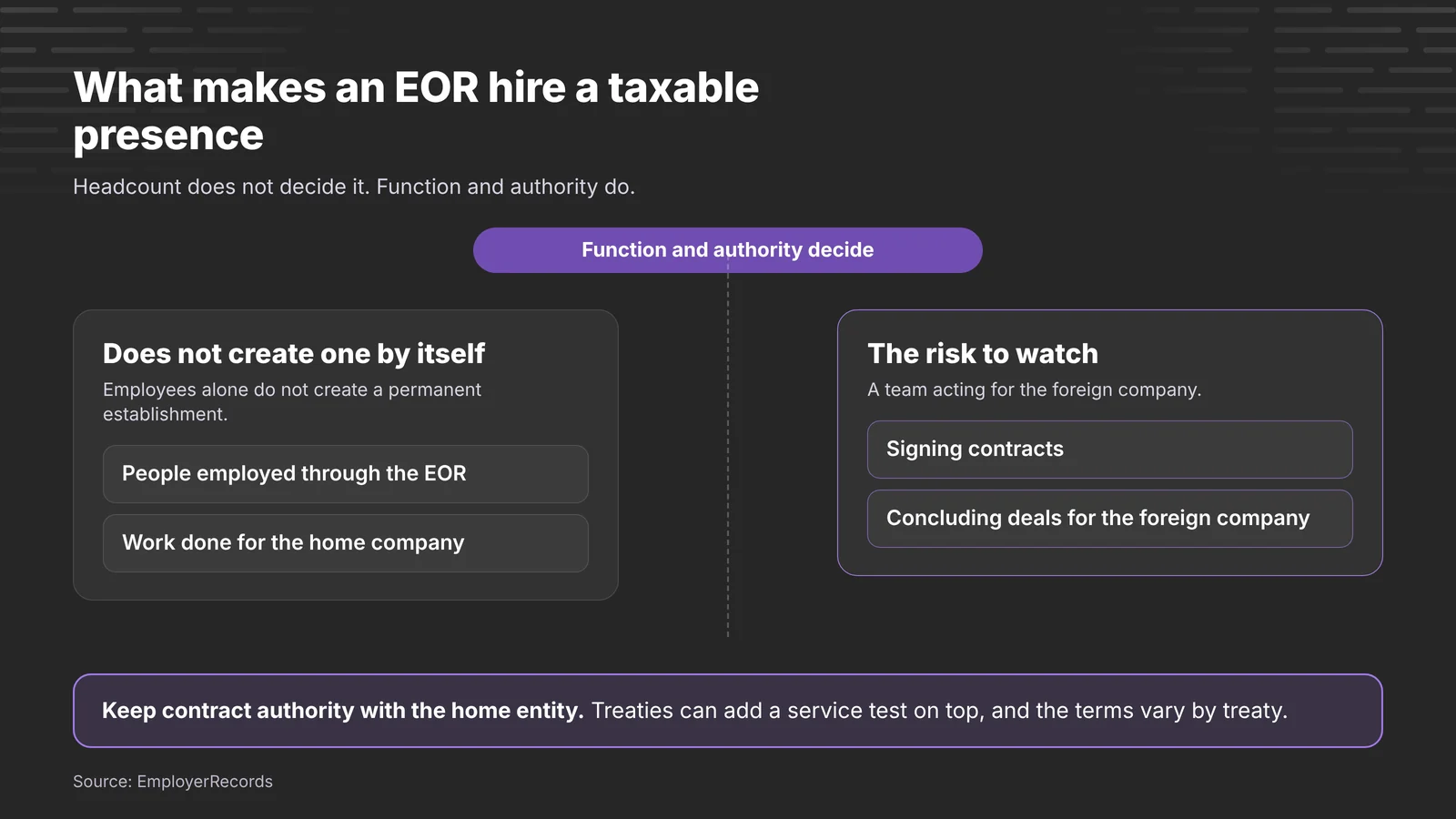
Employees alone do not create a permanent establishment. What matters is function and authority. A team that signs contracts or concludes deals for the foreign company is the risk, which is why contract authority should stay with the home entity.[7]
The courts have worked this through in Morgan Stanley (2007), E-Funds (2017) and Formula One (2017). Treaty tests add a service PE, typically after 90 days in 12 months, though terms vary by treaty.
The Income-tax Act, 2025 has applied since 1 April 2026, so check current section references rather than the old Section 9 wording that most commentary still uses.
Is a contractor safer than an EOR in India?
Not for full-time work under your direction. Such a person fails the control and integration tests above, and reclassification can bring back provident fund contributions and tax.
A contractor is the right fit for a defined project with independent tools and several clients. For an ongoing role in your team, compare the EOR route with a Private Limited Company.
What does a compliant EOR setup in India look like?
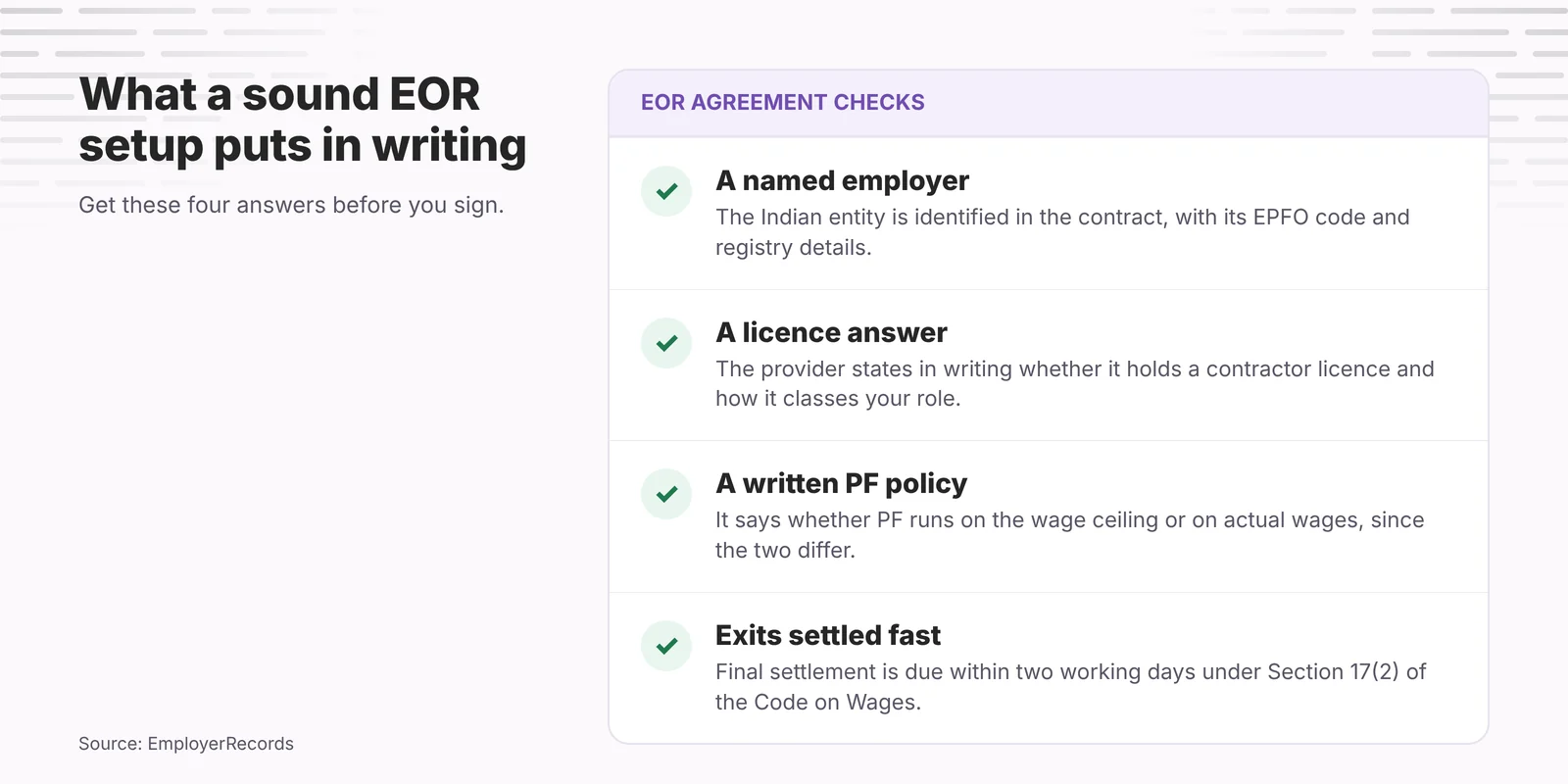
What should the EOR agreement say?
Clauses worth asking for
| Clause | What it protects |
|---|---|
| Licence and OSH Code classification warranty | Puts the contravention risk on the provider, not you. |
| Indemnity for statutory dues | Covers wages, PF and ESI if the provider defaults. |
| Audit rights over remittances | Lets you check PF and ESI payments against payroll. |
| Named entity and EPFO code | Shows who the legal employer actually is. |
| Limits on signing authority | Keeps contract authority with you and out of India. |
Contract review. Have Indian counsel read the final clauses. This page is research, not legal advice.
What does the compliance layer cost?
The fee is the smaller number. EOR fees run $99 to $699 per employee a month, with a median of $499, in our pricing index (reviewed 25 October 2026).
The provider’s PF policy moves more money. On a ₹1,50,000 salary, the two policies differ by ₹6,250 a month, or ₹75,000 a year. Run your own headcount through the EOR cost calculator.
Questions about EOR legal risks in India
Short answers to what employers ask most before signing an EOR agreement in India, checked against the sources below on 6 November 2026.
Are EORs legal in India?
India has no law that regulates EORs by name. They operate through an Indian entity that employs the worker, and the OSH Code contract labour rules may apply depending on structure.
Does the OSH Code apply to EORs?
It can, if the EOR supplies workers to you under your direction. The Code requires a licence for contractors supplying 50 or more workers, and the contravention lands on you as principal employer if the licence is missing.
Can contract labour be used for core activities in India?
Only under three exceptions in Section 57: the work is ordinarily done through a contractor, it does not need full-time workers for most of the day, or there is a sudden surge in work.
What are you liable for if an EOR fails to pay?
As principal employer you can be liable for wage shortfalls under Section 55 of the OSH Code, and for provident fund and ESI under Sections 17 and 31 of the Code on Social Security. You can recover the cost from the provider.
Has an Indian court ruled on EORs?
We found no judgment on EORs. The Supreme Court’s September 2025 Achchey Lal ruling sets the tests for who an employer is and allows sham contracts to be pierced.
Can an EOR hire create a permanent establishment in India?
Employees alone do not. Risk rises when staff sign contracts or conclude deals for the foreign company, so contract authority should stay with the home entity.
Which EOR providers own an Indian entity?
In our check of 15 providers, 8 own an Indian company matched on the MCA register. Four state it without naming one, one uses a partner and two are unconfirmed.
How much does an EOR cost in India?
$99 to $699 per employee a month, median $499, in our pricing index reviewed on 25 October 2026.
References and sources
Every figure on this page comes from the sources below. Numbers in square brackets in the text link to the matching entry. Official statistics are used wherever they exist, and our own calculations are labelled as estimates. All sources were checked on 06 November 2026.
- ↑Contract labour: new dynamics under the new labour code. Lakshmikumaran and Sridharan. lkslaw.com. Retrieved 06 November 2026. Guide
- ↑Mastering CLRA to OSH transition: principal employer compliance roadmap. Mondaq. mondaq.com. Retrieved 06 November 2026. Guide
- ↑Outsourcing under India’s labour codes: redrawing the core activity boundary. Mondaq. mondaq.com. Retrieved 06 November 2026. Guide
- ↑Contractor and principal employer duties and vicarious liabilities under the labour codes. Corporate Professionals. corporateprofessionals.com. Retrieved 06 November 2026. Guide
- ↑General Manager, U.P. Cooperative Bank Ltd. v. Achchey Lal, final order, 11 September 2025. Supreme Court of India. sci.gov.in. Retrieved 06 November 2026. Official
- ↑Legal implications of using an EOR in India. Wisemonk. wisemonk.io. Retrieved 06 November 2026. Provider
- ↑Can employment or consulting create a permanent establishment in India?. KS&K. ksandk.com. Retrieved 06 November 2026. Guide
About the author

Manjuri Dutta is Co-Founder and Content Editor at EmployerRecords.com, covering Employer of Record providers and global hiring platforms. She evaluates providers on entity ownership, statutory compliance, and real pricing rather than vendor claims, and built the verification process used across EmployerRecords' country guides, checking vendor claims against government registries and public filings.
View all articles by ManjuriHiring guides for other countries
Compare India with the legal and cost picture in other markets.
 IndiaAverage salaryAverage Salary in India (2026): Pay by Role and Employer CostOfficial pay by gender and work type, role benchmarks, take-home and the employer cost on top of a salary in...Read the guideIndiaEOR vs Private Limited CompanyEOR vs Private Limited Company in India (2026): Cost and TimelineSet-up cost, time to first hire, compliance, tax exposure and exit compared for an EOR and a Private Limited Company...Read the guideIndiaMaternity and Paternity LeaveMaternity and Paternity Leave in India (2026): Rules and Cost26 weeks paid maternity leave, no private sector paternity law, and a 2026 Supreme Court ruling that changed the rules...Read the guideIndiaMinimum wageMinimum Wage in India (2026): State Rates, Codes and CostsState minimum wages by skill and zone, the labour codes in force since November 2025, and what an employer really...Read the guide
 Czech RepublicAverage salaryAverage Salary in the Czech Republic (2026): CZK 50,650 a MonthAverage and median pay, regional gaps, gross to net and what employers add on top, from the Czech Statistical Office.Read the guideCzech RepublicMinimum wageMinimum Wage in the Czech Republic (2026): CZK 22,400 a MonthThe monthly and hourly minimum wage for 2026, the increase for 2027, overtime and what employers add on top.Read the guide
Hiring in India?
See the full cost of a hire at any salary, state-by-state compliance, visas and the providers that employ in India.