







Rippling Vs Remote Comparison Summary
When you’re managing an international workforce, choosing the right tool matters. Rippling and Remote both help companies hire, pay, and manage employees across borders, but they approach global employment in very different ways.
Rippling is built for automation and control, connecting HR, IT, and finance in one system. Remote focuses on compliance and simplicity, offering full legal coverage through its own global entities.
This comparison breaks down what each platform does, who it’s best for, and the key trade-offs to help you decide which fits your organization best.
Rippling Vs Remote: Product Overview
At a glance, both platforms enable global employment, payroll, and compliance. The difference lies in how much control you want to keep in-house.
Rippling
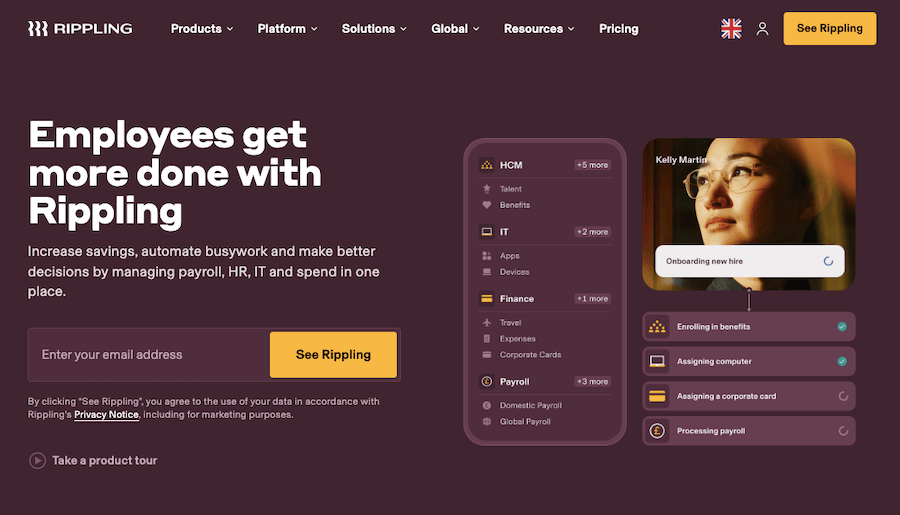
What it does: Rippling unifies HR, payroll, benefits, device management, and global hiring in one platform. It supports payroll and hiring in over 180 countries and lets you automate everything from onboarding to offboarding.
Who it’s for: Mid-sized and large organizations with internal HR and IT teams who want automation and full visibility into their operations.
Philosophy: Centralize everything. Automate what can be automated. Replace disconnected tools and manual workflows with one system.
What stands out: Rippling isn’t just HR software; it also handles IT setup, app access, and finance workflows. That’s a big advantage if your company wants to manage the entire employee lifecycle in one place.
Remote
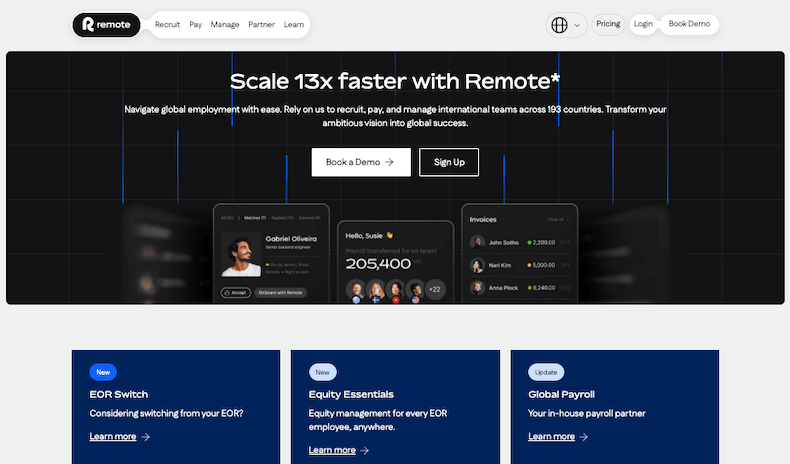
What it does: Remote is a global Employer of Record (EOR) platform that lets you hire and pay employees anywhere without setting up local entities. It manages payroll, compliance, benefits, and tax filings through its own entities in over 90 countries.
Who it’s for: Companies expanding internationally that don’t want to manage local compliance or legal risk themselves.
Philosophy: Simplify global employment. Offer full compliance and support so companies can hire anywhere confidently.
What stands out: Transparent pricing and fully owned entities give Remote a strong edge for compliance and legal protection.
Rippling Vs Remote: Feature Comparison
| Feature | Rippling | Remote |
|---|---|---|
| Global Coverage | 180+ countries, 50+ currencies | 90+ countries via owned entities |
| Platform Type | Unified HR, IT, and Finance system | Dedicated Employer of Record (EOR) |
| Onboarding Speed | Fast, automated workflows (as little as 90 seconds in some cases) | Yes, contractor management is built in |
| Contractor Support | Yes, automated contractor payments | Custom starts around $20/user for HR modules; EOR pricing on request |
| Payroll Engine | Global payroll with local filing automation | Typically 1–3 days, depending on the country |
| Benefits | Localized payroll managed by Remote | Pre-built local benefits packages |
| Compliance & IP Protection | Automated compliance tools, data protection, SOC 2 and GDPR certified | Full legal and employment compliance through owned entities |
| UX / UI | Modern, modular dashboard with deep automation | Simple and intuitive interface |
| Integrations | 500+ integrations and open API | Core integrations for HR and accounting |
| Customer Support | Dedicated account manager and chat support | 24/7 support and regional compliance specialists |
| Pricing | Custom, starts around $20/user for HR modules; EOR pricing on request | Transparent: $599/employee/month (annual) or $699 (monthly) |
| Security | SOC 2, ISO, GDPR | GDPR, ISO aligned |
| Scalability | Ideal for internal process expansion (HR, IT, Finance) | Ideal for geographic expansion without entities |
Rippling Vs Remote: Feature Deep-Dive
Onboarding and Global Hiring
Rippling makes onboarding fast and almost fully automated. You can hire someone, issue their device, set up payroll, and grant app access in one go. The system is built for speed and internal control.
Remote’s onboarding focuses on compliance. Each hire goes through local contract setup, payroll registration, and benefits alignment. It’s slower but ensures everything is legally sound in each country. If you value automation, Rippling fits better. If compliance is your top concern, Remote is safer.
Payroll and Benefits
Rippling offers a unified global payroll engine that processes payments in multiple currencies while keeping everything under one system. It’s efficient for companies already managing payroll in several countries.
Remote runs payroll locally in each jurisdiction. You don’t have to worry about filings or calculations; they do it for you. This hands-off model suits companies that want legal certainty more than control.
Integrations and Automation
Rippling clearly leads here. It connects to hundreds of tools across HR, IT, and finance. You can trigger workflows that update payroll, send devices, and manage app access, all automatically.
Remote integrates with core HR and accounting tools but keeps things simpler. It’s not designed for complex IT automation; it’s focused on global hiring and payroll.
Compliance and Legal Assurance
Remote’s key strength is compliance. Because it owns entities in every country it operates in, your employees are legally employed through Remote, and all local risks are covered.
Rippling, while compliant and certified, relies partly on partnerships in some regions. It’s highly secure and automates compliance tracking but doesn’t remove employment risk entirely. For legal teams, this is often the deciding factor. Remote assumes more responsibility.
Rippling Vs Remote: My Take
The real difference between Rippling and Remote is philosophical.
Rippling is built for control and integration. It’s ideal for teams that want automation and a single system to manage HR, IT, and finance together.
Remote is built for peace of mind. It’s best for teams that want to hire across borders quickly, stay compliant everywhere, and lean on expert support.
Rippling works well for companies that already have internal HR infrastructure. Remote is a better fit for teams without it. Pricing transparency is another contrast: Remote publishes its rates, while Rippling provides custom quotes depending on the mix of modules.
Recommendation
Choose Rippling if you:
• Want a unified HR, IT, and finance platform
• Have internal HR or compliance teams
• Prefer automation and system control
• Plan to scale across functions as well as countries
Choose Remote if you:
• Need to hire globally without local entities
• Value legal assurance and local compliance support
• Prefer transparent pricing and personal assistance
• Want to reduce internal admin and risk
Rippling Vs Remote: Final Verdict
If automation and unified control are your priorities, Rippling stands out. If compliance, simplicity, and risk protection matter more, Remote delivers what most global teams need.
Ultimately, it’s not about which platform is better; it’s about which fits how you operate.