


Hiring someone in another country sounds straightforward until you actually try to do it. You need a legal entity in that country, a local bank account, a working understanding of that country’s labor law, tax registration, and a compliant employment contract, all before you can put someone on payroll.
Most companies don’t have that infrastructure. And building it takes months, sometimes longer.
An Employer of Record solves this. The EOR is a third-party company that employs workers on your behalf in countries where you don’t have a legal presence. You find the person, you direct their work, but the EOR is the legal employer. They handle payroll, taxes, benefits, and compliance with local labor law.
This isn’t a workaround or a grey-area solution. It’s a well-established model used by companies at every stage, from startups making their first international hire to enterprises expanding into new markets quickly.
This guide covers how EORs actually work, what they handle, how they compare to other models, and how to decide whether one is the right fit for your situation.
What Is an Employer of Record?
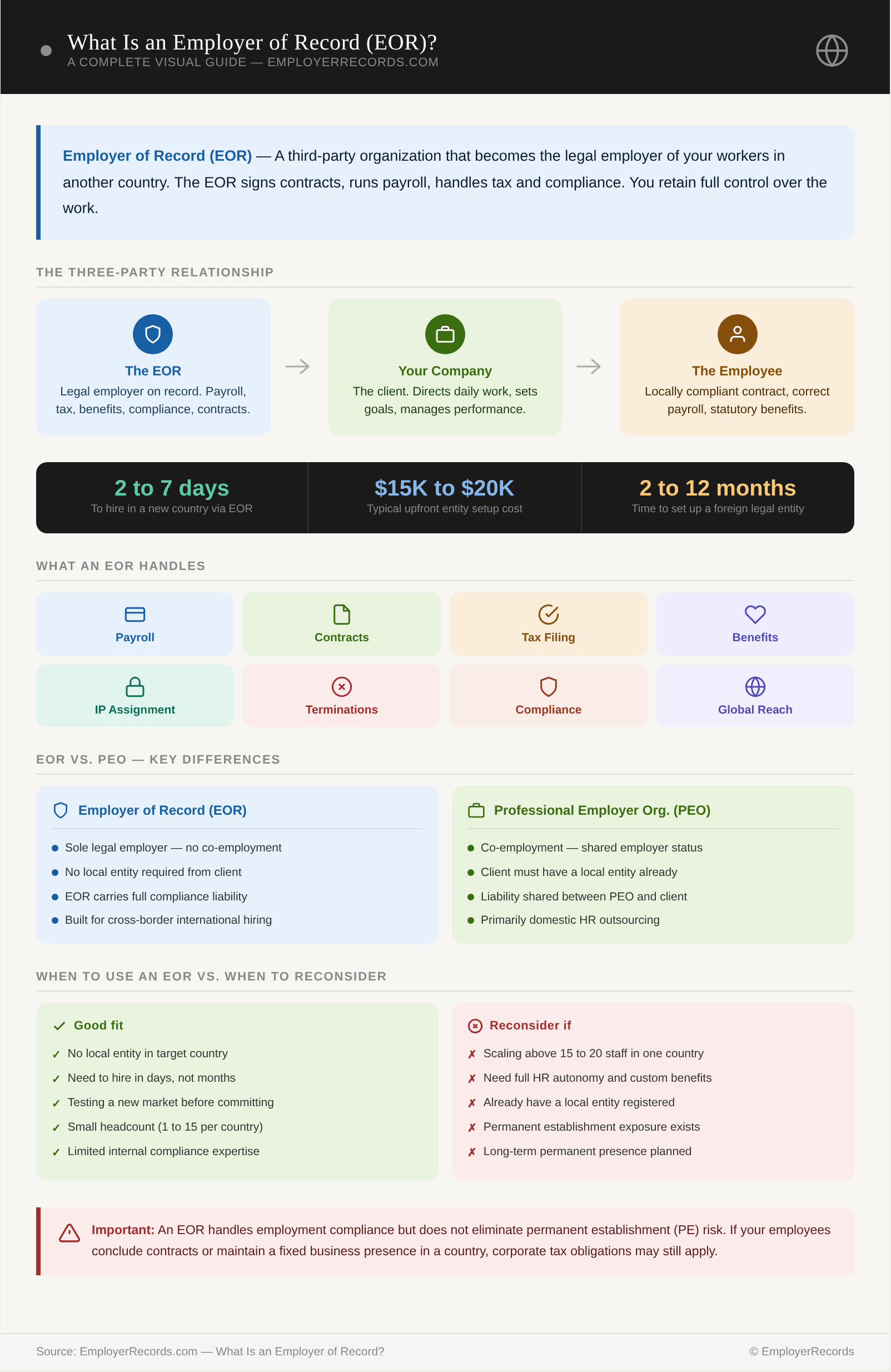
An Employer of Record is a third-party organization that becomes the legal employer of your workers in a given country. They sign the employment contract, run payroll, withhold taxes, and administer benefits — all in full compliance with local law.
Your company still controls the work. You set the job responsibilities, manage day-to-day tasks, and decide who gets hired or let go. The EOR handles everything on the employment and compliance side.
This creates a three-way relationship: the EOR is the employer on paper, the worker is employed through the EOR, and your company is the client directing the actual work.
The distinction matters legally. In most countries, you cannot simply pay someone in another jurisdiction without a registered legal entity there. The EOR’s local entity is what makes the hire compliant. Without it, you’re either misclassifying the worker as a contractor or operating illegally as an unregistered employer.
Companies use EORs when they want to hire in a country without setting up a subsidiary, when they need to move fast, or when the volume of hires doesn’t justify the cost of establishing a local entity.
How Does an EOR Work?
When you decide to hire someone in another country, the EOR steps in as the legal employer in that market. You agree on the candidate, the role, and the compensation. The EOR handles everything else from that point forward.
The EOR uses its own registered legal entity in the target country to employ the worker. This is what makes the arrangement compliant. The worker receives a locally valid employment contract, gets paid through local payroll, and receives benefits that meet or exceed what local law requires.
Your company signs a client services agreement with the EOR. This contract defines the commercial relationship, your obligations, the EOR’s responsibilities, fees, and how the arrangement can be ended. The worker never sees this agreement. From a legal standpoint, their employer is the EOR.
On the compliance side, the EOR stays current with changes to local labor law, tax codes, and statutory benefit requirements. If the minimum wage increases, if termination rules change, or if new payroll reporting obligations come into force, the EOR adapts. Your company doesn’t need to track any of it.
Terminations are also handled through the EOR. This matters because wrongful termination exposure varies significantly by country. In markets like Germany, France, or Brazil, termination without proper process carries serious legal and financial consequences. The EOR manages this correctly so your company isn’t exposed.
Throughout the employment, you manage the person’s work directly. The EOR has no say in what projects they work on, how their performance is evaluated, or what their day-to-day looks like. That remains entirely with you.
What Does an EOR Actually Handle?
The short answer is everything on the employment side. But it’s worth understanding what that actually means in practice, because the scope is broader than most people expect when they first look at EOR services.
Payroll
Payroll through an EOR isn’t just sending a salary. The EOR calculates gross-to-net pay in the local currency, applies the correct income tax withholding, deducts employee social contributions, adds employer-side contributions, and files everything with the relevant tax authority on the correct schedule.
In countries with complex payroll rules like Brazil or Italy, this alone is a significant compliance undertaking.
Employment Contracts
Every country has specific requirements for what an employment contract must contain. Notice periods, probation terms, working hour limits, overtime rules, termination conditions, these vary widely and cannot simply be lifted from a template. The EOR drafts contracts that are compliant with the law of the country where the worker is based, not where your company is headquartered.
Tax Compliance
The EOR registers as an employer with local tax authorities, withholds the correct amounts from employee pay, and makes employer tax contributions on schedule. They also handle year-end filings and any employer reporting obligations specific to that jurisdiction.
Statutory Benefits
Most countries mandate benefits beyond salary. These include paid leave entitlements, sick pay, maternity and paternity leave, pension contributions, and in some cases healthcare.
The International Labour Organization sets baseline standards that national laws build on, but the specifics differ significantly by country. The EOR ensures workers receive everything they are legally entitled to.
Supplementary Benefits
Beyond statutory minimums, EORs often administer supplementary benefits, private health insurance, life cover, equipment stipends, and wellness allowances. These vary by provider and by what the client company wants to offer to remain competitive in that market.
IP and Confidentiality Agreements
Intellectual property assignment is often overlooked in international hiring. The EOR ensures that IP created by the employee in the course of their work is correctly assigned to your company, and that confidentiality obligations are enforceable under local law.
Terminations and Offboarding
This is where EOR value is most underestimated. Termination law varies enormously across jurisdictions. In markets like France, Germany, and the Netherlands, employers must follow specific procedures, observe statutory notice periods, and in some cases pay severance regardless of the reason for termination.
The EOR manages this process correctly, reducing your exposure to wrongful dismissal claims significantly.
EOR vs. PEO: The Real Difference
The terms EOR and PEO get used interchangeably in some conversations. They shouldn’t. The two models are built on fundamentally different legal structures, and choosing the wrong one can create real compliance problems.
The core distinction comes down to legal structure. A PEO operates through co-employment, your company and the PEO both hold employer status simultaneously. You remain the worksite employer, directing day-to-day work, while the PEO acts as the administrative employer handling payroll, benefits, and tax filings under its own employer identification number.
An EOR is different. There is no co-employment. The EOR becomes the sole legal employer in that country. Your company has no employer status there at all. That is the entire point; it is what allows you to hire without a registered entity.
The entity requirement is where the practical difference really shows up. A PEO requires your company to already have a legal entity in the country where the workers are based. The PEO then manages HR functions within that existing structure. An EOR requires no local entity from you; its own registered presence in that country is what makes the hire legal.
This makes PEOs primarily a domestic or same-country tool, and EORs the model of choice for cross-border hiring where you have no local footprint.
Liability also splits differently. With a PEO, employment liability is shared between you and the PEO under the co-employment agreement. With an EOR, the EOR carries the full legal employer liability. Your exposure on employment compliance matters is substantially lower.
The right question to ask is not which model is better, but which one your situation actually supports. If you have a legal entity in the country and want to offload HR administration, a PEO may be the right fit. If you are hiring across borders without a local entity, an EOR is the only compliant path.
EOR vs. Subsidiary Setup: What You’re Actually Choosing Between
For many companies, the real decision isn’t EOR versus PEO. It’s EOR versus setting up their own legal entity in the target country. Both paths get you to compliant employment. The question is which one makes sense for your situation right now.
Setting up a foreign entity typically takes between two and twelve months depending on the country, and setup costs generally range from $15,000 to $20,000 upfront, with ongoing maintenance costs that can reach significantly higher.
An EOR can get a worker on payroll in a new country within days. That gap in timelines is the first thing to weigh.
But speed isn’t the only factor. The nature of your commitment to that market matters just as much. If you are testing whether a market is worth entering, or if you need one or two people on the ground to evaluate demand, building a subsidiary for that purpose makes no financial or operational sense. An EOR lets you move without locking in.
If you are committed to a market long term, plan to hire a significant headcount there, and want full operational control over your local HR infrastructure, a subsidiary starts to make more sense.
The EOR fee structure, typically charged per employee per month, can become more expensive than running your own entity once your team in that country reaches a certain size.
There is also a control consideration. With your own entity, you set the HR policies, choose the benefits structure, and manage the employment relationship directly. With an EOR, you operate within the EOR’s framework.
For most companies hiring one to ten people in a country, that trade-off is easy. For companies with large, established teams and specific HR requirements, it becomes worth revisiting.
The practical decision framework is straightforward. Use an EOR when you are entering a new market, moving fast, hiring a small team, or unsure of your long-term commitment. Move to a subsidiary when you have validated the market, are scaling headcount significantly, and need the operational autonomy that comes with your own legal presence.
EOR vs. Contractor Engagement
Hiring an independent contractor in another country feels like the simplest option. No entity required, no payroll setup, just a contract and an invoice. The problem is that simplicity comes with significant legal exposure if the working relationship doesn’t actually match the contractor classification.
Most countries determine worker classification based on the reality of the working relationship, not what the contract says. If someone works exclusively for your company, follows your direction, uses your equipment, and operates on your schedule, most labor authorities will treat them as an employee regardless of what the agreement calls them.
The tests vary by country. The US uses multiple frameworks including the IRS common law test and the Department of Labor’s economic reality test. The UK uses employment status tests under the Employment Rights Act. Germany applies an overall assessment of economic dependence. The EU’s Platform Work Directive, formally adopted in 2024 and requiring member state implementation by 2026, creates a legal presumption of employment for platform workers across all EU countries. The direction of travel globally is toward stricter classification, not looser.
What Misclassification Actually Costs?
The financial consequences of getting this wrong are significant. In the US, penalties for unintentional misclassification start at $50 per unfiled W-2 and scale up to 40% of unpaid FICA taxes for wilful violations. Spain fined Glovo €136 million across two rulings for misclassifying delivery riders.
As EmployerRecords documents in detail, Nike faces potential tax exposure exceeding $530 million for allegedly misclassifying thousands of temporary workers, a case still working through IRS proceedings.
Penalties also apply retroactively. A reclassification finding doesn’t just cover today; it can reach back several years, stacking back taxes, unpaid contributions, interest, and fines for the entire period the worker was incorrectly classified.
Where an EOR Fits In?
An EOR removes this exposure entirely. The worker is classified as an employee from day one, employed under a compliant contract, with all statutory contributions made correctly. There is no ambiguity in the classification and no retroactive liability to manage.
Contractors remain appropriate where the relationship is genuinely independent, project-based, non-exclusive, with the worker offering the same services to multiple clients. Where that independence doesn’t exist in practice, contractor engagement is a compliance risk, not a cost saving.
Benefits of Using an EOR
The case for an EOR comes down to four things: speed, compliance, cost structure, and flexibility. Each one matters differently depending on where your company is in its growth.
Speed
The most immediate benefit is how fast you can hire. With an EOR, a worker in a new country can be on payroll within days. Without one, you are waiting months for entity setup before a single compliant hire can be made. In competitive talent markets, that gap costs you candidates.
Compliance Without the Overhead
Every country has its own payroll rules, tax filing schedules, statutory benefits, and termination procedures. Staying current with all of it across multiple jurisdictions is a full-time job. The EOR carries that burden. Their legal and compliance teams track regulatory changes, update employment terms as laws shift, and ensure your workers are always covered correctly.
This matters most in markets with complex or frequently changing labor laws, Brazil, France, Germany, the Netherlands, where the cost of non-compliance is not just a fine but potential criminal liability for directors.
Lower Upfront Cost
Setting up a foreign entity costs between $15,000 and $20,000 upfront in most markets, before accounting for ongoing maintenance, local directors, accounting, and legal fees.
An EOR replaces all of that with a predictable per-employee monthly fee. For early-stage international expansion, the cash flow difference is significant.
Flexibility to Scale or Exit
Business conditions change. A market that looks strong today may not justify a permanent presence in twelve months. An EOR lets you scale a team up quickly when demand is there, and wind down cleanly when it isn’t. Closing a foreign subsidiary, by contrast, is a slow and expensive process in most jurisdictions.
Access to Local Expertise
Beyond compliance, EORs bring ground-level knowledge of local hiring norms, competitive benefits benchmarks, and what workers in that market actually expect.
That context is hard to develop quickly from the outside, and getting it wrong affects your ability to attract and retain talent.
Limitations and When an EOR Is Not the Right Fit
An EOR is a strong solution for many international hiring scenarios. It is not the right fit for all of them. Being clear about the limitations helps you make a better decision and avoid building a workforce structure that creates problems later.
Cost at Scale
EOR pricing is typically charged per employee per month. At low headcount, this is efficient and far cheaper than entity setup. At higher headcount, generally above fifteen to twenty employees in a single country, the cumulative monthly fees can exceed what it would cost to run your own local entity.
If you are planning significant long-term hiring in one market, the cost comparison is worth running before you commit to an EOR as a permanent solution.
Reduced HR Autonomy
When you employ through an EOR, you operate within their employment framework. Benefits structures, onboarding processes, and certain HR policies are shaped by the EOR’s systems and the contracts they use. For most companies this is a reasonable trade-off.
For companies with highly specific HR requirements, strong employer brand considerations, or particular benefits designs they want to offer, this loss of direct control can become a genuine constraint.
Not a Substitute for Permanent Establishment Planning
An EOR handles employment compliance. It does not eliminate permanent establishment (PE) risk.
If your team in a country is signing contracts, generating revenue locally, or operating from a fixed place of business, you may still trigger corporate tax obligations under local law.
The EOR structure doesn’t shield you from this. PE risk needs to be assessed separately, based on how your business actually operates in that market.nalysis.
Employee Perception
In some markets, workers are aware that they are employed through a third party rather than directly by the company they work for. This can occasionally affect how employees perceive their relationship with your organisation, particularly around job security, career progression, and cultural integration.
Most EOR providers manage onboarding in a way that minimises this, but it is worth acknowledging, particularly for senior or long-term hires.
Long-Term Presence Strategy
If your goal from the outset is to build a substantial, permanent operation in a country, an EOR is best used as a bridge, not a destination.
Starting with an EOR to hire your first people while your entity setup is underway is a well-established approach. Staying on an EOR indefinitely when you have thirty employees in a market and no exit plan is a different situation, and one worth reviewing.
Is an EOR Right for Your Business?
The answer depends less on company size and more on your specific situation in a given market. A 5,000-person company entering a new country for the first time faces the same fundamental question as a 50-person startup making their first international hire.
Here is how to think through it.
Use an EOR if:
- You have no legal entity in the target country. This is the clearest trigger. Without a registered entity, an EOR is the only compliant path to employment. The alternative is misclassifying workers as contractors, which carries the risks covered in the previous section.
- You need to hire fast. If a candidate won’t wait three to six months while you set up an entity, an EOR closes that gap immediately. Speed of hire matters most in competitive talent markets and time-sensitive project situations.
- You are testing a new market. Before committing to a permanent local presence, an EOR lets you validate whether the market justifies the investment. You can hire one or two people, assess the opportunity, and make the entity decision later with real data rather than projections.
- Your headcount in the country is small. For teams of one to fifteen people in a single country, the EOR fee structure is almost always more cost-effective than running your own entity with all its associated overhead.
- You want compliance handled. If your internal team lacks the expertise to manage local payroll, tax filings, and employment law across multiple jurisdictions, an EOR removes that risk entirely.
Reconsider if:
- You are scaling significantly in one country. Above fifteen to twenty employees in a single market, run the numbers. Entity setup and maintenance costs may be lower than cumulative EOR fees at that headcount.
- You have specific HR requirements. If your employer brand, benefits design, or HR policies are central to how you attract and retain talent, the EOR framework may constrain what you can offer.
- You already have a local entity. If you have an existing registered presence in the country, a PEO arrangement or direct employment through your entity is likely more appropriate than an EOR.
- You have permanent establishment exposure. If your employees are conducting activities that could trigger a taxable corporate presence, concluding contracts, maintaining a fixed place of business, get a PE assessment done separately. An EOR does not resolve that.
Owned Entity vs. Partner Network
The first question to ask any EOR provider is whether they own their legal entities in the countries you need, or whether they operate through a network of local partners. Both models exist and both can work, but they carry different risk profiles.
An owned-entity provider directly employs your workers through its own registered legal entities. It controls payroll, tax filings, and compliance directly. When something goes wrong, a payroll error, a regulatory change, a termination dispute, there is one accountable party and no third-party coordination delay.
A partner-network provider uses locally registered firms to employ your workers on their behalf. The chain runs from you to the EOR provider to a local partner entity to your employee.
If the local partner makes a payroll error or mishandles a termination, resolution requires coordination across that chain. You have no direct contractual relationship with the party actually employing your worker.
Neither model is categorically wrong. Some partner-network providers operate with well-vetted, long-standing local partners and strong service levels. But for your highest-headcount or highest-risk markets, the owned-entity model carries materially less compliance exposure. Ask every provider to specify which model they use in each country you need.
Country Coverage Depth vs. Breadth
A provider claiming coverage in 180 countries is not the same as a provider with deep compliance infrastructure in the twenty countries you actually need. Country count is a marketing number.
What matters is whether the provider has genuine legal expertise, current knowledge of local employment law, and a track record of handling terminations and disputes correctly in your specific markets.
Pricing Transparency
EOR pricing varies significantly across providers and is not always straightforward. Some charge a flat fee per employee per month. Others charge a percentage of gross salary. Some bundle benefits costs into the fee, others invoice them separately.
Before comparing providers, get a fully loaded cost breakdown for a specific hire in each country you need, including benefits, statutory contributions, and any additional fees.
IP and Data Handling
Confirm that employment contracts include explicit IP assignment language that transfers ownership of work product to your company, not to the EOR.
Also confirm how employee data is handled, where it is stored, and what mechanisms are in place for cross-border data transfers, particularly if you are hiring in the EU where GDPR governs personal data processing.
Termination Track Record
Terminations are where EOR providers either earn or lose trust. Ask prospective providers how they handle terminations in your target markets, what their process is, and whether they have handled similar cases before.
A provider with no real experience managing a termination in a protected market like France or Germany is a meaningful risk.
For a full breakdown of how to evaluate providers by industry and use case, see EmployerRecords — How to Choose the Right EOR for Your Industry.
Conclusion
An Employer of Record removes the single biggest barrier to international hiring, the need for a local legal entity. Instead of spending months on entity setup and building compliance infrastructure from scratch, you can have workers on payroll in a new country within days, with every employment obligation handled correctly from day one.
The model works best when you are moving fast, testing a market, or hiring a small team across multiple countries. It is a bridge, not a permanent solution, and knowing when to transition to your own entity is as important as knowing when to use an EOR in the first place.
The compliance side is where most companies underestimate what an EOR actually protects them from.
Misclassification risk, wrongful termination exposure, incorrect tax filings, and missed statutory benefit obligations are not administrative inconveniences, in markets like Germany, France, and Brazil, they carry serious legal and financial consequences. Getting this right from the start is significantly cheaper than fixing it later.
If you are evaluating EOR providers, the questions that matter most are not about country count or platform features. They are about entity ownership, termination track record, IP assignment language, and what happens when something goes wrong. A provider that answers those questions clearly is worth far more than one with a polished sales deck.
For a deeper look at specific providers, country-by-country compliance requirements, and cost comparisons, explore the full EmployerRecords research library.