






Remote Vs Papaya Global Comparison Summary
On paper, both Remote and Papaya Global solve the same problem: helping companies hire and pay people across borders without setting up local entities.
But once you actually start using these tools across multiple countries, the differences show up quickly. Not in feature lists, but in how contracts are handled, how payroll behaves in edge cases, and how much internal coordination your team ends up managing.
Remote and Papaya Global are often compared because they sit in the same category, yet they come from very different starting points. Remote is built around ownership and control of employment infrastructure. Papaya Global is built around orchestration, connecting multiple local systems into one layer.
That distinction carries through almost every part of the experience.
About Remote
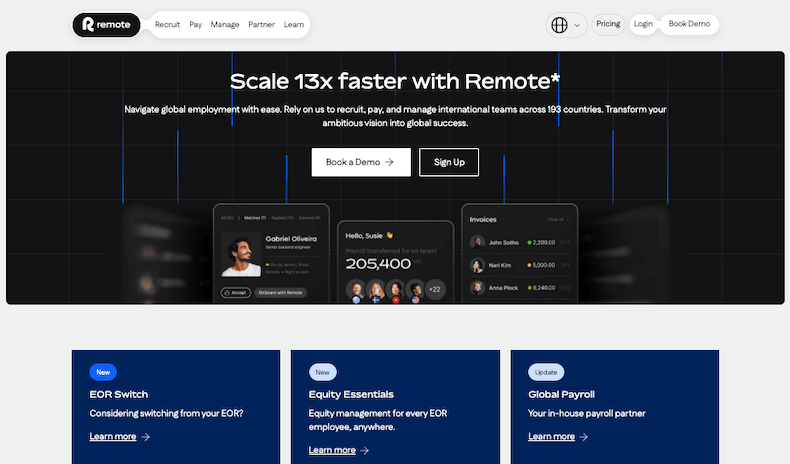
Remote operates as a global employment platform with a strong emphasis on direct control. Most teams use it as their primary EOR system, often alongside contractor management and payroll.
A big part of its model is owning legal entities in key markets. That reduces reliance on third parties and gives Remote more consistency in how employment terms, IP protections, and compliance workflows are handled. For companies hiring in multiple countries, that consistency becomes noticeable over time.
It’s commonly adopted by startups and remote-first companies that want to move quickly without building internal legal or HR infrastructure. The platform is designed to be straightforward, and in most cases, it is.
The broader perception in the market is that Remote prioritizes clarity over flexibility. You don’t get endless customization, but you do get fewer surprises.
About Papaya Global
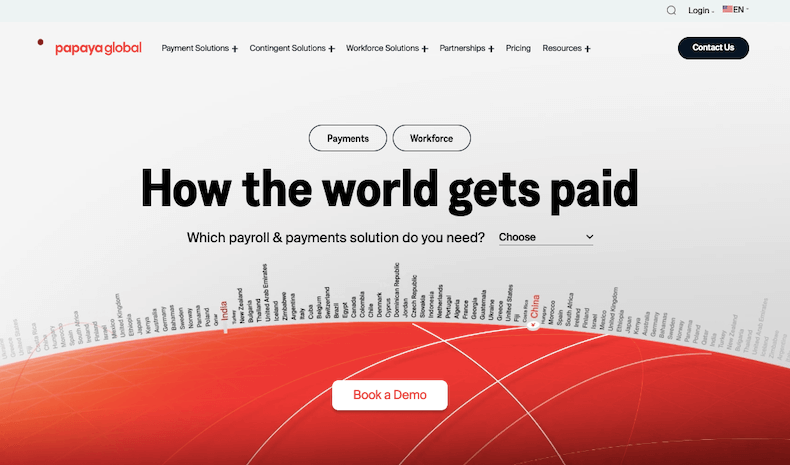
Papaya Global comes from a payroll-first background, and that influence is hard to miss once you start using it.
Rather than building everything in-house, Papaya connects a wide network of in-country partners and wraps them in a unified platform. This gives it reach and adaptability, especially in markets where direct entity ownership would be slower or more complex.
Where it tends to resonate most is in organizations already dealing with cross-border payroll at scale. Finance teams, in particular, often value the reporting depth and consolidated view across regions.
It’s not always the simplest system to get comfortable with, but it wasn’t designed to be. The strength lies in handling complexity rather than hiding it.

Remote Vs Papaya Global: At a Glance
Remote is a better fit for:
✓ Expanding globally on a tight budget
✓ Managing a large international contractor base
✓ Hiring in emerging markets
✓ Teams that want a fast, lightweight, self-serve EOR platform
Papaya Global is a better fit for:
✓ Building a remote-first team with stronger benefits structures
✓ Competing for talent on employee experience and consistency
✓ First-time global hiring with more structured guidance
✓ Companies that want centralized payroll visibility and control
Remote Vs Papaya Global: Editor’s Note
In practice, the gap between these platforms shows up less in features and more in how teams operate around them.
Remote tends to suit HR-led environments where the goal is to simplify decisions and reduce variability. Papaya Global often fits organizations where finance and operations play a larger role, and visibility across countries is a priority.
What teams usually realize after expanding into a few regions is that tooling decisions start to mirror internal structure. Not the other way around.
Remote vs Papaya Global: Feature-by-Feature Breakdown
EOR Country Coverage
Papaya Global casts a wider net. Its partner network allows hiring in a broader range of countries, including less common markets.
Remote’s footprint is slightly narrower but more controlled. In countries where it operates directly, the experience tends to be more uniform.
If your hiring roadmap includes edge markets, Papaya is easier to extend with. If your focus is on a handful of core regions, Remote often feels steadier.
Platform Type
Remote behaves like a single system that owns the process end to end. Papaya Global behaves more like a coordination layer sitting on top of multiple systems.
That difference becomes clearer as you scale. One reduces moving parts. The other organizes them.
Onboarding & Compliance
With Remote, onboarding follows a fairly predictable path. Documentation, contracts, and compliance steps are standardized to a large extent.
Papaya Global’s onboarding flow depends more on the country. In some cases it’s seamless, in others it involves more coordination with local partners.
This isn’t necessarily a drawback, but it does mean timelines can vary.
Payroll & Benefits
Papaya Global is particularly strong here. Its payroll engine is built to handle multi-country complexity, and the reporting layer reflects that.
Remote keeps payroll simpler. It works well, but it’s not trying to solve for highly customized scenarios.
Benefits follow a similar pattern. Papaya’s partner model allows more localized and competitive offerings, while Remote keeps things more structured.
Legal, IP & Security
Remote’s approach to legal infrastructure is one of its defining traits. Owning entities allows for more consistent handling of IP rights and employment terms.
Papaya Global still manages compliance effectively, but the structure varies depending on the partner in each country.
Where this shows up most clearly is in contract consistency across regions.
Platform UX & Integrations
Remote’s interface is easy to navigate, especially for teams that don’t want to spend time learning a new system.
Papaya Global surfaces more data and control, which can feel heavier initially but becomes useful in larger operations.
Both platforms integrate with common HR and finance tools, though Papaya leans more toward enterprise-level workflows.
Support Model
Remote keeps support centralized, which generally means fewer layers to navigate.
Papaya Global’s support can involve coordination between its internal team and local partners. In straightforward cases, that’s fine. In more complex situations, response times can vary.
Support becomes more important once you’re operating across several countries simultaneously.
Pricing Structure
Remote’s pricing is typically easier to understand upfront, with flat per-employee costs in many cases.
Papaya Global’s pricing reflects its flexibility. It can vary based on country, services, and partner involvement, which makes it harder to generalize.
At scale, that flexibility can work in your favor, but it requires closer evaluation.
Scalability
Scaling with Remote tends to feel controlled and incremental. It works well when expansion is focused and deliberate.
Papaya Global is built for broader distribution. If your workforce spans many countries with different setups, its model handles that spread more naturally.
Different scaling paths lead to different tool preferences.
Remote vs Papaya Global: EOR Capabilities Side-by-Side
The table below focuses strictly on Employer of Record capabilities, where meaningful differences usually appear.
| EOR Feature | Remote | Papaya Global |
|---|---|---|
| EOR Country Coverage | 150+ countries | 160+ countries |
| Entity & Partner Model | Primarily owned entities | Partner-led model with global network |
| Localized Employment Contracts | Standardized and consistent | Localized with country-specific variation |
| Compliance Management | Centralized and controlled | Managed across partner network |
| Payroll Execution | Streamlined and predictable | Flexible and multi-layered |
| Tax Withholding & Filings | Managed directly in most regions | Handled via local partners |
| Statutory Benefits Administration | Standardized approach | Highly localized delivery |
| Optional / Supplemental Benefits | Moderate flexibility | Broader customization options |
| Onboarding Model | Structured and consistent | Varies by country |
| Offboarding & Terminations | Standardized workflows | Country-dependent processes |
| IP Assignment & Confidentiality | Strong consistency | Varies slightly by jurisdiction |
| Worker Types Supported | Employees and contractors | Employees, contractors, and complex models |
| Statutory Leave Tracking | Built-in and uniform | Managed with local variation |
| Multi-Currency Payroll | Supported | Strong global capabilities |
| Expense & Reimbursement Handling | Basic but integrated | More advanced options |
| Equity & Variable Pay Handling | Limited flexibility | Better suited for complex structures |
| Audit & Documentation Support | Centralized records | Distributed but comprehensive |
| Support Style | Direct and centralized | Coordinated across partners |
| Best EOR Use Case | Consistency and control | Scale and flexibility |
The short version: Remote reduces variation. Papaya Global manages it.
Remote Vs Papaya Global: Final Recommendation
Choose Remote if you:
• Want consistency across countries without managing multiple workflows
• Prefer a simpler system that your HR team can run independently
• Care about IP protection and standardized contracts
Choose Papaya Global if you:
• Are operating across many countries with different employment setups
• Need deeper payroll reporting and financial visibility
• Require flexibility in benefits, compensation, or workforce structure
Verdict
Both platforms address the same underlying need, but they reflect different ways of thinking about global hiring.
Remote leans toward control and standardization. Papaya Global leans toward coordination and flexibility.
The right choice depends less on feature comparison and more on how your organization is structured to handle complexity.