






RemoFirst Vs Remote: Detailed Comparison 2026

A detailed side-by-side RemoFirst Vs Remote comparison to help you select the best option between these two solutions. We have considered top features, community rating, country coverage, pros and cons, pricing and other details to help you choose the right solution.
Manjuri-Dutta
Edited By: Manjuri Dutta

Co-founder & Editor

Remote Logo

Remote EOR

Avg 4.5 (5,799 Ratings Analyzed)
Remofirst Logo

Remofirst

Avg 4.6 (200 Reviews Analyzed)
Remote EOR Review
Remote is best for hiring and managing international employees legally and efficiently, without needing to set up local entities.

Remote EOR Company Profile

Co Name: Remote Technology, Inc.
HQ: San Francisco, California, United States
Est Year: 2019
Co Size: 1001-5000 employees
Remofirst EOR Review
Remofirst is great for companies that want to hire full-time employees in other countries quickly and legally, without setting up a local entity, while handling payroll, compliance, taxes, and benefits through one easy EOR solution.

Remofirst Company Profile

Co Name: Remofirst, Inc.
HQ: California, United States
Est Year: 2021
Co Size: 11-50 employees

RemoFirst Vs Remote: Quick Comparison

This quick comparison highlights the key differences between RemoFirst Vs Remote, including country coverage, onboarding speed, pricing transparency, and the types of companies each platform is best suited for.
Remote Logo

Remote EOR

Entity Model
Owned
Onboarding Speed
Fast
Best For
Mid-market
Payroll & Compliance
Handles complex cases
Global Coverage Strength
Broad, shallow
Country Coverage
150+ Countries
Benefits Quality
Standard
Pricing Transparency
Public pricing
Support Model
Shared support
Best Use Case
Long-term expansion
Remofirst Logo

Remofirst

Entity Model
Partner-based
Onboarding Speed
Fast
Best For
Startups
Payroll & Compliance
Standard setups only
Global Coverage Strength
Broad, shallow
Country Coverage
185+ Countries
Benefits Quality
Standard
Pricing Transparency
Public pricing
Support Model
Dedicated manager
Best Use Case
First global hire

RemoFirst Vs Remote: Community Review Summary

RemoFirst Vs Remote We have checked community ratings for both the products to give you an idea about how both the platform are performing with real user data.

Remote EOR: Community Rating

Avg 4.5 (5,799 Ratings Analyzed)
g2
4.5/5
capterra-logo-icon
4.4/5
Trustpilot
4.7/5

Remofirst: Community Rating

Avg 4.6 (200 Reviews Analyzed)
g2
4.5
Trustpilot
2.9
capterra-logo-icon
5

RemoFirst Vs Remote: Community Sentiment & Ratings

We have looked at all the community reviews of RemoFirst Vs Remote and generated these ratings on various parameters.
Overall Rating & Sentiments
Based on 5,799 user reviews.
4.5
User Sentiments
Positive 79%
Neutral 11%
Negative 10%

Ratings of Remote EOR

Ease of Use
Reviews praise the intuitive dashboard and easy navigation for payroll and HR tasks.
4.6/5
Features & Functionality
Users note strong global payroll, benefits, compliance, and contractor/employee management features.
4.5/5
Compliance & Risk Management
Consistent feedback highlights reliable compliance handling across many countries.
4.7/5
Payroll Accuracy & Timeliness
Many Trustpilot reviews emphasize timely, consistent payments with clear reporting.
4.6/5
Customer Support Quality
Support is generally responsive and helpful, though a few reviews mention slower phone support.
4.4/5
Pricing & Value
Sentiment is positive overall but some users and secondary reviews note costs can be high for smaller teams.
4.2/5
Onboarding Speed & Experience
Quick, clear onboarding with useful documentation and responsive guidance.
4.6/5
Platform Stability & Integrations
Platform is stable and integrates well with HR workflows and tools.
4.5/5
Benefits Administration Quality
Benefits and statutory entitlements are generally well managed; some regional variation noted.
4.4/5
Global Coverage & Scalability
Very broad global reach and strong multi-country support praised across reviews.
4.8/5
Overall Rating & Sentiments
Based on 200 user reviews.
4.6
User Sentiments
Positive 74%
Neutral 12%
Negative 14%

Ratings of Remofirst

Ease of Use
Users consistently praise the intuitive UI and straightforward onboarding process.
4.4/5
Features & Functionality
Covers essential EOR functions, payroll, compliance, basic benefits, but lacks advanced HRIS integrations and extra perks.
3.8/5
Compliance & Risk Management
Handles local-law compliance in many regions via partner networks, though coverage depth varies by country.
4.0/5
Payroll Accuracy & Timeliness
Multiple users report correct salaries and timely payments.
4.5/5
Customer Support Quality
Dedicated account managers and responsive support are appreciated; some reports mention weekend/support limitations depending on region.
4.0/5
Pricing & Value
Among the most competitive rate-per-employee globally — attractive for budget-conscious companies compared with premium EORs.
4.6/5
Onboarding Speed & Experience
Onboarding is often described as fast and smooth, even across multiple countries.
4.3/5
Platform Stability & Integrations
The core platform is stable, but advanced integrations (HRIS, third-party tools) are limited or work via partners, not native.
3.7/5
Benefits Administration Quality
Provides basic global health insurance and local compliance, but benefit packages remain basic compared to enterprise-grade EORs
3.5/5
Global Coverage & Scalability
Offers support in 180+ countries, making it broadly useful, though partner-based structure means quality varies region by region.
4.0/5

RemoFirst Vs Remote: Pros & Cons

Remote EOR Pros & Cons

Pros of Remote EOR

Unified Global Payroll
Consolidates payroll, taxes, and contractor payments across countries within one structured system.
Strong Compliance Infrastructure
In-house entities and legal expertise reduce misclassification and local labor law exposure.
Structured Onboarding Workflow
Guided hiring flows simplify contract generation, document collection, and employee activation.
Transparent Cost Breakdown
Clear pricing visibility helps finance teams understand EOR fees and statutory components.
Centralized HR Documentation
Contracts, payslips, and compliance documents remain organized and easily accessible.
Wide Country Coverage
Supports hiring in numerous jurisdictions without requiring your own local entities.

Cons of Remote EOR

Variable Support Response
Response times can fluctuate, particularly during payroll cycles or urgent compliance matters.
Expense Reimbursement Delays
Some users report slower processing times for reimbursements and off-cycle payments.
Premium Pricing Structure
Costs run higher than basic payroll providers, especially for smaller headcounts.
Limited Custom Workflows
Platform flexibility is narrower for companies needing complex approval structures.

Remofirst Pros & Cons

Pros of Remofirst

Competitive EOR Pricing
Lower monthly fees make it viable for startups hiring internationally without inflating operational costs.
Fast Employee Onboarding
Most new hires can be onboarded quickly once documentation is submitted and approved internally.
Broad Country Coverage
Supports hiring across multiple emerging markets often underserved by higher-priced EOR vendors.
Contract Setup Simplicity
Employment agreements are generated quickly with localized clauses handled through standardized workflows.
Straightforward Payroll Runs
Payroll processing remains predictable for standard full-time employee hiring across supported countries.

Cons of Remofirst

Support Ticket Delays
Users report slower turnaround times when resolving payroll corrections or compliance-related questions.
Benefits Package Gaps
Some regional benefit plans lack depth for senior hires expecting competitive local compensation.
Limited Reporting Tools
Platform reporting options remain basic for finance teams managing multi-country payroll costs.
Integration Constraints
Native integrations with HRIS or accounting systems are fewer compared to premium EOR platforms.
Remote Logo

Remote EOR

Avg 4.5 (5,799 Ratings Analyzed)
Remofirst Logo

Remofirst

Avg 4.6 (200 Reviews Analyzed)

RemoFirst vs Remote Comparison Summary

If you’ve tried hiring across borders, you know how messy it can get. Tax codes, compliance rules, benefits that differ by city, it add up fast. Platforms like RemoFirst and Remote make that process easier by acting as the legal employer in other countries so you don’t have to set up entities yourself.

Both help companies build global teams. But they take very different paths to get there. RemoFirst focuses on accessibility and affordability. Remote focuses on control, compliance, and ownership.

Here’s how that difference plays out in the real world.

Product Overview

RemoFirst keeps things straightforward. It handles hiring, payroll, and compliance in roughly 180 countries. It’s popular with smaller companies and fast-growing teams that want to move quickly without spending heavily on infrastructure.

It works through local partners, which is why it can scale so widely. That setup also keeps costs low and onboarding fast, though it means you’re relying on those in-country partners for compliance.

Remofirst EOR Review

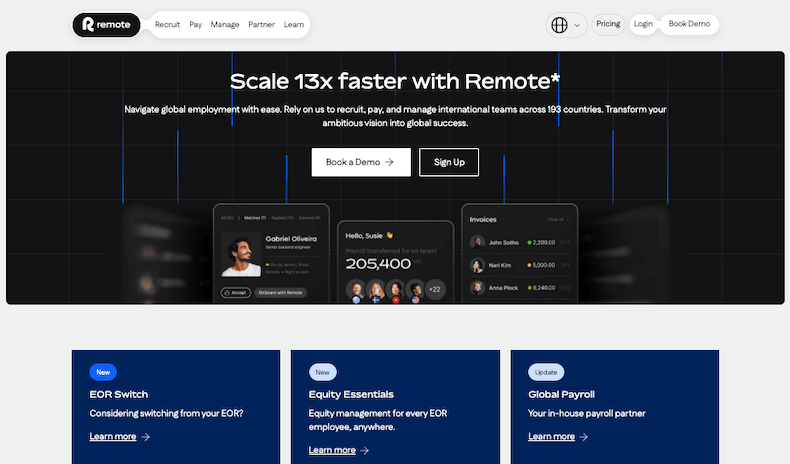
Remote is more structured. It owns its legal entities in most countries, which gives it stronger control over compliance, intellectual property, and legal continuity.

It’s not just an EOR, it’s a full global employment platform with payroll, benefits, HRIS, and even equity management. Larger companies and those in regulated industries tend to prefer it for that reason.
Remote EOR Review

If RemoFirst is about keeping things simple, Remote is about minimizing risk.

Feature Comparison

FeatureRemoFirstRemote
Global CoverageAround 180+ countries (via partners)About 150+ countries
Platform TypeEOR + contractor managementFull HR platform with EOR, payroll, and HRIS
Onboarding SpeedUsually a few business daysTypically 2–5 days
Contractor SupportYesYes, more advanced
Payroll EngineCentralized global dashboardMulti-currency, integrated payroll
BenefitsBasic regional packagesCountry-specific, customizable
Compliance ModelPartner-basedOwned-entity model
IP ProtectionStandard contractsDirect IP continuity through owned entities
InterfaceClean, simple layoutRicher dashboard and more features
IntegrationsAPI and basic HR toolsWider range including HR, payroll, and finance apps
SupportAccount manager and live chat24/7 with regional specialists
PricingFrom about $199 per employee per monthAround $599–$699 per employee per month
Ideal ForStartups and small to mid-sized teamsLarger or compliance-driven organizations

RemoFirst Vs Remote: Features Comparison

Speed and onboarding

RemoFirst sets up employees quickly. Most clients can onboard within a few days once documents are ready. Remote’s process takes a little longer because it runs deeper compliance checks and documentation reviews. You trade a bit of speed for a higher degree of assurance.

Compliance and control

RemoFirst relies on vetted partners in each country. It’s a compliant setup but one step removed from direct ownership. For most use cases, that’s fine. Remote owns its entities outright, which gives clients a more predictable structure. That matters for companies handling sensitive data or intellectual property.

Pricing

This is where the gap gets noticeable. RemoFirst’s base price starts around $199 per employee per month, while Remote starts at $599. If you’re hiring a handful of employees, it’s manageable. But if you scale beyond 20 or 30 people, the cost difference becomes significant.

Platform scope

Remote covers more ground. It includes payroll, benefits, HR data, and equity tracking in one place. RemoFirst focuses on employment and compliance. If you already use another HR or payroll system, that lighter approach can be an advantage.

RemoFirst Vs Remote: My Take

If you’re trying to scale quickly and need a tool that just works, RemoFirst hits the mark. It’s straightforward, covers nearly everywhere, and doesn’t punish you on price.

If your company values governance, risk control, and long-term stability, Remote feels safer. It’s more expensive, but you’re buying a structure that can hold up under audits and investor scrutiny.

I usually tell clients: RemoFirst is for momentum; Remote is for maturity.

RemoFirst Vs Remote: Recommendations

Choose RemoFirst if you:

  • Want to start hiring globally without a long setup process
  • Have a small or midsize HR team
  • Need broad coverage at a manageable price
  • Prefer to keep existing HR or payroll tools

Choose Remote if you:

  • Operate in regulated industries or handle sensitive IP
  • Plan to expand heavily in multiple countries
  • Need a single system that covers HR, payroll, and compliance
  • Want owned-entity control rather than partner models

RemoFirst Vs Remote: Final Verdict

If you value speed, simplicity, and cost control, RemoFirst makes a lot of sense. It’s quick to deploy and covers most countries you’d care about.

If your organization prioritizes compliance and long-term stability, Remote offers more structure and assurance. You’ll pay more, but you get a deeper platform and tighter legal control.

It really comes down to what you’re optimizing for. RemoFirst is the nimble option. Remote is the careful one.

RemoFirst Vs Remote Comparison FAQs

Yes. Many teams run entire distributed workforces through it. Just keep in mind that local partners manage compliance in each country, so experiences can differ slightly.
It depends. For IP-heavy or compliance-driven industries, yes. For typical global hiring, probably not right away.
You can. Transferring employees between EORs is common. It takes some paperwork, but both platforms handle it often enough that it’s not painful.
Both handle contractors globally. Remote’s system includes more visibility and automation, but RemoFirst covers just as many countries.

Our Comparison Methodology

Our side-by-side comparisons reflect how companies actually evaluate Employer of Record providers before making a hiring or compliance decision.

We compare platforms across a small set of high-impact factors:

  • Employment & compliance model: How each provider delivers EOR services, including entity structure, compliance responsibility, and risk ownership.
  • Country coverage quality: Depth of in-country support, not just the number of countries listed.
  • Operational execution: Hiring, payroll accuracy, benefits handling, and offboarding reliability.
  • Pricing structure: Cost transparency, billing clarity, and long-term predictability.
  • Platform & support maturity: Day-to-day usability, scalability, and service reliability.
  • Customer experience signals: Consistent patterns from third-party user feedback.

Outcomes are fit-based and highlight trade-offs depending on hiring needs, regions, and risk tolerance. No platform is treated as universally superior.

Comparisons are written independently and are not influenced by commercial relationships.

Manjuri-Dutta
Article By: Manjuri Dutta

Manjuri Dutta is the co-founder and Content Editor at Employer Records, a platform specialized in discovering best Employer-of-Record services for global hiring. She brings a thoughtful and expert voice to articles designed to inform HR leaders, practitioners, and tech buyers alike.

Related Comparisons

Deel Vs Oyster HR

Deel Vs Oyster HR

Multiplier Vs Hire with Columbus

Multiplier Vs Hire with Columbus

Multiplier Vs Oyster HR

Multiplier Vs Oyster HR

RemoFirst Vs Oyster HR

RemoFirst Vs Oyster HR

Rippling Vs Remote

Rippling Vs Remote

Oyster Vs Remote

Oyster HR Vs Remote

Rippling Vs Remofirst

Rippling Vs Remofirst

Deel Vs Remote

Deel Vs Remote

This website uses cookies to enhance user experience and to analyze performance and traffic on our website. By continuing to browse this site you are agreeing to our use of cookies.