







Pebl Vs Rippling Comparison Summary
Most teams don’t go looking for an Employer of Record platform until things start breaking. Hiring across borders gets slow, compliance questions pile up, and payroll becomes harder to manage than it should be.
That’s where tools like Pebl and Rippling come into the picture. Both are built to remove that friction, but they come from very different starting points.
Pebl is usually evaluated as a focused, cost-conscious EOR solution. Rippling tends to enter the conversation when companies are thinking beyond hiring, looking at HR, IT, and finance as one connected system.
On the surface, they overlap. In practice, they solve adjacent problems with very different philosophies.
About Pebl
Pebl is designed to keep global hiring simple and accessible.
You’ll typically see it used by startups and mid-sized companies expanding into new markets without wanting to build a heavy HR stack. It’s especially common in teams hiring across multiple regions at once, where speed and cost control matter.
What stands out operationally is how little friction there is. The platform stays focused on EOR, contractor management, and payroll without trying to extend into unrelated areas. That keeps onboarding fast and reduces the number of decisions teams have to make.
It’s still a newer name compared to larger vendors, but it’s gaining traction as a practical alternative for companies that want to move quickly without overengineering their setup.

About Rippling
Rippling approaches the same space from a much broader angle.
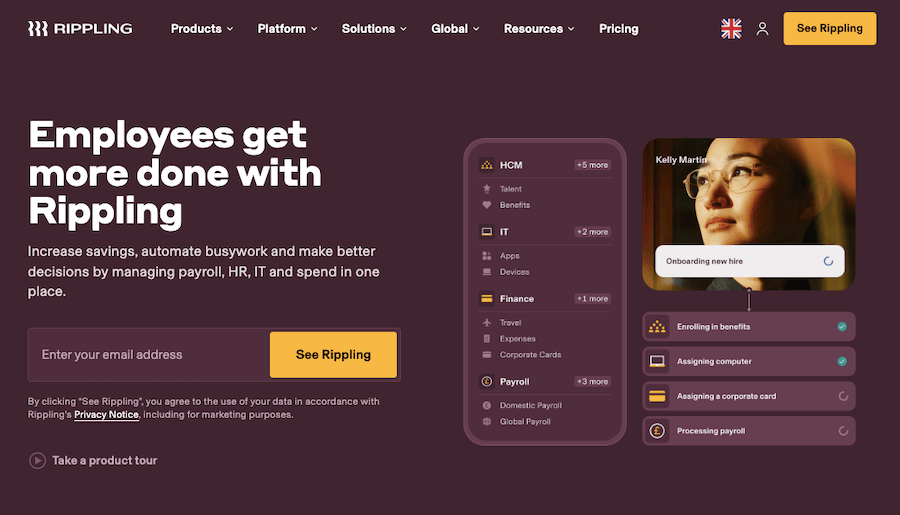
It’s a workforce platform first, with EOR built into a larger system that also handles HR, IT, payroll, and finance operations. For many companies, the appeal isn’t just global hiring, it’s consolidation.
You’ll often find Rippling in organizations trying to reduce tool sprawl. Instead of managing multiple systems, they centralize everything into one platform and build workflows around it.
Where it stands out is automation. Onboarding, payroll, device management, and access control can all be connected, which becomes increasingly valuable as teams scale.
It’s a more established player, and it’s typically evaluated as part of a long-term infrastructure decision rather than a short-term hiring solution.
At a Glance: Who Each Platform Is Best For
Pebl is a better fit for:
✓ Expanding globally on a tight budget
✓ Managing a large international contractor base
✓ Hiring in emerging markets
✓ Teams that want a focused, lightweight EOR solution
Rippling is a better fit for:
✓ Building a remote-first team with strong benefits
✓ Competing for talent on candidate experience
✓ First-time global hiring with more structured guidance
✓ Companies looking to consolidate HR, IT, and payroll into one platform
Pebl Vs Rippling: Editor’s Note
In practice, the decision often comes down to how the organization is run.
Pebl tends to appeal to operations or finance-led teams that want efficiency and predictable costs. Rippling is more often driven by HR or leadership teams looking to standardize systems and improve the overall employee experience.
What becomes clear after a few international hires is this: the platform you choose early has a long tail. It shapes how processes evolve as you scale.
Pebl vs Rippling: Feature-by-Feature Breakdown
EOR Country Coverage
Coverage exists on both sides, but the approach differs.
Pebl leans on a partner network, which gives it flexibility in less common hiring markets. That can be useful when expanding into regions where options are limited.
Rippling is more deliberate about where and how it operates. The focus is on consistency, even if that means expanding coverage more gradually.
The trade-off is flexibility versus standardization.
Platform Type
This is where the separation becomes obvious.
Pebl stays tightly focused on EOR and global payroll. It does one job and keeps the experience straightforward.
Rippling positions itself as a system of record for your workforce. Hiring, payroll, devices, and access all sit within the same environment.
One simplifies a process. The other restructures how teams operate.
Onboarding & Compliance
Pebl keeps onboarding lightweight. Teams can move quickly, especially when hiring across several countries at once.
Rippling introduces more structure into the process. Onboarding is tied into workflows across departments, which adds depth but also some initial setup.
Speed versus coordination. Both matter, depending on context.
Payroll & Benefits
Payroll runs reliably on both platforms, but the experience around it feels different.
Pebl focuses on meeting statutory requirements and keeping payroll predictable.
Rippling invests more in benefits and presentation. The way compensation and perks are delivered can make a noticeable difference when hiring competitively.
This is often where HR teams start to lean one way or the other.
Legal, IP & Security
Both platforms cover the essentials: contracts, IP protection, and local compliance.
Pebl keeps things standardized and partner-driven. It works, without drawing much attention. Rippling integrates these elements into its broader system, which can be useful for companies with stricter governance requirements.
Most teams won’t see a major gap here unless they operate in highly regulated environments.
Platform UX & Integrations
Pebl keeps the experience simple and contained. It’s easy to navigate, but it’s not trying to be the center of your tech stack. Rippling is designed to sit at the center. Integrations and automation are part of how it delivers value.
This is where you decide whether you want a tool or a platform.
Support Model
Support styles differ more than you might expect.
Pebl tends to feel more direct and hands-on, particularly when dealing with new regions. Rippling relies more on structured processes and documentation, which scales better across larger teams.
Neither is better universally, it depends on how much guidance you expect.
Pricing Structure
Pricing is usually where the conversation becomes practical.
Pebl is positioned to be cost-efficient, with a clearer link between what you pay and what you use. Rippling’s pricing reflects its broader scope. You’re investing in a system, not just an EOR service.
For many teams, this ends up being the deciding factor.
Scalability
Both platforms scale, but in different ways.
Pebl supports distributed hiring across multiple countries without adding much operational weight.
Rippling becomes more valuable as more of your organization runs through it. The bigger the system, the stronger the payoff.
It’s not just about growth, it’s about how you want that growth to look.
Pebl vs Rippling: EOR Capabilities Side-by-Side
The table below focuses strictly on Employer of Record capabilities, where the more practical differences tend to appear.
| EOR Feature | Pebl | Rippling |
|---|---|---|
| EOR Country Coverage | 185+ Countries | 50+ Countries |
| Entity & Partner Model | Primarily partner-based | Mix of owned entities and partners |
| Localized Employment Contracts | Standard localized contracts | Structured, system-integrated contracts |
| Compliance Management | Partner-driven compliance | Centralized compliance workflows |
| Payroll Execution | Reliable multi-country payroll | Fully integrated payroll |
| Tax Withholding & Filings | Managed locally via partners | Automated and system-driven |
| Statutory Benefits Administration | Covered per local laws | Structured delivery |
| Optional / Supplemental Benefits | Limited customization | Strong flexibility |
| Onboarding Model | Fast and lightweight | Workflow-driven |
| Offboarding & Terminations | Managed via partners | Systemized processes |
| IP Assignment & Confidentiality | Standard protections | Integrated legal workflows |
| Worker Types Supported | Employees + contractors | Employees + contractors + broader workforce tools |
| Statutory Leave Tracking | Basic tracking | Integrated leave management |
| Multi-Currency Payroll | Supported | Fully integrated |
| Expense & Reimbursement Handling | Limited features | Built-in systems |
| Equity & Variable Pay Handling | Basic support | Advanced compensation tools |
| Audit & Documentation Support | Provided via partners | Centralized reporting |
| Support Style | Hands-on | Structured |
| Best EOR Use Case | Cost-efficient global hiring | Integrated workforce management |
The difference here isn’t capability, both platforms cover the fundamentals. It’s how those capabilities are delivered and how much of your broader workflow they touch.
Pebl Vs Rippling: Final Recommendation
Choose Pebl if you:
• Want a cost-effective way to hire globally without building a complex stack
• Are managing contractors or hiring across emerging markets
• Prefer a focused solution that gets you operational quickly
Choose Rippling if you:
• Want one system to manage HR, IT, payroll, and global hiring
• Care about delivering a stronger employee experience
• Are scaling and want to reduce reliance on multiple tools
Verdict
Pebl and Rippling address the same challenge, but from opposite ends.
- Pebl keeps global hiring lean and efficient.
- Rippling builds a broader system around it.
The better choice depends less on features and more on how your organization prefers to operate as it grows.