



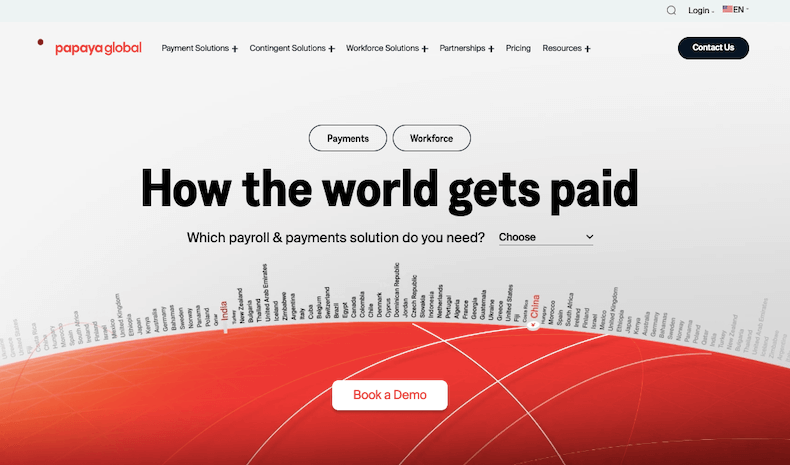
Multiplier Vs. Papaya Global Comparison Summary
On paper, Multiplier and Papaya Global sit in the same category. Both let companies hire internationally without setting up local entities, handle compliance, and run payroll across borders.
That’s usually where the similarity ends.
When teams seriously evaluate Multiplier vs Papaya Global, the decision rarely comes down to feature checklists. It’s more about how each platform fits into the way a company actually operates day to day.
Multiplier is often chosen by teams that want hiring to move quickly without adding operational weight. Papaya Global tends to come into the picture when payroll, reporting, and workforce standardization start becoming harder to manage internally.
Same problem space, different priorities.
About Multiplier
Multiplier is built for execution. It focuses on helping companies hire internationally without turning global expansion into a project of its own.
You’ll typically see it used by startups and mid-sized teams that are growing across multiple regions but don’t want to invest heavily in infrastructure. It’s especially useful when hiring in countries where compliance can be unpredictable or fragmented.
One thing that stands out is how quickly teams get up and running. Contracts are localized, onboarding flows are straightforward, and payroll doesn’t require much hand-holding once it’s set up.

About Papaya Global
Papaya Global approaches the same problem from a different angle. It starts with global payroll, then layers EOR capabilities on top.
That shift in focus changes who it appeals to. Instead of being purely HR-led, Papaya Global often sits closer to finance and payroll teams, especially in organizations already operating across several countries.
The platform is designed to bring structure to complexity. Payroll data, compliance tracking, and reporting are centralized, which becomes valuable once headcount starts spreading across regions.
It’s not just about hiring internationally. It’s about managing that workforce in a consistent, controlled way.

Multiplier vs Papaya Global: At a Glance
| Use Case | Best Option |
|---|---|
| Expanding globally on a tight budget | Multiplier |
| Building a remote-first team with strong benefits | Papaya Global |
| Managing a large international contractor base | Multiplier |
| Competing for talent on candidate experience | Papaya Global |
| Hiring in emerging markets | Multiplier |
| First-time global hiring with more guidance | Papaya Global |
Multiplier vs Papaya Global: Editor’s Note
In practice, the decision here usually reflects how the business is wired internally.
Teams that prioritize speed and cost control tend to gravitate toward Multiplier. The focus is on getting people hired and paid without friction.
Papaya Global shows up when organizations start asking different questions, around payroll visibility, reporting accuracy, and consistency across regions.
What often changes over time is the level of control a company needs. Early on, flexibility matters more. As the workforce grows, standardization starts to take over.
That’s where the gap between these two platforms becomes more visible.
Multiplier vs Papaya Global: Feature-by-Feature Breakdown
EOR Country Coverage
Both platforms operate at global scale, but their coverage isn’t identical in practice.
Multiplier supports hiring in 150+ countries, with particularly strong operational depth in regions like Southeast Asia, the Middle East, and parts of Africa. These are markets where EOR execution can break down if local expertise isn’t strong, and Multiplier has clearly invested there.
Papaya Global supports 160+ countries, but its model leans more heavily on a partner network. Coverage is broad, but the experience can vary slightly depending on the country and partner involved.
Where this shows up:
If your hiring roadmap includes less conventional markets, Multiplier tends to feel more predictable.
If your footprint is spread across major global economies, Papaya Global delivers more consistency at scale.
Platform Type
Papaya Global is fundamentally a payroll system that includes EOR. Multiplier is closer to a dedicated EOR platform with payroll built in.
That difference shapes how each tool is used internally. One leans toward finance ownership. The other fits more naturally with HR or operations.
Onboarding & Compliance
Multiplier keeps things moving. Onboarding is quick, contracts are generated with minimal friction, and teams don’t need to navigate a lot of configuration.
Papaya Global introduces more structure into the process. There are additional steps, more oversight, and often more stakeholders involved.
Payroll & Benefits
This is where Papaya Global starts to pull ahead.
Its payroll capabilities are built for scale, with stronger automation and reporting. Benefits are also more developed, which can matter when hiring competitively across regions.
Multiplier handles payroll reliably, but without the same level of depth. Benefits coverage is more dependent on local statutory requirements.
Legal, IP & Security
Both platforms cover the essentials, including IP protection and compliant employment agreements.
Papaya Global places more emphasis on documentation and audit readiness, which becomes relevant for larger organizations.
Multiplier keeps things simpler, focusing on meeting compliance requirements without adding layers of process.
Platform UX & Integrations
Multiplier’s interface is easy to navigate. Most teams can start using it without much onboarding.
Papaya Global offers more functionality, but it takes longer to fully adopt. Integrations are broader, especially for companies already using HRIS or financial systems.
It’s a familiar trade-off.
Simplicity versus capability.
Support Model
Multiplier’s support is generally fast and execution-focused, especially during onboarding and payroll cycles.
Papaya Global provides a more structured support model, often including dedicated account management depending on the plan.
The experience can feel quite different depending on company size and complexity.
Pricing Structure
Multiplier is typically the more accessible option from a cost perspective. Papaya Global sits higher, which aligns with its broader scope and deeper payroll capabilities.
The gap tends to widen as the workforce grows.
Scalability
Papaya Global is built to handle scale in a controlled way. It’s designed for organizations that need visibility and consistency across multiple regions.
Multiplier scales in a more flexible way. It works well for distributed teams but doesn’t push heavy standardization.
Multiplier vs Papaya Global: EOR Capabilities Side-by-Side
The table below focuses strictly on Employer of Record capabilities, where practical differences tend to show up.
| EOR Feature | Multiplier | Papaya Global |
|---|---|---|
| EOR Country Coverage | 150+ Countries | 160+ Countries |
| Entity & Partner Model | Mix of owned entities and partners | Partner-driven with centralized oversight |
| Localized Employment Contracts | Standardized and quick to deploy | More structured with customization options |
| Compliance Management | Built-in and execution-focused | Layered with stronger visibility |
| Payroll Execution | Straightforward and reliable | Advanced with automation |
| Tax Withholding & Filings | Managed locally per country | Centralized with reporting |
| Statutory Benefits Administration | Covered, varies by region | More standardized |
| Optional / Supplemental Benefits | Limited flexibility | Stronger offering |
| Onboarding Model | Fast and simple | Structured and controlled |
| Offboarding & Terminations | Managed with compliance | More process-driven |
| IP Assignment & Confidentiality | Included | Included with more documentation |
| Worker Types Supported | Employees and contractors | Broader workforce models |
| Statutory Leave Tracking | Basic | More advanced |
| Multi-Currency Payroll | Supported | Strong infrastructure |
| Expense & Reimbursement Handling | Basic support | More integrated |
| Equity & Variable Pay Handling | Limited | Better support |
| Audit & Documentation Support | Basic | Strong |
| Support Style | Responsive | Structured |
| Best EOR Use Case | Cost-efficient hiring | Payroll-led workforce management |
Multiplier vs Papaya Global: Final Recommendation
Choose Multiplier if you:
- Want to hire quickly without adding operational complexity
- Are expanding into emerging or less predictable markets
- Need to keep global hiring costs under control
Choose Papaya Global if you:
- Need stronger payroll systems across multiple countries
- Care about benefits and employee experience at scale
- Want centralized control over a growing global workforce
Verdict
Both platforms solve the same core problem, but they’re built with different assumptions.
Multiplier assumes you want hiring to be fast and straightforward. Papaya Global assumes you’ll eventually need more control, visibility, and structure.
Neither approach is better in isolation. It depends on where your company is today and how much complexity you’re prepared to manage as you grow.