




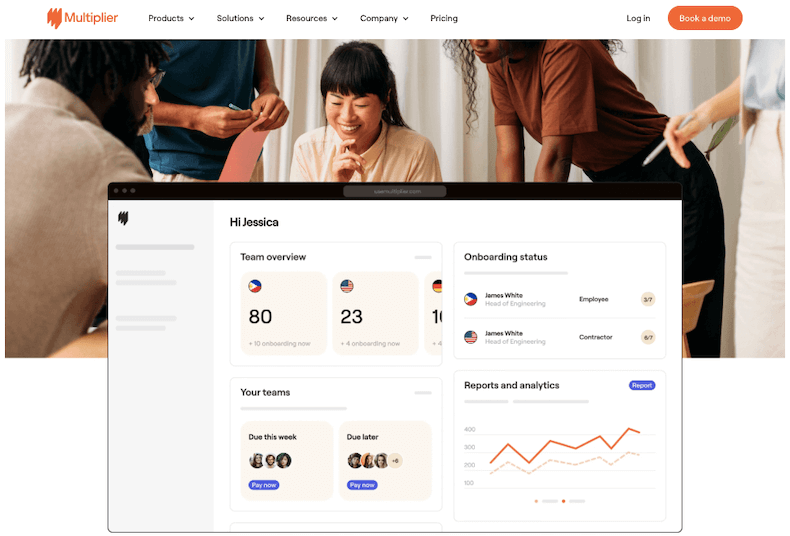



Multiplier and Oyster HR are two popular options for companies hiring internationally without opening local entities. On the surface, they solve the same problem. In practice, they often appeal to slightly different priorities.
Multiplier tends to resonate with teams that are scaling quickly and keeping a close eye on cost and operational efficiency. Oyster is frequently chosen by remote-first companies that put extra weight on employee experience and benefits.
Both cover EOR, global payroll, and contractor management. The real differences show up once you look at how you plan to grow and what your team values day to day.
About Multiplier
Multiplier is a global employment platform focused on helping companies hire, pay, and manage international employees and contractors without setting up local entities. Its core strength is operational execution: payroll accuracy, cross-border payments, and compliant employment in a wide range of countries.
The platform is often used by startups and mid-sized companies expanding into multiple regions at once, especially across Asia, the Middle East, and other fast-growing markets.
Multiplier has built its reputation around cost efficiency, contractor management, and practical compliance handling rather than flashy HR features.
In short, Multiplier’s expertise sits at the intersection of global payroll, contractor management, and EOR-driven expansion at scale.
About Oyster HR
Oyster HR is a distributed-work platform designed to make global hiring accessible for remote-first companies. It combines Employer of Record services with a strong emphasis on employee experience, benefits access, and guided compliance workflows.
Oyster is commonly adopted by companies building long-term international teams rather than just testing markets. Its positioning leans toward fair pay, benefits parity, and responsible global employment.
Where Oyster stands out is in how it packages compliance, onboarding, and benefits into a more HR-friendly experience. It’s often chosen by organizations that see global hiring as a long-term strategy, not just a tactical move.
At a Glance: Who Each Platform Is Best For
| Use Case | Best Option |
|---|---|
| Expanding globally on a tight budget | ✓ Multiplier |
| Building a remote-first team with strong benefits | ✓ Oyster HR |
| Handling a large international contractor base | ✓ Multiplier |
| Competing for talent on candidate experience | ✓ Oyster HR |
| Hiring in emerging or less common markets | ✓ Multiplier |
| First-time global hiring with more guidance | ✓ Oyster HR |
Editor’s Note
If you strip away marketing, the choice often comes down to what matters more inside your company: cost control or employee experience.
Teams led by finance or operations often end up leaning toward Multiplier after looking at numbers across several countries. HR-led, remote-first organizations frequently gravitate toward Oyster because the experience feels more guided and benefits options are easier to position to candidates.
Neither is a risky pick. The better choice is the one that matches how you actually run your company, not just where you want to be.
Multiplier Vs Oyster HR: Feature-by-Feature Breakdown
EOR Country Coverage
Multiplier: Multiplier supports hiring in 150+ countries and is especially practical if you’re expanding across Asia, the Middle East, or other emerging markets. Companies hiring in less “mainstream” locations often find workable coverage here.
Oyster HR: Oyster supports 180+ countries and focuses heavily on distributed, remote-friendly markets. Documentation and onboarding steps are usually clear, which helps first-time global employers.
Reality check: If you’re hiring in common markets like the UK, Canada, or Germany, both will work fine. Differences start to matter when you’re managing payroll across 8–10+ countries monthly.
Platform Type
Multiplier: Primarily built for EOR and global payroll, with contractor management baked in. It’s focused on cross-border employment execution, not replacing your HRIS.
Oyster HR: Also EOR-first, but designed with more HR workflow visibility and employee lifecycle touchpoints.
Practical note: Most companies still keep their core HRIS. These tools sit alongside it, not instead of it.
Onboarding & Compliance
Multiplier: Onboarding can be quick once documents are in place. Compliance handling is one of its strong suits, especially around local contract requirements.
Oyster HR: Onboarding feels more guided step-by-step. This is helpful for teams new to international hiring who want clarity on what comes next.
What this looks like in real life: If your HR team has done global hiring before, both will feel manageable. If this is your first time, Oyster may feel less intimidating.
Payroll & Benefits
Multiplier: Runs automated multi-country payroll in local currencies. Benefits are available, but often standardized depending on the country.
Oyster HR: Invests heavily in benefits partnerships and localized packages. This can matter when candidates compare offers.
Where this shows up: Benefits usually become a bigger issue after your first declined offer, not before. Companies often underestimate this early on.
Legal, IP & Security
Both platforms handle IP transfer and locally compliant contracts. Standard data protection and privacy frameworks are in place on both sides.
For most mid-sized companies, this area rarely becomes the deciding factor unless you’re in a highly regulated industry.
Platform UX & Integrations
Multiplier: Simple and functional. Gets the job done without much friction, though it’s not built to impress.
Oyster HR: More polished and employee-friendly. The experience is noticeably smoother for new hires entering the system.
Honest take: HR may care about UX. Finance usually cares more about clean invoices and predictable billing.
Support Model
Multiplier: Responsive support with local expertise. Works well for teams that already know what they need and want fast answers.
Oyster HR: More guidance-oriented. Helpful if you want a bit more hand-holding during expansion.
Pricing Structure
Multiplier: Often comes in lower on EOR and contractor pricing. This becomes noticeable when you scale across multiple countries.
Oyster HR: Typically priced higher, reflecting its focus on experience and benefits access.
Reality check: No EOR is truly cheap at scale. The question is whether the added cost helps you hire or retain better talent.
Scalability
Multiplier: Commonly used by startups and mid-sized firms expanding quickly into several regions at once.
Oyster HR: Popular with distributed companies building long-term remote teams.
Both can support growth. The difference is more about philosophy than capability.
Multiplier vs Oyster HR: EOR Capabilities Side-by-Side
This table focuses strictly on Employer of Record functionality, where meaningful differences usually appear.
| EOR Feature | Multiplier | Oyster HR |
|---|---|---|
| EOR Country Coverage | 150+ countries | 180+ countries |
| Entity & Partner Model | Mix of owned entities and local partners | Owned entities plus vetted in-country partners |
| Localized Employment Contracts | Country-specific contracts with adjustable terms | Fully localized contracts aligned to local labor laws |
| Compliance Management | Structured compliance processes across jurisdictions | Compliance-first approach with strong local law alignment |
| Payroll Execution | Centralized global payroll system | Localized payroll runs with statutory breakdowns |
| Tax Withholding & Filings | Managed through platform and partners | Fully managed with emphasis on local accuracy |
| Statutory Benefits Administration | Supported; depth varies by country | Strong statutory alignment and consistency |
| Optional / Supplemental Benefits | Available in many regions, more standardized | Broader benefits options in key markets |
| Onboarding Model | Fast, operations-driven onboarding | Guided onboarding with compliance checks |
| Offboarding & Terminations | Structured workflows with country rules | Compliance-led terminations, notice, and severance guidance |
| IP Assignment & Confidentiality | Included in standard agreements | Embedded into localized contracts |
| Worker Types Supported | Employees and contractors equally supported | Employees primary; contractors supported |
| Statutory Leave Tracking | Country-based leave compliance | Built-in statutory leave management |
| Multi-Currency Payroll | Yes | Yes |
| Expense & Reimbursement Handling | Supported via payroll workflows | Supported with localized compliance considerations |
| Equity & Variable Pay Handling | Supported in common scenarios | Supported with localized treatment |
| Audit & Documentation Support | Documentation available for compliance needs | Strong documentation and audit trail focus |
| Support Style | Execution-focused, responsive | Consultative and guidance-heavy |
| Best EOR Use Case | Cost-efficient, multi-country scaling | Long-term, compliance-driven global teams |
Final Recommendation: Which One Should You Choose?
Choose Multiplier if you:
- Are scaling across several countries at once
- Need to keep close control on costs
- Hire many contractors internationally
- Have an ops- or finance-driven decision process
Choose Oyster HR if you:
- Compete for global talent on benefits and experience
- Run a remote-first or distributed culture
- Want guided workflows for international hiring
- Are comfortable paying more for polish and support