


Quick Summary: Minimum Wage in Taiwan
Taiwan runs a single national minimum wage. No regional tiers, no sector-based wage ladders, and one rate that updates on a fixed annual rhythm. That part is simple.
The cost of employing someone at that rate is not. The statutory wage is the floor, and several mandatory contributions attach to it from the first day of employment.
Most companies that get into trouble in Taiwan do not misread the wage. They underestimate the contribution load, the bracket-based way it is calculated, or the leave and severance obligations tied to the employment relationship.
This guide covers the current rates, the full employer cost, income tax, working hours, leave, severance, and the penalties for getting any of it wrong.
What the Minimum Wage in Taiwan Actually Means
The 2026 statutory rates
As of 1 January 2026, the monthly minimum is NT$29,500 and the hourly minimum is NT$196, confirmed by the Ministry of Labor. Both figures rose 3.18% from the 2025 levels of NT$28,590 and NT$190.
The rate is a legal floor, not a salary target. Employers have to ensure total earnings reach it no matter how pay is structured.
Pay structure does not change the obligation
Workers paid by piece rate, commission, or output still have to clear the monthly or hourly minimum once total earnings are calculated. The method of payment has no bearing on the requirement.
Taiwan also does not adjust the minimum for region, experience, or company size. The same baseline applies across the board, which removes ambiguity but leaves no flexibility at the lower end.
Minimum Wage in Taiwan at a Glance
A Single National Wage, No Variations
One rate across regions and industries
The same minimum applies in Taipei and in the smallest regional town, in retail and in semiconductor manufacturing, and to local and foreign employees who are legally employed. There is one number to track.
That consistency cuts compliance work, since there are no location-based calculations to run. It also removes the option to set lower pay in lower-cost areas, which some employers expect to find.
The limited exceptions
Domestic workers fall outside the Labor Standards Act and are not subject to the statutory minimum. Certain government and civil service roles follow separate compensation frameworks. For private commercial hiring, the single rate applies without exception.
How the Minimum Wage Is Decided in Taiwan
The Minimum Wage Deliberation Committee
Each year the Minimum Wage Deliberation Committee reviews the rate. The group brings together employer representatives, labor organizations, government agencies, and academic experts.
It weighs the Consumer Price Index, GDP and growth forecasts, productivity trends, and broader employment conditions. The recommendation then goes to the Ministry of Labor and on to the Executive Yuan for approval before it takes effect.
Since the Minimum Wage Act took effect in 2024, this process has a clear statutory basis rather than resting on annual administrative discretion. The result is a predictable yearly adjustment, and President Lai Ching-te has signaled a target of pushing the monthly figure past NT$30,000.
Minimum Wage Growth in Taiwan, 2016 to 2026
A decade of consistent increases
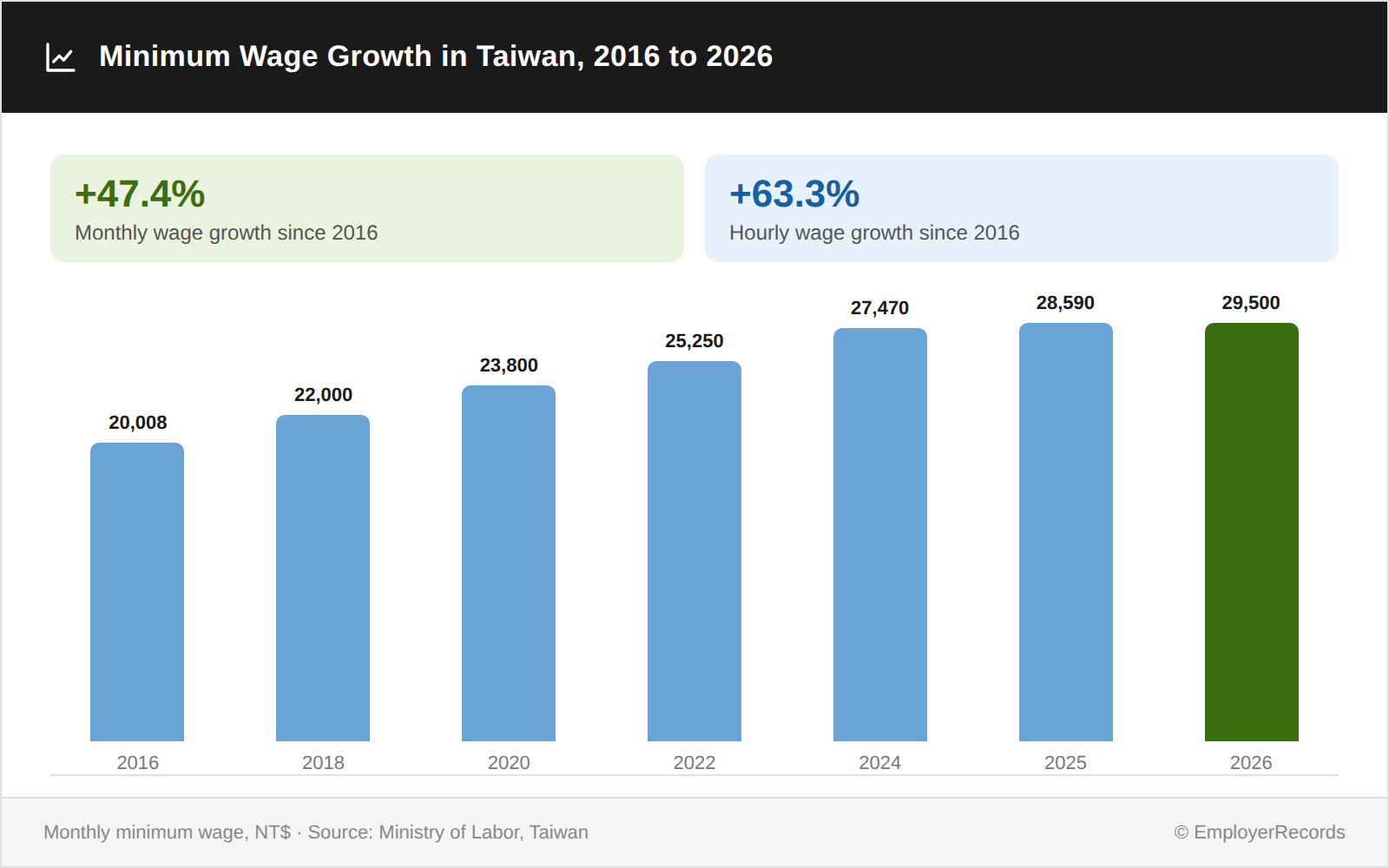
The current number means little in isolation. The useful view is the trend, and Taiwan has raised its minimum wage every year for a decade.
Across that period the monthly wage climbed 47.4% and the hourly wage rose 63.3%, according to figures cited by Human Resources Online. The pattern is steady annual movement rather than sudden jumps, which is why the minimum should be treated as a moving baseline.
Minimum Wage Trend (Selected Years)
| Year | Monthly (NT$) | Hourly (NT$) |
|---|---|---|
| 2016 | 20,008 | 120 |
| 2018 | 22,000 | 140 |
| 2020 | 23,800 | 158 |
| 2022 | 25,250 | 168 |
| 2024 | 27,470 | 183 |
| 2025 | 28,590 | 190 |
| 2026 | 29,500 | 196 |
Who the Minimum Wage Applies To, and the Five-Employee Rule
The minimum applies to full-time, part-time, and hourly staff, to employees paid by output once total earnings are counted, and to foreign workers holding valid work permits. The exceptions are narrow: domestic workers, some civil service roles, and specific training arrangements.
The five-employee threshold most foreign employers miss
Taiwan’s minimum wage looks like it has no eligibility rules, but the contribution side does. Ordinary Labor Insurance is compulsory only for businesses with five or more employees, and smaller firms enroll voluntarily.
The Labor Pension and the occupational accident scheme work differently. Both apply regardless of headcount, the latter since the Labor Occupational Accident Insurance and Protection Act took effect in 2022. So company size changes which programs are mandatory, even though the wage floor itself does not move.
What Employers Actually Pay Beyond the Minimum Wage
Mandatory Employer Contributions in Taiwan
Employer pays about 70% of the premium. Insured-salary ceiling of NT$45,800. Compulsory at five or more employees.
Employer share is 60%, but the dependent multiplier pushes the effective rate to roughly 4.84% of insured salary.
Employer funded into the worker’s individual account. Cap of NT$150,000 monthly salary. Cannot be offset against other costs.
Funds unemployment benefits and training. Employer pays 70% of the premium, with employee and government covering the rest.
Fully employer funded. The rate is set by industry risk and applies to every employer regardless of headcount.
A small employer levy on insured wages that protects unpaid wages if a business becomes insolvent.
Contributions are calculated on bracketed insured salary, not flat percentages
This is where the published numbers most often go wrong. Taiwan does not apply a flat percentage to gross pay. Labor Insurance, National Health Insurance, and the pension all run off bracket-based insured salary tables published by the Bureau of Labor Insurance and the National Health Insurance Administration.
Each employee is slotted into a salary grade, and contributions are calculated from that grade rather than the exact gross figure. At minimum wage the grade tracks NT$29,500 closely, so the difference is small, but it widens at higher salaries.
Labor Insurance
The total Labor Insurance premium runs at about 11.5% of insured salary for 2026. Employers carry roughly 70% of it, with employees and the government covering the rest, and the insured-salary ceiling is NT$45,800.
National Health Insurance and the dependent multiplier
NHI is set at 5.17%, split between employer (60%), employee (30%), and government (10%). The detail foreign employers tend to miss is the dependent multiplier: premiums are calculated as insured salary times rate times the contribution ratio times one plus the average number of dependents.
That multiplier, currently around 1.56, pushes the effective employer rate to roughly 4.84% of insured salary rather than the headline 60% share, as set out by payroll providers such as GoGlobal. On a single minimum-wage hire it is modest, but it scales with the workforce.
Labor Pension
Employers contribute at least 6% of the employee’s monthly salary into an individual pension account. The contribution is mandatory, cannot be offset against other costs, and is capped at a monthly salary of NT$150,000.
Employment insurance, occupational accident cover, and the wage arrears fund
Three smaller line items round out the load. Employment Insurance is 1% of insured salary, with the employer paying 70%. Occupational accident insurance is fully employer-funded and ranges from 0.12% to 0.96% depending on industry risk. The wage arrears compensation fund adds 0.025% of insured wages.
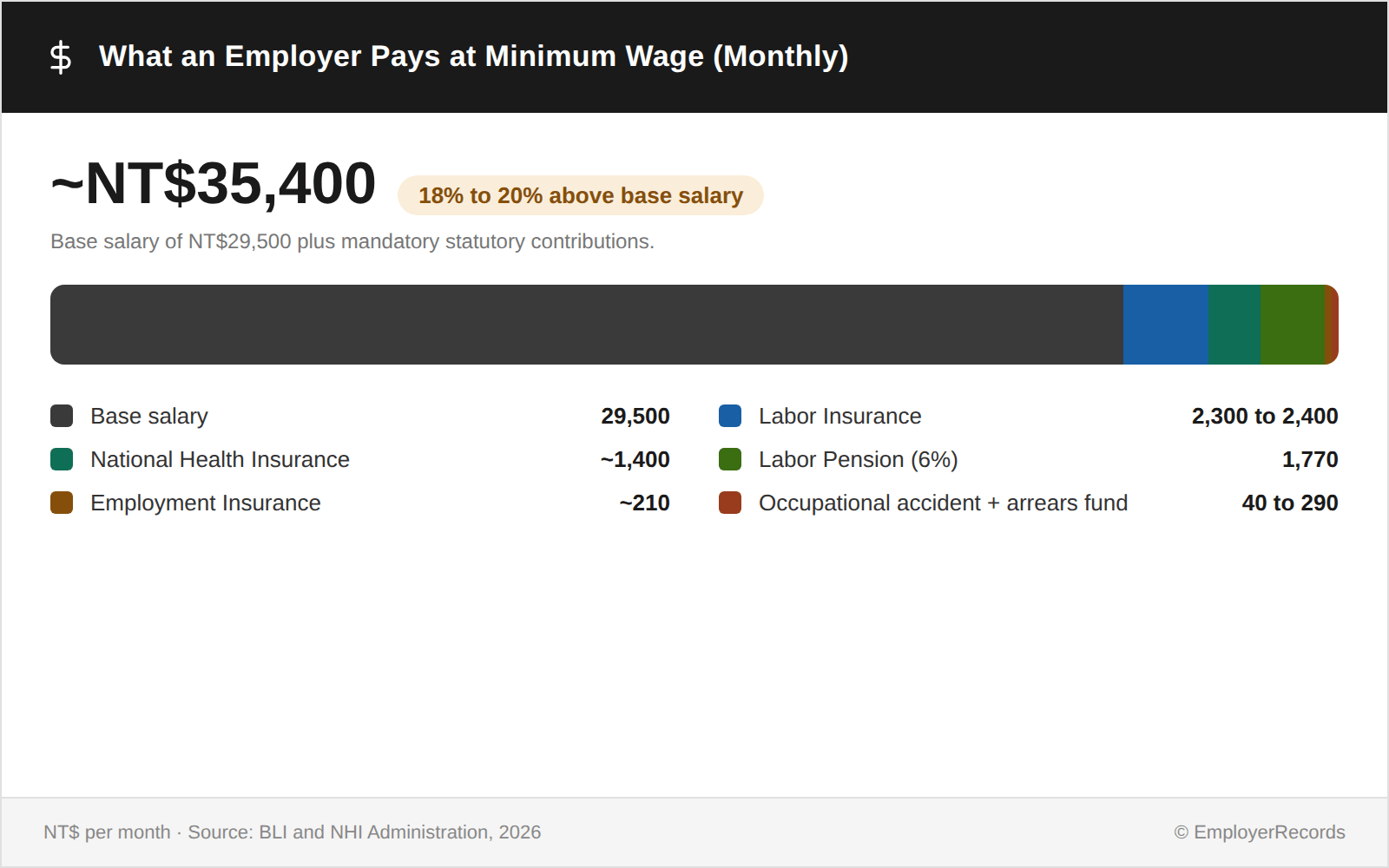
Monthly Employer Cost at Minimum Wage
| Component | Basis | Employer cost (NT$) |
|---|---|---|
| Base salary | Statutory minimum | 29,500 |
| Labor Insurance | ~70% of ~11.5% | 2,300 to 2,400 |
| National Health Insurance | ~4.84% effective | ~1,400 |
| Labor Pension | 6% | 1,770 |
| Employment Insurance | ~0.7% | ~210 |
| Occupational accident | 0.12% to 0.96% | 35 to 280 |
| Wage arrears fund | 0.025% | ~7 |
| Total employer cost | Base plus contributions | ~35,200 to 35,600 |
What it adds up to
At minimum-wage level the contributions add roughly 18% to 20% on top of base salary, since none of the caps bind at NT$29,500. For higher salaries the effective rate falls toward 13% to 15% as Labor Insurance, NHI, and the pension hit their ceilings.
The point holds regardless of the exact figure: the minimum wage is the baseline, not the budget. To model a specific role, the EOR cost calculator works through the same components.
Income Tax Withholding in Taiwan
Progressive rates from 5% to 40%
Resident employees are taxed on a five-band progressive scale. Employers withhold income tax monthly and remit it to the National Taxation Bureau by the tenth of the following month, with annual reconciliation filed in May.
Non-residents, meaning anyone in Taiwan for fewer than 183 days in the calendar year, face a flat 18% withholding on Taiwan-source salary instead of the progressive bands.
Resident Income Tax Bands (2026 Income)
| Taxable income (NT$) | Rate |
|---|---|
| Up to 610,000 | 5% |
| 610,001 to 1,380,000 | 12% |
| 1,380,001 to 2,770,000 | 20% |
| 2,770,001 to 5,190,000 | 30% |
| Over 5,190,000 | 40% |
Deductions mean low earners pay little
The bands apply to taxable income after deductions, not gross pay. A single employed resident can claim around NT$464,000 in combined personal exemption, standard deduction, and salary deduction for 2026, so earnings below that point attract no income tax. A worker on the minimum wage falls well inside that zone.
Working Hours, Overtime, and Pay Structure
Standard hours
Under the Labor Standards Act, standard hours are eight per day and forty per week. Anything beyond that counts as overtime and must be paid at premium rates.
Tiered overtime
Taiwan uses tiered overtime multipliers rather than a single rate, and overtime is capped at 46 hours per month, extendable to 54 with a labor-management agreement. Employers have to keep detailed working-hour records, and gaps in those records are a common audit finding.
Overtime Pay Multipliers
| Overtime type | Rate |
|---|---|
| First 2 hours on a workday | At least 1.34x hourly wage |
| Third hour onward on a workday | At least 1.67x |
| Rest day, first 2 hours | 1.34x |
| Rest day, beyond 2 hours | 1.67x |
| National holiday or mandatory day off | One extra day’s wage |
Why it ties back to minimum wage
Overtime is calculated from the employee’s wage level, so a base salary set too low distorts every overtime payment that follows. Roles at or near the minimum are the most exposed, which is why wage compliance is not only about the headline number.
Leave Entitlements in Taiwan
Annual leave scales with tenure
Paid annual leave starts after six months of service and increases with length of employment. These are statutory costs that sit on top of wage and contributions, so they belong in any total-cost estimate.
Statutory Annual Leave by Length of Service
| Length of service | Paid annual leave |
|---|---|
| 6 months to under 1 year | 3 days |
| 1 to under 2 years | 7 days |
| 2 to under 3 years | 10 days |
| 3 to under 5 years | 14 days |
| 5 to under 10 years | 15 days |
| 10 years and above | +1 day per year, up to 30 |
Sick, maternity, paternity, and parental leave
Ordinary sick leave runs up to 30 days a year at half pay, with longer unpaid hospitalization leave available. Maternity leave is eight weeks, paid in full for employees with at least six months of service and at half pay below that threshold.
Fathers receive seven days of paternity and prenatal accompaniment leave. Parental leave is available until a child turns three for employees with at least six months of service.
13th-Month Salary and Festival Bonuses
Customary, not mandatory
Taiwan has no legal requirement for a 13th-month salary, but paying one is standard practice and is generally disbursed before the Lunar New Year. Some employers add a 14th month, and festival bonuses often appear around the Dragon Boat and Mid-Autumn festivals.
None of this is statutory, yet candidates expect it, and a compensation offer that ignores it will read as below market. For a role budgeted near the minimum, an extra month of pay is a material cost that should be planned rather than discovered.
Severance and Termination
Notice periods by tenure
Employer-initiated termination for business or performance reasons, the grounds set out in Article 11 of the Labor Standards Act, requires advance notice or payment in lieu. The notice period rises with length of service.
Notice Periods for Employer-Initiated Termination
| Length of service | Advance notice |
|---|---|
| 3 months to under 1 year | 10 days |
| 1 to under 3 years | 20 days |
| 3 years and above | 30 days |
Severance under the current pension system
For service under the pension system in force since 2005, severance is half a month of average wage per year of service, capped at six months of pay. Employees who remain on the legacy system accrue one month per year with no cap, so older tenures can carry a larger liability.
Termination for just cause, the misconduct grounds under Article 12, does not require notice or severance. Dismissals outside the lawful grounds can be reversed and can trigger compensation, so the cause and the paperwork both matter.
Minimum Wage vs Average Salary in Taiwan
The minimum marks the bottom of the labor market, not the going rate. Average gross monthly pay sits near NT$58,000 to NT$60,000, with a median closer to NT$45,000, so most skilled roles clear the minimum by a wide margin.
The minimum mainly affects entry-level positions, service sector work, and lower-skilled roles. For specialist hiring in technology, manufacturing, or professional services, it functions as the legal floor and cost baseline rather than the benchmark for an offer.
Cost of Living vs Minimum Wage
Taiwan is cheaper than Singapore or Hong Kong, but costs vary sharply by location. Taipei rents run well above the rest of the island, and housing is the single largest pressure on a minimum-wage budget.
At the minimum, a single person can cover essentials with shared or modest housing, but there is little room for saving. Many workers rely on additional income or household support, and employers who pay slightly above the floor tend to have an easier time hiring and retaining staff.
Penalties for Non-Compliance
Taiwan enforces wage and labor rules actively. Paying below the minimum carries fines of NT$20,000 to NT$1,000,000, and serious or repeat violations can lead to public disclosure of the employer’s name.
Insurance and payroll failures draw their own separate penalties. Beyond the fines, non-compliance invites employee disputes, administrative audits, and reputational damage that outlasts the original error.
What International Companies Need to Know
Salaries must be paid in New Taiwan Dollars on a consistent monthly cycle, and employer contributions add roughly 18% to 20% at minimum-wage level. Foreign employees are subject to the same wage rules when legally employed, and working-hour record-keeping is strict.
The system is manageable, but it expects accuracy from day one. Late insurance enrollment, missing hour records, and miscalculated overtime are the failures that turn an ordinary hire into a compliance problem.
Using an Employer of Record in Taiwan
Companies without a local entity can hire through an Employer of Record, which acts as the legal employer in Taiwan. The EOR handles compliant contracts, payroll and tax withholding, insurance and pension registration, and ongoing reporting.
That route removes the need to set up an entity while keeping the contribution and compliance work in local hands. Our full Employer of Record in Taiwan guide compares how providers handle the local requirements, and the broader country-specific EOR guides cover the same ground for other markets.
Frequently Asked Questions
What is the minimum wage in Taiwan in 2026?
The minimum wage in Taiwan is NT$29,500 per month and NT$196 per hour, effective 1 January 2026. Both figures rose 3.18% from the 2025 levels of NT$28,590 and NT$190.
Does Taiwan have different minimum wages by city or industry?
No. Taiwan applies one national minimum wage across every region and industry, with no regional tiers or sector-based rates.
Do foreign employees get the same minimum wage in Taiwan?
Yes. Foreign workers who are legally employed are covered by the same minimum wage and the same Labor Standards Act protections as local staff.
How much does an employer actually pay above the minimum wage?
Mandatory contributions add roughly 18% to 20% on top of gross at minimum-wage level. The effective rate falls toward 13% to 15% at higher salaries as contribution caps apply.
Is a 13th-month salary mandatory in Taiwan?
No. A 13th-month salary is customary rather than legally required, usually paid before the Lunar New Year. Most employers budget for it because candidates expect it.
What are the penalties for paying below minimum wage?
Wage violations carry fines from NT$20,000 to NT$1,000,000. Serious or repeat cases can lead to public disclosure of the employer’s name, alongside separate penalties for insurance and payroll failures.
Can you hire in Taiwan without a local entity?
Yes. An Employer of Record can act as the legal employer in Taiwan, handling payroll, contributions, and compliance, so a company can hire without registering its own entity.