






Oyster HR Vs Remote: Detailed Comparison 2026

A detailed side-by-side Oyster HR Vs Remote comparison to help you select the best option between these two solutions. We have considered top features, community rating, country coverage, pros and cons, pricing and other details to help you choose the right solution.
Manjuri-Dutta
Edited By: Manjuri Dutta

Co-founder & Editor

Remote Logo

Remote EOR

Avg 4.5 (5,799 Ratings Analyzed)
Oysterhr Logo

Oyster HR

Avg 4.5 (1,200 Ratings Analyzed)
Remote EOR Review
Remote is best for hiring and managing international employees legally and efficiently, without needing to set up local entities.

Remote EOR Company Profile

Co Name: Remote Technology, Inc.
HQ: San Francisco, California, United States
Est Year: 2019
Co Size: 1001-5000 employees
Oyster HR Review
Oyster is best for hiring and managing full-time international employees without setting up local legal entities.

Oyster HR Company Profile

Co Name: Oyster HR Inc.
HQ: Charlotte, North Carolina, United States
Est Year: 2020
Co Size: 501-1000 employees

Oyster HR Vs Remote: Quick Comparison

This quick comparison highlights the key differences between Oyster HR Vs Remote, including country coverage, onboarding speed, pricing transparency, and the types of companies each platform is best suited for.
Remote Logo

Remote EOR

Entity Model
Owned
Onboarding Speed
Fast
Best For
Mid-market
Payroll & Compliance
Handles complex cases
Global Coverage Strength
Broad, shallow
Country Coverage
150+ Countries
Benefits Quality
Standard
Pricing Transparency
Public pricing
Support Model
Shared support
Best Use Case
Long-term expansion
Oysterhr Logo

Oyster HR

Entity Model
Hybrid
Onboarding Speed
Fast
Best For
SMBs
Payroll & Compliance
Handles complex cases
Global Coverage Strength
Broad, shallow
Country Coverage
180 Countries
Benefits Quality
Standard
Pricing Transparency
Public pricing
Support Model
Shared support
Best Use Case
Distributed teams

Oyster HR Vs Remote: Community Review Summary

Oyster HR Vs Remote We have checked community ratings for both the products to give you an idea about how both the platform are performing with real user data.

Remote EOR: Community Rating

Avg 4.5 (5,799 Ratings Analyzed)
g2
4.5/5
capterra-logo-icon
4.4/5
Trustpilot
4.7/5

Oyster HR: Community Rating

Avg 4.5 (1,200 Ratings Analyzed)
g2
4.4/5
Trustpilot
4.5/5
capterra-logo-icon
4.6/5

Oyster HR Vs Remote: Community Sentiment & Ratings

We have looked at all the community reviews of Oyster HR Vs Remote and generated these ratings on various parameters.
Overall Rating & Sentiments
Based on 5,799 user reviews.
4.5
User Sentiments
Positive 79%
Neutral 11%
Negative 10%

Ratings of Remote EOR

Ease of Use
Reviews praise the intuitive dashboard and easy navigation for payroll and HR tasks.
4.6/5
Features & Functionality
Users note strong global payroll, benefits, compliance, and contractor/employee management features.
4.5/5
Compliance & Risk Management
Consistent feedback highlights reliable compliance handling across many countries.
4.7/5
Payroll Accuracy & Timeliness
Many Trustpilot reviews emphasize timely, consistent payments with clear reporting.
4.6/5
Customer Support Quality
Support is generally responsive and helpful, though a few reviews mention slower phone support.
4.4/5
Pricing & Value
Sentiment is positive overall but some users and secondary reviews note costs can be high for smaller teams.
4.2/5
Onboarding Speed & Experience
Quick, clear onboarding with useful documentation and responsive guidance.
4.6/5
Platform Stability & Integrations
Platform is stable and integrates well with HR workflows and tools.
4.5/5
Benefits Administration Quality
Benefits and statutory entitlements are generally well managed; some regional variation noted.
4.4/5
Global Coverage & Scalability
Very broad global reach and strong multi-country support praised across reviews.
4.8/5
Overall Rating & Sentiments
Based on 1,200 user reviews.
4.5
User Sentiments
Positive 78%
Neutral 10%
Negative 12%

Ratings of Oyster HR

Ease of Use
Users highlight an intuitive, clean interface and smooth onboarding.
4.6/5
Features & Functionality
Comprehensive EOR features , payroll, compliance, benefits, local contracts, for global teams.
4.5/5
Compliance & Risk Management
Strong local compliance coverage across 180+ countries, with legal-reviewed contracts and local-expert support.
4.6/5
Payroll Accuracy & Timeliness
Payroll and taxes handled reliably; users report correct payments and prompt processing.
4.5/5
Customer Support Quality
Support is generally responsive and backed by experienced local-law experts.
4.4/5
Pricing & Value
Viewed as fair for full-service global EOR, though pricing may feel steep for small teams.
4.1/5
Onboarding Speed & Experience
Onboarding workflows and country-specific contracts make onboarding efficient.
4.4/5
Platform Stability & Integrations
Platform is stable and integrates with common HR/finance tools, though some users note limited integrations.
4.3/5
Benefits Administration Quality
Offers localized benefits (healthcare, paid leave, etc.) aligned with local laws.
4.5/5
Global Coverage & Scalability
Supports hiring in 180+ countries and scales well from small teams to large global workforces.
4.7/5

Oyster HR Vs Remote: Pros & Cons

Remote EOR Pros & Cons

Pros of Remote EOR

Unified Global Payroll
Consolidates payroll, taxes, and contractor payments across countries within one structured system.
Strong Compliance Infrastructure
In-house entities and legal expertise reduce misclassification and local labor law exposure.
Structured Onboarding Workflow
Guided hiring flows simplify contract generation, document collection, and employee activation.
Transparent Cost Breakdown
Clear pricing visibility helps finance teams understand EOR fees and statutory components.
Centralized HR Documentation
Contracts, payslips, and compliance documents remain organized and easily accessible.
Wide Country Coverage
Supports hiring in numerous jurisdictions without requiring your own local entities.

Cons of Remote EOR

Variable Support Response
Response times can fluctuate, particularly during payroll cycles or urgent compliance matters.
Expense Reimbursement Delays
Some users report slower processing times for reimbursements and off-cycle payments.
Premium Pricing Structure
Costs run higher than basic payroll providers, especially for smaller headcounts.
Limited Custom Workflows
Platform flexibility is narrower for companies needing complex approval structures.

Oyster HR Pros & Cons

Pros of Oyster HR

Entity-Free Hiring
Hire full-time international employees legally without setting up a local business entity in each country.
Automated Contracts
Generate localized employment agreements that reflect country-specific labor laws and statutory requirements automatically.
Multi-Country Payroll
Manage payroll for distributed teams across multiple countries from a single centralized system dashboard.
Built-In Compliance Tools
Access country-specific compliance documentation and employment policy guidance in one platform interface.
HRIS Integrations
Sync employee records with external HR and finance systems to avoid duplicate data entry across tools.

Cons of Oyster HR

Benefits Cost Variation
Health insurance and statutory benefits pricing varies widely depending on employee location and provider availability.
Support Queue Delays
Customer support response times can increase during peak onboarding periods or regulatory escalations.
Pricing Tier Jumps
Monthly costs tend to rise significantly as hiring volume increases across new international markets.
Limited Customization
Employment contract templates allow only minor adjustments beyond predefined country-level legal frameworks.
Remote Logo

Remote EOR

Avg 4.5 (5,799 Ratings Analyzed)
Oysterhr Logo

Oyster HR

Avg 4.5 (1,200 Ratings Analyzed)

Oyster HR Vs Remote Comparison Summary

When companies begin hiring across borders, the names Oyster HR and Remote almost always come up. Both promise to take the pain out of international hiring by handling contracts, payroll, and compliance, yet they do it in very different ways.

This comparison looks beyond the feature lists. It focuses on how each platform actually works in practice, where they differ philosophically, and which kind of organization each one truly serves best.

Oyster HR Vs Remote: Product Overview

At a glance, Oyster and Remote operate in the same lane. They are both Employer of Record (EOR) platforms that help you legally hire and pay global employees without opening foreign entities. The difference lies in how they deliver that promise.

Oyster HR

Oyster is built for speed and flexibility. It allows you to start small, perhaps paying a few contractors in one region, and expand later into full global employment as your needs grow. The platform manages payroll, benefits, and compliance across more than 180 countries through a clean interface that feels lightweight and fast.

It is automation-driven but not impersonal, giving HR teams room to stay hands-on without getting buried in admin. Many mid-size companies choose Oyster for that balance, since it scales quickly without requiring a complete overhaul of how HR is already managed.

Oyster HR Review

Remote

Remote in contrast, is all about control and accountability. It owns its own legal entities in most countries, which means there is no middleman between you and your employees. That ownership makes a difference. Compliance, intellectual property, and payroll filings all stay under one roof.

Remote was built for organizations that do not want to juggle partners or wonder who is legally responsible in each jurisdiction. It is a more structured, compliance-first approach; less flexible than Oyster but steadier for complex or risk-heavy markets.

Both platforms solve the same problem, enabling cross-border employment, but they approach it from opposite directions. Oyster prioritizes agility, while Remote prioritizes certainty.
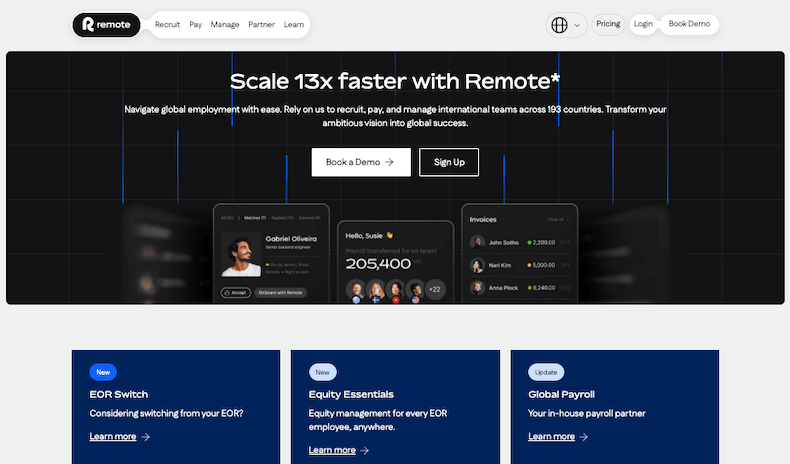
Remote EOR Review

Oyster HR Vs Remote: Feature Comparison

FeatureOyster HRRemote
Global Coverage180+ countries using a mix of direct and partner entitiesAround 180 countries, with most covered by Remote’s owned entities
Platform TypeModular, EOR, contractor management, and payroll can be used separatelyUnified platform, everything integrated into one system
Onboarding SpeedTypically 2–5 days depending on countryAround 2 days in most owned-entity markets
Contractor SupportYes, self-serve setup and payment automationYes, integrated contractor management
Payroll EngineMulti-country payroll using local providersCentralized payroll managed directly by Remote
BenefitsLocal statutory and optional add-on benefitsBuilt-in localized benefits through Remote entities
Compliance & IP ProtectionCompliance automation and IP transfer toolsDirect entity ownership with internal compliance audits
UX / UIModern, modular, quick to navigateConsistent and unified interface across HR and payroll
IntegrationsConnects to popular HR and finance apps via APIWide integration support, consistent across tools
Customer SupportDedicated success managers; quality varies by region24/7 global support with in-house experts
PricingEOR from roughly $699 per employee per month; contractors $29 per monthEOR from about $599 per employee (annual); contractors $29 per month
Security CertificationsGDPR-compliant data handlingGDPR and ISO-aligned standards
ScalabilityFlexible and modular, easy to add countriesBuilt for consistent global scale and compliance control

Oyster HR Vs Remote: Feature Deep Dive

Onboarding and Contracts

Oyster makes global onboarding quick. In many countries, it can complete the process within a few days, using templates and local checks to keep things moving. That said, speed can depend on the region, since in some places the final compliance step relies on local partners.

Remote’s onboarding feels steadier. Because the company owns its local entities, there is no waiting on third-party reviews or paperwork. That control means fewer delays in more complex countries, which is a quiet but important advantage.

In everyday use, Oyster tends to be faster where rules are straightforward, while Remote is more reliable where they are not.

Compliance and Legal Confidence

Oyster’s model gives you freedom but adds a bit of variation. Its network of partners works well in most cases, yet it means not every process is identical worldwide. For many businesses, that is a fair trade-off for the lower cost and flexibility.

Remote removes that uncertainty by owning the legal structure in most of its markets. The company can guarantee consistency, maintaining the same standards, legal accountability, and IP protection everywhere it operates. For industries with strict compliance or data needs, that assurance is often worth the premium.

Payroll and Benefits

Oyster lets you run global payroll even in countries where you already have your own entities. It is flexible, supports multiple currencies, and integrates neatly into existing workflows.

Remote takes a more unified approach. Its payroll is built directly into its EOR model, which keeps reporting cleaner and ensures local taxes and benefits are managed under one system. The trade-off is less customization but stronger oversight.

Integrations and Workflow

Both connect easily to HR and accounting systems, but they do it differently. Oyster’s modular setup lets you pick only the integrations you actually need. Remote’s integrations are more consistent because the platform itself is tightly connected across modules.

If your HR tech stack is already well established, Oyster slips in easily. If you prefer one all-in-one platform, Remote feels more cohesive.

Customer Support

Support often determines the long-term success of an EOR platform. Oyster provides personal success managers and responsive help in major markets, though feedback varies by region.

Remote’s support is more centralized, with in-house specialists covering payroll, legal, and tax issues. Many users highlight reliability as a major reason they stay.

Oyster HR Vs Remote: Editor’s Note

Oyster and Remote reflect two different mindsets. Oyster is for teams that value agility, often younger or fast-growing companies that move quickly and prefer light structures. It gives you control, flexibility, and a high degree of autonomy.

Remote is built for predictability. It is less about flexibility and more about confidence that every box is ticked. The owned-entity model, legal control, and deep compliance coverage are designed for teams that would rather eliminate risk than manage it internally.

There is no single right choice. It comes down to how much control you want over the process versus how much control you want over risk.

Oyster HR Vs Remote: Recommendations

Choose Oyster HR if you:

  • Prefer to start small with contractors or payroll and scale later
  • Want a more flexible, modular setup
  • Have internal HR or compliance experience
  • Operate mainly in familiar or low-risk markets

Choose Remote if you:

  • Need full legal protection and entity ownership
  • Hire in complex or highly regulated countries
  • Want one provider to handle every aspect of global employment
  • Expect to scale quickly across multiple regions

Oyster HR Vs Remote: Verdict

If flexibility and speed matter most, Oyster HR will feel lighter and easier to grow with. It lets you test new markets, hire fast, and refine your approach as you expand.

If your priority is risk management and compliance, Remote provides more control and consistency. It takes responsibility for the details so you can focus on building your team.

It is not about which platform is better overall; it is about which one matches how your company operates. Oyster suits fast-moving, tech-savvy teams. Remote fits organizations that value certainty and accountability.


Oyster HR Vs Remote Comparison FAQs

Remote’s pricing is generally more transparent, but Oyster offers greater flexibility for smaller or mixed teams.
Yes. Both allow you to run payroll and handle taxes while keeping your own entities active.
They do. Each includes tools for compliant contracts, automated payments, and invoicing.
Oyster grows modularly, allowing you to add countries as you go. Remote scales structurally, maintaining consistency as your workforce expands across regions.

Our Comparison Methodology

Our side-by-side comparisons reflect how companies actually evaluate Employer of Record providers before making a hiring or compliance decision.

We compare platforms across a small set of high-impact factors:

  • Employment & compliance model: How each provider delivers EOR services, including entity structure, compliance responsibility, and risk ownership.
  • Country coverage quality: Depth of in-country support, not just the number of countries listed.
  • Operational execution: Hiring, payroll accuracy, benefits handling, and offboarding reliability.
  • Pricing structure: Cost transparency, billing clarity, and long-term predictability.
  • Platform & support maturity: Day-to-day usability, scalability, and service reliability.
  • Customer experience signals: Consistent patterns from third-party user feedback.

Outcomes are fit-based and highlight trade-offs depending on hiring needs, regions, and risk tolerance. No platform is treated as universally superior.

Comparisons are written independently and are not influenced by commercial relationships.

Manjuri-Dutta
Article By: Manjuri Dutta

Manjuri Dutta is the co-founder and Content Editor at Employer Records, a platform specialized in discovering best Employer-of-Record services for global hiring. She brings a thoughtful and expert voice to articles designed to inform HR leaders, practitioners, and tech buyers alike.

Related Comparisons

Deel Vs Oyster HR

Deel Vs Oyster HR

Multiplier Vs Hire with Columbus

Multiplier Vs Hire with Columbus

Multiplier Vs Oyster HR

Multiplier Vs Oyster HR

RemoFirst Vs Oyster HR

RemoFirst Vs Oyster HR

Rippling Vs Remote

Rippling Vs Remote

RemoFirst Vs Remote

RemoFirst Vs Remote

Rippling Vs Remofirst

Rippling Vs Remofirst

Deel Vs Remote

Deel Vs Remote

This website uses cookies to enhance user experience and to analyze performance and traffic on our website. By continuing to browse this site you are agreeing to our use of cookies.