



Quick Summary: Choosing an EOR by Industry
An EOR that handles a remote software engineer in Portugal without trouble can be the wrong vehicle for a site engineer in Munich or a compliance analyst in London. The provider may be equally competent in all three cases. What changes is whether the law in that sector lets a third party act as the employer, and what that costs when it does.
Most EOR selection guides compare dashboards and price per employee. This guide starts where industry buyers get caught out: sector bans on employee leasing, roles where the client firm keeps its regulatory duties, tax exposure from revenue-generating hires, and IP rules written for a world where the employer and the business are the same company.
If you are new to the model, read What Is an Employer of Record? first. Everything below assumes you already know an EOR is the legal employer and you are deciding which one fits your sector.
Check Whether an EOR Can Legally Employ This Role
Sector restrictions on employee leasing
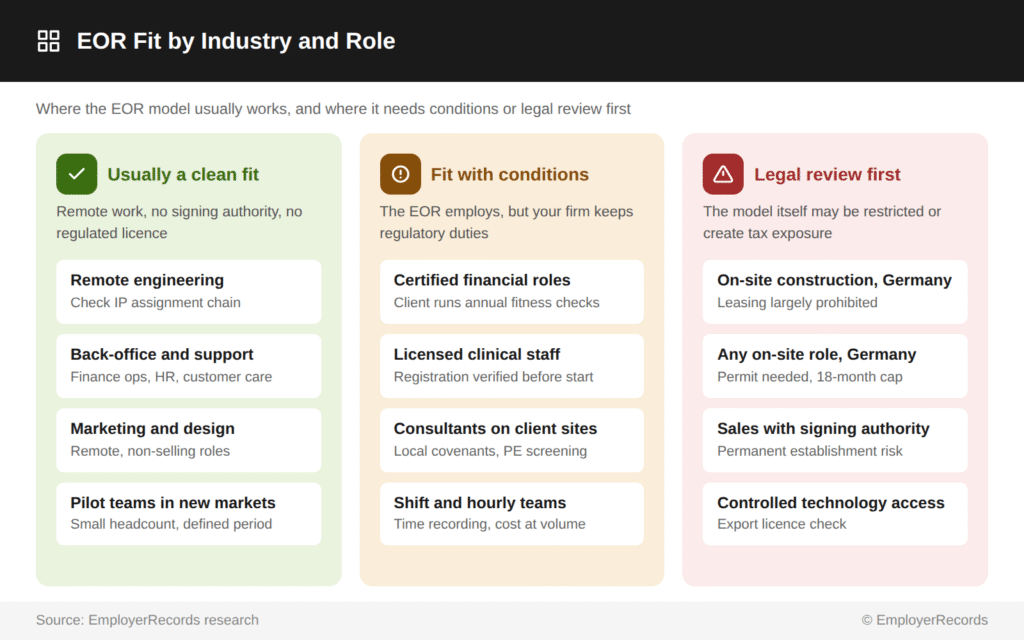
Several countries treat an EOR arrangement as a form of labour leasing, and leasing law comes with sector rules. Germany is the clearest example. Under the Temporary Agency Work Act (AÜG), supplying workers to construction businesses is largely prohibited, and placements with the same client are capped at 18 consecutive months.
Remote work is treated differently. After reversing a stricter position it had taken in October 2024, Germany’s Federal Employment Agency now requires a leasing permit only where foreign-employed workers are deployed on site in Germany. If your EOR employs someone inside Germany for you, ask for its AÜG permit and plan for the 18-month limit. Our Germany EOR guide covers the local detail.
Regulated roles where the client firm keeps the duty
In UK financial services, the Senior Managers and Certification Regime puts responsibility for staff fitness on the regulated firm. The FCA Handbook requires firms to check that certified staff are fit and proper on appointment and to reassess them at least once a year. An EOR can run payroll for a certified employee. It cannot take over the certification, and the firm answers to the FCA if the process fails.
Healthcare follows a similar pattern. A clinician’s right to practise depends on registration with a regulator such as the Nursing and Midwifery Council in the UK, or on recognition under the EU Professional Qualifications Directive. The EOR’s job is to verify that registration before day one and track renewals. Ask to see how it does both.
Revenue roles and permanent establishment
An EOR can employ your salesperson. It does not stop a tax authority from treating that salesperson as your company’s taxable presence. Under the 2017 OECD Model wording, a dependent agent creates a permanent establishment if they habitually conclude contracts or play the principal role leading to contracts the company signs without material change. The UK aligned its domestic rules with that wording for accounting periods beginning on or after 1 January 2026.
This hits SaaS, industrial sales and consulting firms hardest, because their first overseas hire is usually a country manager or account executive. A careful EOR will ask about signing authority during onboarding. A careless one will onboard the hire and leave the tax question with you.
Where the EOR Model Hits Legal Limits
| Sector or role | Jurisdiction | Legal trigger | Verify before signing | Status |
|---|---|---|---|---|
| Construction, on site | Germany | Leasing workers into construction businesses is largely prohibited under § 1b AÜG | Whether any on-site task counts as construction work; take German legal advice | Restricted |
| Any on-site role | Germany | EOR employment treated as leasing; permit required; 18-month cap per client | The provider’s AÜG permit and a planned end date or transfer | Conditional |
| Certified financial roles | United Kingdom | The regulated firm must certify fitness and propriety at least annually | Who runs the assessment, holds the records and issues regulatory references | Client duty |
| Clinical and licensed care | UK and EU | Practice depends on professional registration or qualification recognition | How the EOR checks registration before start and alerts you to lapses | Conditional |
| Sales and country managers | Treaty countries; UK from 2026 | Dependent agent permanent establishment if the hire concludes or principally negotiates contracts | Signing authority, role scope and the provider’s PE screening | Tax exposure |
| Controlled technology | US-origin technology | Releasing controlled technology or source code to a foreign person is an export under the EAR | Export classification before system access is granted | Licence check |
Profile Your Workforce Before You Shortlist
The four facts that decide industry fit
Industry fit is mostly decided by four facts about the hire, not by the provider’s feature list. Will the work happen on site or remotely? How long will it last? Will the person sell, sign, invent or handle controlled data? How many people will you employ in that country in two years?
Send the same profile to every provider. It turns a discovery call into an answer you can compare, and it exposes providers that quote a price before asking what the role involves.
Why headcount changes the conversation
Ten engineers in one country is a different negotiation, and a different entity decision, from ten engineers spread across ten countries. Concentrated headcount strengthens your hand on fees and brings the exit question forward. Our guide to measuring the ROI of EOR services shows how to model that break point.
The Workforce Profile to Send Every Provider
What Each Industry Needs From an EOR
Technology and SaaS
Tech buyers usually arrive with contractors they want to convert, so check how the provider handles switching a contractor to full-time employment via EOR without leaving a misclassification trail. The harder issue is IP. In Germany, the Employee Inventions Act gives service inventions to the employer once claimed, and the inventor is owed reasonable compensation. When the EOR is the employer, the rights must travel from the EOR to you by contract.
Export controls are the other trap. Under the EAR, releasing controlled technology or source code to a foreign person counts as an export, whether that person sits in your US office or abroad on an EOR contract. Encryption, semiconductor and defence-adjacent software teams need a classification check before access is granted.
Financial services and fintech
Beyond staff certification, EU firms now carry vendor rules. The Digital Operational Resilience Act, in force since 17 January 2025, requires financial entities to keep a register of ICT third-party arrangements and to include set contract terms such as audit rights and exit support. Whether your EOR platform falls in scope is your compliance team’s call, but the provider should be ready to sign those terms.
Background screening is the other test. Financial roles often need credit, criminal and regulatory reference checks that go well beyond standard onboarding. Ask which checks the provider runs in each country and which ones local law restricts.
Healthcare and life sciences
Licence verification comes first, covered above. The second issue is data. Health information is a special category under Article 9 GDPR, and clinical or pharmacovigilance staff handle it daily, so the EOR’s own access to employee medical records needs the same scrutiny as your systems.
Ask about professional indemnity too. In many clinical roles the question of who insures the individual’s practice has to be settled before the contract is signed, not after an incident.
Manufacturing, energy and construction
On-site work is where EOR arrangements meet leasing law, as the German rules show. It also brings working time obligations. The Court of Justice of the EU ruled in May 2019 that member states must require employers to record each worker’s daily hours, which matters for shift and overtime payroll.
Moving staff between EU sites adds posting rules. Under Directive (EU) 2018/957, posted workers get host-country pay rules from day one, and after 12 months (18 with notification) nearly all host-country labour law applies. Your EOR has to file the postings, not just run payroll.
Professional services and consulting
Consultants create permanent establishment risk faster than most, because billable work and client relationships often look like the principal role in winning contracts. The same applies to partners or directors hired to open a new market.
Client-site work and restrictive covenants need local drafting. A non-solicit clause that works in a US template may be unenforceable where the employee lives. Ask the provider to show its local contract terms, not a translated global one.
Retail, hospitality and field teams
These sectors run on hourly pay, variable schedules and high turnover. EOR fees are usually charged per employee per month, which makes the model expensive for large hourly teams with short tenure.
An EOR works well for a pilot store team or a regional manager. For volume hourly hiring, a local staffing agency or your own entity is usually cheaper. Test the provider on time recording, variable-hours payroll and the cost of a mid-month exit.
Industry Requirements and the Question to Ask
| Industry | Main exposure | Must-have EOR capability | Ask the provider |
|---|---|---|---|
| Technology and SaaS | IP ownership, contractor conversions, export controls | A clear IP assignment chain from EOR to client | “Show me the IP clause for this country and how it passes rights to us.” |
| Financial services | Staff certification, ICT vendor rules, screening | Enhanced background checks and audit-ready contract terms | “Will you sign our ICT third-party terms, including audit rights and exit support?” |
| Healthcare and life sciences | Professional registration, health data, indemnity | Licence verification with renewal tracking | “How do you verify registration before day one, and who is told when it lapses?” |
| Manufacturing, energy, construction | Leasing rules, working time records, postings | Shift and overtime payroll plus posting filings | “Is on-site work here treated as leasing, and do you hold the permit?” |
| Professional services | Permanent establishment, client-site work, covenants | PE screening and locally drafted restrictive covenants | “What in this role’s scope would you flag as PE risk?” |
| Retail, hospitality, field | Hourly pay, scheduling, turnover | Time recording and variable-hours payroll | “What does a mid-month termination cost, all in?” |
Own Entities or Partner Networks: Why It Matters More in Regulated Sectors
Who signs the employment contract
Many EORs own entities in some countries and rely on local partners in others. In a partner country, your employee’s contract may be signed by a company you have never vetted. For a remote marketing hire that may be acceptable. For a licensed or regulated role, the entity that holds the licence, the payroll and the personnel file is the one the regulator will look at.
Where accountability sits
Ask for the name of the legal employer in each country before you sign, and whether it holds the licences that country requires. Ask too whether the provider can switch partners without your approval. DORA already expects financial entities to control subcontracting chains for important services, and the same logic is sound for any regulated buyer. Our EOR provider reviews note each provider’s coverage model where it is disclosed.
Own Entity vs Partner Network
Data Security and IP Protection by Sector
Certifications and access controls
Ask for the provider’s current ISO/IEC 27001 certificate or SOC 2 Type II report, not a badge on a security page. Then ask a narrower question: which people at the EOR and at its partners can see payroll data, identity documents and medical records. Regulated buyers should get that answer per country.
Cross-border data transfers
EU and UK employee data leaving the region needs a valid transfer mechanism under Chapter V of the GDPR. For US recipients that usually means certification under the EU-US Data Privacy Framework or standard contractual clauses. Our guide to GDPR and data privacy in global hiring covers the transfer tools in detail.
IP assignment in local contracts
IP protection under an EOR depends on two documents lining up: the local employment contract must assign rights to the EOR, and the EOR agreement must pass them to you. Check both, and check them against local law. A gap in either one leaves your code, formulas or designs with a company you do not own. The local employment contracts and GDPR compliance guide explains what the local contract should contain.
Price the Full Year, Not the Monthly Fee
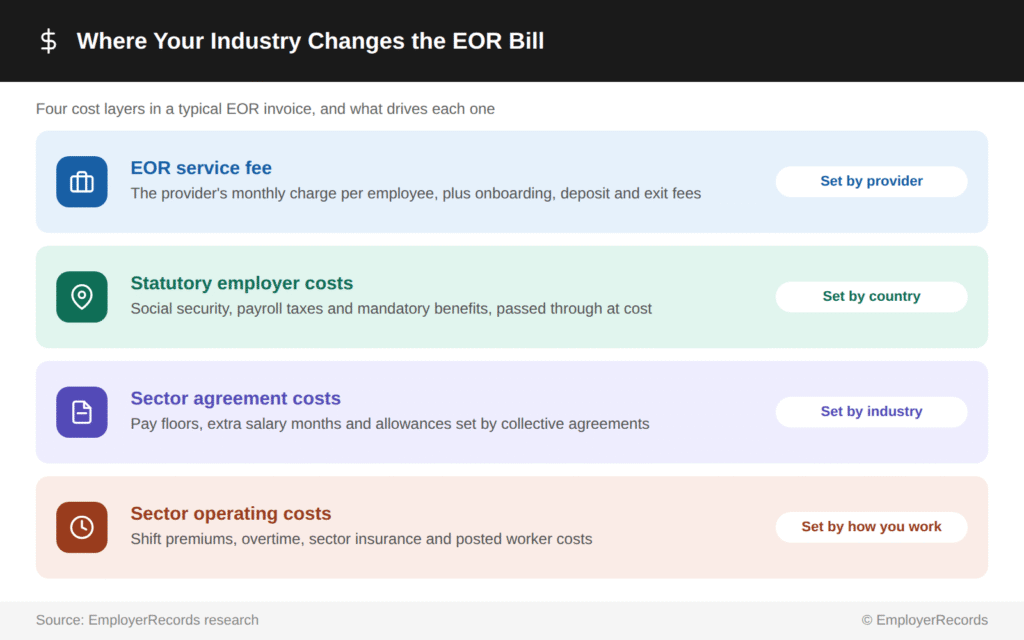
What the fee covers and what passes through
The advertised monthly fee covers the EOR’s service. Employer taxes, statutory benefits and mandatory insurance are passed through at cost, and they vary by country far more than the fee does. Deposits, currency margins, onboarding charges and termination fees sit on top.
Sector cost drivers
Industry changes the bill mainly through collective agreements. Italy has no statutory minimum wage, so the sector agreement, or CCNL, sets the pay floor, and some agreements add a 14th month’s salary on top of the 13th every employee receives. An EOR that applies the wrong agreement underpays your staff and leaves you with the back-pay claim.
Operating costs follow the sector too. Shift premiums, overtime, posting costs and sector insurance can add more to a manufacturing or hospitality hire than the EOR fee itself.
Build a 12-month cost model
Ask each shortlisted provider for the all-in cost of one employee at a fixed salary in each target country over 12 months, including a termination scenario. Put the answers side by side with the EOR Pricing Index and run your own numbers through the EOR cost calculator.
Pricing Questions to Get Answered in Writing
Liability, Indemnity and Exit Terms
Indemnity scope
Read the exclusions before the headline promise. Many EOR contracts exclude claims caused by the client’s own instructions, and that is where misclassification and permanent establishment claims usually start. Check how the provider treats the legal risks of hiring without an EOR that carry over from your pre-EOR arrangements.
Insurance
Ask for current certificates, not a description of cover. Employer’s liability, professional indemnity and cyber insurance matter most, and the limits should reflect your sector’s claim sizes.
Exit and transfer
Every EOR relationship ends, either with a move to your own entity or to another provider. The contract should set out notice, how employees transfer, how data is handed over and what it costs. The guide to handling termination and offboarding with an EOR covers the individual exit side.
Service levels
Response times, payroll error correction deadlines and a named contact belong in the contract. Regulated buyers should add audit rights and approval over partner changes.
Four Clauses to Redline Before You Sign
Score Providers and Run a Pilot
Weight criteria by industry profile
A bank and a SaaS startup should not score EOR providers the same way. Regulated buyers put compliance and the legal employer model first. High-volume hourly employers care most about cost and payroll accuracy. Tech firms put IP and data security near the top. The weights below are a starting point, and they follow the same logic as our review methodology.
Pilot in your hardest country
Run the pilot with one or two hires in the country that worries you most, not the easiest one. Keep it running through at least two payroll cycles. Track time to signed contract, first payroll accuracy, and how fast and how well the provider answers one hard question, such as a PE query or a licence check. Once you have a shortlist, the EOR comparisons set providers side by side.
Suggested Scorecard Weights by Industry Profile
| Criterion | Regulated (finance, healthcare) | High-volume (retail, hospitality, field) | Tech and SaaS |
|---|---|---|---|
| Sector compliance and licensing | 30 | 15 | 15 |
| Legal employer model | 20 | 10 | 10 |
| Data security and IP | 15 | 5 | 25 |
| Total annual cost | 10 | 30 | 20 |
| Payroll accuracy and scheduling | 10 | 25 | 10 |
| Contract terms and liability | 10 | 5 | 10 |
| Employee support | 5 | 10 | 10 |
When an EOR Stops Being the Right Tool
Signals that it is time to move
Three signals point toward your own entity. Headcount in one country grows until entity running costs fall below the EOR fees. A legal cap approaches, such as the 18-month leasing limit for on-site roles in Germany. Or your local team starts selling and signing, which raises permanent establishment exposure regardless of who employs them.
Plan the move before you need it
The cheapest transfer is one agreed at the start. If the exit and transfer terms are already in your contract, moving employees to your own entity becomes an admin project rather than a negotiation. If you are weighing a co-employment model for countries where you already have an entity, see EOR vs PEO: what’s the difference?