



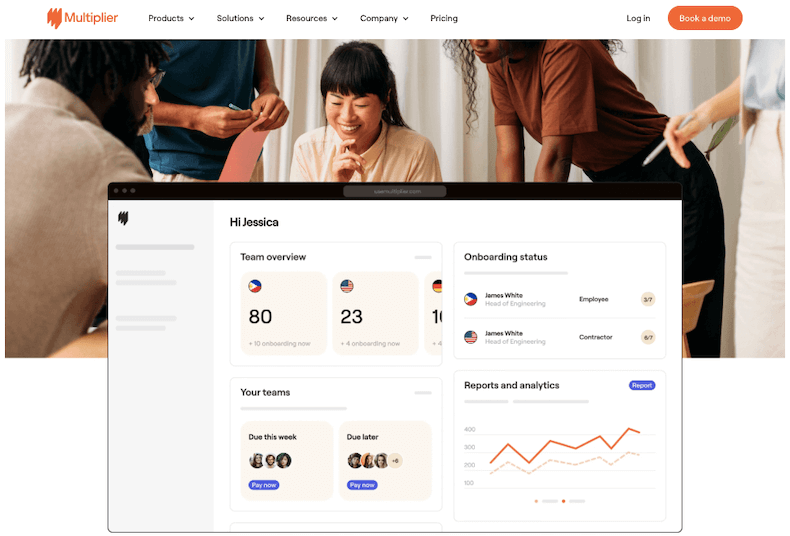
Multiplier is built for companies that want to hire globally at speed without losing control over compliance. At a basic level, it acts as your legal employer in over 150 countries, handling contracts, payroll, taxes, and local benefits so you don’t have to build entities or chase down local providers in every market.
Using Multiplier feels like plugging your team into a single operating system for global employment. You onboard someone through the platform, and it generates a locally compliant contract, aligned with that country’s labor laws and norms.
Once the employee signs, Multiplier effectively becomes their legal employer, while you still manage their day-to-day work.
Payroll is where a lot of global setups fall apart, and that’s the part Multiplier quietly stabilizes. You can run payroll for employees and contractors in multiple countries from one place, while Multiplier takes care of the calculations, tax withholdings, and filings in the background.
They support payouts in 120+ currencies, which means people are paid in the currency they actually live in, not whatever is convenient for your finance team.
The same platform also covers localized benefits and statutory contributions. Instead of trying to guess what “competitive” looks like in each country, you lean on their templates and local knowledge: social security, mandatory insurance, leave policies, and common extras are already built into the setup.
For a lot of teams, this is the difference between “we technically hired someone abroad” and “this feels like a proper local employment experience.”
Multiplier also leans into the risk side of global work. Their offering includes IP protection and compliance guardrails so that when you’re hiring in stricter markets, you’re not improvising clauses around ownership, confidentiality, or misclassification.
It’s especially useful when you’re mixing full-time EOR hires with contractors across different regions and want one consistent framework.
In practice, Multiplier suits companies that are scaling across multiple regions at once and want one partner they can use everywhere instead of stitching together local vendors.
Tech companies, distributed teams, and fast-growing mid-market businesses tend to get the most value: they can move into new countries quickly, keep payroll and compliance reliable, and avoid building an internal legal and HR army just to support a global footprint.