


The difference between hiring through an Employer of Record and setting up a legal entity is not a matter of preference or paperwork style.
It is the difference between getting someone on payroll in 14 days and waiting 20 weeks before you can legally issue a contract. That gap, days versus months, is what this comparison is actually about.
Most companies researching the EOR vs entity setup decision have already found a candidate they want to hire. The candidate is in a country where the company has no legal presence. The question is not which model is theoretically better. It is which one gets this person employed before they accept another offer, and what that choice costs at different scales.
This guide breaks down the time-to-hire comparison across both paths with country-by-country data, real cost figures, and a scenario guide built for the situations companies actually face, urgent hires, market tests, long-term scale-up, and everything between.
EOR vs. Legal Entity Setup: Understanding the Difference
These two models get compared as if they are faster and slower versions of the same thing. They are not. One borrows existing infrastructure. The other builds it from scratch.
Before getting into timelines, it helps to be precise about what each model actually involves. The decision affects how fast someone starts, who carries the legal risk, what it costs to leave a market, and whether the economics make sense at your planned headcount.
| Employer of Record (EOR) | Legal Entity Setup | |
|---|---|---|
| What it is | A third party that becomes the legal employer of your workers in a country where you have no entity | A company you incorporate locally, making you the direct employer under that country’s law |
| Who holds the employment relationship | The EOR is the employer of record; you direct the day-to-day work | You are the employer, responsible for contracts, compliance, and payroll |
| Infrastructure needed before first hire | None. You use the EOR’s existing entity, payroll, and banking | Full build required: registration, tax ID, bank account, payroll system, compliance setup |
| Time to first hire | 5 to 14 days in most markets | 10 to 28 weeks or more, depending on country |
| Best suited for | 1 to 15 employees, market testing, urgent hires | 15 or more employees with long-term market commitment |
| Monthly cost per employee | $199 to $800 or more in service fees, on top of salary | $15,000 to $100,000 or more upfront before the first hire; lower per-employee cost at scale |
| Exit flexibility | High. No entity to wind down | Low. Entity closure is slow and costly |
An EOR is not a contractor arrangement. The worker gets a proper employment contract, receives statutory benefits, and goes on local payroll.
The legal employer name on the contract belongs to the EOR’s local entity rather than yours, but the worker’s rights, pay cycle, and protections are identical to any directly employed worker in that country. You manage the work. The EOR manages everything that makes the employment legal.
A legal entity means you incorporated a company there. You are the employer. Every compliance obligation, every payroll cycle, every statutory registration is yours to own and maintain indefinitely.
Key Factors That Drive Global Hiring Timelines
Finding the right candidate is one problem. Getting the legal and operational infrastructure in place to employ them is a separate project on its own schedule, and it does not bend to business pressure. Most hiring teams underestimate the second part until they are already inside it.
Legal Entity Registration
Every country runs its own incorporation process at its own pace. Companies House in the UK processes most online applications within 24 hours.
Germany’s GmbH formation requires a notarized deed of incorporation, a minimum share capital deposit of at least €12,500 at registration (with a total minimum of €25,000), and sequential registrations across the commercial court (Handelsregister), the tax authority, and the trade office, a process that runs 4 to 8 weeks.
India’s Ministry of Corporate Affairs process, even with complete and correct paperwork, takes 3 to 5 weeks. Government registries process applications on their own schedule and urgency does not move them faster.
Tax and Payroll Registration
Once an entity is registered, it still needs a tax identity before it can pay anyone. Getting a state employer ID, payroll tax account, and unemployment insurance account in a new US state takes 2 to 4 weeks through state agencies.
France and Brazil each involve multiple agencies with their own submission windows that do not coordinate with each other. EU countries with mandatory social contribution systems add further registrations on top of corporate tax registration, each with separate processing timelines.
Corporate Bank Account Opening
This is the step that consistently blindsides companies most badly. AML and KYC requirements for corporate accounts held by foreign-owned subsidiaries have grown substantially heavier in recent years. Applications can require 50 to 100 pages of supporting materials.
Banks set their own internal review timelines and there is no escalation path when they go quiet for weeks. In Germany, France, the Netherlands, and Singapore, waiting 4 to 10 weeks for a corporate account to become operational is not unusual. No bank account means no payroll. Nothing substitutes for that dependency.
Employment Contract Localization
A US employment agreement cannot be translated and applied in France or Japan. Each jurisdiction’s labor law mandates specific terms around notice periods, probation length, non-compete enforceability, and termination conditions that must be written into local contracts.
Getting those drafted and reviewed by local labor counsel takes 1 to 2 weeks in most markets. When internal legal teams add a review layer on top, that timeline extends further.
Internal Approval Cycles
A sizeable share of global hiring delays originate inside the company, not outside it. Expanding into a new country needs sign-off from finance, legal, IT, and HR leadership.
Each review takes 3 to 10 business days. Run those reviews sequentially, which is how most companies handle it, and 3 to 4 weeks disappear before any external vendor has been engaged.
The fix is to start internal reviews while the candidate is still in the final interview stage rather than after offer acceptance. Most companies figure this out only after missing their first target start date.
EOR Time-to-Hire: How the Onboarding Process Works
The EOR already has a registered entity, compliant payroll systems, and banking running in the countries they cover. You select the candidate, agree on the offer, and hand off the employment relationship. The time savings comes from skipping the entity-building phase entirely, which is the expensive, slow part.
The EOR drafts the locally compliant contract, registers the employee with tax and social security authorities, runs payroll, and manages statutory benefits. What the EOR does not handle is the work relationship itself.
You manage the offer negotiation, equipment, system access, onboarding content, and the day-to-day management of the person. If the hire does not work out, you manage the performance side. The EOR handles the legal mechanics of any separation under local law.
Common Delays That Push EOR Onboarding Past 14 Days
The 5 to 14 day window is achievable but requires everything to move without friction. Candidates who are slow returning passport copies, tax IDs, and bank account details are the most common reason any market misses the lower end.
Background checks in countries where in-person verification is required add days that cannot be compressed. Companies that engage the EOR only after offer acceptance rather than during the final candidate stage also lose a week or more.
Some markets require mandatory pre-employment health checks or government notifications that add time regardless of how organized the process is.
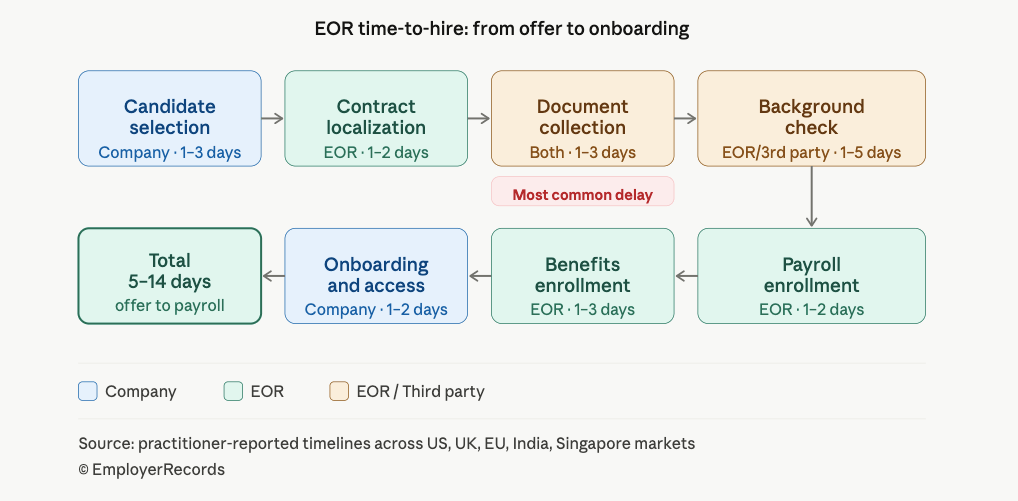
The table below breaks the EOR process down step by step, showing who owns each stage and where the time realistically goes.
EOR Time-to-Hire Process
| Step | Owner | Typical Time | Notes |
|---|---|---|---|
| Candidate selection and offer letter | Company | 1 to 3 days | Company drafts the offer. EOR reviews it for local compliance issues before it goes to the candidate |
| Employment contract localization | EOR | 1 to 2 days | EOR generates a contract compliant with local labor law |
| Employee document collection | Company and Employee | 1 to 3 days | Most common delay point. Speed depends on how quickly the candidate returns documents |
| Background check where required | EOR or Third-party | 1 to 5 days | Varies by country and depth of check |
| Payroll enrollment | EOR | 1 to 2 days | Employee added to EOR’s existing payroll infrastructure |
| Benefits enrollment and statutory registrations | EOR | 1 to 3 days | Health insurance, pension, and other statutory benefits handled by EOR |
| Onboarding: equipment, access, orientation | Company | 1 to 2 days | IT setup and system access remain with the company |
| Total | 5 to 14 days | Varies by country, how fast the candidate responds, and whether background checks apply |
These timelines assume a single country. Hiring across multiple countries at once adds coordination time.
Legal Entity Setup Timeline: What Actually Takes So Long
Setting up a legal entity is a project with fixed dependencies that stack on each other. The bank account cannot open before the entity is registered. Payroll cannot be configured without an active bank account.
The first hire cannot start until payroll has been tested. That sequence does not compress under business pressure regardless of what is at stake commercially.
According to Lano’s research on international incorporation costs, direct setup fees in most countries run $15,000 to $20,000, with total first-year costs including legal counsel, payroll infrastructure, and ongoing compliance reaching $50,000 to $100,000 in complex markets.
The ongoing entity maintenance at $3,000 to $8,000 per month for accounting, tax filings, statutory reporting, and registered agent services, regardless of headcount.
Entity Setup Timelines by Country: Where the Delays Happen
The UK and Singapore sit at the fast end. Companies House and ACRA each process most incorporations within one to three business days. Banking is where both countries add weeks to the total.
Brazil, India, and most EU member states have multi-agency registration processes that take 6 to 8 weeks for entity formation alone, before banking and payroll setup begins.
Germany is particularly demanding. In December 2024, the German Customs Authority (Hauptzollamt) ran nationwide enforcement operations targeting false self-employment across industries. In 2024, German misclassification investigations resulted in more than 100,000 criminal proceedings.
Banks operating in that environment are correspondingly thorough about onboarding foreign-owned entities, which is a significant contributor to Germany’s banking delays.
Best-case timeline with experienced local counsel and an organized internal team: 10 to 12 weeks. A realistic timeline for a company running this process in a new market for the first time: 20 to 28 weeks. That gap opens because one stuck step, a rejected bank application, a government registry backlog, a missed notarization, cascades into everything that follows it.
The table below maps each step, how long it takes, and where things go wrong most often.
Entity Setup Time-to-Hire Process
| Step | Description | Typical Time | Risk and Common Delays |
|---|---|---|---|
| Decision and legal structure | Choose entity type: branch, subsidiary, or local equivalent | 1 to 2 weeks | Wrong structure requires costly rework. Local legal input is not optional |
| Local legal counsel engagement | Hire in-country lawyers for incorporation and compliance | 1 to 2 weeks | Finding reliable counsel takes time. Fees vary considerably by market |
| Entity registration | File incorporation documents with government registry | 1 to 6 weeks | India: 3 to 5 weeks. UK: 1 day to 1 week. Germany: 4 to 6 weeks |
| Tax ID and VAT registration | Register with tax authority for employer ID and VAT where applicable | 1 to 4 weeks | EU VAT registration can lag by weeks. Some countries require physical presence first |
| Corporate bank account opening | Open local business account for payroll and operations | 2 to 8 weeks | AML and KYC review is the most consistent source of delays across all markets |
| Payroll system setup | Configure local payroll, integrate with HRIS, run test cycle | 1 to 3 weeks | Cannot begin without an active bank account. Payroll vendor onboarding adds time |
| Social security and pension registration | Register with statutory social and pension bodies | 1 to 3 weeks | France, Spain, and Italy each require distinct multi-agency registration steps |
| Employment contract templates | Draft locally compliant offer letters and employment agreements | 1 to 2 weeks | Internal legal review rounds can push this out considerably |
| Hiring first employee | Recruit, offer, and onboard once all infrastructure is operational | 1 to 2 weeks | Some companies start recruiting in parallel, which carries interim legal risk |
| Total | End-to-end from initial decision to first payroll | 10 to 28 weeks or more | Banking delays and registration backlogs drive the upper end |
Brazil and Germany land at or above the upper end of this range. France frequently does too.
EOR vs. entity setup: time-to-hire by country
Bar length represents midpoint of published range. Ordered from fastest to slowest entity setup.
EOR vs. Entity Setup: Side by Side
The tables above show each path in isolation. The comparison below puts them side by side across the factors that matter most when making the decision.
The cost rows deserve particular attention. EOR wins on upfront cost for smaller headcounts, but monthly service fees compound as the team grows.
Entity setup demands a large upfront investment but spreads its fixed overhead across more employees over time. The crossover point sits at 15 to 20 employees for most countries on a three-year horizon.
In simpler markets like the UK or Singapore, it drops to around 10 employees because entity maintenance there is cheaper. In complex markets like France or Brazil, EOR can remain cost-effective past 20 employees because the entity overhead is so high.
EOR vs. Entity Setup
EOR Time-to-Hire by Country
The 5 to 14 day EOR onboarding window is not uniform across markets. Some countries have light compliance requirements and minimal document burdens. Others layer in mandatory government notifications, multi-body statutory registrations, or pre-employment checks that add days regardless of how prepared the EOR is.
The figures below reflect the regulatory requirements each country imposes on new hires through an EOR. The lower end of each range assumes a candidate who returns documents promptly and no background check complications. Slow document return pushes every market toward the upper end of its range.
Table 4: EOR Onboarding Timeline by Market
| Country | Offer to First Payroll | Key Requirements That Drive the Timeline |
|---|---|---|
| United States | 3 to 7 days | State-specific wage notices and new-hire reporting apply. California and New York carry extra wage statement obligations |
| United Kingdom | 5 to 10 days | Right-to-work checks are mandatory and add 1 to 2 days |
| Germany | 7 to 14 days | Social contributions cover health, pension, unemployment, and nursing care insurance — each administered separately |
| India | 7 to 14 days | Provident Fund and ESIC registration required. Document collection from employees tends to be heavy |
| Singapore | 5 to 10 days | Smooth for local hires. Foreign nationals needing an Employment Pass extend this considerably |
| Brazil | 10 to 21 days | CTPS registration required. Mandatory 13th-month salary, FGTS contributions, and vacation bonus rules add processing complexity |
| Australia | 5 to 10 days | Superannuation setup and Fair Work compliance apply |
| France | 7 to 14 days | Mandatory DPAE filing with URSSAF before the employee’s first day. Convention collective identification and mutuelle enrollment required on top |
| Canada | 5 to 10 days | Federal and provincial registrations both apply. Quebec adds its own distinct layer |
| Netherlands | 5 to 10 days | BSN number required for the employee. UWV registration for unemployment contributions |
Entity Setup Time-to-Hire by Country
Entity setup timelines vary far more than EOR timelines because the underlying variables differ so much by jurisdiction. Registration complexity, banking scrutiny, and mandatory capital requirements each push timelines in ways that are hard to predict from the outside.
The table below separates registration and banking timelines because they diverge most often from company expectations. Registration timelines are relatively predictable once you know the country.
Banking timelines are not, because banks control their own review processes and are under no obligation to move at a pace that suits your expansion plan. The total realistic timeline accounts for both, plus payroll setup and the first hire, which is what companies are actually trying to plan for.
Entity Setup Timeline by Market
| Country | Registration | Banking Setup | Total Realistic Timeline | Primary Delay Factor |
|---|---|---|---|---|
| United Kingdom | 1 day to 1 week | 2 to 4 weeks | 4 to 8 weeks | Banking KYC for foreign-owned entities |
| Singapore | 1 to 3 days | 3 to 6 weeks | 4 to 8 weeks | Banking KYC despite fast incorporation |
| United States (new state) | 1 to 2 weeks | 1 to 2 weeks | 3 to 6 weeks | State payroll tax and unemployment account registration varies by state |
| Germany | 4 to 6 weeks | 6 to 10 weeks | 8 to 20 weeks | Notarial deed, Handelsregister filing, €25,000 minimum capital requirement, and banking KYC all compound |
| India | 3 to 5 weeks | 2 to 4 weeks | 8 to 16 weeks | MCA21 registration plus GST, PF, ESIC, Professional Tax, and TAN are each separate processes |
| Netherlands | 1 to 2 weeks | 3 to 6 weeks | 6 to 12 weeks | Banking KYC is stricter for non-EU parent companies |
| France | 2 to 4 weeks | 4 to 8 weeks | 8 to 16 weeks | URSSAF registration and mandatory AGIRC-ARRCO pension scheme enrollment are distinct steps, even though URSSAF now collects contributions for both since January 2023 |
| Australia | 1 to 2 weeks | 1 to 3 weeks | 4 to 8 weeks | Generally manageable. PAYG withholding and superannuation setup are well-documented |
| Canada | 1 to 3 weeks | 1 to 3 weeks | 4 to 8 weeks | Quebec requires separate provincial registration from the federal process |
| Brazil | 4 to 8 weeks | 4 to 8 weeks | 16 to 32 weeks | Federal CNPJ plus state and municipal IDs. One of the most complex labor law systems globally |
EOR vs. Entity Setup: Choosing the Right Path for Your Hiring Situation
Choosing between EOR and entity setup is not an abstract question about which model sounds better. It comes down to three variables in your specific situation: how fast you need to hire, how many people you plan to bring on in that market over the next 12 to 24 months, and how long you intend to stay.
Most real situations fit one of the patterns in the table below. The two scenario breakdowns that follow go deeper on the cases companies face most often.
The two scenarios companies face most often are worth breaking down in detail. A candidate already waiting in Germany and a planned 30-person engineering build in India represent opposite ends of the decision spectrum, and they illustrate exactly why the right answer depends entirely on your situation.
Hidden Delays in Global Hiring: What Companies Miss on Both Paths
Most timeline estimates focus on the external steps, registration, banking, payroll setup. What they consistently undercount are the delays that originate inside the company or surface unexpectedly at the offer stage. These four show up more than any others.
Why Corporate Banking Delays Wreck Entity Setup Timelines
Finance teams unfamiliar with foreign corporate account applications often assume the process resembles opening a domestic business account.
It does not. AML and KYC requirements for foreign-owned subsidiaries involve multi-stage document submissions, multiple rounds of verification from the bank’s compliance team, and review queues that run at the bank’s pace with no external pressure point.
In Germany and France, the banking step alone regularly adds 6 to 10 weeks after incorporation is complete. Entity setup timeline estimates almost always underweight this step, not by a little, but by a factor of two or three.
Internal Sign-Off Adds Weeks Nobody Budgets For
Expanding into a new country needs sign-off from finance, legal, IT, and HR leadership. Run those reviews one after another rather than at the same time, and 3 to 4 weeks of internal time accumulates before any EOR or legal counsel has been contacted.
Starting those reviews while the candidate is still in the final interview stage, rather than after the offer goes out, removes that drag. It costs nothing to implement and most companies figure it out only after their first global hire misses its start date by weeks.
The Contractor Shortcut Has Documented Legal Consequences
Some companies bring workers on as independent contractors while entity setup finishes. In Germany, the legal consequences of misclassification (Scheinselbstständigkeit) are specific and severe.
Under German social insurance law, a finding of misclassification triggers retroactive social security contributions going back up to 4 years, or up to 30 years where intent is alleged. Unlawful labor leasing carries administrative fines of up to €30,000 per breach.
Intentional tax evasion related to misclassification can result in fines up to €10 million, and company directors face personal criminal liability including imprisonment of up to 5 years, according to Baker McKenzie’s Germany compliance guidance.
In 2024 alone, German misclassification investigations resulted in more than 100,000 criminal proceedings, per Remofirst’s published analysis. France, Brazil, and India carry comparable enforcement risk under their respective labor codes.
Labor Law Surprises That Derail Offers in Germany, France, and India
Offers written from a US or UK perspective run into compliance problems in other markets with some regularity. In France, companies above 50 employees must provide mandatory profit-sharing schemes under the French Labor Code.
India’s Shop and Establishment Act notice period requirements differ by state.
Brazil’s CLT mandates a 13th-month salary, a vacation bonus equal to one-third of monthly pay, and FGTS contributions of 8% of gross salary paid by the employer into a separate government fund each month.
Finding any of these issues after an offer is signed creates renegotiation conversations and puts the employment relationship in a difficult spot before the person has started.
The Real Cost of Hiring Delays: Revenue, Candidates, and Market Entry
Candidates Without a Contract Are Free to Rescind
A candidate who accepts an offer but receives no signed employment contract, because the entity that would issue it does not exist yet, is legally free to walk away at any point.
They are still fielding other calls. Most competitive technical candidates will not sit in an unsigned gap for 4 to 6 weeks. EOR gets a signed, locally compliant contract in place within days of offer acceptance. Entity setup cannot produce a legal employment contract until the legal employer exists, which can be months away. That is not a scheduling gap. It is a structural one.
Revenue Roles Lose Pipeline While Waiting
A regional sales hire with a £150,000 OTE and a standard 12-month ramp who starts two months late is not just delayed on a calendar. They are producing two months less pipeline in the early stage where ramp-up has the sharpest impact.
On conservative estimates, that represents roughly £25,000 in foregone early-stage pipeline activity per hire. Across three or four strategic hires in a new market each delayed by entity setup, the upfront cost comparison between EOR and entity looks very different from what the original spreadsheet showed.
Why Competitive Hiring Markets Won’t Wait for Your Entity to Register
In Bangalore, London, Berlin, and Toronto, strong technical candidates at offer stage are rarely available for more than two to three weeks. Research from the Talent Board on candidate experience points to delays between offer acceptance and employment contract signing as a meaningful driver of candidate withdrawal.
Reopening a search after losing a hire at that stage means starting over on a role that probably took 6 to 12 weeks to fill the first time, under renewed time pressure and with the market aware the role is open again.
EOR vs. Entity Setup: How to Make the Right Decision for Your Business
The choice between EOR and entity setup is not really about which model is better. It is about where your company is right now. If you need someone employed within two to four weeks, EOR is the only path that works in that window.
If you are committing to a market with 15 or more hires planned over the next 18 to 24 months, building your own entity will pay off. Most companies sit somewhere between those two points, which is exactly why the bridge strategy, EOR first, entity when the market proves out, exists and is so widely used.
What the data in this article consistently shows is that the biggest delays in global hiring are not external. Banking KYC, government registration timelines, and labor law surprises all matter.
But the 3 to 4 weeks lost to sequential internal approvals, the candidate who rescinds because no contract arrived, the contractor misclassification that surfaces during an audit, those are avoidable. They happen because the structural decision was delayed, not because the process was hard.
The worst outcome is not choosing the wrong model. It is sitting on the decision while a candidate waits unsigned.