






Agile HRO does one thing genuinely well. For companies hiring across Asia-Pacific, its Singapore base and on-the-ground payroll experience make it a dependable, hands-on partner at a published $399 per employee per month. The problem is proof.
It holds a 3.9 rating from just 30 analyzed reviews, with almost no presence on the review platforms most buyers check, and its software layer trails the category on automation and integrations. We shortlisted the strongest alternatives here, not every competitor that runs an EOR.
Each one below is assessed directly against Agile HRO, with a specific reason to switch and an honest note on who should stay.
Why Agile HRO users start looking elsewhere
The most common reason we hear is confidence. Agile HRO carries a 3.9 rating across only 30 analyzed reviews, with almost no footprint on the platforms buyers usually check first. For a company about to hand employment liability to a vendor in several countries, that thin a record is hard to justify.
The platform is the second sticking point. Reviewers score its stability and integrations at 3.5 out of 5, the weakest mark on its own profile, and teams that expect payroll to sync with their HRIS or accounting tools end up exporting data by hand.
Coverage looks broad but isn’t even.
Agile HRO advertises 100+ countries, yet we found its operational depth concentrates in Singapore, the Philippines, Australia, and Thailand. Outside APAC, hires route through the same partner firms smaller EORs rely on, which means thinner local knowledge in markets like Germany, Brazil, or Nigeria. If your hiring map leans toward Europe or the Americas, that unevenness shows up quickly.
Pricing is clear at the headline but not at the edges. Buyers rate value at 3.6 out of 5, one of the lowest scores on the profile, and some tax-filing and payroll-compliance tasks arrive as separate service arrangements rather than sitting inside the $399 base.
Scale is the last concern. Agile HRO fits small and mid-sized teams well, but its service-led model is far less tested for complex enterprise stacks or high-volume, multi-region hiring. The companies that outgrow it usually move to a provider with owned entities and deeper automation.
Agile HRO alternatives compared side by side
Before we check the detailed alternatives, here is a quick side-by-side comparison of all the alternatives listed.
| Agile HRO | Deel | Rippling | |
|---|---|---|---|
| EOR price | $399/mo | ||
| EOR country coverage | 100+ | ||
| Entity model | Hybrid, APAC-owned | ||
| Contractor management | Add-on, not published | ||
| Deposit | Not publicly stated | ||
| Native integrations | Few |
Best Agile HRO Alternatives in Detail
Here are the top selected Agile HRO alternatives in detail.

Deel
Best for: proven, large-scale hiringDeel, Inc. · Founded 2019 · San Francisco
Why teams move from Agile HRO to Deel
The move to Deel is usually about proof and platform. Deel owns most of its local entities across 150 countries and runs everything through a self-serve dashboard with 100+ native integrations, including Workday, BambooHR, and QuickBooks. That is the depth Agile HRO’s service-led model doesn’t offer.
The numbers back it up. Deel holds a 4.8 rating across 16,900 analyzed reviews, against Agile HRO’s 3.9 from 30. You pay for it, though: $599 per employee per month versus $399, plus a refundable deposit of roughly one month’s salary.
Agile HRO vs Deel at a glance
| Agile HRO | Deel | |
|---|---|---|
| EOR price | $399/mo | $599/mo |
| EOR country coverage | 100+ | 150 |
| Entity model | Hybrid, APAC-owned | Owns most entities |
| Contractor management | Add-on, not published | $49/contractor/mo |
| Deposit | Not publicly stated | ~1 month salary, refundable |
| Native integrations | Few | 100+ (Workday, BambooHR, QuickBooks) |
| Platform scope | Basic self-service | Full HR, payroll, contractor, EOR |
Where Deel beats Agile HRO
Owned-entity coverage
Deel owns most of its entities across 150 countries, so onboarding is faster and less dependent on the partner firms Agile HRO uses outside APAC.
Integration depth
100+ native connectors, including Workday, BambooHR, and QuickBooks, where Agile HRO leaves teams exporting data by hand.
Proven track record
A 4.8 rating from 16,900 reviews against 3.9 from 30 gives buyers far more to verify before signing.
Watch out for
Higher cost
At $599 per employee per month, Deel runs $200 above Agile HRO, and rates only ease with volume.
Salary deposit
Deel locks roughly one month of gross salary per employee as a refundable deposit, which is real working capital.
Support during peaks
Reviewers note slower support responses during high-volume hiring waves.
When to choose each
Choose Deel if
You want owned-entity coverage, deep integrations, and a proven platform, and the $599 price is justified by your hiring volume.
Stay with Agile HRO if
Your hiring is APAC-focused, you value hands-on service, and the $399 entry price matters more than platform depth.

Rippling
Best for: HR, IT, payroll automationRippling People Center, Inc. · Founded 2016 · California
Why teams move from Agile HRO to Rippling
Rippling is the opposite of Agile HRO’s service-first model.
It unifies HR, IT, and payroll in one system with deep automation, from onboarding to device provisioning to payroll approvals, and connects to hundreds of apps. Teams frustrated by Agile HRO’s thin integrations and manual exports move here for the workflow depth.
The catch is reach. Rippling’s EOR covers 50+ countries against Agile HRO’s 100+, so it fits automation-heavy teams hiring in core markets, not those spread across long-tail geographies.
Agile HRO vs Rippling at a glance
| Agile HRO | Rippling | |
|---|---|---|
| EOR price | $399/mo | $500/mo |
| EOR country coverage | 100+ | 50+ |
| Entity model | Hybrid, APAC-owned | Mixed (owned + partner) |
| Contractor management | Add-on, not published | Not publicly listed |
| Deposit | Not publicly stated | Not publicly stated |
| Native integrations | Few | Hundreds of HR, IT, finance apps |
| Platform scope | Basic self-service | HR, IT, payroll, finance automation |
Where Rippling beats Agile HRO
Unified HR, IT, and payroll
Rippling runs HR, device management, and payroll in one system, automating onboarding and access where Agile HRO stops at basic self-service.
Deep integrations
It connects to hundreds of workplace apps and manages access automatically as employees join or leave, well beyond Agile HRO’s few connectors.
Proven adoption
A 4.8 rating from 13,600 reviews against 3.9 from 30 reflects far wider, more tested use.
Watch out for
Narrow EOR coverage
Rippling’s EOR reaches about 50+ countries against Agile HRO’s 100+, a problem if you hire across many regions.
Pricing scales fast
Costs climb as you add HR, IT, and payroll modules, so the $500 base rarely stays the real number.
Setup complexity
Configuring workflows and automation takes time and technical familiarity, more than a small team may want.
When to choose each
Choose Rippling if
You want HR, IT, and payroll automation in one platform and your global hiring sits within its 50+ supported countries.
Stay with Agile HRO if
You need coverage beyond Rippling’s 50+ countries, or you prefer hands-on service over configuring automation.

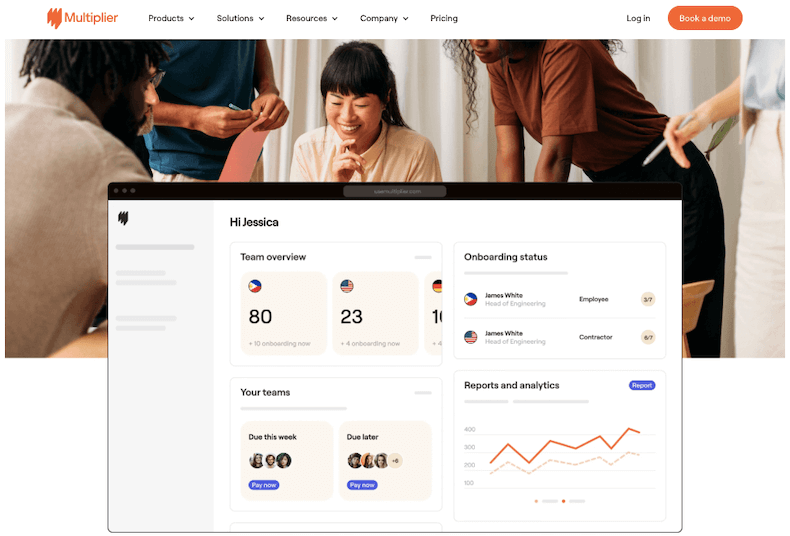
Multiplier
Best for: APAC-focused hiring at lower costMultiplier Technologies Pte. Ltd. · Founded 2020 · New York
Why teams move from Agile HRO to Multiplier
Multiplier is the closest like-for-like swap for Agile HRO. It targets the same APAC and emerging markets, charges $400 against Agile HRO’s $399, and brings far more proof: a 4.7 rating from 3,059 reviews versus 3.9 from 30.
The difference is depth. Multiplier covers 150+ countries with stronger owned-entity reach, adds IP protection and a real-time cost calculator, and publishes contractor pricing at $40 per month. For a team comfortable with Agile HRO’s positioning but worried about its track record, this is the safer version of the same bet.
Agile HRO vs Multiplier at a glance
| Agile HRO | Multiplier | |
|---|---|---|
| EOR price | $399/mo | $400/mo |
| EOR country coverage | 100+ | 150+ |
| Entity model | Hybrid, APAC-owned | Owned + partner, broader reach |
| Contractor management | Add-on, not published | $40/contractor/mo |
| Deposit | Not publicly stated | ~1 month salary, refundable |
| Native integrations | Few | Limited native HRIS |
| Platform scope | Basic self-service | EOR, payroll, contractor, IP protection |
Where Multiplier beats Agile HRO
Same focus, more proof
Multiplier matches Agile HRO’s APAC strength but backs it with a 4.7 rating from 3,059 reviews against 3.9 from 30.
Broader owned coverage
150+ countries with deeper owned-entity reach than Agile HRO’s 100+, much of which is partner-routed outside APAC.
Built-in IP and cost tools
IP protection clauses and a real-time cost calculator that Agile HRO’s basic platform doesn’t match.
Watch out for
Integrations stay limited
Native HRIS and finance connectors are thin, much like Agile HRO, so deep automation isn’t the draw.
Salary deposit
Multiplier holds roughly one month of gross salary per employee as a deposit, locking working capital.
Pricing tightens at scale
Per-employee tiers rise as distributed teams grow past early stages.
When to choose each
Choose Multiplier if
You want Agile HRO’s APAC strengths at the same price but with a proven track record and 150+ country reach.
Stay with Agile HRO if
You value its hands-on service model and your hiring stays inside its core APAC markets.

RemoFirst
Best for: lowest-cost global hiringRemofirst, Inc. · Founded 2021 · California
Why teams move from Agile HRO to RemoFirst
RemoFirst wins on one thing above all: price. At $199 per employee per month it’s roughly half of Agile HRO’s $399, and it covers 185+ countries with no deposit and a $25 contractor rate. For cost-conscious startups, that math is hard to argue with.
The trade-off is depth: lean reporting, few integrations, and more reliance on local partners than owned entities.
Agile HRO vs RemoFirst at a glance
| Agile HRO | RemoFirst | |
|---|---|---|
| EOR price | $399/mo | $199/mo |
| EOR country coverage | 100+ | 185+ |
| Entity model | Hybrid, APAC-owned | Partner-led |
| Contractor management | Add-on, not published | $25/contractor/mo |
| Deposit | Not publicly stated | None |
| Native integrations | Few | Few, no enterprise depth |
| Platform scope | Basic self-service | Lean, core EOR only |
Where RemoFirst beats Agile HRO
Half the price
$199 per employee per month against Agile HRO’s $399, with no deposit, so less cash is tied up from day one.
Wider coverage
185+ countries versus 100+, useful if your hiring map runs beyond APAC.
Cheapest contractors
Contractor management at $25 per month, the lowest on this list and clearer than Agile HRO’s add-on.
Watch out for
Lean platform
Reporting and analytics are basic and integrations lack enterprise depth, similar to Agile HRO.
Partner-reliant delivery
Some services run through local partners rather than owned entities, which can affect consistency.
Young, small company
Founded in 2021 with a small team and 200 analyzed reviews, less track record than the category leaders.
When to choose each
Choose RemoFirst if
Price is your first constraint and you want broad coverage without a deposit or a heavy platform.
Stay with Agile HRO if
You want more hands-on service and owned-entity depth in your core APAC markets.

Pebl
Best for: complex regulated marketsVelocity Global, LLC · Founded 2014 · Denver
Why teams move from Agile HRO to Pebl
Pebl, formerly Velocity Global, trades up on coverage and compliance maturity. It owns a 180+ country footprint and leans on years of regulatory experience, which matters when you hire in markets with strict labor rules.
Where Agile HRO routes through partners outside APAC, Pebl brings owned-entity depth and white-glove onboarding across complex regions. It carries a 4.6 rating from 507 reviews against 3.9 from 30. You pay for it at $599 per employee per month, a $200 premium over Agile HRO.
Agile HRO vs Pebl at a glance
| Agile HRO | Pebl | |
|---|---|---|
| EOR price | $399/mo | $599/mo |
| EOR country coverage | 100+ | 180+ |
| Entity model | Hybrid, APAC-owned | Owned global footprint |
| Contractor management | Add-on, not published | Not publicly stated |
| Deposit | Not publicly stated | Not publicly stated |
| Native integrations | Few | Limited, still evolving |
| Platform scope | Basic self-service | Full EOR with compliance depth |
Where Pebl beats Agile HRO
Owned global footprint
180+ countries with owned entities and deep compliance experience, against Agile HRO’s partner routing outside APAC.
Built for hard markets
Years of regulatory know-how make Pebl steadier in strict-labor jurisdictions than a smaller, newer provider.
Stronger track record
A 4.6 rating from 507 reviews versus Agile HRO’s 3.9 from 30.
Watch out for
Premium pricing
At $599 per employee per month, Pebl runs $200 above Agile HRO, and flat-fee pricing strains smaller budgets.
Evolving integrations
Third-party integrations and the interface are still maturing after the rebrand.
Support varies by region
Reviewers report inconsistent support in less-common markets.
When to choose each
Choose Pebl if
You’re hiring into complex, regulated markets and want owned-entity coverage and white-glove onboarding.
Stay with Agile HRO if
Your hiring is APAC-centric and the $399 price matters more than 180+ country reach.

Globalization Partners
Best for: enterprise compliance maturityGlobalization Partners, Inc. · Founded 2012 · Boston
Why teams move from Agile HRO to Globalization Partners
Globalization Partners is the incumbent’s incumbent.
Founded in 2012, it has spent over a decade building owned entities across 180+ countries, which gives it compliance depth Agile HRO can’t match in strict or high-risk markets. Onboarding is steady rather than fast, and the experience is structured to the point of rigid. For enterprises that prize stability and have seen tricky terminations handled well, that maturity is the draw.
The cost is opacity: pricing is custom and quote-only, where Agile HRO publishes $399.
Agile HRO vs Globalization Partners at a glance
| Agile HRO | G-P | |
|---|---|---|
| EOR price | $399/mo | Custom, quote-only |
| EOR country coverage | 100+ | 180+ |
| Entity model | Hybrid, APAC-owned | Deep owned entities (since 2012) |
| Contractor management | Add-on, not published | Not publicly stated |
| Deposit | Not publicly stated | Not publicly stated |
| Native integrations | Few | Some, with third-party reliance |
| Platform scope | Basic self-service | Mature, structured EOR |
Where G-P beats Agile HRO
Decade of owned entities
G-P has built entities across 180+ countries since 2012, deeper and more tested than Agile HRO’s partner routing.
Handles hard cases
Experienced teams manage complex terminations and disputes that strain smaller providers.
Enterprise-grade stability
Structured workflows and predictability suit large, risk-sensitive organizations.
Watch out for
Opaque pricing
G-P is quote-only, so you can’t compare it against Agile HRO’s published $399 without a sales call, and it skews premium.
Can feel rigid
The structured process is less flexible than lighter, newer platforms.
Third-party tool reliance
Some payroll and expense workflows lean on external systems.
When to choose each
Choose Globalization Partners if
You’re an enterprise that values a decade of owned-entity compliance and can work with custom pricing.
Stay with Agile HRO if
You want transparent $399 pricing and a lighter, more hands-on service relationship.

Remote
Best for: owned-entity compliance and IPRemote Technology, Inc. · Founded 2019 · San Francisco
Why teams move from Agile HRO to Remote
Remote is the owned-entity counterweight to Agile HRO’s partner model.
It owns its entities across 150+ countries, runs payroll and contractor management in one place, and adds IP protection and equity support that Agile HRO doesn’t offer. No deposit and a $29 contractor rate keep it clean.
The trade-off is price. At $599 per employee per month it’s $200 over Agile HRO, though a 4.5 rating from 5,799 reviews gives it a track record Agile HRO can’t approach.
Agile HRO vs Remote at a glance
| Agile HRO | Remote | |
|---|---|---|
| EOR price | $399/mo | $599/mo |
| EOR country coverage | 100+ | 150+ |
| Entity model | Hybrid, APAC-owned | Owns its own entities |
| Contractor management | Add-on, not published | $29/contractor/mo |
| Deposit | Not publicly stated | None |
| Native integrations | Few | Solid HR and payroll set |
| Platform scope | Basic self-service | EOR, payroll, contractor, IP, equity |
Where Remote beats Agile HRO
Owned entities, no deposit
Remote owns its entities across 150+ countries and requires no deposit, unlike the partner routing and unclear terms at Agile HRO.
IP and equity built in
Strong IP protection and equity management that Agile HRO’s platform doesn’t cover.
Deep track record
A 4.5 rating from 5,799 reviews against 3.9 from 30.
Watch out for
Higher price
$599 per employee per month is $200 above Agile HRO.
Variable support
Response times can fluctuate during payroll cycles or urgent compliance issues.
Limited custom workflows
Less flexible for companies needing complex approval structures.
When to choose each
Choose Remote if
You want owned-entity compliance, no deposit, and IP protection across 150+ countries.
Stay with Agile HRO if
Your hiring is APAC-focused and the $399 price outweighs Remote’s broader, owned coverage.

Oyster HR
Best for: SMB global onboardingOyster HR Inc. · Founded 2020 · Charlotte
Why teams move from Agile HRO to Oyster HR
Oyster sits between Agile HRO and the category leaders. It covers 180 countries with automated onboarding, HRIS integrations, and built-in cost calculators that make first international hires less stressful for SMB HR teams.
It’s the most polished SMB onboarding experience here, but also the priciest at $699 per employee per month, $300 over Agile HRO. There’s no mobile app and analytics are limited. A 4.5 rating from 1,200 reviews still beats Agile HRO’s 3.9 from 30 comfortably.
Agile HRO vs Oyster HR at a glance
| Agile HRO | Oyster HR | |
|---|---|---|
| EOR price | $399/mo | $699/mo |
| EOR country coverage | 100+ | 180 |
| Entity model | Hybrid, APAC-owned | Mixed (owned + partner) |
| Contractor management | Add-on, not published | $29/contractor/mo |
| Deposit | Not publicly stated | Refundable deposit required |
| Native integrations | Few | HRIS integrations |
| Platform scope | Basic self-service | Automated onboarding, compliance tools |
Where Oyster beats Agile HRO
Smooth SMB onboarding
Automated contracts, HRIS sync, and cost calculators make first global hires easier than Agile HRO’s manual, service-led flow.
Broader coverage
180 countries against 100+, with more transparent self-serve tooling.
Clear contractor pricing
Contractor management at $29 per month versus Agile HRO’s undefined add-on.
Watch out for
Highest price here
$699 per employee per month is $300 above Agile HRO, steep for smaller hiring volumes.
No mobile app, thin analytics
Limited reporting and no dedicated mobile app constrain on-the-go management.
Security deposit
Oyster requires a refundable deposit to start, locking some working capital.
When to choose each
Choose Oyster if
You’re an SMB wanting a polished onboarding platform and 180-country reach, and can absorb the $699 price.
Stay with Agile HRO if
Budget matters and your hiring is concentrated in APAC where Agile HRO’s service shines.

Papaya Global
Best for: global payroll analyticsPapaya Global Ltd. · Founded 2016 · New York
Why teams move from Agile HRO to Papaya Global
Papaya Global is a payroll engine first, an EOR second.
It’s built for finance teams running payroll across many countries, with consolidated dashboards, real-time cost visibility, and actual payment processing that Agile HRO’s service model doesn’t attempt. Coverage runs to 160 countries. The platform is dense with a steep learning curve, and a 4.2 rating from 125 reviews is the lowest of the leaders here, though still above Agile HRO’s 3.9.
Agile HRO vs Papaya Global at a glance
| Agile HRO | Papaya Global | |
|---|---|---|
| EOR price | $399/mo | $599/mo |
| EOR country coverage | 100+ | 160 |
| Entity model | Hybrid, APAC-owned | Partner network |
| Contractor management | Add-on, not published | Not clearly published |
| Deposit | Not publicly stated | Payroll prefunded |
| Native integrations | Few | Payroll and finance integrations |
| Platform scope | Basic self-service | Deep payroll engine and analytics |
Where Papaya beats Agile HRO
Payroll depth and analytics
Consolidated multi-country payroll dashboards and real-time cost visibility that Agile HRO’s basic platform doesn’t offer.
Processes actual payments
Papaya pays employees, contractors, and authorities through one system, beyond Agile HRO’s calculate-and-hand-off model.
Broader coverage
160 countries against Agile HRO’s 100+.
Watch out for
Steep learning curve
The platform is dense, and first-time global payroll buyers often find it hard to navigate.
Premium pricing and prefunding
EOR runs $599 and up, and payroll is prefunded, which affects cash flow. Some sources cite $650 to $770.
Lowest leader rating
A 4.2 from 125 reviews trails the other major platforms here.
When to choose each
Choose Papaya if
You’re a finance-led team consolidating payroll across many countries and need real-time cost analytics.
Stay with Agile HRO if
You want simpler, hands-on EOR in APAC without an enterprise payroll platform’s complexity.

Why teams move from Agile HRO to Teamed
Teamed is a London-based EOR aimed squarely at UK and European hiring. For teams whose center of gravity is Britain or the EU, its local specialists and transparent, itemized invoicing are the appeal.
It covers 150+ countries and publishes contractor pricing at $49, but the platform is lean, integrations are limited, and it focuses on payroll and compliance rather than full HR. At a flat $599 per employee per month and a 4.0 rating from 45 reviews, it’s a niche pick rather than a broad Agile HRO replacement.
Agile HRO vs Teamed at a glance
| Agile HRO | Teamed | |
|---|---|---|
| EOR price | $399/mo | $599/mo |
| EOR country coverage | 100+ | 150+ |
| Entity model | Hybrid, APAC-owned | Owned + partner |
| Contractor management | Add-on, not published | $49/contractor/mo |
| Deposit | Not publicly stated | None stated |
| Native integrations | Few | Limited |
| Platform scope | Basic self-service | Payroll and compliance focus |
Where Teamed beats Agile HRO
UK and Europe focus
London-based with named local specialists, a fit for teams concentrated in Britain and the EU rather than APAC.
Transparent invoicing
Itemized, flat per-employee pricing with no hidden fees, clearer than Agile HRO’s add-on model.
Contractor-to-EOR path
Move workers from contractor to full employment without re-onboarding, at $49 per contractor.
Watch out for
Lean platform
Limited native integrations and a payroll-and-compliance focus rather than full HR, similar to Agile HRO.
Thin track record
A 4.0 rating from 45 reviews and a small team mean less proof than the leaders.
Premium flat fee
At $599 per employee per month it’s well above Agile HRO’s $399, despite a similar service-led model.
When to choose each
Choose Teamed if
Your hiring centers on the UK and Europe and you want local specialists with transparent, itemized billing.
Stay with Agile HRO if
Your focus is APAC and the $399 price beats Teamed’s $599 for a comparable service model.
Which Agile HRO alternative is right for you
The right move depends on why Agile HRO is falling short for you. Here’s how the ten alternatives map to the most common reasons teams switch.
If your hiring is concentrated in Asia-Pacific
Stay close to Agile HRO’s strength and pick a provider that does the same job with more proof. Multiplier is the natural choice: it targets the same APAC and emerging markets at $400 against Agile HRO’s $399, but carries a 4.7 rating from 3,059 reviews and broader owned-entity coverage across 150+ countries.
If price leads over everything, RemoFirst covers 185+ countries at $199 with no deposit. Avoid both if you need deep enterprise integrations, which neither prioritizes.
If you need the platform depth Agile HRO lacks
This is the most common reason teams leave Agile HRO. Rippling unifies HR, IT, and payroll with automation and hundreds of integrations Agile HRO can’t match, though its EOR reaches only about 50+ countries.
For broad coverage plus 100+ native integrations and owned entities, Deel is the safer all-rounder at $599 with a 4.8 rating from 16,900 reviews. Skip both if you have only a handful of hires and value hands-on service over software you have to configure.
If budget is the deciding factor
RemoFirst is the clearest win here, roughly half Agile HRO’s price at $199 across 185+ countries, with no deposit and a $25 contractor rate.
If you want a more polished onboarding platform and can spend more, Oyster HR offers cleaner self-serve tooling at $699, though that is the priciest option on this list. Cost-led buyers should avoid Oyster’s premium and stay with RemoFirst unless richer reporting matters.
If you’re expanding into complex, regulated markets
Owned entities beat partner routing once the labor rules get strict. Remote owns its entities across 150+ countries with IP protection and no deposit, while Pebl brings a 180+ country owned footprint built on more than a decade of compliance work.
Both run $599 per employee per month, so budget-first teams hiring only in straightforward markets will find them more than they need.
If you need enterprise payroll or compliance maturity
For finance teams consolidating payroll across many countries, Papaya Global offers consolidated analytics and real-time payment processing that Agile HRO doesn’t attempt, at a premium and with a real learning curve.
Globalization Partners is the most mature owned-entity option for high-risk, high-stakes hiring, though pricing is quote-only and skews enterprise. If your center of gravity is the UK or Europe, Teamed fits with named local specialists. None of the three suit a small team making its first overseas hire.
That’s about 450 words, five scenarios, every alternative placed, and all ten product names linked inline to their reviews on first mention.
Switching from Agile HRO: what to prepare
Switching EOR providers means moving each employee from one legal employer to another, so timing is everything. Check every contract for notice periods, which run anywhere from 30 to 90 days depending on the country and local statutory minimums.
Before you offboard, export your records, including signed contracts, payslips, tax filings, and benefits enrollment, since Agile HRO holds these as the employer of record and you will need them to set up clean employment elsewhere.
Budget two to four weeks per country for the new provider to establish local employment and re-paper contracts. Keep Agile HRO active until each employee is fully onboarded on the new platform, and run at least one parallel payroll cycle so nobody misses a payment or loses benefits coverage in the gap.
Our verdict on Agile HRO
Agile HRO does real work in Asia-Pacific. For small and mid-sized teams hiring across Singapore, the Philippines, and Southeast Asia, its hands-on payroll and compliance support at $399 per employee per month is a fair deal. The problem is a thin track record and a platform that trails the field.
Our picks against it: Deel is the best overall alternative, with owned entities across 150 countries, 100+ integrations, and a 4.8 rating from 16,900 reviews. For teams that want Agile HRO’s APAC strength with far more proof, Multiplier is the closest match at nearly the same price. And RemoFirst is the best value: at $199 per employee per month it saves $200 against Agile HRO’s $399 while covering more countries.
For the full breakdown on any of these, read our individual reviews linked throughout.
About 150 words: two to three sentences on what Agile HRO genuinely does well, then the three named picks (best overall, best APAC match, best on price with the $200 saving), and a closing pointer to the reviews. Deel, Multiplier, and RemoFirst are linked inline.
Agile HRO alternatives, answered
Common questions on price, features, coverage, and switching.